
Written by Dania Ghraoui, a translator and language teacher with 10 years of experience.
At A Glance: Arabic proverbs about family teach more than vocabulary. They show how Arabic speakers talk about mothers, fathers, children, brothers, relatives, loyalty, and kindness. Arabic family proverbs usually express respect for mothers, the resemblance between parent and child, loyalty among brothers, and duty toward relatives. This guide includes 10 Arabic family proverbs, each with its pronunciation and meaning.
When you have learned enough Arabic words and phrases, you may sometimes hear a new expression that does not translate well. This is usually either an Arabic idiom or a proverb.
These are common expressions that carry deeper meanings, which cannot always be understood from the individual words alone. It is important to learn them not only to understand the Arabic conversations around you, but also to sound more natural when you speak Arabic.
In this article, we will look at 10 very common Arabic proverbs about family, along with their pronunciation, meanings, and the right context to use them.
Before you go further!
If you are still building your Arabic vocabulary around family, you may want to start with How to Talk About Family in Arabic. It explains the main family words in Arabic, such as mother, father, brother, sister, and relatives.
You may also find 10 Useful Arabic Phrases to Talk about Family and Relationships helpful if you want simple sentences, not only single words.
And if you enjoy Arabic proverbs in general, you can continue with 9 Timeless Arabic Proverbs about Wisdom or browse the Arabic Proverbs section for more examples.
Why Learn Arabic Proverbs about Family?
Family proverbs carry meanings from everyday life, so they are easy to understand and relatable to almost everyone. This means you may come across some of these proverbs when talking to native Arabic speakers or when you are exposed to Arabic, for example, while watching an Arabic series or show.
Also, when you learn what Arabic proverbs about family mean, you learn a lot about Arab culture and the values connected to it, such as respect, kinship, and responsibility.
What Does Family Mean in Arabic?
Family in Arabic can be expressed with words such as ʿāʾilah (family), usrah (household or family unit), and aqārib (relatives). These words often appear in family conversations and cultural sayings.
| Meaning | Pronunciation | Arabic | |
|---|---|---|---|
|
family |
ʿāʾilah |
عَائِلَة |
|
|
Household, family unit |
usrah |
أُسرَة |
|
|
relatives |
aqārib |
أَقارِب |
|
For a wider vocabulary list, see AlifBee’s guide to family in Arabic. This list of proverbs builds on that foundation by showing how family words carry emotional and cultural meaning.
10 Arabic Proverbs about Family: Quick Table
In this list, there are three proverbs about mothers, three about fathers, two about brothers, and two about relatives. Let’s have a quick look at them before we go deeper into them one by one.
| Meaning | Pronunciation | Arabic | |
|---|---|---|---|
|
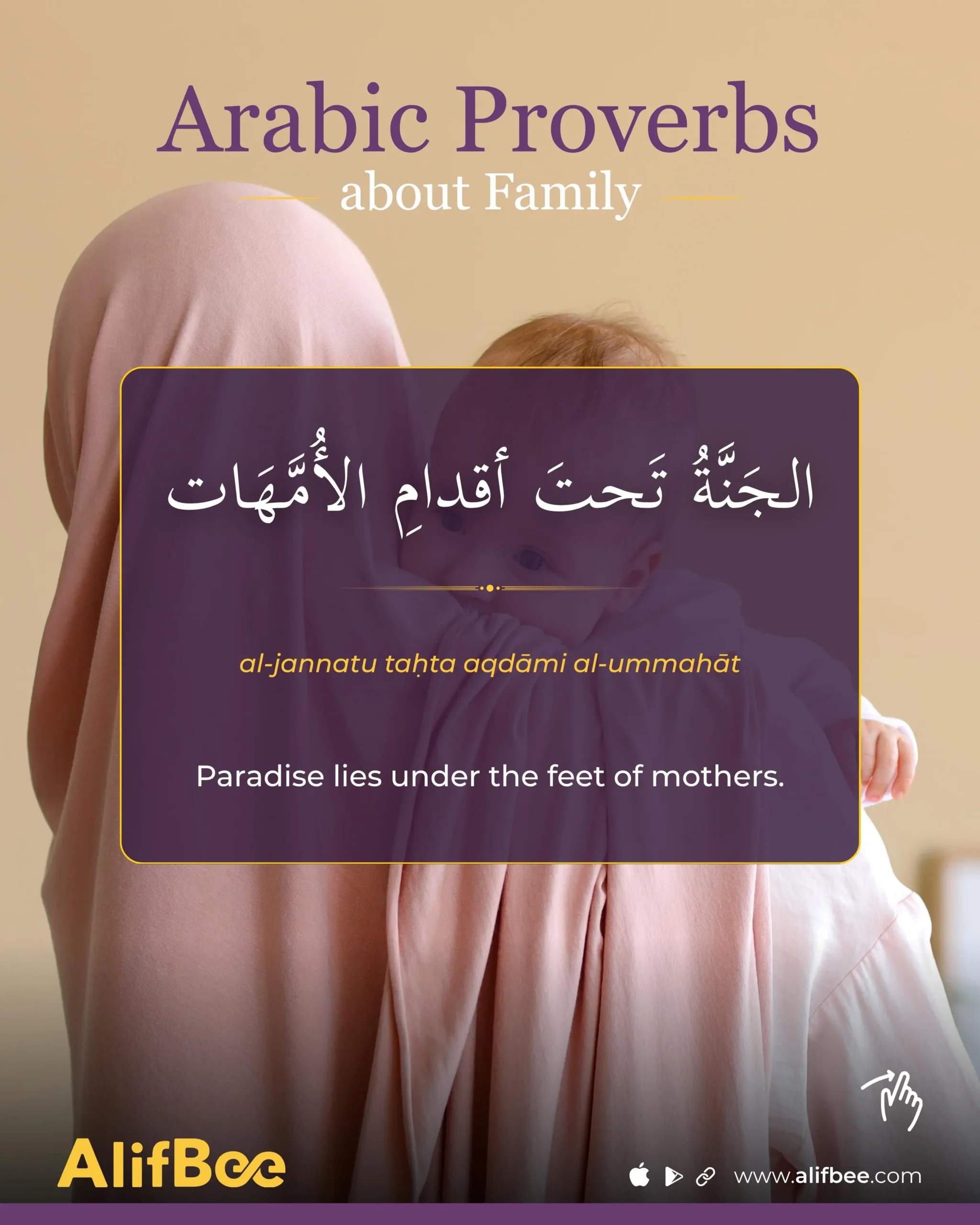
Paradise lies under the feet of mothers. |
al-jannatu taḥta aqdāmi al-ummahāt |
الجَنَّةُ تَحتَ أقدامِ الأُمَّهَات |
|
|
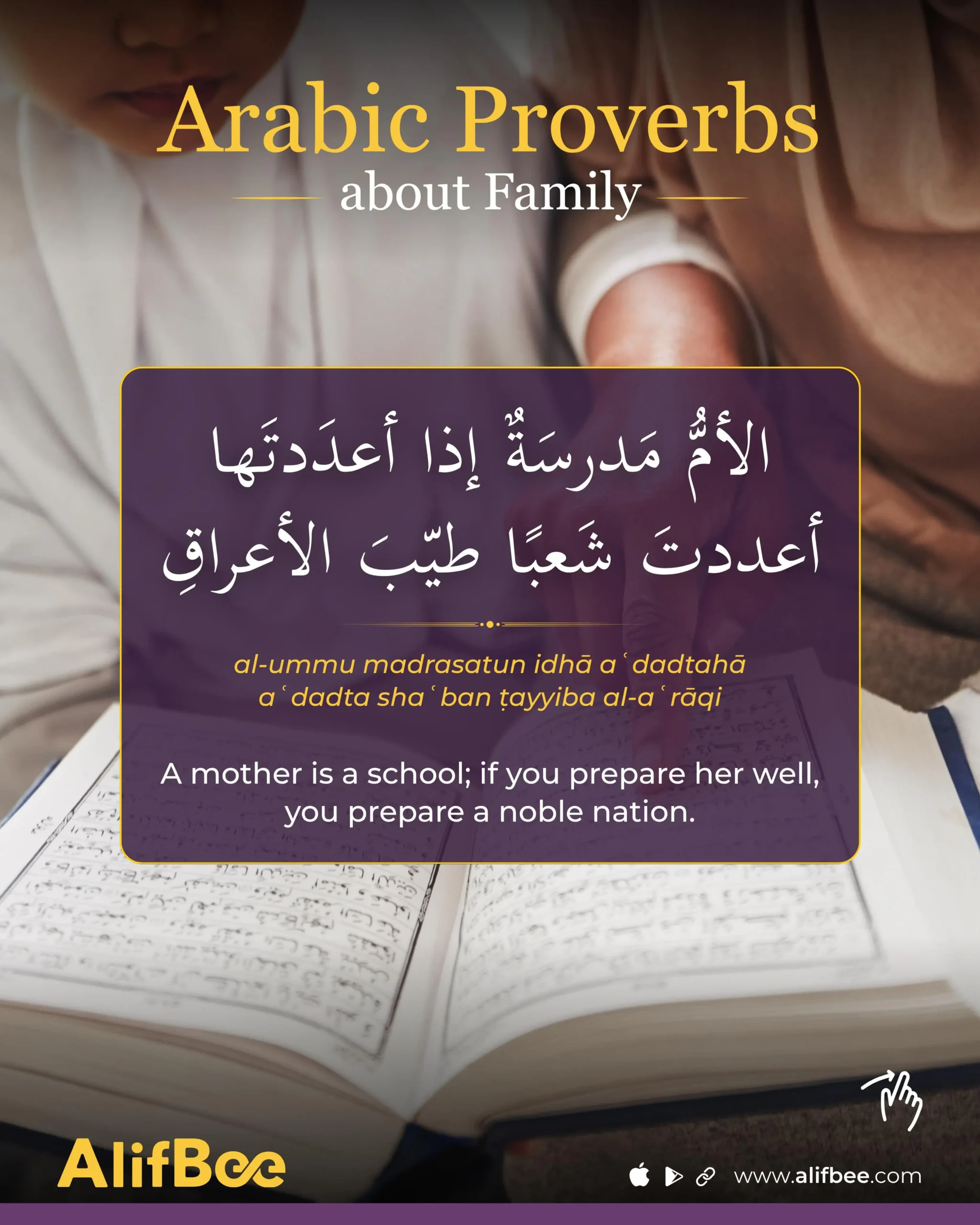
A mother is a school; if you prepare her well, you prepare a noble nation. |
al-ummu madrasatun idhā aʿdadtahā aʿdadta shaʿban ṭayyiba al-aʿrāqi |
الأمُّ مَدرسَةٌ إذا أعدَدتَها أعددتَ شَعبًا طيّبَ الأعراقِ |
|
|
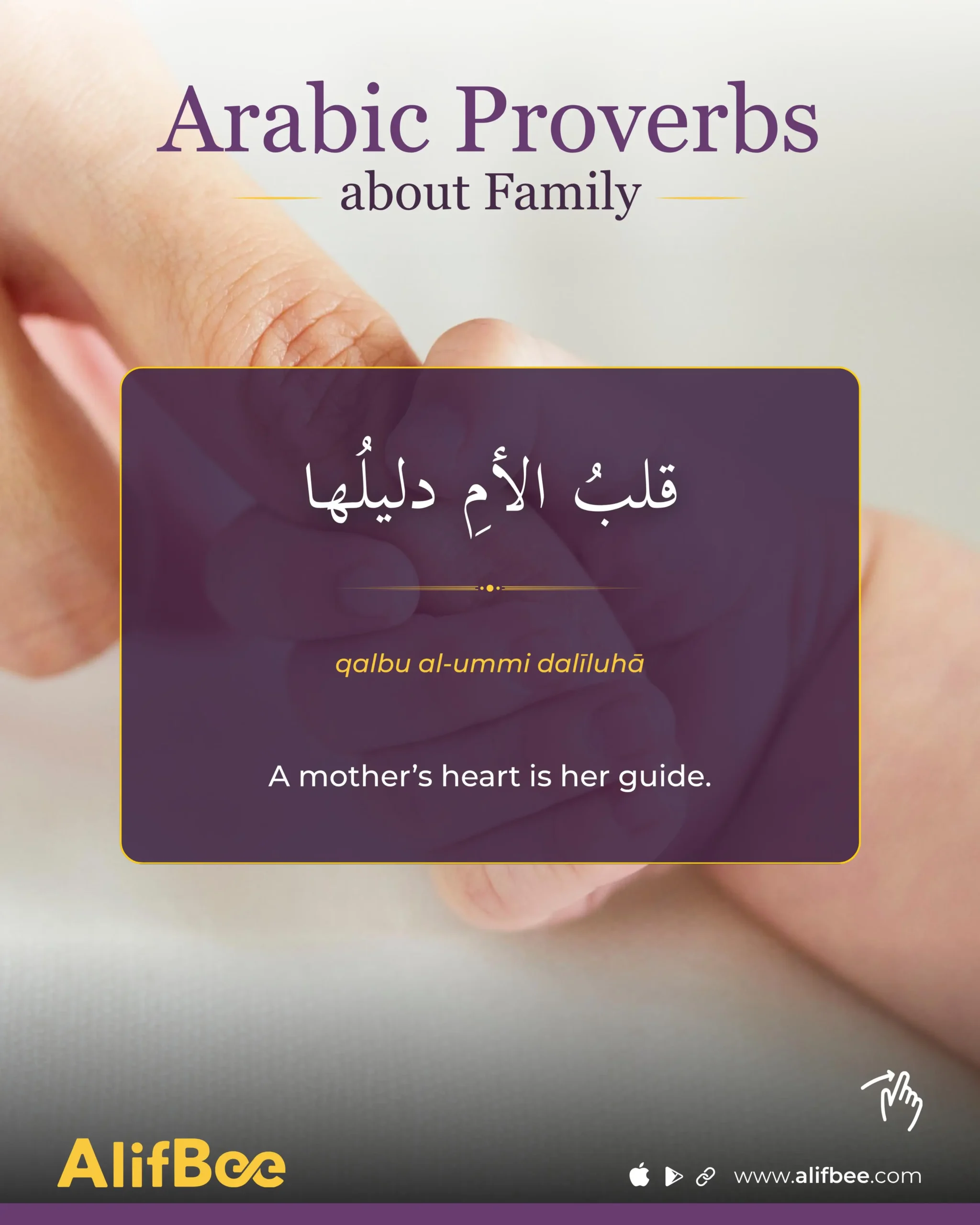
A mother’s heart is her guide. |
qalbu al-ummi dalīluhā |
قلبُ الأمِ دليلُها |
|
|
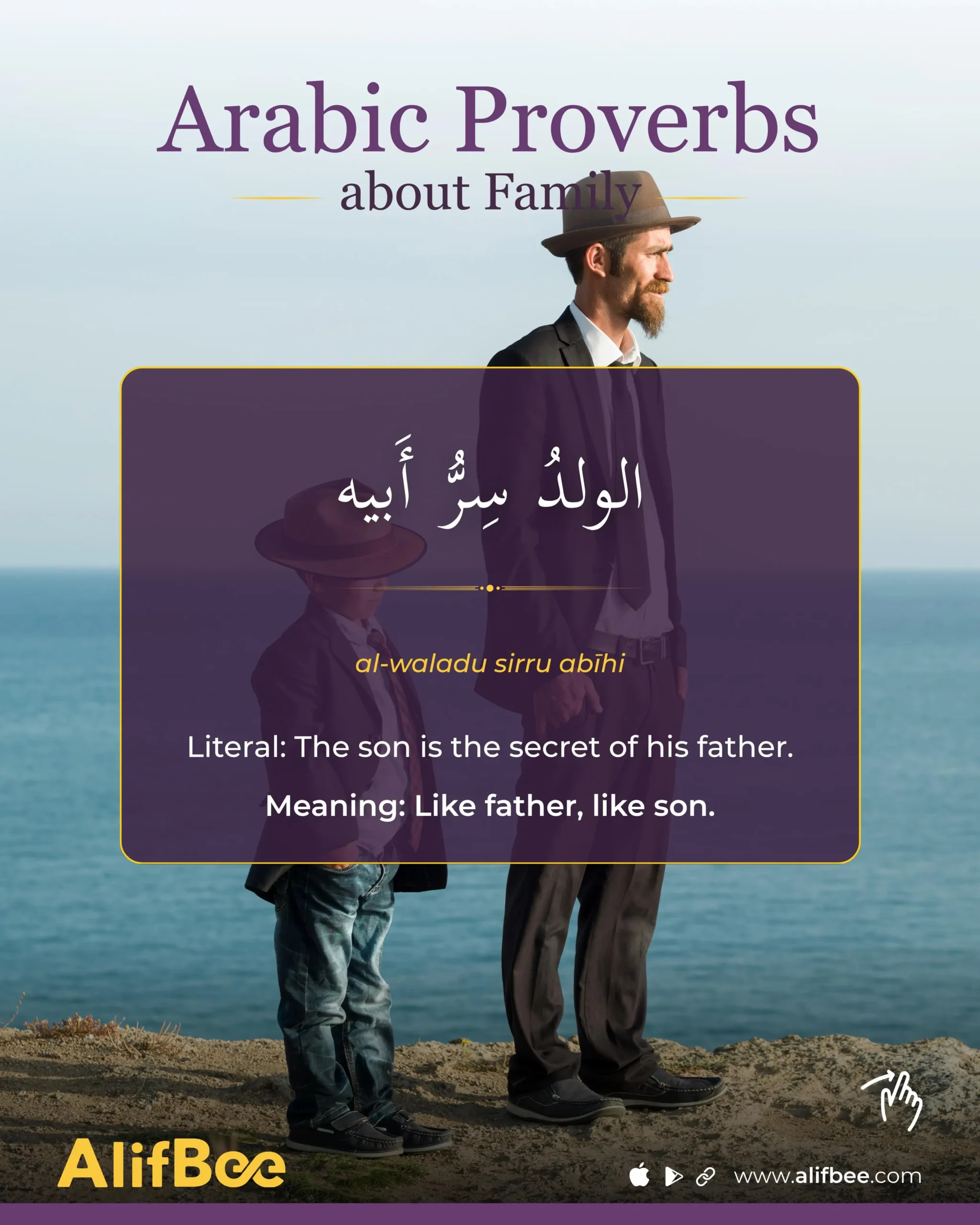
Literal: The son is the secret of his father.
Meaning: Like father, like son. |
al-waladu sirru abīhi |
الولدُ سِرُّ أَبيه |
|
|
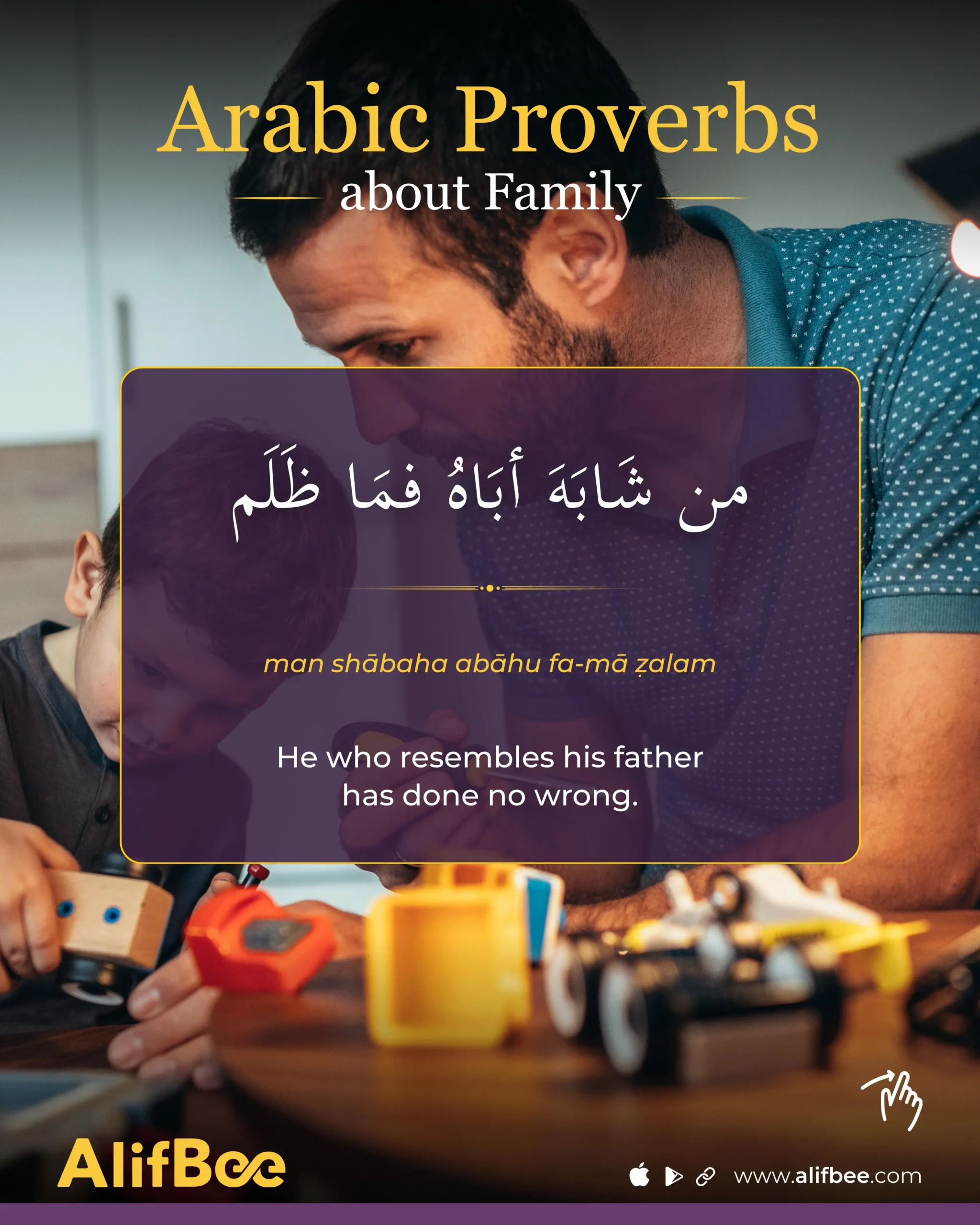
He who resembles his father has done no wrong. |
man shābaha abāhu fa-mā ẓalam |
من شَابَهَ أبَاهُ فمَا ظَلَم |
|
|
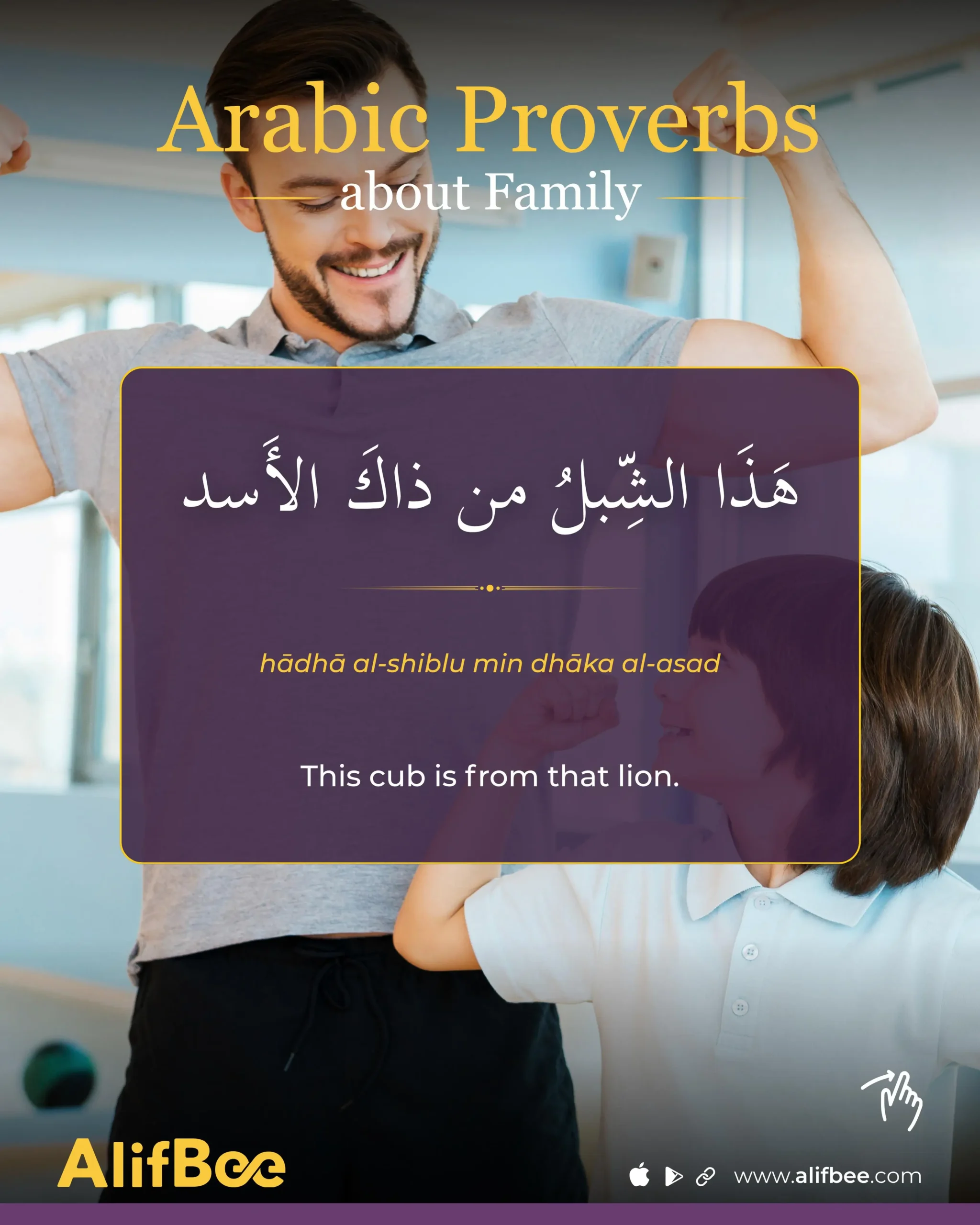
This cub is from that lion. |
hādhā al-shiblu min dhāka al-asad |
هَذَا الشِّبلُ من ذاكَ الأَسد |
|
|
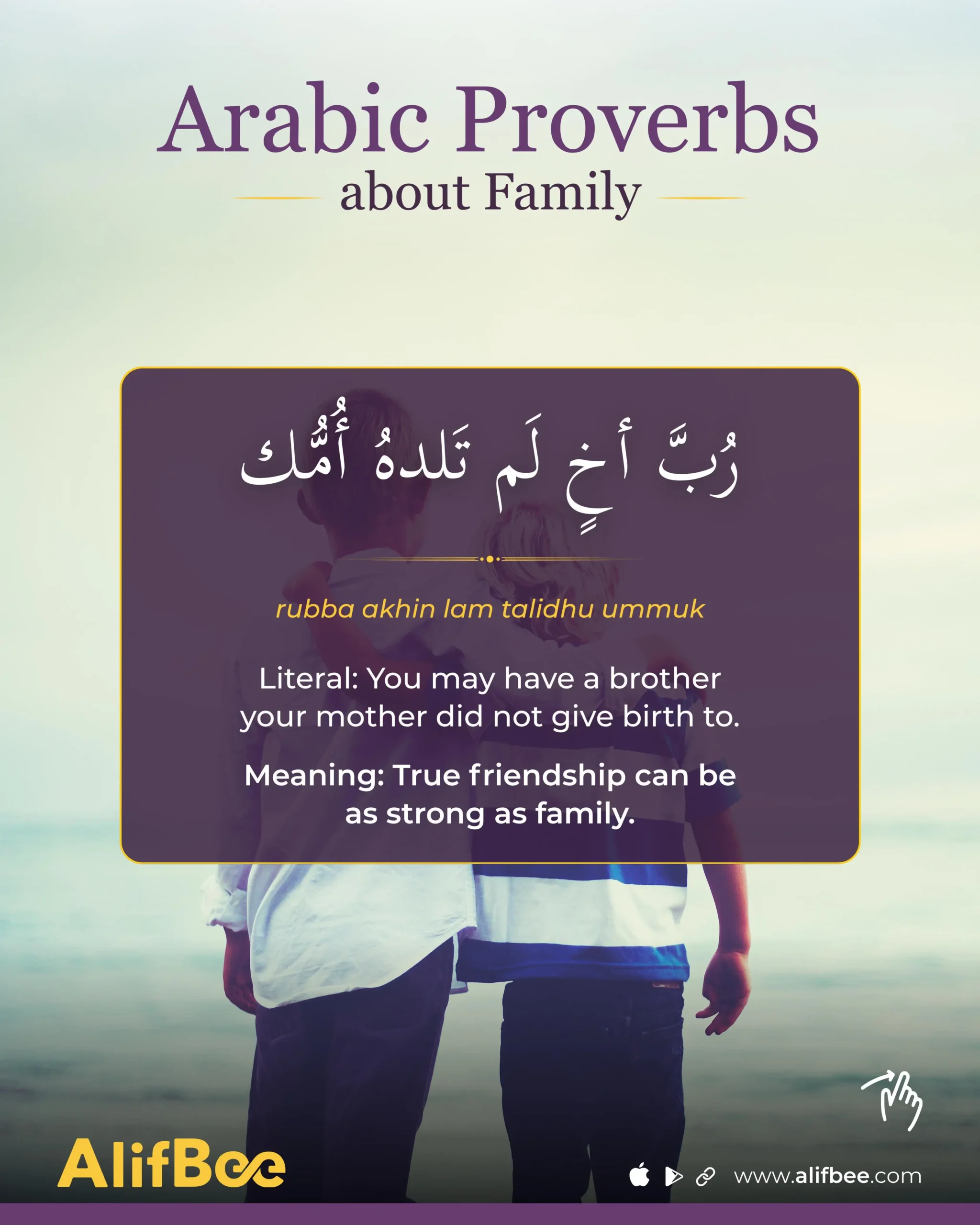
Literal: You may have a brother your mother did not give birth to.
Meaning: True friendship can be as strong as family. |
rubba akhin lam talidhu ummuk |
رُبَّ أخٍ لَم تَلدهُ أُمُّك |
|
|
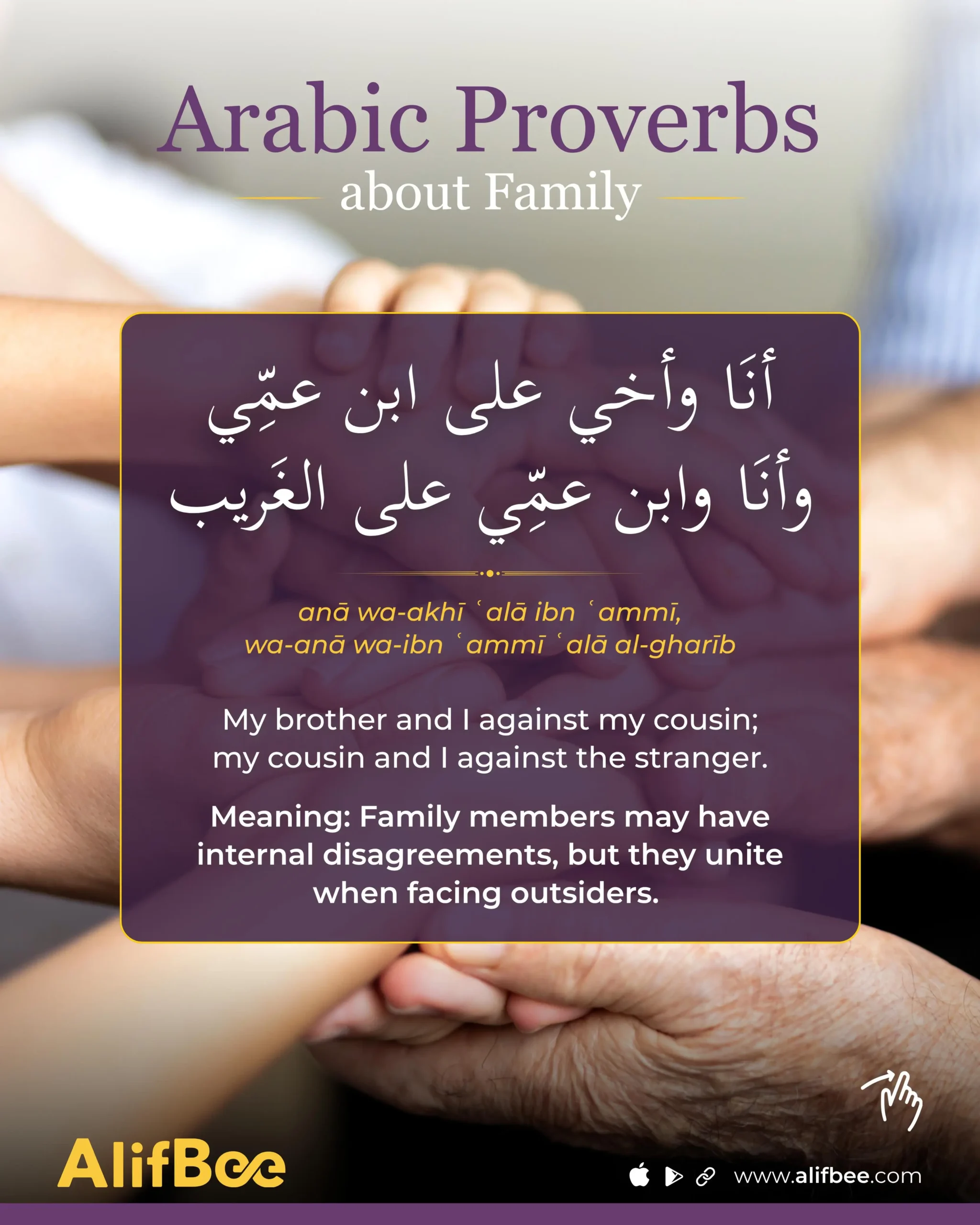
My brother and I against my cousin; my cousin and I against the stranger.
Meaning: Family members may have internal disagreements, but they unite when facing outsiders. |
anā wa-akhī ʿalā ibn ʿammī, wa-anā wa-ibn ʿammī ʿalā al-gharīb |
أنَا وأخي على ابن عمِّي وأنَا وابن عمِّي على الغَريب |
|
|
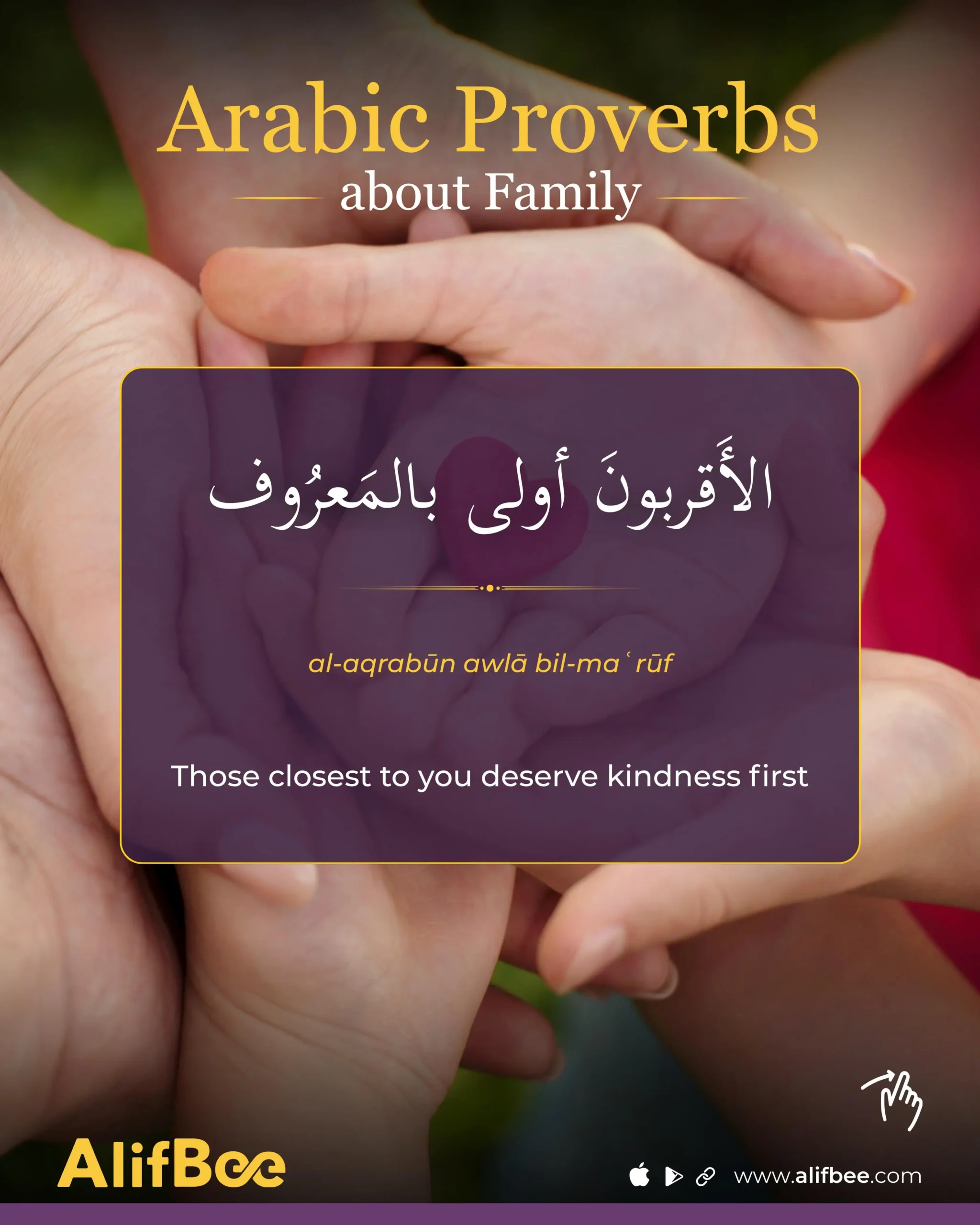
Those closest to you deserve kindness first |
al-aqrabūn awlā bil-maʿrūf |
الأَقربونَ أولى بالمَعرُوف |
|
|
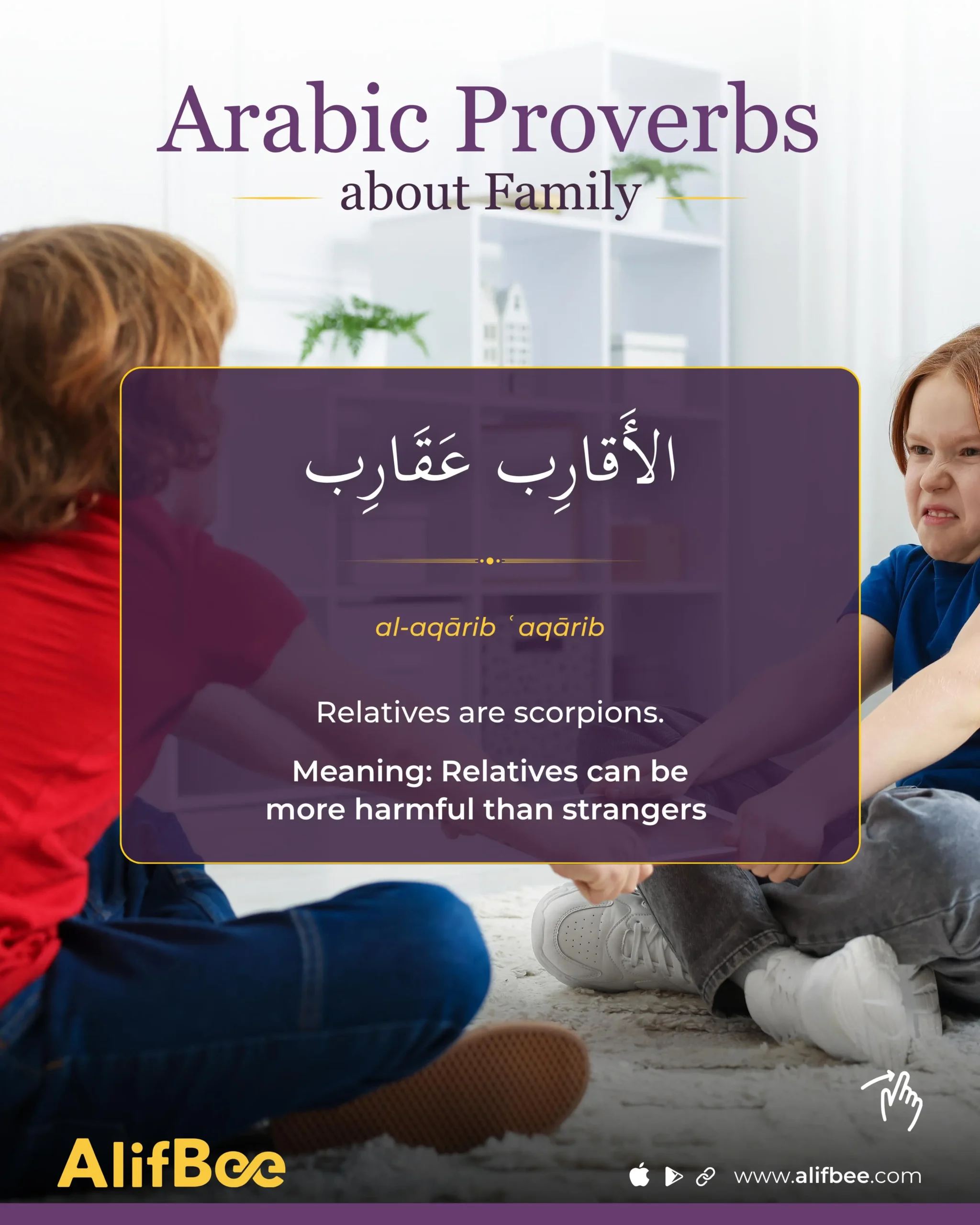
Relatives are scorpions.
Meaning: Relatives can be more harmful than strangers |
al-aqārib ʿaqārib |
الأَقارِب عَقَارِب |
|
Arabic Proverbs about Mothers
Arabic sayings often speak of mothers with deep respect. We have chosen three proverbs that connect the mother with spiritual value, education, and intuition.
Proverb 1: Paradise Lies Under the Feet of Mothers
| Meaning | Pronunciation | Arabic Proverb | |
|---|---|---|---|
|
Paradise lies under the feet of Mothers |
al-jannatu taḥta aqdāmi al-ummahāt |
الجنَّةُ َتحتَ أقدامِ الأُمَّهات |
|
Used in: Mainly MSA, but widely quoted in dialect conversations
Tone: Respectful, religious, and formal
Use when: Praising someone for caring for and honoring their mother
Example: When Khaled cancelled his trip to care for his sick mother, his uncle reminded him: الجَنَّةُ تَحتَ أقدامِ الأُمَّهَات.
Avoid when: Do not describe it as a Quranic verse. It is associated with a hadith about honoring one’s mother.
This saying reminds learners that honoring and serving one’s mother carries deep spiritual value. A related hadith wording appears in Sunan an-Nasa’i 3104, where the Prophet Muhammad tells a man to stay with his mother because Paradise is beneath her feet. Quran 17:23 also gives a strong Islamic context for kindness and respectful speech toward parents.
Proverb 2: A Mother Is Like a School
| Meaning | Pronunciation | Arabic Proverb | |
|---|---|---|---|
|
A Mother is Like a School. If you prepare her well, you prepare a noble nation |
al-ummu madrasatun idhā aʿdadtahā aʿdadta shaʿban ṭayyib al-aʿrāqi |
الأُمُّ مَدرسةٌ إذا أَعدَدتَها أَعددتَ شَعبًا طَيِّبَ الأَعراقِ |
|
Used in: MSA
Tone: Poetic, respectful, and formal
Use when: Discussing the importance of mothers in education and character-building
Example: During the school ceremony, the principal praised the role of mothers and said: الأُمُّ مَدرسةٌ إذا أَعدَدتَها أَعددتَ شَعبًا طَيِّبَ الأَعراقِ.
Avoid when: Do not use it to suggest that mothers alone are responsible for educating or raising children.
This is a poetic line attributed to the Egyptian poet Hafez Ibrahim, known as the Poet of the Nile. It praises the mother as a child’s first teacher, not only for her own family but for society as a whole.
In Arab culture, mothers hold an important place in both the family and society. Their role goes beyond caring for their children’s daily needs; they are also responsible for raising them with kindness, knowledge, and good manners. In this sense, the mother does the work of a teacher: she helps educate children and shape their character from the very beginning.
This proverb is used in Modern Standard Arabic (MSA), so it is best suited to writing and formal speeches.
Proverb 3: A Mother’s Heart Is Her Guide
| Meaning | Pronunciation | Arabic Proverb | |
|---|---|---|---|
|
A mother’s heart is her guide. |
qalbu al-ummi dalīluhā |
قلبُ الأمِّ دَليلُها |
|
Used in: Both MSA and dialect
Tone: Warm, affectionate, and poetic
Use when: A mother correctly senses that her child is worried, upset, or in trouble
Example: The mother knew that her daughter was upset before she said anything, so the grandmother smiled and said: قلبُ الأمِّ دليلُها.
Avoid when: Avoid using it to suggest that intuition should replace facts, communication, or professional advice.
The image is simple and easy to remember. Qalb means heart and dalīl means guide. The saying refers to a mother’s instinct and her ability to sense what her child needs, even before the child explains it.
Many people can relate to this proverb. You can use it when a mother correctly guesses what her children are feeling, senses that they are in trouble, or senses that something is bothering them.
A dialectal version of this proverb is ʾalb il-imm dalīlha, especially in Levantine Arabic.
Arabic Proverbs about Fathers and Children
Father-and-child proverbs often emphasize resemblance. Sometimes they refer to physical appearance, and sometimes to character, habits, courage, or reputation. These sayings are usually affectionate or admiring, especially when a child inherits a positive quality from their father.
Proverb 4: The Son Is the Secret of His Father
| Meaning | Pronunciation | Arabic Proverb | |
|---|---|---|---|
|
The son is the secret of his father |
al-waladu sirru abīhi |
الوَلَدُ سِرُّ أَبيه |
|
Used in: Both MSA and dialect
Tone: Affectionate and observant
Use when: A son shows the same habit, talent, or personality trait as his father
Example: When the boy began repairing things exactly as his father did, his mother laughed and said: الوَلَدُ سِرُّ أَبيه.
Avoid when: Avoid it when the comparison concerns an embarrassing or negative quality that could offend either person.
The word sirr means secret, but the intended meaning is closer to hidden nature, reflection, or inner character. You can use this proverb when a son’s behavior, talent, or personality reveals something of his father.
The proverb can be used in MSA and Arabic dialects, with some minor changes. In Levantine Arabic, for example, you can hear the saying الولد سر أبوه il-walad sirr abūh.
Proverb 5: He Who Resembles His Father Has Done No Wrong
| Meaning | Pronunciation | Arabic Proverb | |
|---|---|---|---|
|
He who resembles his father has done no wrong |
man shābaha abāhu fa-mā ẓalam |
منْ شابَهَ أَباهُ فمَا ظَلَم |
|
Used in: Both, although the fixed wording is close to MSA
Tone: Approving, affectionate, or lightly humorous
Use when: A child follows the same profession, behavior, or path as their father
Example: The son chose the same career as his father, so one of the relatives said: مَن شابَهَ أباهُ فما ظَلَم.
Avoid when: Be careful when speaking about complicated family relationships or when comparison with the father may be unwelcome.
This proverb is similar to “like father, like son,” but it sounds more approving. You might hear it when a child looks like his father, follows his path, or shows a familiar habit that the family recognizes with affection.
Even though it is formal Arabic, it is not uncommon to hear it in a casual conversation.
Proverb 6: This Cub is from That Lion
| Meaning | Pronunciation | Arabic Proverb | |
|---|---|---|---|
|
This cub is from that lion |
hādhā al-shiblu min dhāka al-asad |
هذا الشِّبلُ مِن ذاكَ الأَسد |
|
Used in: Mainly MSA, but sometimes quoted in everyday speech
Tone: Poetic, formal, and highly complimentary
Use when: Praising a young person who displays the courage, talent, or strength of a respected parent or mentor
Example: After the young athlete won the same championship as his father, the coach said: هَذَا الشِّبلُ مِن ذَاكَ الأَسَد.
Avoid when: Avoid using it for an ordinary resemblance. The expression is strong and can sound exaggerated if the achievement is minor.
This proverb is stronger and more complimentary than a simple expression of resemblance. A shibl means a lion cub, and asad means lion. It is used to praise a son, student, or younger person who reflects the strength, character, or qualities of a respected father or mentor. But keep in mind that it is in MSA and is generally considered formal.
Arabic Proverbs about Brothers and Relatives
Arabic proverbs about brothers and relatives do not always present family relationships in a positive light. Some celebrate brotherhood and kindness, while others describe family loyalty, rivalry, or painful family conflict.
Proverb 7: There may be a brother (for you) not born by your mother
| Meaning | Pronunciation | Arabic Proverb | |
|---|---|---|---|
|
You may have a brother your mother did not give birth to. |
rubba akhin lam talidhu ummuk |
رُبَّ أَخٍ لَم تَلدهُ أُمُّك |
|
Used in: Mainly MSA, but often quoted in everyday conversations
Tone: Warm, poetic, and sincere
Use when: Describing a loyal friend who supported you through a serious difficulty
Example: His friend stayed beside him throughout his illness, and he later said: رُبَّ أَخٍ لَم تَلدهُ أُمُّك.
Avoid when: Avoid saying it to a new or casual friend because it expresses a deep emotional bond.
This is a formal expression used to describe a loyal friend who feels like a true brother. The word akh means brother, but Arabic speakers may also use it warmly for a close companion, trusted friend, or someone who always stands by you.
You can use it when speaking about a loyal friend who feels like family, especially someone who supports you in difficult times. Even though this proverb is in Modern Standard Arabic, people can use it in everyday speech, especially when talking about a loyal friend who feels like family.
Proverb 8: My Brother and I Against My Cousin
| Meaning | Pronunciation | Arabic Proverb | |
|---|---|---|---|
|
My brother and I against my cousin, and my cousin and I against the stranger |
anā wa-akhī ʿalā ibn ʿammī, wa-anā wa-ibn ʿammī ʿalā al-gharīb |
أَنا وَأَخي عَلى اِبن عَمِّي وَأنا واِبن عَمِّي عَلى الغَرِيب |
|
Used in: Mainly dialect and informal proverbial speech
Tone: Cynical, critical, or humorous
Use when: Describing relatives or groups that stop arguing and unite when an outsider becomes involved
Example: After months of disagreement, the relatives suddenly supported one another when a stranger criticized the family. Someone commented: أَنا وَأَخي عَلى اِبن عَمِّي، وَأَنا وَاِبن عَمِّي عَلى الغَرِيب.
Avoid when: Do not use it as advice or to justify unfairly supporting relatives when they are wrong.
This is an informal proverb that means “Family sides with family when facing outsiders.” It describes loyalty that shifts according to closeness. A person may disagree with a brother, cousin, or relative, but still stand with them when someone outside the family or group is involved.
It is often used to describe family members who may disagree among themselves but defend one another in public, or groups that have internal conflicts yet unite against an outside group. It can also refer to tribal, political, or social loyalties, especially when loyalty becomes more important than determining who is right.
The proverb can sound negative or cynical, so it should be used carefully. It is better to teach it as a cultural expression rather than as advice on fair behavior.
Proverb 9: Those Closest to You Deserve Kindness First
| Meaning | Pronunciation | Arabic Proverb | |
|---|---|---|---|
|
Those closest to you deserve kindness first |
al-aqrabūn awlā bil-maʿrūf |
الأَقرَبون أَولى بالمَعروف |
|
Used in: Mainly MSA, but commonly quoted in ordinary speech
Tone: Respectful, moral, and gently critical
Use when: Someone helps distant people while overlooking a relative or close person who genuinely needs support
Example: The man donated to several distant causes while his struggling brother received no help, so a friend reminded him: الأَقرَبون أَولى بالمَعروف.
Avoid when: Do not use it to argue that kindness should be limited to relatives or that strangers are less deserving of help.
It is similar to “charity begins at home,” but the Arabic word maʿrūf suggests goodness, kindness, or generous action. Almaany Dictionary gives three translations for it:
- Blood is thicker than water
- Your relations (in need) are more deserving of your generosity
- Charity begins at home
You use it when someone is helping others while neglecting their own family, relatives, neighbors, or close people who also need support.
It can refer to money, support, visits, emotional care, or any good action. It does not mean you should only help relatives. It means they should not be forgotten when you do good.
Proverb 10: Relatives Are Scorpions
| Meaning | Pronunciation | Arabic Proverb | |
|---|---|---|---|
|
Relatives are scorpions |
al-aqārib ʿaqārib |
الأَقارِب عَقَارِب |
|
Used in: Both MSA-style phrasing and dialectal speech
Tone: Cynical, sharp, or darkly humorous
Use when: Someone is expressing frustration after a painful dispute with relatives
Example: After a bitter disagreement over inheritance, the man said with frustration: الأَقارِب عَقَارِب.
Avoid when: Avoid saying it directly in front of relatives unless the humorous intention is completely clear. It can sound insulting and hostile.
This proverb is especially striking because aqārib means relatives, while ʿaqārib means scorpions. The two words sound almost the same, but they begin with different sounds:
- aqārib starts with a hamza/alif (ʾ) sound and means relatives.
- ʿaqārib starts with ʿayn (ʿ) and means scorpions.
The difference in meaning, however, is dramatic. This is a cynical saying that is used to describe painful family conflicts or difficult relationships with relatives. It is not meant as a general statement about families in Arab societies. In fact, Arab families are often known for their strong family ties and close-knit relationships. The proverb is best understood as a piece of wordplay that may be used humorously or, in some cases, to express frustration with a particular family situation.
Formal vs Colloquial Arabic Family Sayings
Some family sayings retain their formal wording even when people use them in casual conversations. Others are more likely to appear in a local dialect. The distinction is not always absolute because speakers may quote an MSA proverb while speaking dialect.
| Usage Note | How It May Sound in Conversation | Most Common Register | Saying |
|---|---|---|---|
|
More natural in writing, speeches, school events, and formal discussions |
Usually kept in its original literary form |
MSA |
الأُمُّ مَدرسةٌ إذا أَعدَدتَها… |
|
The dialectal version sounds more natural in family conversation |
Levantine: قلب الإِم دليلها, pronounced ʾalb il-imm dalīlha |
Both |
قلبُ الأمِّ دليلُها |
|
The structure changes slightly according to dialect |
Levantine: الولد سر أبوه, pronounced il-walad sirr abūh |
Both |
الوَلَدُ سِرُّ أَبيه |
|
Common enough to be understood in casual speech, but still sounds proverbial |
Often quoted without being translated into dialect |
Mainly MSA |
مَن شابَهَ أباهُ فما ظَلَم |
|
Sounds literary and strongly complimentary |
Usually kept in its formal form |
MSA |
هَذَا الشِّبلُ مِن ذَاكَ الأَسَد |
|
Formal in grammar, but familiar in emotional everyday contexts |
Usually quoted in its original wording |
MSA |
رُبَّ أَخٍ لَم تَلدهُ أُمُّك |
|
Often used critically or humorously to describe group loyalty |
Wording and pronunciation vary by region |
Mainly dialectal and informal |
أَنا وَأَخي عَلى اِبن عَمِّي… |
|
Natural in moral, social, or family discussions |
Frequently quoted unchanged |
Mainly MSA |
الأَقرَبون أَولى بالمَعروف |
|
The wordplay makes it memorable across different varieties of Arabic |
Pronunciation changes with the speaker’s dialect |
Both |
الأَقارِب عَقَارِب |
Review 10 Common Arabic Proverbs about Family
How Native Speakers Actually Use These Sayings
Native speakers rarely introduce a proverb without a reason. They usually say it after a particular event has reminded them of its meaning. For example, someone may say الوَلَدُ سِرُّ أَبيه (al-waladu sirru abīhi) after noticing that a boy behaves exactly like his father. The proverb works as a short comment on what has just happened.
Many speakers use dialect in the surrounding sentence but keep the proverb itself in its familiar MSA form. This is especially common with literary expressions such as هَذَا الشِّبلُ مِن ذَاكَ الأَسَد (hādhā al-shiblu min dhāka al-asad) and مَن شابَهَ أباهُ فما ظَلَم (man shābaha abāhu fa-mā ẓalam). A speaker does not need to switch the entire conversation into formal Arabic to quote them.
Tone and facial expression also affect the meaning. الأَقارِب عَقَارِب (al-aqārib ʿaqārib), for example, may express real anger after a family dispute, but friends may also use it jokingly after a minor disagreement with a cousin. Similarly, the proverb about a brother, cousin, and stranger is normally used to describe biased loyalty, not to recommend it.
Learners should also remember that not every well-known saying is a traditional folk proverb. Some expressions began as poetry, religious wording, or literary quotations but became so familiar that people now use them like proverbs. It is better to learn where a saying comes from, how formal it sounds, and what emotion it carries before using it yourself.
Arabic Family Proverbs vs Arabic Family Idioms: What Is the Difference?
Arabic proverbs and idioms can both be difficult to translate literally, but they serve different purposes.
| Feature | Arabic Proverb | Arabic Idiom |
|---|---|---|
|
Form |
Usually a complete sentence or independent statement |
Usually a phrase used as part of a larger sentence |
|
Purpose |
Expresses advice, a lesson, a warning, or a general observation |
Describes a person, feeling, relationship, or situation figuratively |
|
Can it stand alone? |
Usually yes |
Usually no |
|
Example |
مَن شابَهَ أباهُ فما ظَلَم: He who resembles his father has done no wrong |
مِن لَحمِنا وَدَمِنا: One of our own, literally “from our flesh and blood” |
|
Typical use |
Commenting on a situation or sharing inherited wisdom |
Adding figurative meaning within an ordinary sentence |
For example, man shābaha abāhu fa-mā ẓalam can be said by itself after someone notices a resemblance between a father and son. It presents a complete observation, so it functions as a proverb.
By contrast, min laḥminā wa-daminā usually appears inside a sentence, such as “He is one of our own.” It does not offer a general lesson. Instead, it figuratively describes a close family or group connection, so it functions as an idiomatic expression.
The boundary is not always perfectly clear. Some expressions may behave like an idiom in one context and a proverb in another. For learners, the most useful question is whether the expression offers a general piece of wisdom or simply adds a figurative meaning to a sentence.
FAQs
What Are Arabic Proverbs?
Arabic proverbs are short, fixed sayings that convey a lesson, a warning, or a shared observation. Some sound close to Modern Standard Arabic, while many others come from dialects or everyday speech. A proverb may not always translate word for word into English, so learners should study the meaning, tone, and context before using it.
What are some Arabic proverbs about family?
Common Arabic family proverbs include al-jannatu taḥta aqdāmi al-ummahāt, man shābaha abāhu fa-mā ẓalam, and rubba akhin lam talidhu ummuk. These sayings usually express respect for mothers, father-child resemblance, loyalty, and kinship.
How do you say “like father, like son” in Arabic?
Two useful Arabic sayings are man shābaha abāhu fa-mā ẓalam and hādhā al-shibl min dhāka al-asad. The first means that a child has done no wrong by resembling his father. The second literally means, “This cub is from that lion,” and is used to express the idea of “like father, like son.”
What does الأقارب عقارب mean?
Al-aqārib ʿaqārib means “Relatives are scorpions.” It is a wordplay-based proverb that suggests relatives can sometimes be harmful or cause emotional pain. It has a sharp, critical tone and is typically used only in contexts involving family conflict, tension, or betrayal.
Are Arabic family proverbs MSA or dialect?
Some Arabic family proverbs are expressed in a form close to Modern Standard Arabic, while others exist mainly in dialectal versions or everyday speech. Learners should not worry about this distinction at first. Instead, focus on the phrase itself, its meaning, and the situations in which the proverb sounds natural.
Final word
Arabic proverbs about family teach both language and culture. They help you see how Arabic speakers praise mothers, admire fathers, value brothers, care for relatives, and sometimes speak honestly about family tensions. By learning these sayings, you gain insight into both everyday Arabic and the values that shape family life.
For another next step, explore more Arabic proverbs on the AlifBee blog.
Learn with AlifBee
Want to practice Arabic phrases with audio, examples, and guided lessons? Explore family vocabulary, pronunciation, and everyday expressions inside the AlifBee app, and build your Arabic step by step with a 14-day free trial.