Adhan in Arabic: Learn the Islamic Call to Prayer
Learn the Adhan in Arabic, the Islamic call to prayer, with English translation. Recite the Arabic text, understand the meaning & prayer time. Learn key related words in Arabic.
Imagine if the king or president called you five times every day, not to ask for a favor, but simply to hear your voice. To God belongs the highest example; this is what the Adhan represents for Muslims, a source of inner strength and spiritual renewal.
Hearing the Adhan for the first time may feel unfamiliar, but it often awakens deep emotions and touches the hearts of listeners because of the beauty of the Arabic language and its moving melodies.
In this article, we will examine the Adhan from a linguistic and spiritual perspective, exploring its Arabic words and their English meanings, and helping readers understand one of the world’s most unique rituals.
The Adhan is the alarm that announces the time for Muslims to connect with the Creator through prayer, which serves as a safe haven for Muslims. This is perfectly described by the Prophet Muhammad (peace be upon him) when he said to Bilal ibn Rabah, his companion and the first muʾadhdhin in Islam:
“O Bilal, call iqamah for prayer: give us comfort by it.”
This Muslim call to prayer rises from the minarets of mosques five times a day, marking each specific prayer time. Its purpose is greater than a simple announcement; it is a call inviting Muslims to pause their daily activities and come together for prayer in congregation. The “comfort” the Prophet spoke of becomes a shared reality.
Whether you are in Egypt or Indonesia, the words of the Adhan remain the same. However, for the Adhan to be religiously valid, it must be performed in Arabic.
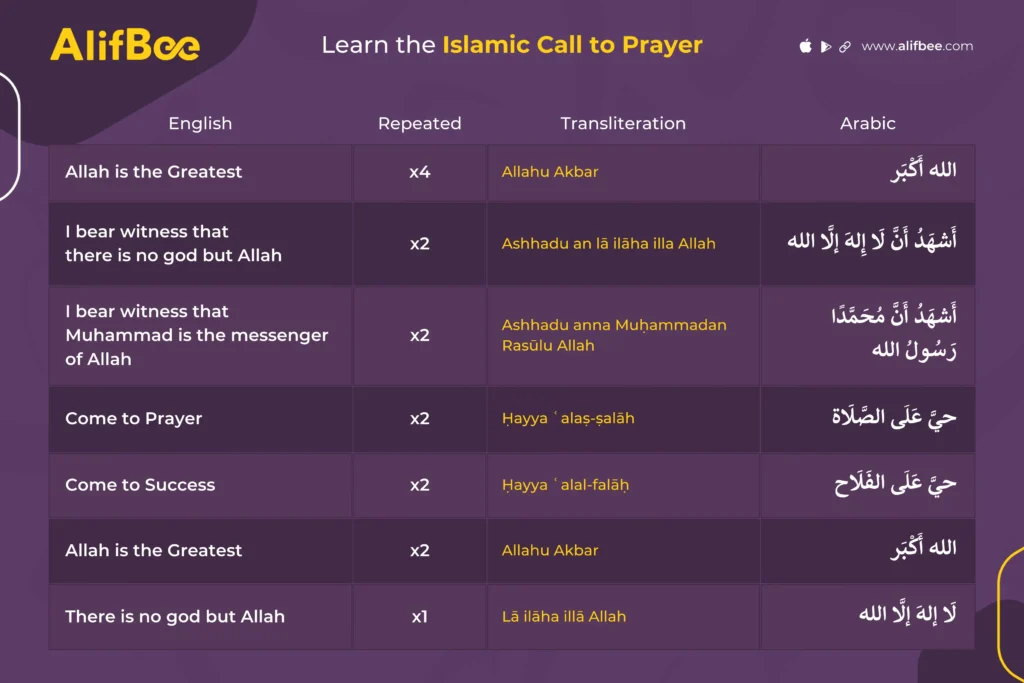
Regardless of a person’s native tongue, pronouncing these phrases in Arabic creates a feeling of Muslim unity and belonging. The table below lists the Adhan phrases and meanings.
English Meaning
Repeated
Transliteration
Arabic Text
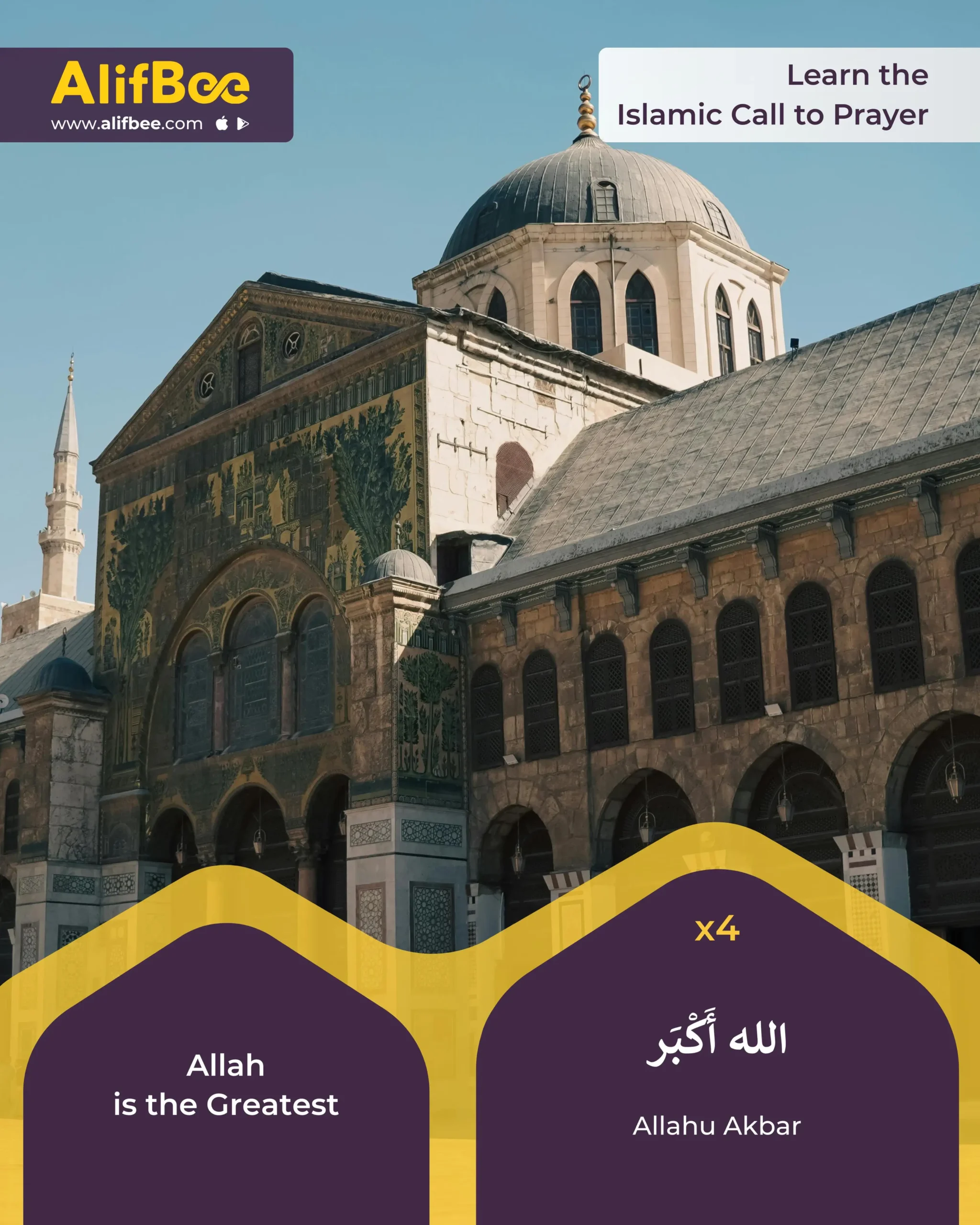
Allah is the Greatest
x4
Allahu Akbar
الله أَكْبَر
I bear witness that there is no god but Allah
x2
Ashhadu an lā ilāha illa Allah
أَشهَدُ أَنَّ لَا إِلهَ إلَّا الله
I bear witness that Muhammad is the messenger of Allah
x2
Ashhadu anna Muḥammadan Rasūlu Allah
أَشهَدُ أَنَّ مُحَمَّدًا رَسُولُ الله
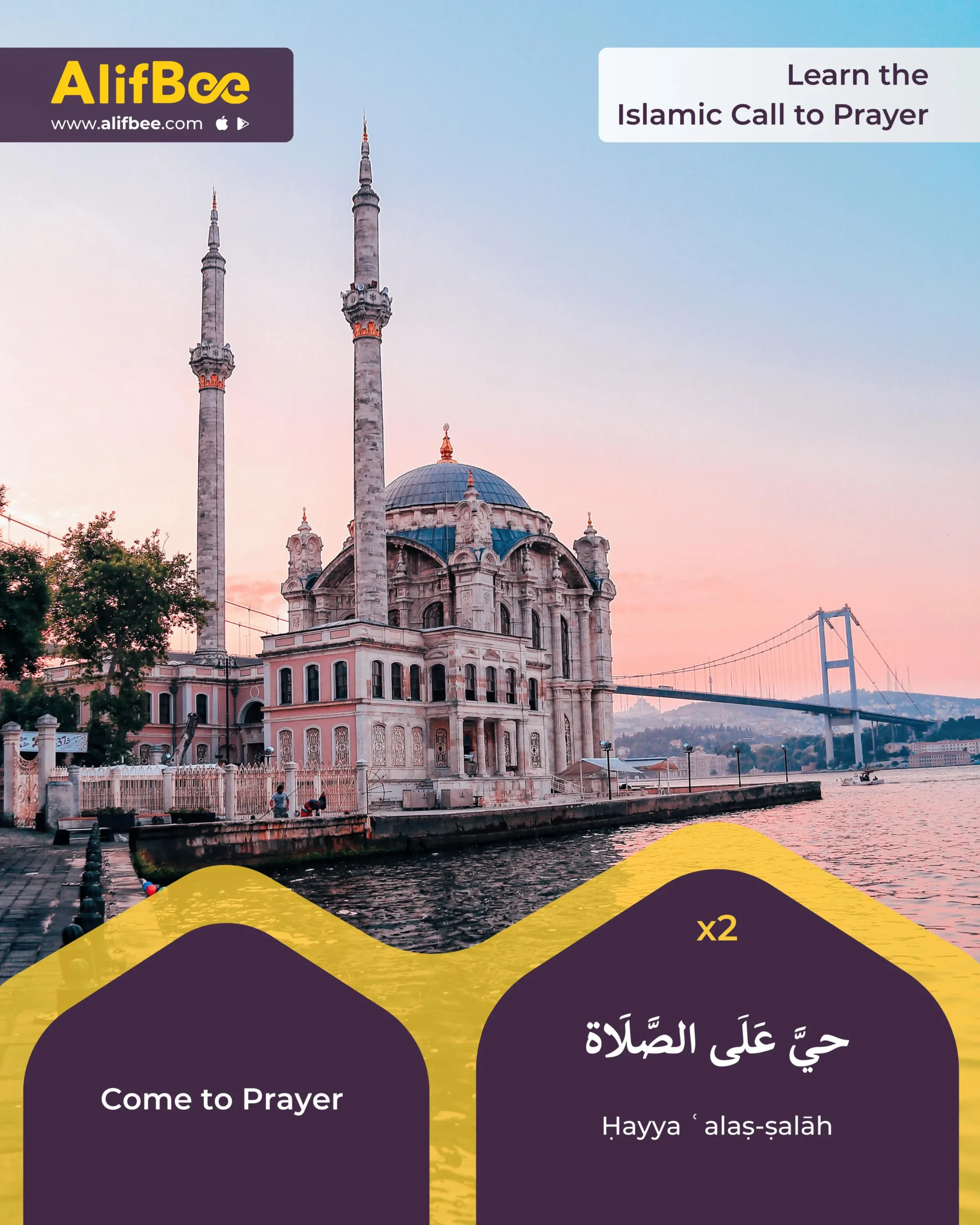
Come to Prayer
x2
Ḥayya ʿalaṣ-ṣalāh
حيَّ عَلَى الصَّلَاة
Come to Success
x2
Ḥayya ʿalal-falāḥ
حيَّ عَلَى الفَلَاح
Allah is the Greatest
x2
Allahu Akbar
الله أَكبَر
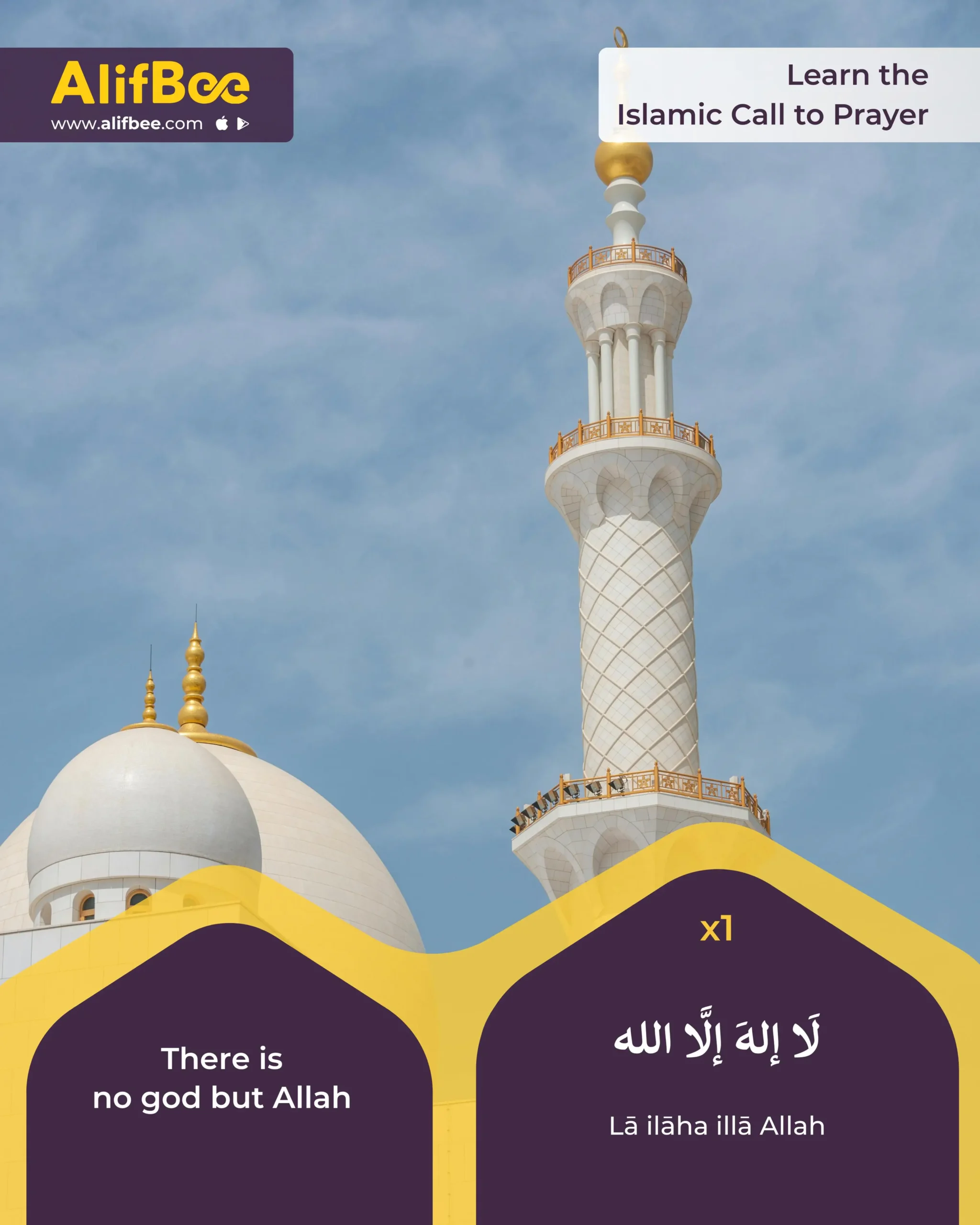
There is no god but Allah
x1
Lā ilāha illā Allah
لَا إلهَ إلَّا الله
To fully appreciate the beauty of the Adhan and feel its meaning, you must understand its words:
Akbar: The opening words of the Adhan teach that God is greater than anything that can be conceived or imagined. Grammatically, Akbar is a superlative form, and it translates as “the Greatest.”
Ḥayya: A word that functions as an imperative verb, meaning come or hasten. It is not a suggestion; it urges immediate response to prayer.
Ṣalāh: A noun meaning prayer. It refers to the act of worship performed by Muslims at specific times throughout the day.
Falāḥ: A noun meaning success. In the context of the Adhan, its meaning is much deeper. It refers to eternal success and attaining salvation in the Hereafter, going far beyond worldly achievement.
“Lā” of Absolute Negation: in“Lā ilāha illā Allah” the particle Lā (لا) here is used for absolute negation, denying the existence of any deity altogether except Allah Almighty.
English Meaning
Transcription
Arabic Word
Mosque
Masjid
مَسْجِد
Announcer
Muʾadhdhin
مُؤَذِّن
Minaret
Miʾdhana
مِئْذَنَة
Takbir
Takbīr
تَكْبير
Prayer
Ṣalāh
صَلَاة
Eid Takbeerat
Takbīrāt al-ʿĪd
تَكْبِيرَاتُ العِيد
Friday Prayer
Ṣalāt al-Jumuʿah
صَلَاة الجُمُعَة
Worship
ʿIbādah
عِبَادَة
Imam
Imām
إِمَام
Iqamah
Iqāmah
إِقَامَة
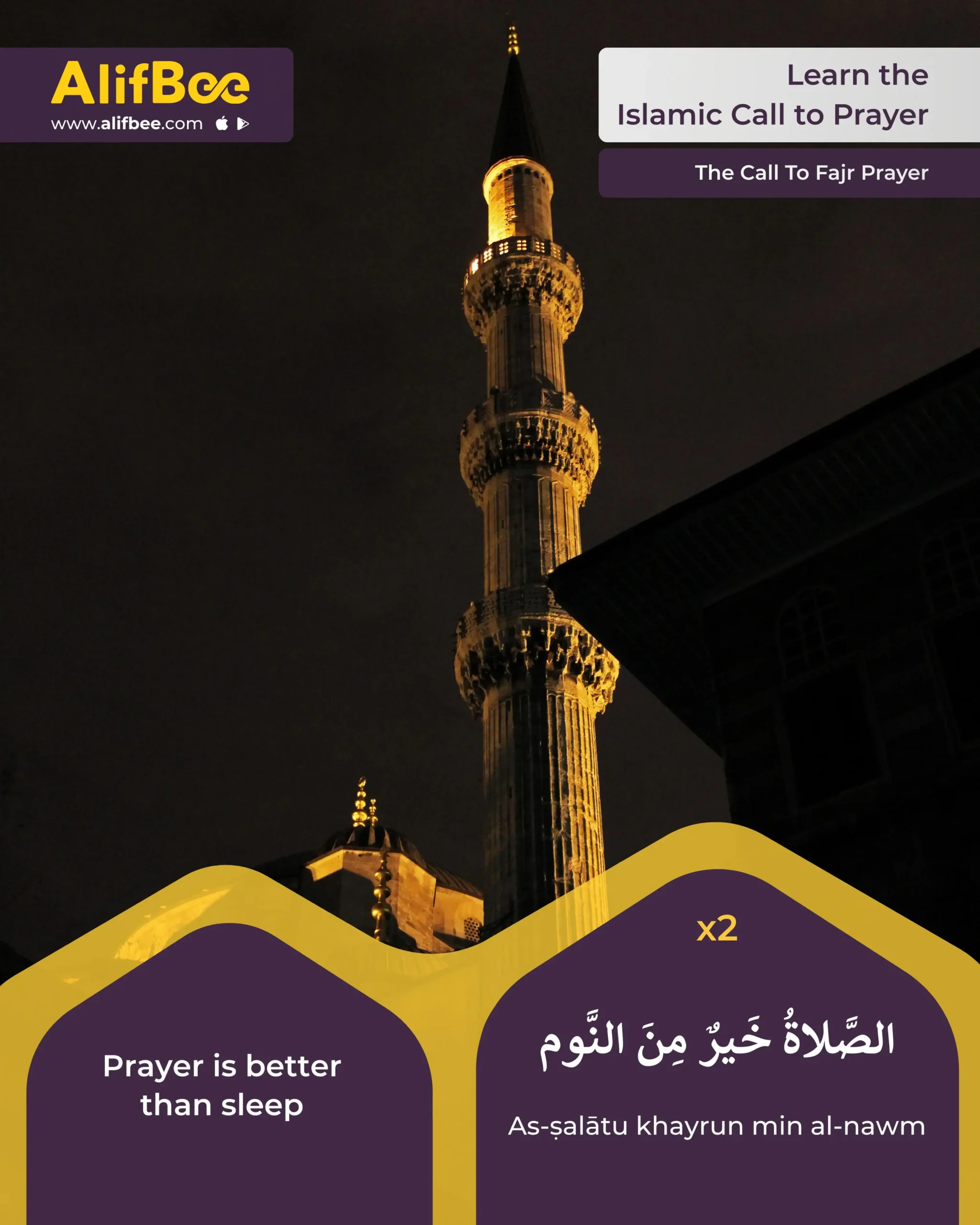
While the five daily calls to prayer remain unchanged, there is a unique addition to the Fajr (Dawn) Adhan. Following the phrase ” Ḥayya ʿala al-Falāḥ” the Muʾadhdhin adds: “As-ṣalātu khayrun min al-nawm”
English Meaning
Transcription
Arabic Word
Prayer is better than sleep
As-ṣalātu khayrun min al-nawm
الصَّلاةُ خَيرٌ مِنَ النَّوم
This addition reminds the believer that performing the Fajr prayer is more beloved to God than the comfort of staying in bed. While sleep represents responding to self-desires and choosing comfort, prayer represents responding to the call of God Almighty.
Adhan is a general public announcement that the prayer time has begun. Iqamah is a specific call to those already present to stand for the start of the prayer. The phrasing and delivery of the two are different: in Adhan, the sentences are repeated, whereas in Iqamah, the phrases are usually not repeated, except for the phrase “Qad qāmati aṣ-ṣalāh,” which is repeated twice by the majority.
English Meaning
Transcription
Arabic Word
The prayer has begun
Qad qāmati aṣ-ṣalāh
قَد قَامَتِ الصَّلاة
After exploring the vocabulary and phrases of the Adhan, you find that it is far more than just a passing call in the day of a muslim. It is a spiritual and religious connection and an attractive point for Arabic language learners.
If you would like to discover more about the Arabic language, download the AlifBee App and start your free 14-day trial with Arabic lessons designed for learners of all levels.

Achieve incredible results with our platform Learn Arabic Online with AlifBee

Join AlifBee Virtual School and master Arabic at your pace — from guided coaching to interactive self-learning.

Learn Arabic faster with live, one-on-one sessions tailored to your level and goals.

Explore AlifBee’s complete range of Arabic learning books for all ages!

Learn the Adhan in Arabic, the Islamic call to prayer, with English translation. Recite the Arabic text, understand the meaning & prayer time. Learn key related words in Arabic.

Master the Arabic letter Noon (ن)! Learn the pronunciation of the letter “n” and its different shapes. Understand the Noon in Arabic and more!

Master the Arabic letter Meem (م)! Learn how to pronounce the meem phonetically and its forms. Explore Arabic words and master the Meem in Arabic.

10 Beautiful Arabic Terms of Endearment: Go beyond “Habibi”! Express your love and affection with these sweet Arabic language terms.