Short Duas for Ramadan in Arabic and English
Short Duas for Ramadan in Arabic and English. Learn short supplications in Arabic and English to connect with Allah (SWT) this holy month. Download Free Daily Dua PDF
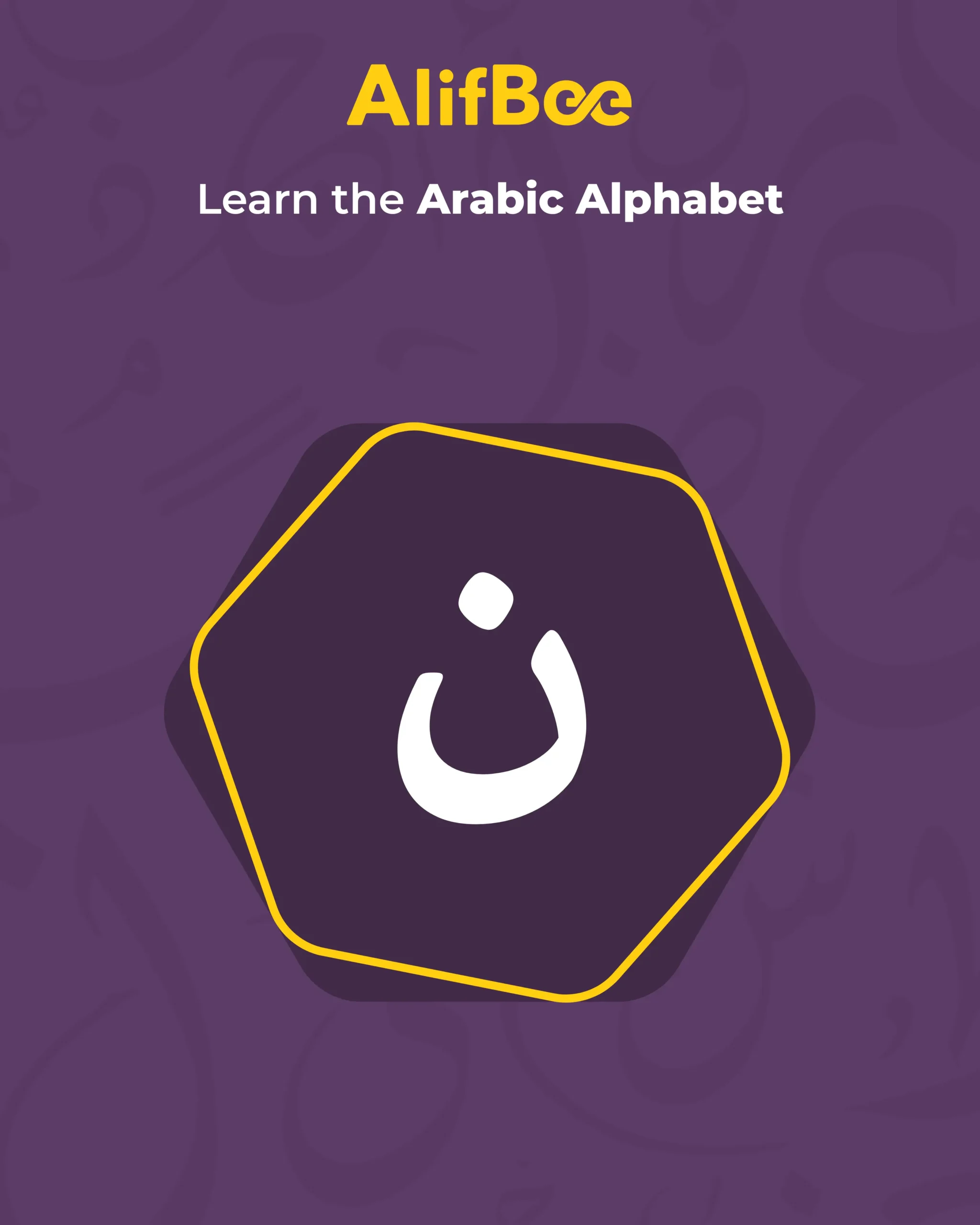
Today’s letter is the 25th in the Arabic alphabet. It’s the letter Noon ن, one of the most beginner-friendly letters, as it shows up in so many familiar Arabic words, such as:
نَعَم “yes”, the Arabic name نور“Nour”, and أنا “I”.
Today, we’ll make sure you know all the details about the letter Noon: its pronunciation, its different shapes and positions in Arabic words, and some interesting examples to help you recognize it in words and sentences.
Just like the English letter N, the Arabic Noon sound is pronounced pretty much the same way. It’s found in words like “no,” “name,” and “noon,” etc. It is a clear, nasal sound produced by placing the tip of the tongue on the gum ridge behind the upper front teeth.
The letter ن changes shape depending on its position in a word. Let’s begin by learning how to write each form, with examples.
Isolated
Initial
Medial
Final
ن
نـ
ـنـ
ـن
Now, let’s look at some common words that have the letter Meem in different positions.
We have the initial form at the beginning of a word, and it connects to the letter after it. Remember that we start writing the letter from right to left.
Draw a small curve with a dot above, followed by a connecting tail. Let’s see some examples with the letter ن at the beginning.
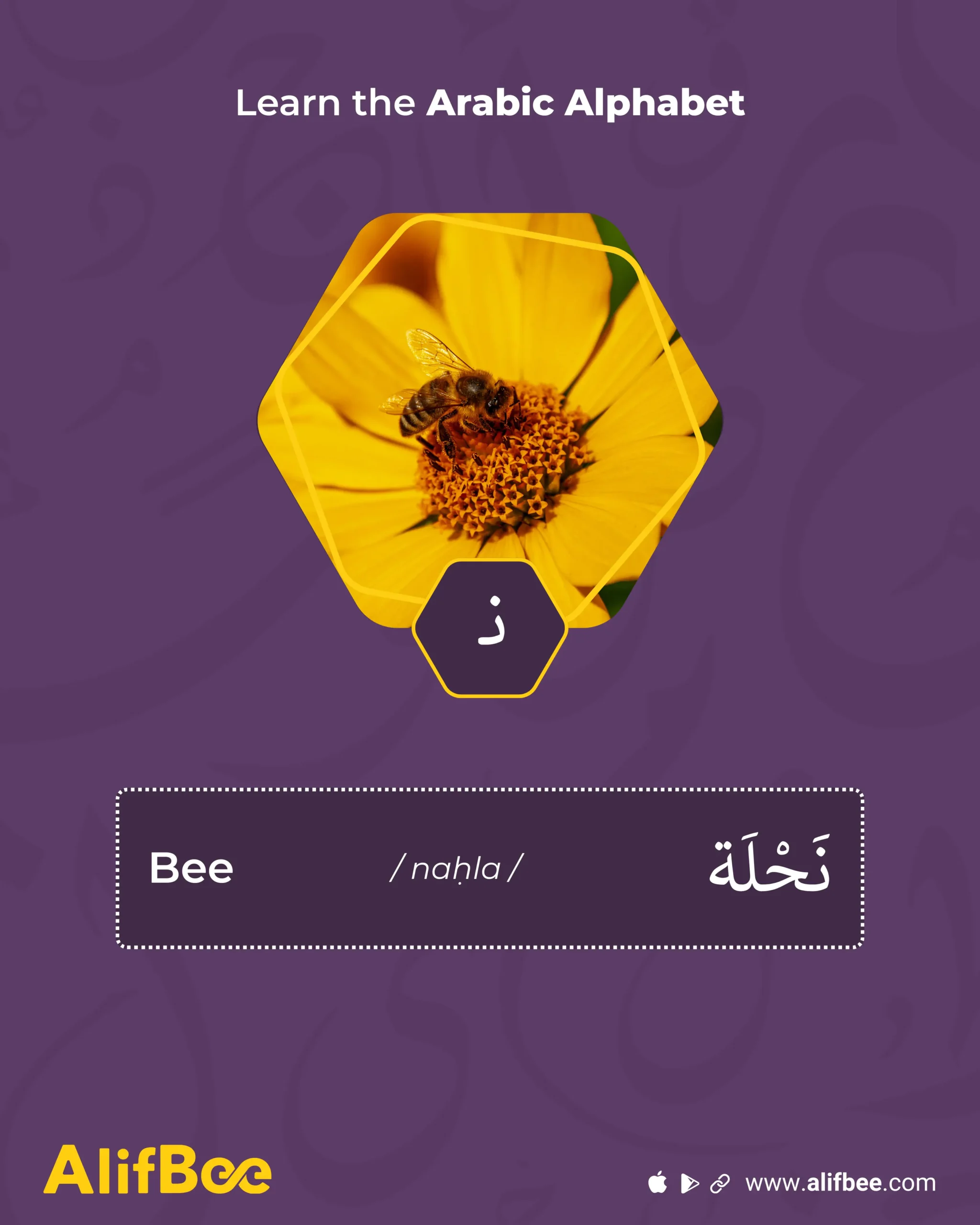
Bee
naḥla
نَحْلَة
A bee landed on the flowers.
waqafat naḥlatun ʿalā al-azhār
وَقَفَتْ نَحْلَةٌ عَلَى الأَزْهَار.
Carpenter
najjār
نَجَّار
This is a skilled carpenter.
hādhā najjārun māhirun
هَذَا نَجَّارٌ مَاهِرٌ
Star
najma
نَجْمَة
I saw a big star in the sky.
raʾaytu najmatan kabīratan fī as-samāʾ
رَأَيْتُ نَجْمَةً كَبِيرَةً فِي السَّمَاء
River
nahr
نَهْر
The children are playing on the riverbank.
yalʿabu al-aṭfāl ʿalā ḍiffat an-nahr
يَلْعَبُ الأَطْفَالُ عَلَى ضِفَّةِ النَّهْر
Sleeping
nawm
نَوْم
Regular sleep is important for health.
an-nawmu al-muntazim muhimm liṣ-ṣiḥḥah
النَّوْمُ المُنْتَظَمُ مُهِمٌّ لِلصِّحَّة
Draw a short horizontal line, then a small curve connecting from the right and extending to the left, and don’t forget the dot above the shape, as it is very important to identify the letter and helps you tell this letter apart from letters like letter ت and letter ث.
Grapes
ʿinab
عِنَب
I bought grapes from the market.
ishtaraytu al-ʿinaba mina as-sūq
اِشْتَرَيْتُ العِنَبَ مِنَ السُّوق
House
manzil
مَنْزِل
I live in a big house.
askunu fī manzilin kabīrin
أَسْكُنُ فِي مَنْزِلٍ كَبِيرٍ
Squirrel
sinjāb
سِنْجَاب
The squirrel jumps on the tree.
yaqfizu as-sinjābu ʿalā ash-shajarah
يَقْفِزُ السِّنْجَابُ عَلَى الشَّجَرَة
Hazelnuts
bunduq
بُنْدُق
I like chocolate with hazelnuts.
uḥibbu ash-shūkūla bil-bunduq
أُحِبُّ الشُّوكُولَا بِالْبُنْدُق
City
madīna
مَدِينَة
I live in a beautiful city.
Askunu fī madīnatin jamīlah.
أَسْكُنُ فِي مَدِينَةٍ جَمِيلَةٍ
Note
The medial form of the letter ن can also have the same shape as the initial form when it is preceded by letters such as ر، ز، د، ذ, as you can see in the following words:
rabbit
ʾarnab
أرنَب
tail
dhanab
ذَنَب
lily
zanbaq
زَنْبَق
This form can be isolated (ن) or connected to the previous letter (ـن).
Start from the right. Draw a half-circle, resembling a small, bowl-shaped curve that opens upward.
The right side of the curve is usually slightly higher than the left, and the bottom of the curve is rounded, not sharp. Finally, add the dot above the letter.
Olive
zaytūn
زَيْتُون
The farmers planted olive trees.
zaraʿa al-fallāḥūna az-zaytūn
زَرَعَ الفَلَّاحُونَ الزَّيْتُون
Milk/Yogurt
laban
لَبَن
The cat drank the milk.
sharibat al-qiṭṭah al-laban
شَرِبَتِ القِطَّةُ اللَّبَن
Knife
sikkīn
سِكِّين
Do not play with the knife.
lā talʿab bi-s-sikkīn
لا تَلْعَبْ بِالسِّكِّين
Teeth
asnān
أَسْنَان
Brush your teeth twice a day.
ighsil asnānaka marratayn yawmiyyan
اِغْسِلْ أَسْنَانَكَ مَرَّتَيْنِ يَوْمِيًّا
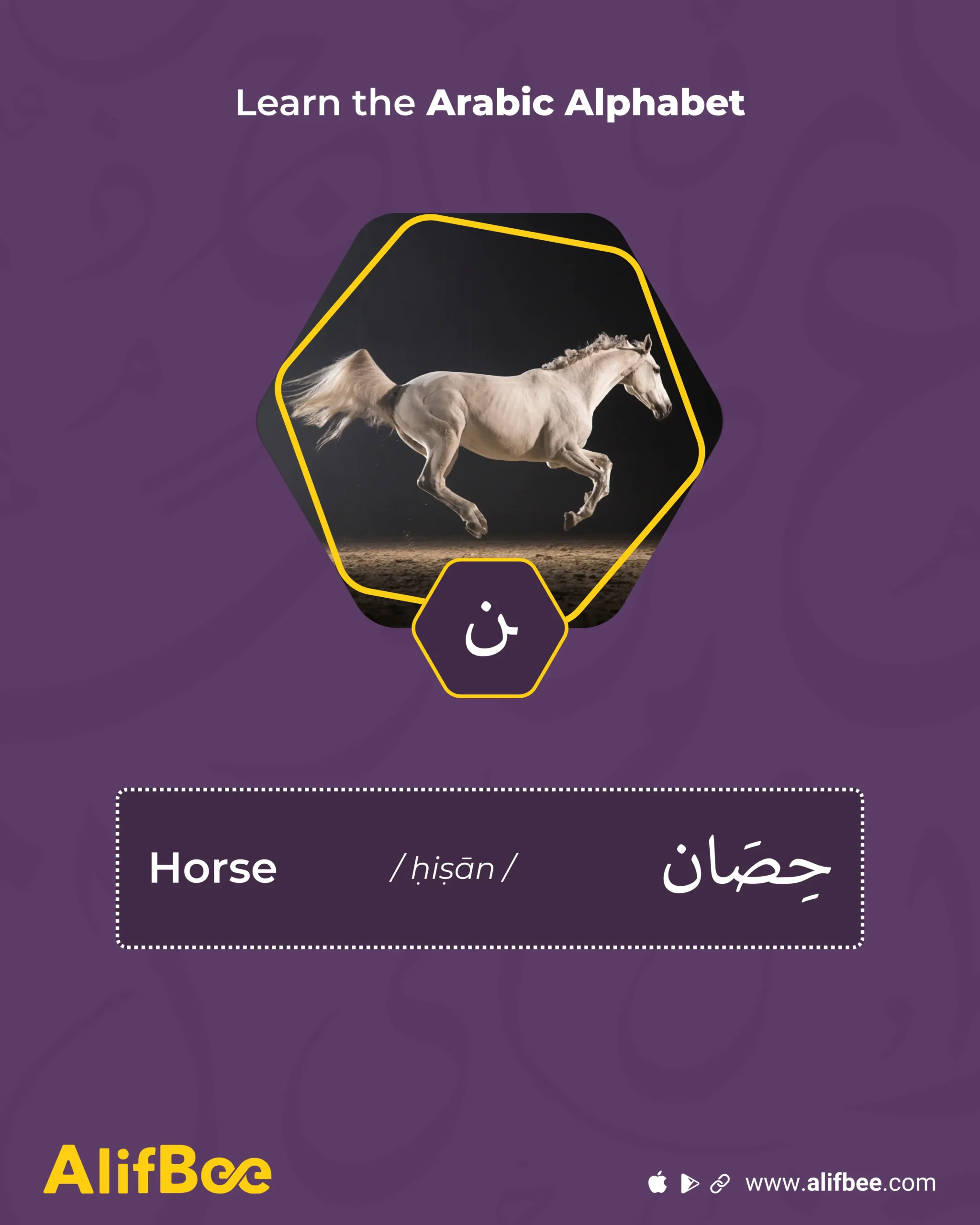
Horse
ḥiṣān
حِصَان
The horse lives on the farm.
Yaʿīshu al-ḥiṣānu fī al-mazraʿah.
يَعِيشُ الحِصَانُ فِي المَزْرَعَةِ
Did you know that you may hear a noon sound in a word even though the letter Noon (ن) is not written?
This is called Tanwīn in Arabic. It adds an “n” sound at the end of a noun or adjective, usually indicated by doubling one of the short vowels (fatḥa, kasra, or ḍamma). Tanwīn is often used with indefinite nouns, showing that the noun is not specific.
When you see double vowels at the end of a word (ــً، ــٍ، ــٌ), think of a hidden Nūn sound; this is Tanwīn. Pronounce it clearly to sound natural in Arabic.
Can you find the hidden Nūn in the following sentences?
I bought a useful book
Ishtaraytu kitāban mufīdan
اشتَرَيتُ كِتَابًا مُفِيدًا
This is a new pen.
Hādhā qalamun jadīdun
هَذَا قَلَمٌ جَدِيدٌ
I gave a book to a hardworking student.
ʾAʿṭaytu kitāban li-ṭālibin mujtahidin
أعطَيتُ كِتَابًا لِطَالبٍ مُجتَهِدٍ
We’ve reached the end of today’s lesson. As you’ve seen, every letter in Arabic matters.
Learning letter Noon in detail, its pronunciation, shapes, and how it appears in different positions in words, is an important step in building your reading and writing skills in Arabic.
And don’t forget, a little practice every day goes a long way. Spot the letters in words, read aloud, write them, and use them in sentences.
To keep learning and practicing more letters, words, and interactive exercises, download the AlifBee App today. You can start with a free 14-day trial and explore all the resources designed to make learning Arabic fun and easy.
Author
Diala is an experienced language educator and writer passionate about making Arabic learning simple and engaging. At AlifBee, she crafts educational content that connects English and Arabic learners through clarity and creativity.

Achieve incredible results with our platform Learn Arabic Online with AlifBee

Join AlifBee Virtual School and master Arabic at your pace — from guided coaching to interactive self-learning.

Learn Arabic faster with live, one-on-one sessions tailored to your level and goals.

Explore AlifBee’s complete range of Arabic learning books for all ages!
Short Duas for Ramadan in Arabic and English. Learn short supplications in Arabic and English to connect with Allah (SWT) this holy month. Download Free Daily Dua PDF

Learn how to say months in Arabic with clear tables, pronunciation tips, and explanations of Gregorian and Hijri calendars for learners.

Learn how to say OK in Arabic! Discover common phrases and useful words like *tayyib* & * tamam* to use in everyday Egyptian Arabic conversation.

Learn about the Arabic letter Yaa (ي). Discover the letter Yaa’s pronunciation in the Arabic alphabet. Explore how to write the letter Yaa (ي).