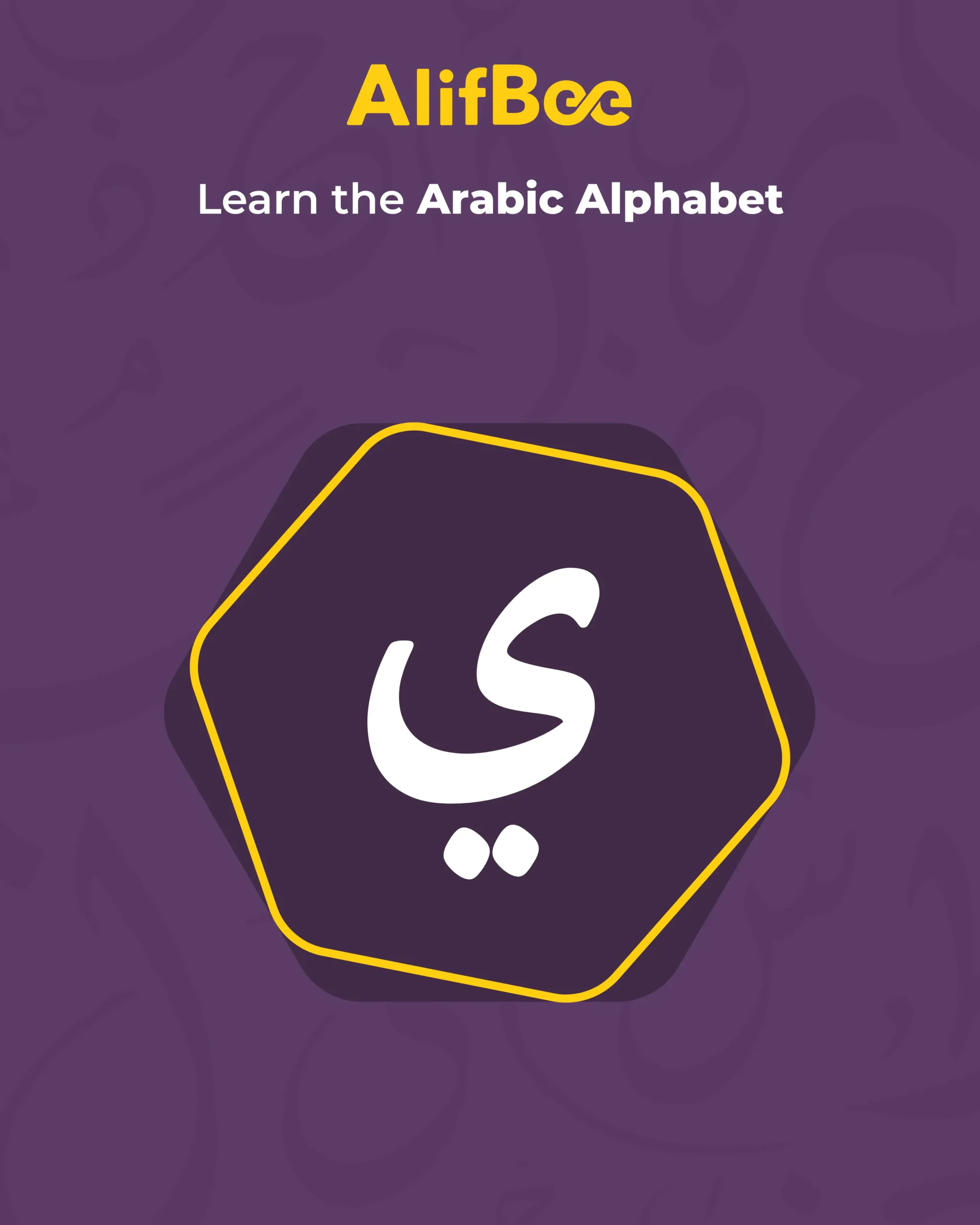
Learn the Arabic Alphabet: The Arabic Letter Yaa ي
Learn about the Arabic letter Yaa (ي). Discover the letter Yaa’s pronunciation in the Arabic alphabet. Explore how to write the letter Yaa (ي).
Congratulations, dear Arabic learners!
By the end of today’s blog, you’ll have completed the Arabic alphabet.
Are you ready to master the 28th letter in the Arabic language? Let’s learn all about its different forms, pronunciation, and see how it appears in words and examples from everyday conversation.
It may be the final letter, but it is also one of the most important milestones in your journey.
As we saw in the letter Wāw blog, a letter can have two functions: it can act as a consonant or as a long vowel. The same applies to the letter Yaa.
When Yaa functions as a consonant, its sound is familiar to most learners, as it closely resembles the “y” in English words like in yes and yellow.
Take these Arabic words as examples:
day
Yawm
يَوم
hand
Yad
يَد
However, Yaa can also function as a long vowel (/ī/) and sound like “ee” when it is preceded by a letter with a kasra. The sound resembles the ‘ee’ in English words like ‘see’, ‘key.’
Check the letter Yaa in the following Arabic words:
in
fī
فِي
long
ṭawīl
طَوِيل
big
kabīr
كَبِير
To pronounce it, keep the tongue high and forward and hold the sound for about two counts.
In addition to this long-vowel sound, Yaa can take on another vowel role when it appears in a different environment. When Yaa is sākinah (يْ) and comes after a fatḥa (ـَ), it forms a diphthong pronounced as /ay/.
The sound begins with a short “a” and glides quickly into a light “y” without being stretched. This is not a long vowel, but a smooth, quick transition between two sounds, as in:
house
bayt
بَيْت
night
layl
لَيْل
thing
shayʾ
شَيْء
The Arabic letter Yaa (ي) changes its shape depending on its position in a word, but it always keeps its distinctive tail and two dots.
Isolated
Initial
Medial
Final
ي
يـ
ـيـ
ـي
To write the isolated form, start with a short horizontal stroke from left to right, as in the letter ‘s’ in English, then continue with a smooth downward curve that bends slightly to the left.
Then end the curve with a small tail pointing slightly upward or straight. Finally, add two dots underneath.
This form is found at the end of the word when Yaa is not connected to the letter before it.
Start from the right with a stroke, then curve it slightly to the left, so it connects to the following letter, and add two dots underneath.
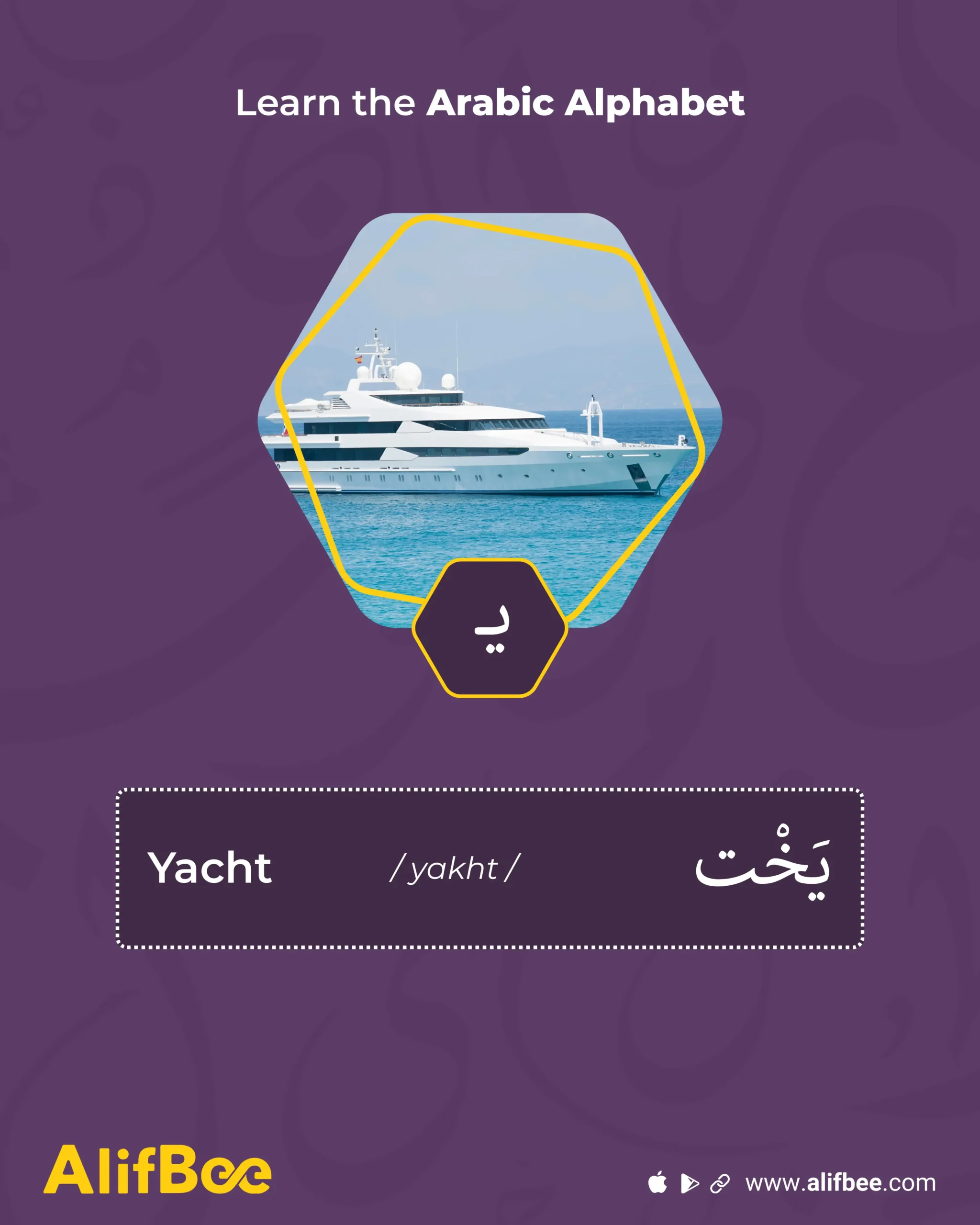
Let’s learn some words with Yaa at the beginning:
yacht
yakht
يَخْت
I rode the yacht with my friends.
Rakibtu al-yakhta maʿa aṣdiqāʾī.
رَكِبْتُ اليَخْتَ مَعَ أَصْدِقَائِي
pumpkin
yaqṭīn
يَقْطِين
I made pumpkin soup.
Ḥaḍartu ḥasāʾal-yaqṭīn.
حَضَّرْتُ حَسَاءَ اليَقْطِين
Caterpillar
yaraqa
يَرَقَة
The caterpillar will become a butterfly.
Satusbiḥu al-yaraqatu farāshah.
سَتُصْبِحُ اليَرَقَةُ فَرَاشَة
Day
Yawm
يَوْم
I spent a beautiful day with my friends.
Qaḍaytu yawman jamīlan maʿa aṣdiqāʾī.
قَضَيْتُ يَوْمًا جَمِيلًا مَعَ أَصْدِقَائِي
Hand
Yad
يَد
He injured his hand with a knife.
jaraḥa yadahu bis-sikkīn.
جَرَحَ يَدَهُ بِالسِّكِّين
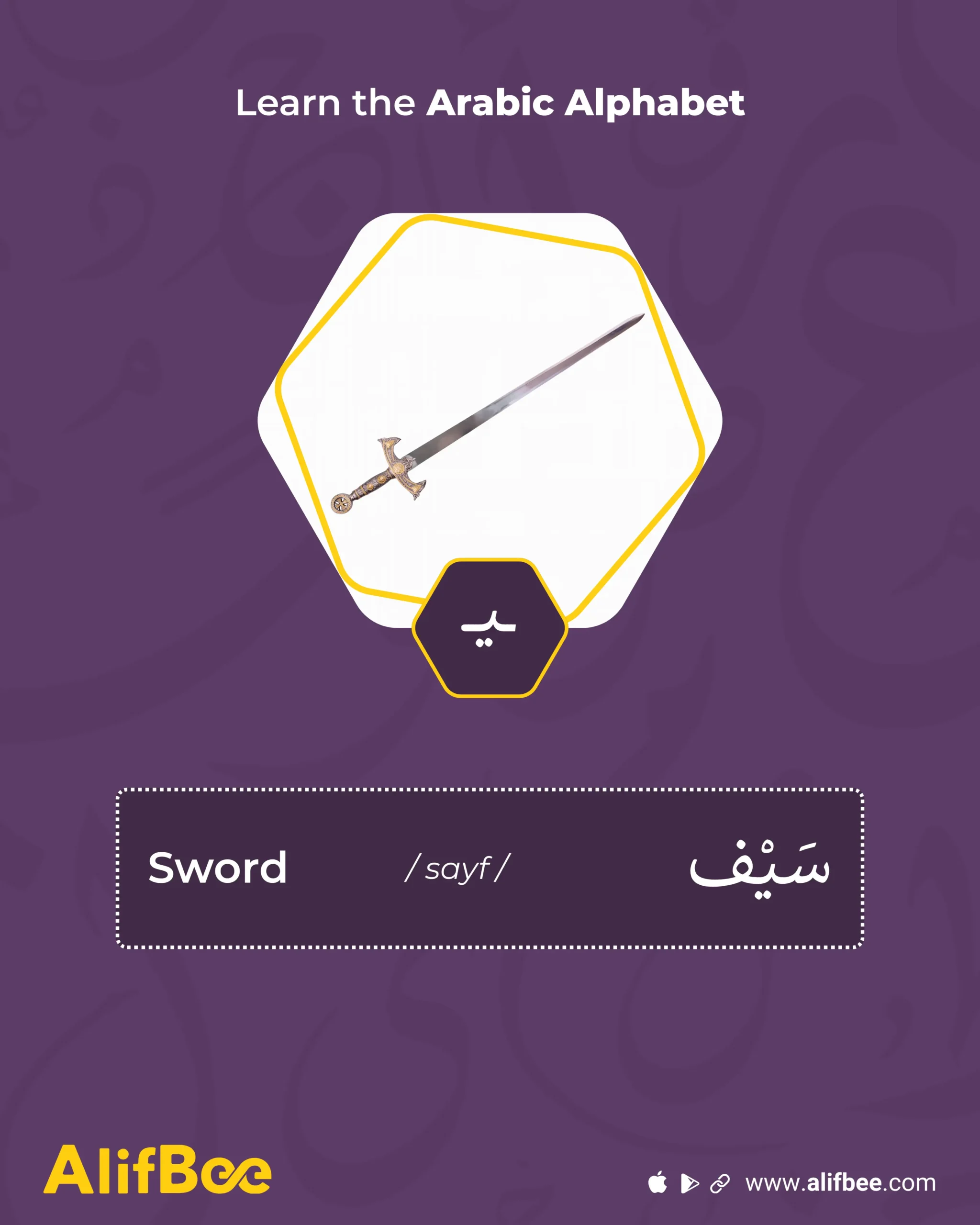
In the medial form (ـيـ), the letter connects from both sides. Start with a horizontal connecting line from the right, rise slightly to form the stroke, then curve it to the left to create another horizontal line that connects to the following letter. Don’t forget to add the two dots underneath.
Here we have some words that have Yaa in the medial position:
Sword
sayf
سَيْف
The child played with a wooden sword.
Laʿiba al-ṭiflu bi-sayfin khashabi.
لَعِبَ الطِّفْلُ بِسَيْفٍ خَشَبِيّ
Eye
ʿayn
عَين
The child hurt his eye while playing.
Aṣāba al-ṭiflu ʿaynahu wa huwa yalʿab.
أَصَابَ الطِّفْلُ عَيْنَهُ وَهُوَ يَلْعَب
House
bayt
بَيْت
I cleaned the house.
Naẓẓaftu al-bayt
نَظَّفْتُ البَيْت
Night
layl
لَيْل
The trip departs at night.
Tanṭaliqu ar-riḥlatu laylan
تَنْطَلِقُ الرِّحْلَةُ لَيْلًا
figs
tīn
تِيْن
I put the figs in the fridge.
Waḍaʿtu at-tīna fī ath-thallāja
وَضَعْتُ التِّينَ فِي الثَّلَّاجَة.
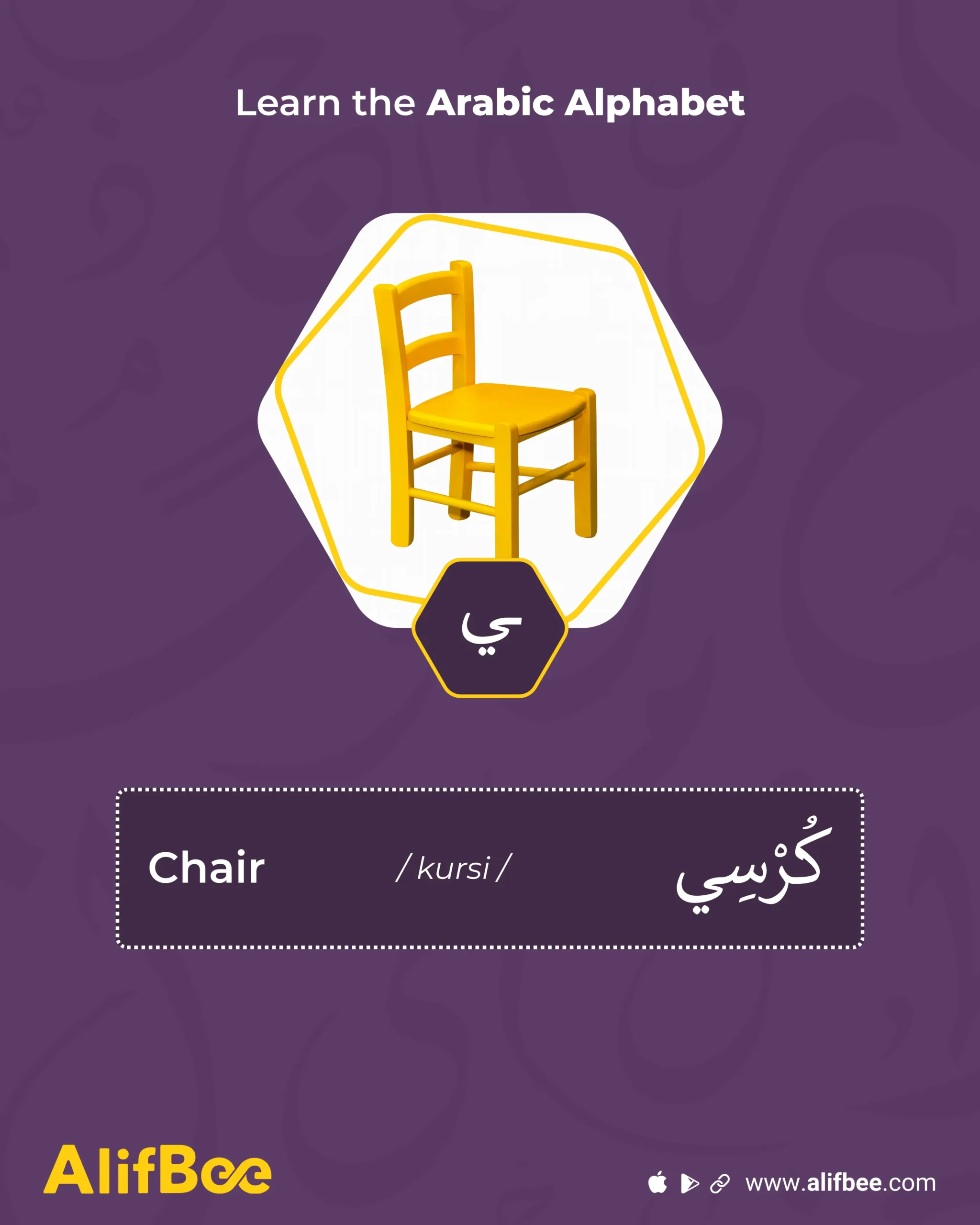
For the final form of Yaa, start with a connecting line from the previous letter (from the right).
Draw a smooth downward curve similar to the isolated form. Then end the curve with a small tail pointing slightly upward. Add two dots underneath the curve.
Let’s see some words with examples. Only No. 2 has the connected form. The rest use the isolated form:
Flute
nāy
نَاي
My friend plays the flute.
Taʿzifُ ṣadīqatī ʿalā an-nāy
تَعْزِفُ صَدِيقَتِي عَلَى النَّاي.
Chair
kursi
كُرْسِي
This is a comfortable chair.
Hādhā kursiyyun murīḥ.
هَذَا كُرْسِيٌّ مُرِيْح
My grandfather
jaddī
جَدّي
My grandfather likes working in the field.
Yuḥibbu jaddī al-ʿamala fī al-ḥaql.
يُحِبُّ جَدِّي العَمَلَ فِي الحَقْل
Tea
shāy
شَاي
I served the tea to the guests.
Qaddamtu ash-shāya liḍ-ḍuyūf.
قَدَّمْتُ الشَّايَ لِلضُّيُوف
Opinion
raʾyi
رأي
The teacher listened to the student's opinion on the equation.
Istamaʿa al-muʿallimu li-raʾyi aṭ-ṭālibi fi al-muʿādalah.
اسْتَمَعَ المُعَلِّمُ لِرَأْيِ الطَّالِبِ فِي المُعَادَلَة
You might have spotted a letter that looks exactly like Yā’ (ي), but with no dots underneath.
We call this Alif Maqsurah (maqṣūra) (ى). How is alif maqṣūra different from Yā’? Why do learners confuse final Yā’ (ي) with Alif Maqṣūrah (ى)?
Well, they look almost identical, but Alif maqṣūra is dotless and comes only at the end of the word, and sounds like a long alif /ā/.
Here we have some words that end with alif maqṣūra
Young man/Boy
Fatā
فَتَى
cafe
Maqhā
مَقهى
hospital
mustashfā
مُسْتَشْفَى
We also have some proper nouns like
Moses
Mūsā
مُوسَى
Laila
Laylā
لَيْلَى
Note: You might sometimes see the final Yā’ written without dots. This can be due to historical writing practices, regional printing norms (such as Egyptian traditions), or Qur’anic orthography.
Do you want to say “my” in Arabic? It’s easy with the letter Yā’ (ي)! When added to the end of a word, Yā’ shows possession, meaning the noun belongs to someone. For example:
my house
baytī
بَيْتِي
my pen
qalamī
قَلَمِي
We have not only reached the end of the blog, but also the end of our journey through the Arabic alphabet. It is such a great achievement, and we want to congratulate you.
As you have seen, although the letter Yaa comes last, it is certainly not the least important. It plays an essential role in Arabic reading and writing. It also has many functions as a consonant and a vowel, and when added to nouns, it gives them a sense of belonging.
Keep practicing its pronunciation and spot the letter Yaa with its different forms in new words until you master it.
We recommend the following blogs as you progress to learning Arabic words and phrases:
50 Easy Arabic Words for Beginners
Don’t forget to download our AlifBee App, which comes with a 14-day trial. It will help you review everything we’ve learned together in a fun and interactive way.
Author
Diala is an experienced language educator and writer passionate about making Arabic learning simple and engaging. At AlifBee, she crafts educational content that connects English and Arabic learners through clarity and creativity.

Achieve incredible results with our platform Learn Arabic Online with AlifBee

Join AlifBee Virtual School and master Arabic at your pace — from guided coaching to interactive self-learning.

Learn Arabic faster with live, one-on-one sessions tailored to your level and goals.

Explore AlifBee’s complete range of Arabic learning books for all ages!
Learn about the Arabic letter Yaa (ي). Discover the letter Yaa’s pronunciation in the Arabic alphabet. Explore how to write the letter Yaa (ي).

Learn the Arabic Alphabet: The Arabic Letter Waw و. Master the arabic letter waw (و)! Discover how to pronounce “w”, its forms, and words in the arabic alphabet.

Learn all Arabic pronouns in one clear guide. Personal, demonstrative, relative & possessive pronouns explained with examples for learners.

Learn how to write, read, and pronounce dates in Arabic. Clear rules, real examples, and common mistakes explained for learners.