Comprehensive Guide to Arabic Pronouns
Learn all Arabic pronouns in one clear guide. Personal, demonstrative, relative & possessive pronouns explained with examples for learners.
Arabic pronouns are a very important part of your Arabic learning journey, as they are frequently used in daily speech. They are essential for clear communication and for reaching fluency.
The good news is that Arabic pronouns are pretty simple to understand once you get used to them, so don’t stress it out and let us lead you through this lesson. By the end of it, you’ll know all you need about pronouns in Arabic.
Just like in English, Arabic pronouns are words used to replace nouns in sentences to avoid repetition and make them clearer and easier to understand.
Arabic pronouns help indicate who is being addressed and who or what is being talked about.
But unlike English pronouns, Arabic pronouns are more flexible. They change according to number, whether it is singular, dual, or plural; according to gender, male or female; and according to their position in the sentence.
While this difference allows Arabic to express meaning more accurately than English, it is where beginners start to get confused and even lost. But don’t worry—it is way easier than it sounds.
When it comes to pronouns, Arabic has a really clear grammatical structure. Think of it as a list of rules to follow—once you understand them, using Arabic pronouns becomes as easy as a board game.
So let’s get this game started and begin with the first rule, which is gender agreement.
In Arabic, every single noun or name has a specific gender, either masculine or feminine. The most important thing to understand is that no matter what the gender of the noun is, the pronoun replacing it must always have the same gender. Otherwise, using the wrong gender can change and confuse the intended meaning of the whole sentence.
Moving on to the second key rule: number agreement.
Arabic is more precise than English in this area, since it distinguishes not only between singular and plural but also dual (used for two people or things), which is less common in other languages.
While this feature allows Arabic to be more precise when addressing things, it can take a new learner a little time—and practice—to get used to it.
Another key concept is the difference between independent pronouns and attached pronouns.
To make it as easy and simple as possible, independent Arabic pronouns stand alone and are usually the subject of the sentence, while attached Arabic pronouns connect to a verb, noun, or preposition to indicate possession or objects.
It is also important to note that the use of Arabic pronouns is sensitive—one wrong pronoun, and the sentence can have a completely different meaning.
Arabic pronouns are grammatically divided into defined categories based on their form and their function in the sentence.
The main types of pronouns in the Arabic language include:
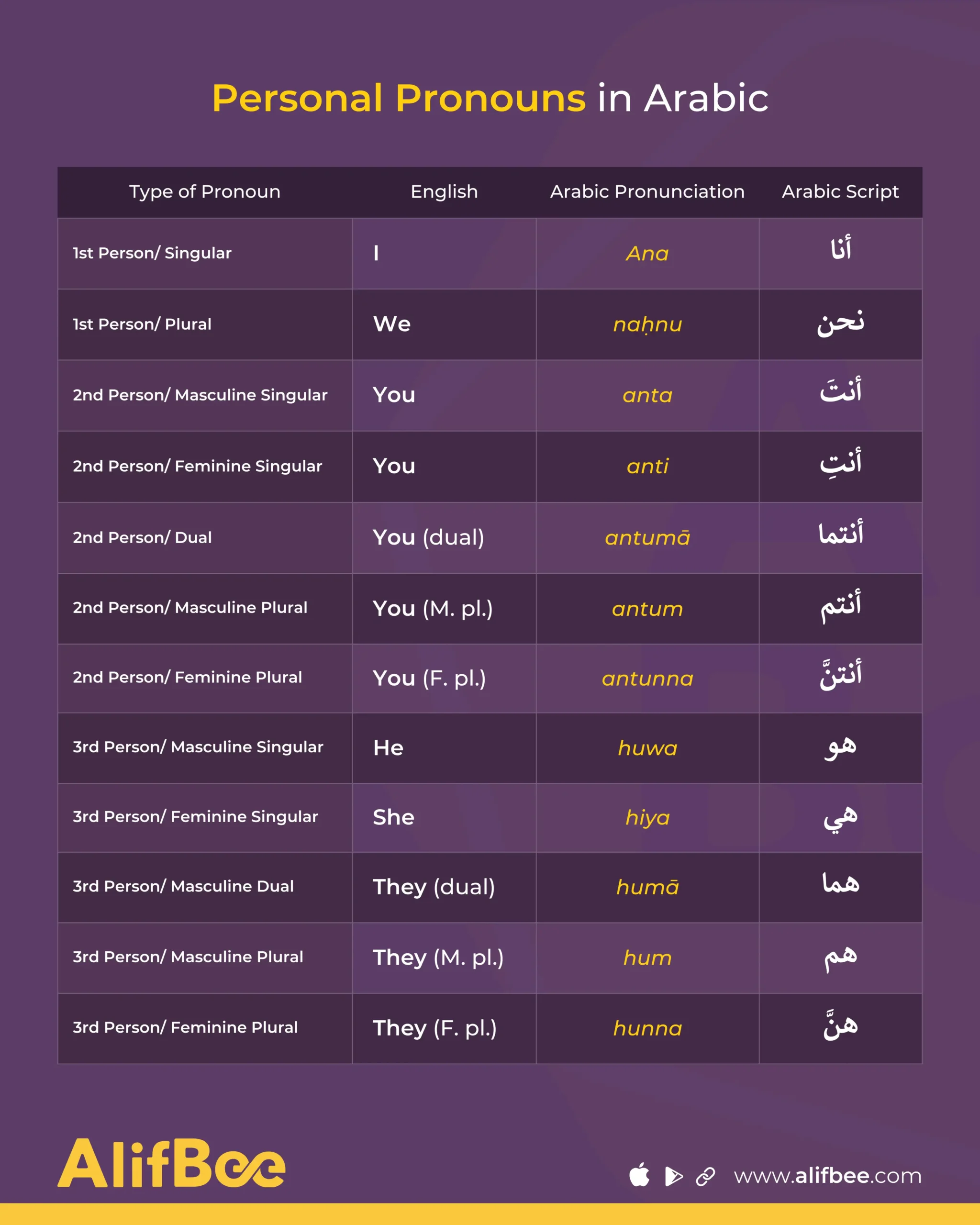
Arabic personal pronouns are used to refer to the speaker, the listener, or the person/thing being spoken about.
They are also divided into: independent subject pronouns and attached object pronouns.
In Arabic, independent subject pronouns tell us who is performing the action of the verb. They stand alone and are mainly used as the subject of a sentence.
As mentioned earlier, Arabic distinguishes between first person, second person, and third person, with each form changing according to gender (masculine/feminine) and number (singular, dual, and plural).
Example:
I am busy
ʾanā mashghūl
أنا مشغولٌ
Arabic attached object pronouns don’t stand alone; they are suffixes added to verbs, nouns, or prepositions, and they function as the direct object to show who receives the action.
Just like independent subject pronouns, Arabic object pronouns change depending on the person, gender, and number they refer to. For example,
I heard him
samiʿtuh
سَمِعتُهُ
I saw you
raʾaytuk
رَأيتُكَ
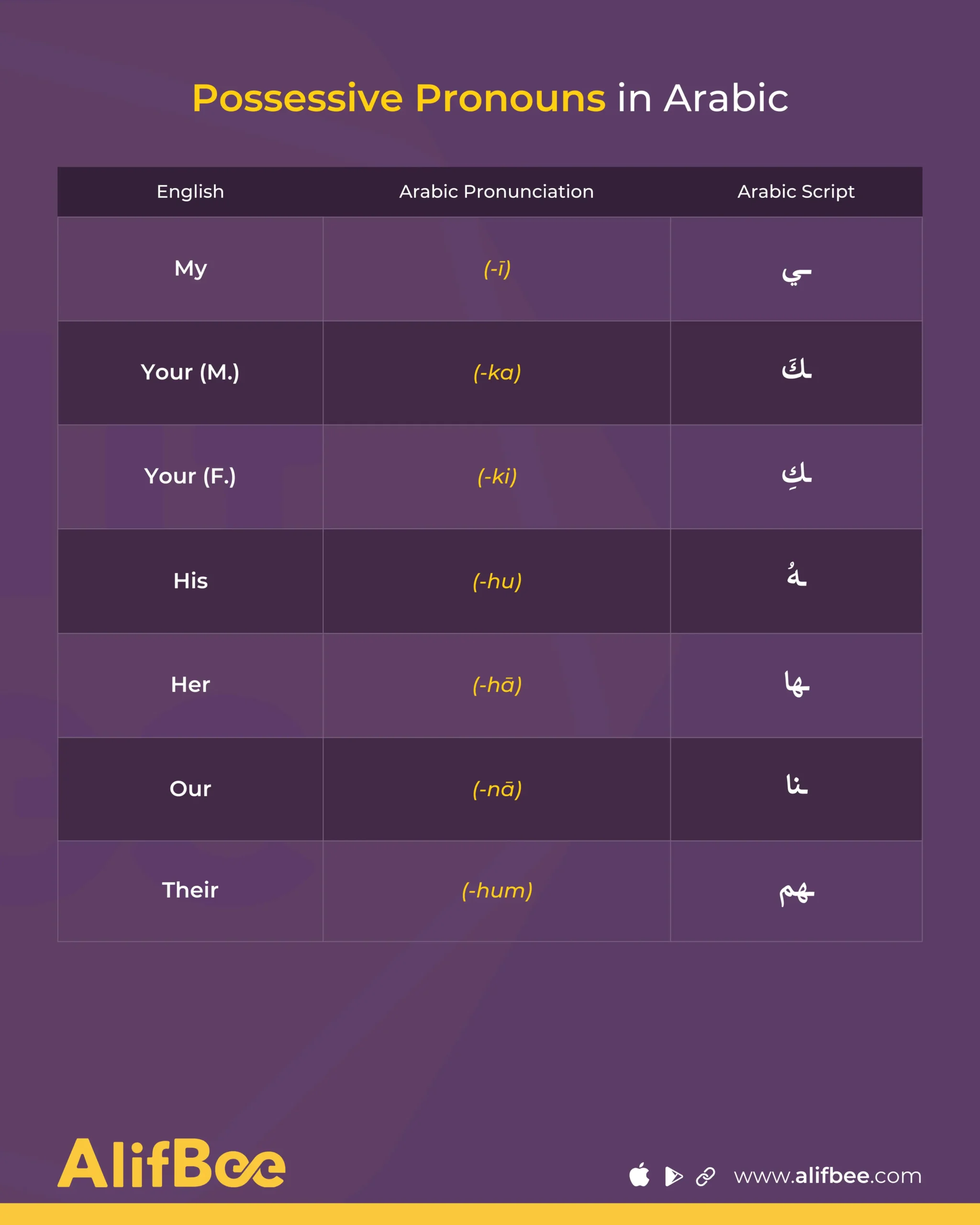
Unlike English, Arabic possessive pronouns are not separate words, but rather suffixes that attach directly to nouns, so there is no word for “my,” “yours,” “his,” “her,” or “their.”
Just like other pronouns in Arabic, these suffixes change according to person, gender, and number.
Their main purpose is to indicate who owns or is associated with the noun.
Example:
Our home
manzilunā
منزلنا (منزل+نا)
In this example, the suffix نا (our) is attached to the noun منزل (home), showing who the home belongs to without using any extra words.
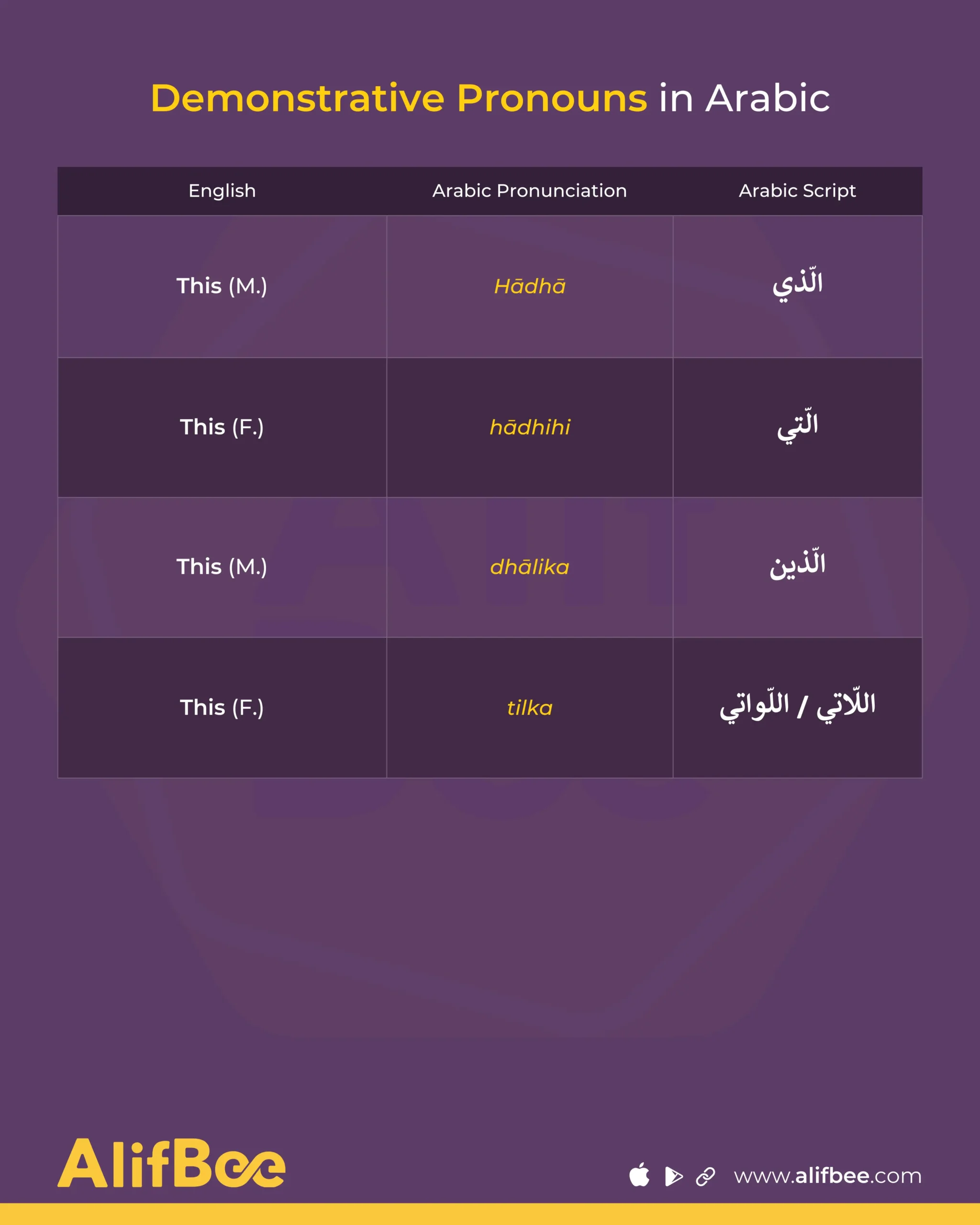
Much like in English, Arabic demonstrative pronouns are used to point to the things we’re talking about—a person, an object, or even an idea.
They’re the equivalent of “this”, “that”, “these”, or “those” in English, and are commonly found before a noun. They help clarify the meaning of a sentence by indicating whether something is near or far.
They must also agree with the noun they refer to in gender and number.
Example:
This is our home
hādhā manzilunā
هَذَا مَنزِلُنَا
In this example, the demonstrative pronoun hādhā is used to point to a nearby masculine singular noun.
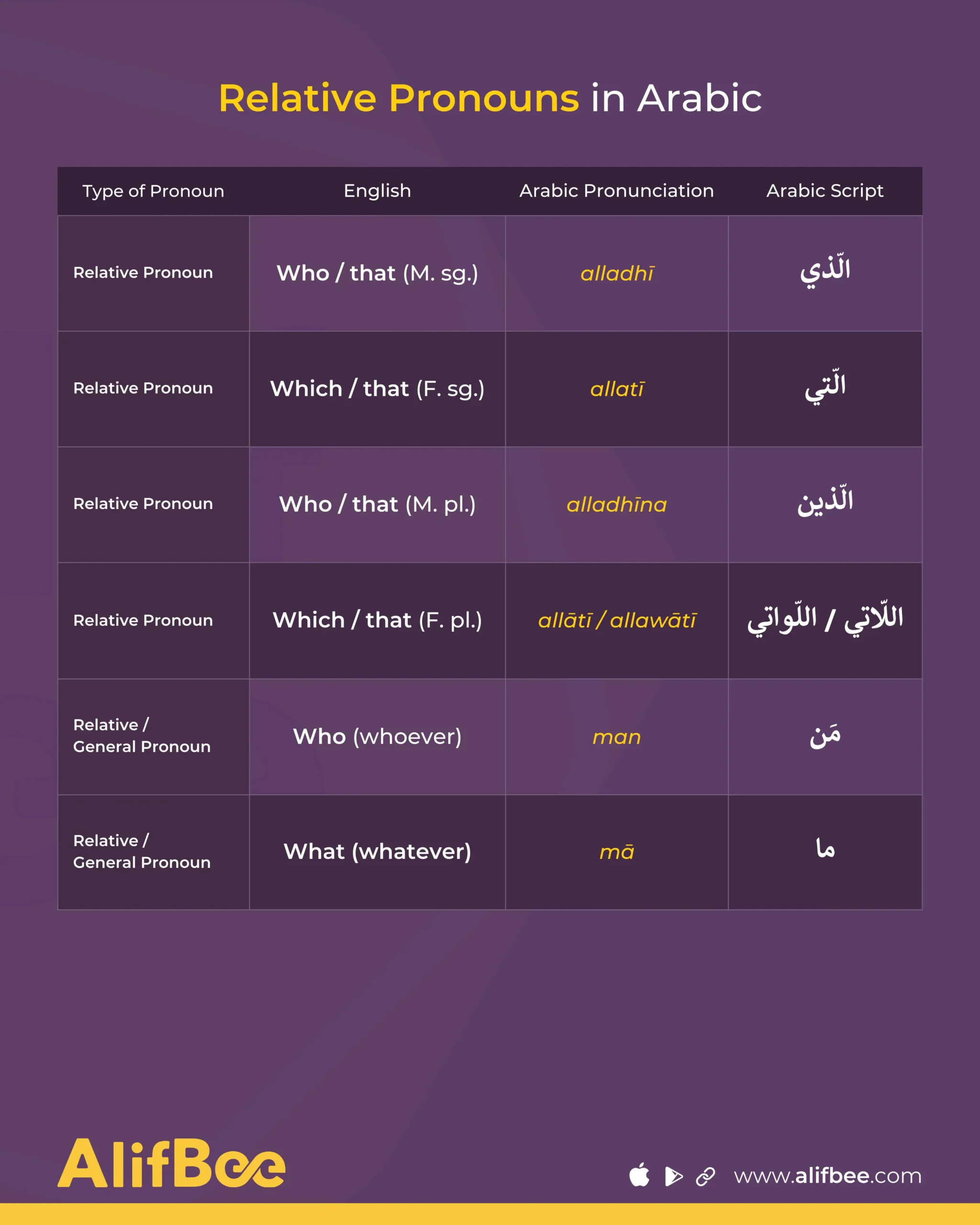
Arabic relative pronouns connect nouns to descriptive clauses, and they also change form to agree with the noun they refer to in both gender and number.
masculine singular
alladhī
الّذي
feminine singular
allatī
الّتي
Masculine dual
alladhān / alladhīna
اللّذين/اللّذان
Feminine dual
allatayn / allatān
اللّتين/ اللّتان
masculine plural
alladhīna
الّذين
feminine plural
allawātī / allatī
اللّاتي / اللّواتي
Example:
The girl who came yesterday
al-fatāh allatī jā’at al-bāriḥah
الفتاةُ الّتي جاءت البارحة
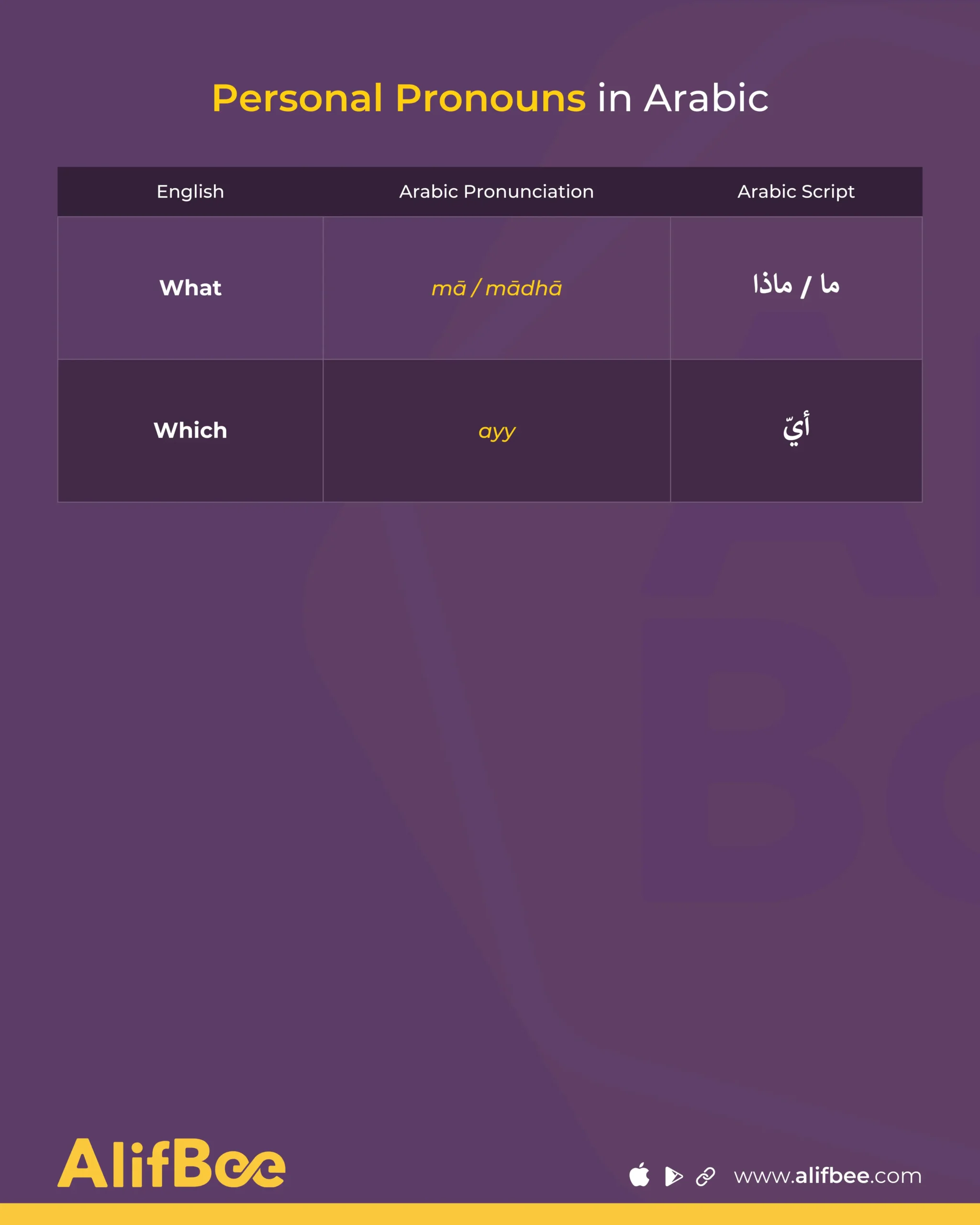
Just like in English, Arabic interrogative pronouns are used at the beginning of a sentence to ask questions, especially about people, things, or information.
But note that Arabic interrogative pronouns do not change form for gender or number; they always remain the same.
Who
man
من
What
mā / mādhā
ما/ ماذا
Which
ayy
أيّ
In this example, the demonstrative pronoun hādhā is used to point to a nearby masculine singular noun.
Who is this man?
man hādhā ar-rajul
من هذا الرّجل؟
Let’s give a few examples to understand Arabic pronouns better:
I study Arabic
ʾanā adrusu al-ʿarabiyyah
أنا أدرسُ العربيّة
He is writing the story
huwa yaktubu al-qiṣṣah
هو يكتبُ القصّة
These are the most common in everyday usage.
I saw him
raʾaytuhu
رأيتهُ
My book
kitābī
كتابي
Bring it to me
aḥḍirhu ilayya
أحضرهُ إليّ
The book that I read
al-kitābu alladhī aqra’uhu
الكتابُ الّذي أقرأه
The girls who came
al-fatayātu allawātī ji’na
الفتياتُ اللّواتي جئنَ
What is this?
mā hādhā
ما هذا؟
Type of Pronoun
English
Arabic Pronunciation
Arabic Script
1st Person/ Singular
I
Ana
أنا
1st Person/ Plural
We
naḥnu
نحن
2nd Person/ Masculine Singular
You
anta
أنتَ
2nd Person/ Feminine Singular
You
anti
أنتِ
2nd Person/ Dual
You (dual)
antumā
أنتما
2nd Person/ Masculine Plural
You (m. pl.)
antum
أنتم
2nd Person/ Feminine Plural
You (f. pl.)
antunna
أنتنَّ
3rd Person/ Masculine Singular
He
huwa
هو
3rd Person/ Feminine Singular
She
hiya
هي
3rd Person/ Masculine Dual
They (m. dual)
humā
هما
3rd Person/ Masculine Plural
They (m. pl.)
hum
هم
3rd Person/ Feminine Plural
They (f. pl.)
hunna
هنَّ
Possessive Pronoun (Suffix)
My
(-ī)
ـي
Possessive Pronoun (Suffix)
Your (m.)
(-ka)
ـكَ
Possessive Pronoun (Suffix)
Your (f.)
(-ki)
ـكِ
Possessive Pronoun (Suffix)
His
(-hu)
ـهُ
Possessive Pronoun (Suffix)
Her
(-hā)
ـها
Possessive Pronoun (Suffix)
Our
(-nā)
ـنا
Possessive Pronoun (Suffix)
Their
(-hum)
ـهم
Interrogative Pronoun
What
mā / mādhā
ما / ماذا
Interrogative Pronoun
Which
ayy
أيّ
Relative Pronoun
Who / that (m. sg.)
alladhī
الّذي
Relative Pronoun
Which / that (f. sg.)
allatī
الّتي
Relative Pronoun
Who / that (m. pl.)
alladhīna
الّذين
Relative Pronoun
Which / that (f. pl.)
allātī / allawātī
اللّاتي / اللّواتي
Relative / General Pronoun
Who (whoever)
man
مَن
Relative / General Pronoun
What (whatever)
mā
ما
Demonstrative Pronoun
This (m.)
Hādhā
هذا
Demonstrative Pronoun
This (f.)
hādhihi
هذه
Demonstrative Pronoun
That (m.)
dhālika
ذلك
Demonstrative Pronoun
That (f.)
tilka
تلك
Arabic pronouns must agree in gender with the noun they refer to, so a common mistake is mismatching the gender.
Attached pronouns must attach to nouns, verbs, or prepositions; they never stand alone. Using them in the wrong position is one of the most common mistakes new learners make.
Learners often use subject pronouns where object pronouns are required.
At the end of the day, learning any new language takes patience and practice. When learning Arabic pronouns, it helps to remember that mastery does not come from memorization alone, but from steady use and growing familiarity over time.
If you want guided practice with pronouns in real sentences, along with listening and speaking activities, download the AlifBee app and build confidence step by step through structured, interactive Arabic lessons.
Arabic has around 80–90 pronoun forms. This includes independent pronouns, attached pronouns, and pronoun suffixes used with verbs, nouns, and prepositions.
Yes. Arabic uses gendered pronouns for both masculine and feminine forms, especially in the second and third person. Gender distinction appears in singular, dual, and plural forms.
No. Arabic uses both independent pronouns (used for emphasis or clarity) and attached pronouns (joined to verbs, nouns, or prepositions). The choice depends on sentence structure and meaning.
Author
Layla Alahmar is a writer and proofreader with a master’s degree in Arabic literature and linguistics. At AlifBee, she creates clear and engaging educational content, blending storytelling with practical language insights to make Arabic learning accessible and inspiring.

Achieve incredible results with our platform Learn Arabic Online with AlifBee

Join AlifBee Virtual School and master Arabic at your pace — from guided coaching to interactive self-learning.

Learn Arabic faster with live, one-on-one sessions tailored to your level and goals.

Explore AlifBee’s complete range of Arabic learning books for all ages!

Learn all Arabic pronouns in one clear guide. Personal, demonstrative, relative & possessive pronouns explained with examples for learners.

Learn how to write, read, and pronounce dates in Arabic. Clear rules, real examples, and common mistakes explained for learners.

Master the Arabic letter Haa (ه)! Explore its form, pronunciation, and variations. Learn how to write and pronounce the haa arabic letter with examples.

Learn Arabic prepositions with a clear list, meanings, and examples. Understand how Arabic prepositions work and avoid common learner mistakes.