

Importance of Learning Duas for Ramadan
Dua is essential in a Muslim’s life. It is an act of worship and a direct connection with Allah. The Prophet Muhammad (PBUH) said, “Duʿa is the essence of worship.”
During Ramadan, Muslims increase their good deeds because their rewards are multiplied. Since dua is a form of worship — and an essential one, as the hadith above shows — the holy month becomes a valuable opportunity to increase supplication.
Ramadan also offers special times when dua is accepted. By making supplications to Allah, Muslims not only grow closer to Him, but also take the opportunity to have their needs and prayers answered.
According to hadith, a fasting man or woman has a supplication that is accepted at the time of iftar.
The Prophet Muhammad (PBUH) said:
“Indeed, the fasting person has a supplication that is not rejected at the time of breaking the fast.” – (Ibn Majah)
In this article, we will list key duas recited before and during the holy month of Ramadan. If you are a beginner learning Arabic, we will also help you with correct pronunciation and audio guidance.
Continue reading until the end of the article to access our free Ramadan Daily Dua PDF with 30 short duas — one for each day of Ramadan.
Some of the duas in this article are taken from the Holy Qur’an and Noble Hadith; others are general duas and supplications known to be recited at this time.
Dua for Ramadan in Arabic - Before Ramadan
The supplications you can make in Ramadan are countless. We have gathered here a list of ten duas for different times before, during, and at the end of Ramadan.
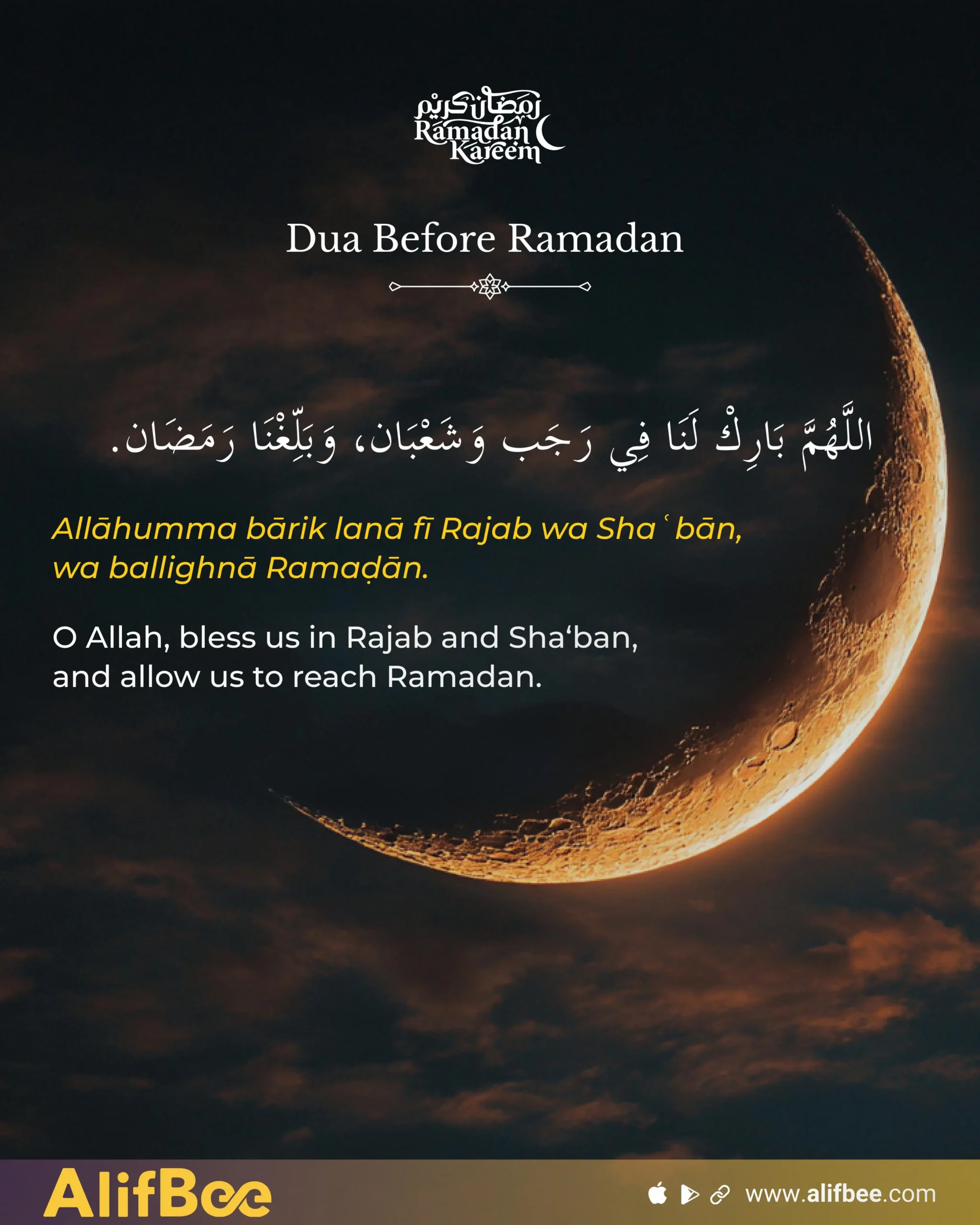
اللَّهُمَّ بَارِكْ لَنَا فِي رَجَب وَشَعْبَان، وَبَلِّغْنَا رَمَضَان
Allāhumma bārik lanā fī Rajab wa Shaʿbān, wa ballighnā Ramaḍān
O Allah, bless us in Rajab and Sha‘ban, and allow us to reach Ramadan.
Dua for Welcoming Ramadan
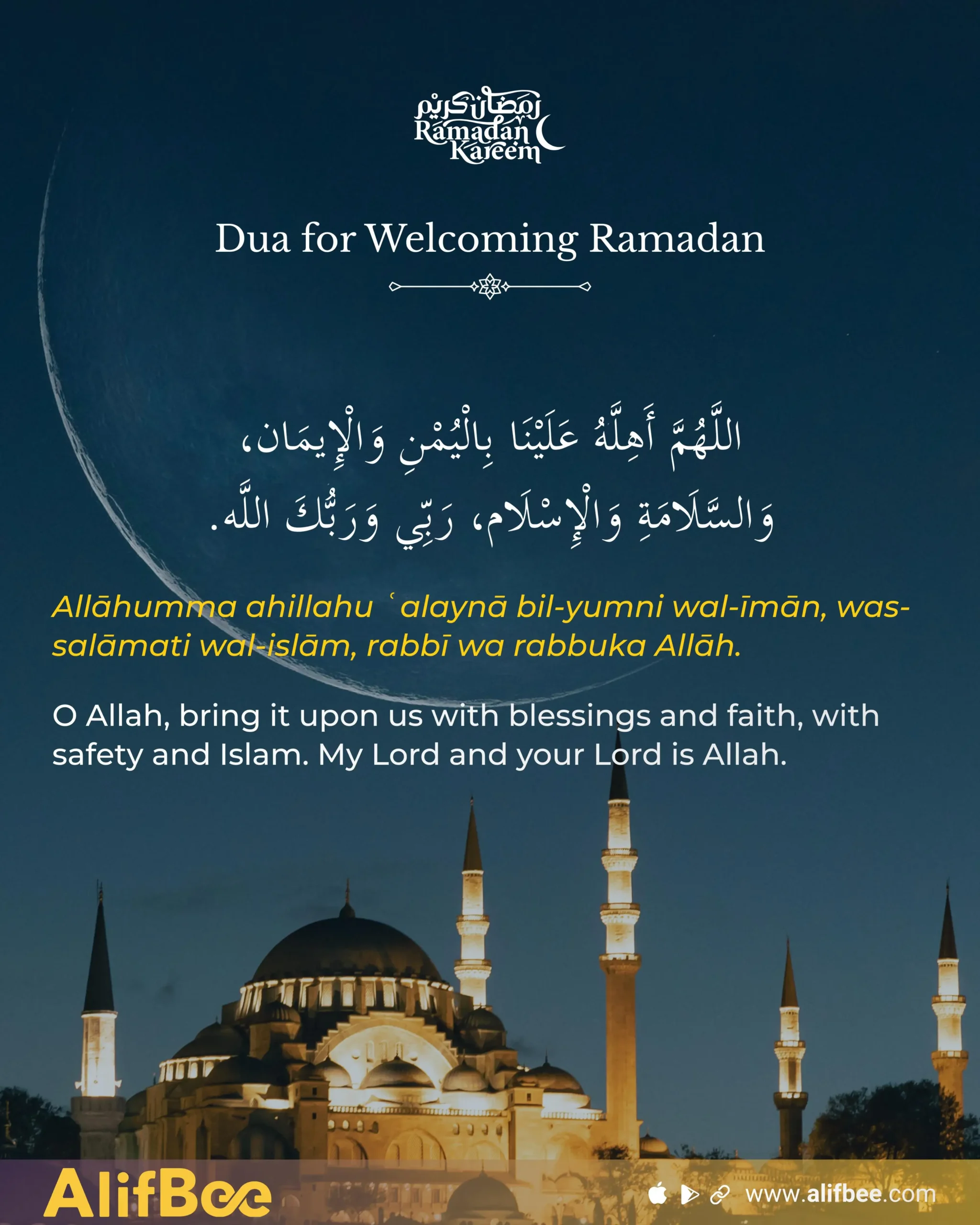
اللَّهُمَّ أَهِلَّهُ عَلَيْنَا بِالْيُمْنِ وَالْإِيمَان، وَالسَّلَامَةِ وَالْإِسْلَام، رَبِّي وَرَبُّكَ اللَّه
Allāhumma ahillahu ʿalaynā bil-yumni wal-īmān, was-salāmati wal-islām, rabbī wa rabbuka Allāh
O Allah, bring it upon us with blessings and faith, with safety and Islam. My Lord and your Lord is Allah
Dua for Suhoor
There is no specific dua for fasting or suhoor from Sunna. It is important to make niyyah, or intention, at suhoor of fasting the following day. This intention can be held in your heart without saying it out loud.
However, the time of suhoor is one of the specific times when prayers are likely to be answered, in the last third of the night. So it is recommended that muslims make supplications and dua asking God for forgiveness, for Janna (entering Paradise), and for anything they want in life and the Hereafter. (Keep reading for a Free Ramadan Daily Dua PDF from AlifBee)
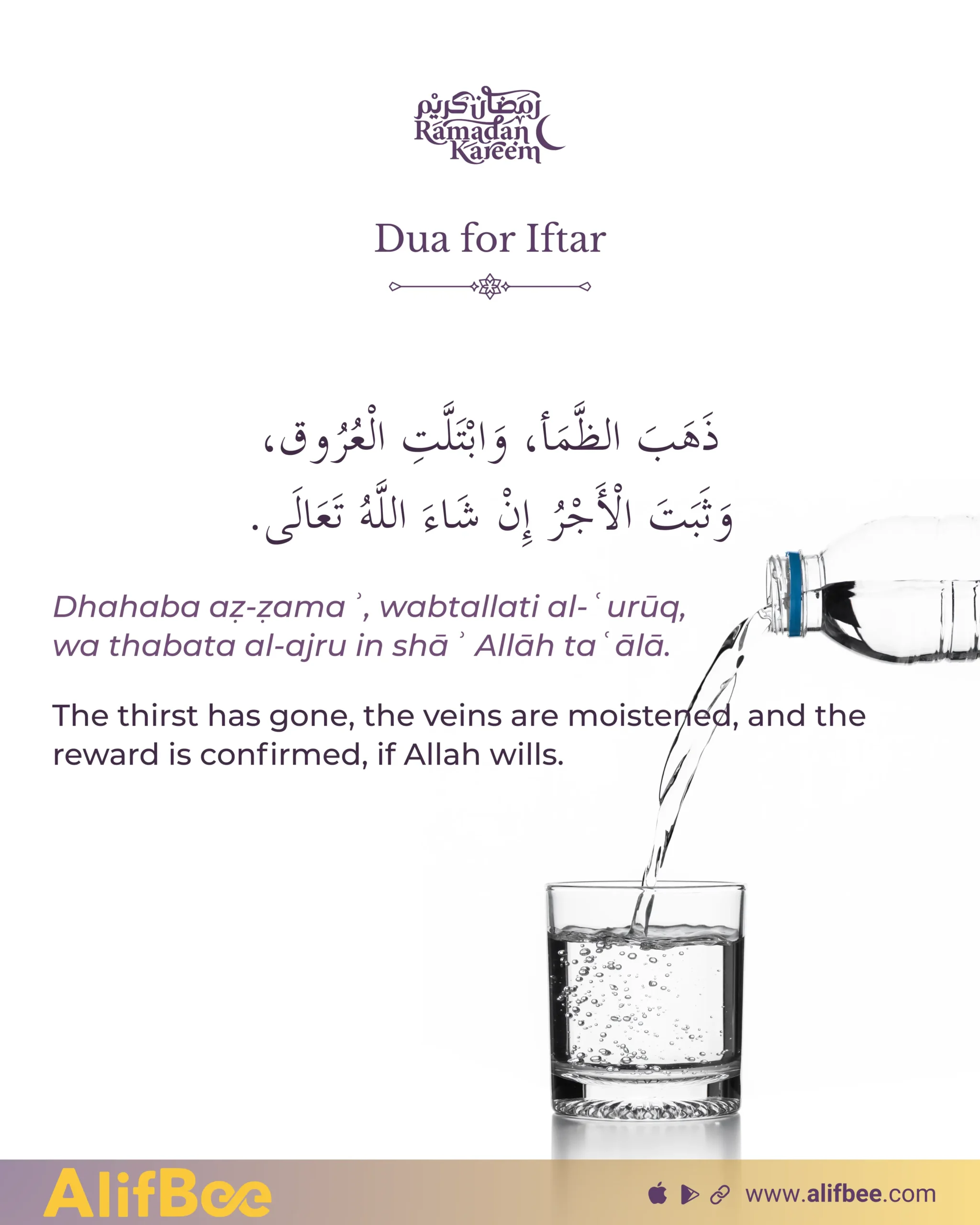
Dua for Iftar
Immediately after breaking the fast, you can make these two Iftar duas:
اللَّهُمَّ إِنِّي لَكَ صُمْت، وَبِكَ آمَنْت، وَعَلَيْكَ تَوَكَّلْت، وَعَلَى رِزْقِكَ أَفْطَرْت.
Allāhumma innī laka ṣumt, wa bika āmant, wa ʿalayka tawakkalt, wa ʿalā rizqika aftart.
O Allah, for You I have fasted, in You I have believed, upon You I have relied, and with Your provision I have broken my fast.
ذَهَبَ الظَّمَأ، وَابْتَلَّتِ الْعُرُوق، وَثَبَتَ الْأَجْرُ إِنْ شَاءَ اللَّهُ تَعَالَى.
Dhahaba aẓ-ẓamaʾ, wabtallati al-ʿurūq, wa thabata al-ajru in shāʾ Allāh taʿālā
The thirst has gone, the veins are moistened, and the reward is confirmed, if Allah wills.
Dua When Eating at Someone’s House
During Ramadan, people often invite one another to share the iftar meal. When breaking your fast at someone’s home, you may recite this supplication as a gesture of gratitude and appreciation.
أَفْطَرَ عِنْدَكُمُ الصَّائِمُون، وَأَكَلَ طَعَامَكُمُ الْأَبْرَار، وَتَنَزَّلَتْ عَلَيْكُمُ الْمَلَائِكَة
Aftara ʿindakumu aṣ-ṣāʾimūn, wa akala ṭaʿāmakumu al-abrār, wa tanazzalat ʿalaykumu al-malāʾikah
May the fasting people break their fast with you, may the righteous eat your food, and may the angels descend upon you.
Dua for Taraweeh
Taraweeh is a recommended night prayer (Sunnah Mu’akkadah) performed by Muslims exclusively during the holy month of Ramadan after the obligatory Isha prayer.
The word Taraweeh (تراويح) means “rest” or “relaxation.” It refers to the practice of taking short pauses after every four rakʿahs (units of prayer), as the prayer is typically longer and often includes extended recitation from the Qur’an—sometimes completing the entire Qur’an over the course of the month.
There is no specific supplication (or taraweeh dua) authentically prescribed exclusively for this prayer. However, worshippers may make personal supplications during appropriate moments in the prayer, such as in sujood (prostration) or after completing the prayer.
For a collection of recommended supplications for Ramadan, you may refer to the Ramadan Daily Dua PDF by AlifBee below.
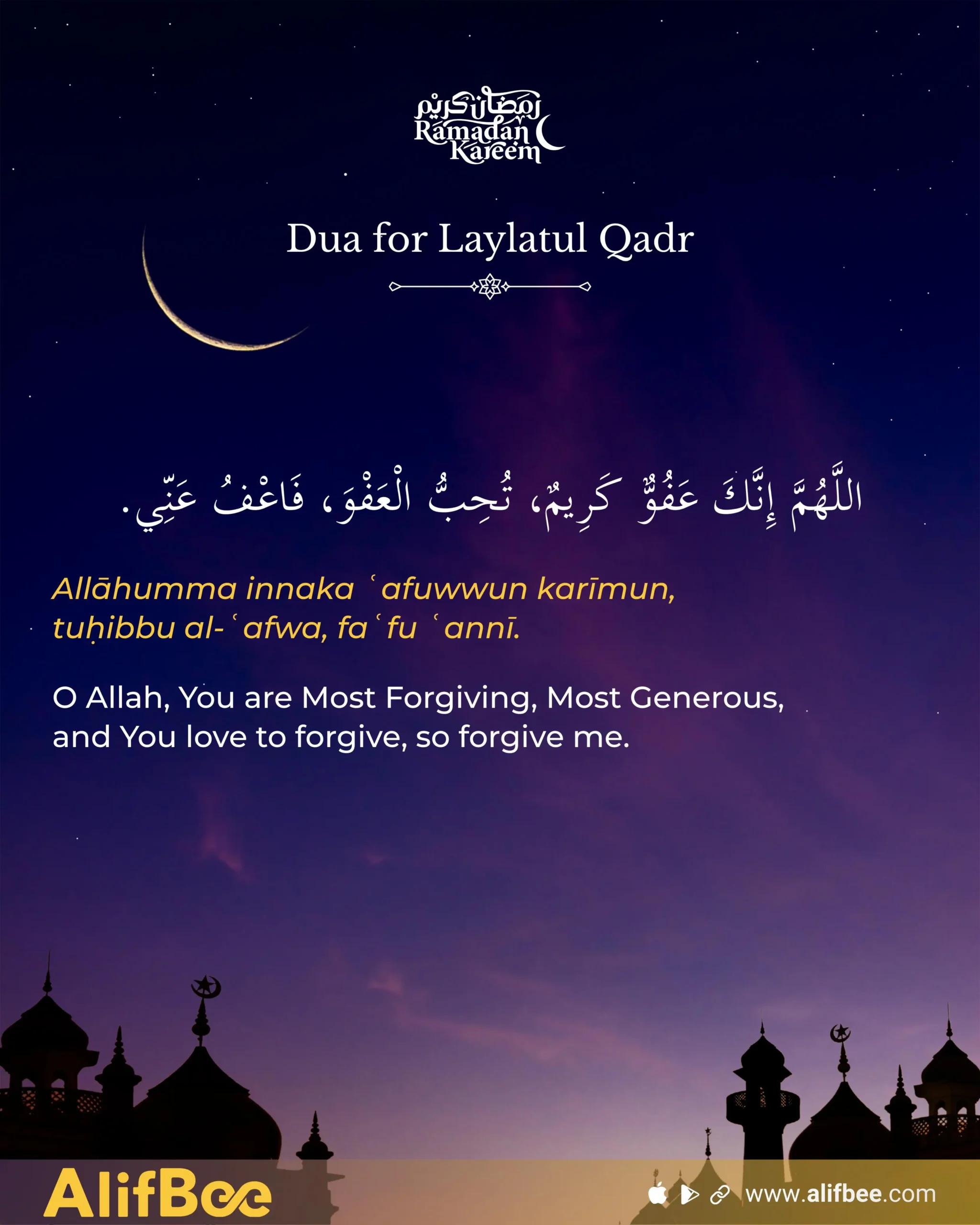
Dua for Laylatul Qadr
Laylat al-Qadr (The Night of Decree) is one of the most sacred nights in Islam. It occurs during the last ten nights of Ramadan and marks the night on which the Qur’an was first revealed. Allah describes it in the Qur’an as “better than a thousand months” (Qur’an 97:3), meaning that worship performed on this night carries a greater reward than worship performed over many decades.
The Prophet (PBUH) encouraged us to seek it and to increase in worship during it. When asked what to say on this night, he taught this Laylat Al qadr dua:
اللَّهُمَّ إِنَّكَ عَفُوٌّ كَرِيمٌ، تُحِبُّ الْعَفْوَ، فَاعْفُ عَنِّي
Allāhumma innaka ʿafuwwun karīmun, tuḥibbu al-ʿafwa, faʿfu ʿannī
O Allah, You are Most Forgiving, Most Generous, and You love to forgive, so forgive me.
Dua in the Last 10 Days of Ramadan
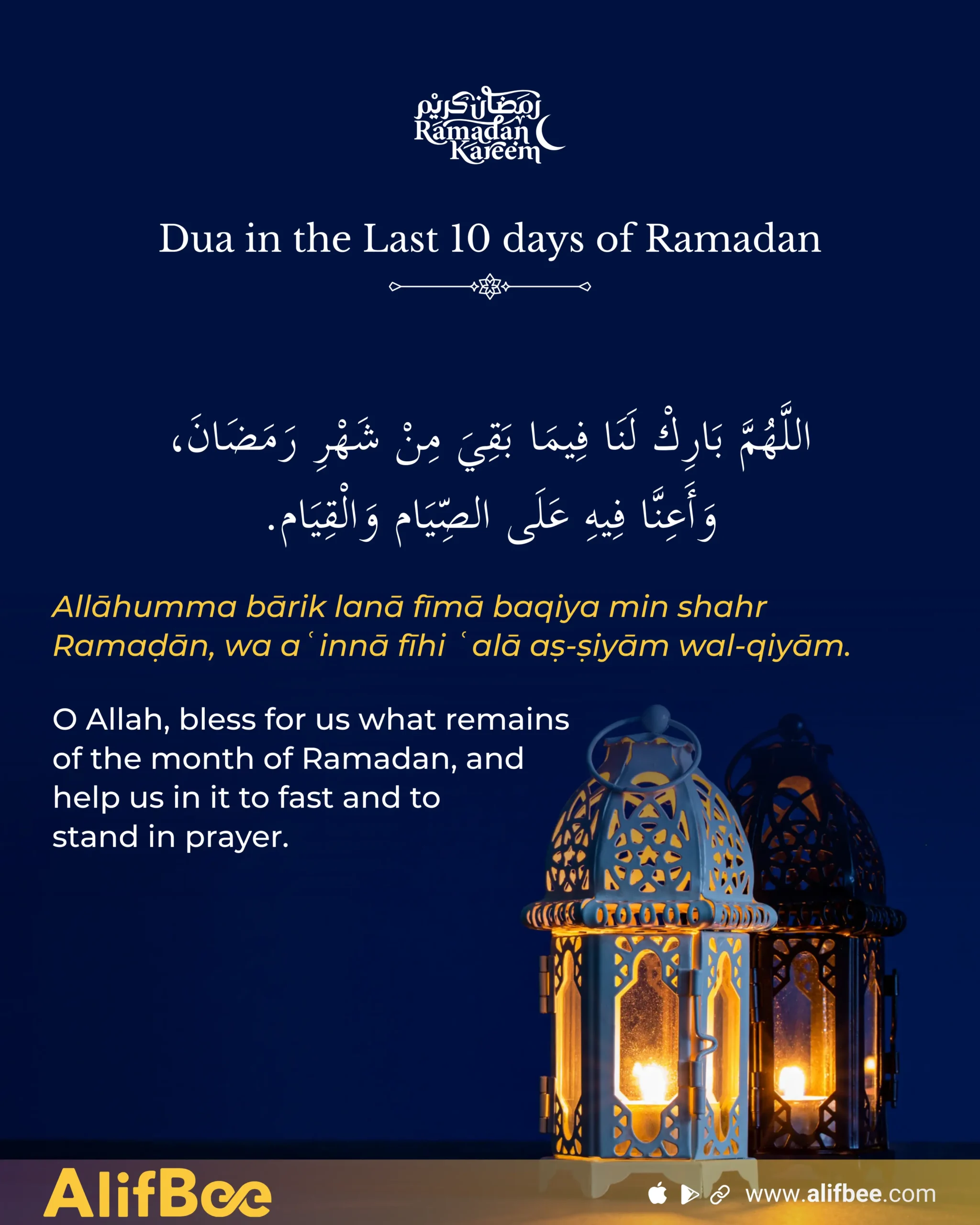
اللَّهُمَّ بَارِكْ لَنَا فِيمَا بَقِيَ مِنْ شَهْرِ رَمَضَانَ، وَأَعِنَّا فِيهِ عَلَى الصِّيَام وَالْقِيَام
Allāhumma bārik lanā fīmā baqiya min shahr Ramaḍān, wa aʿinnā fīhi ʿalā aṣ-ṣiyām wal-qiyām
O Allah, bless for us what remains of the month of Ramadan, and help us in it to fast and to stand in prayer.
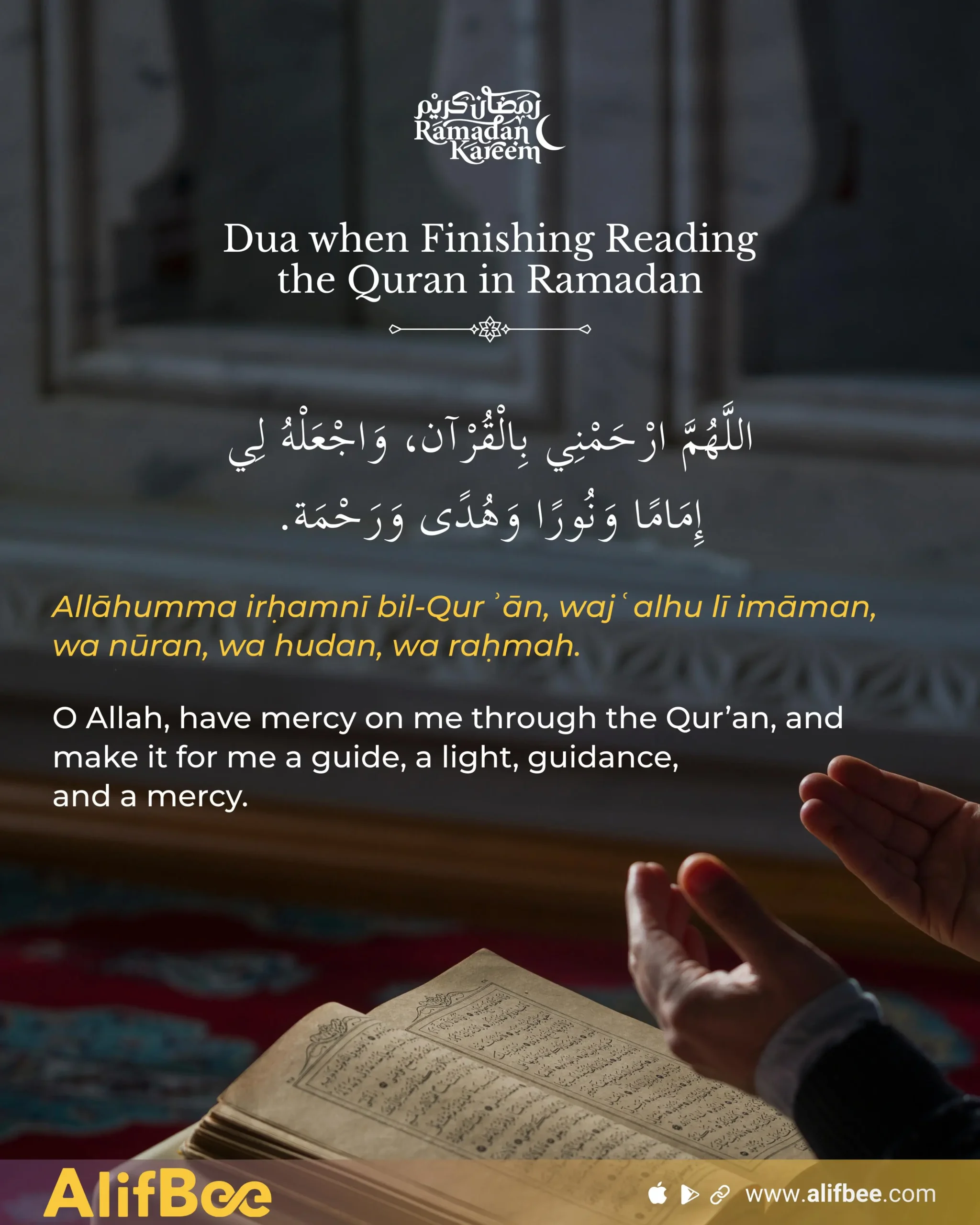
Dua when Finishing Reading the Quran in Ramadan
اللَّهُمَّ ارْحَمْنِي بِالْقُرْآن، وَاجْعَلْهُ لِي إِمَامًا وَنُورًا وَهُدًى وَرَحْمَة.
Allāhumma irḥamnī bil-Qurʾān, wajʿalhu lī imāman, wa nūran, wa hudan, wa raḥmah
O Allah, have mercy on me through the Qur’an, and make it for me a guide, a light, guidance, and a mercy.
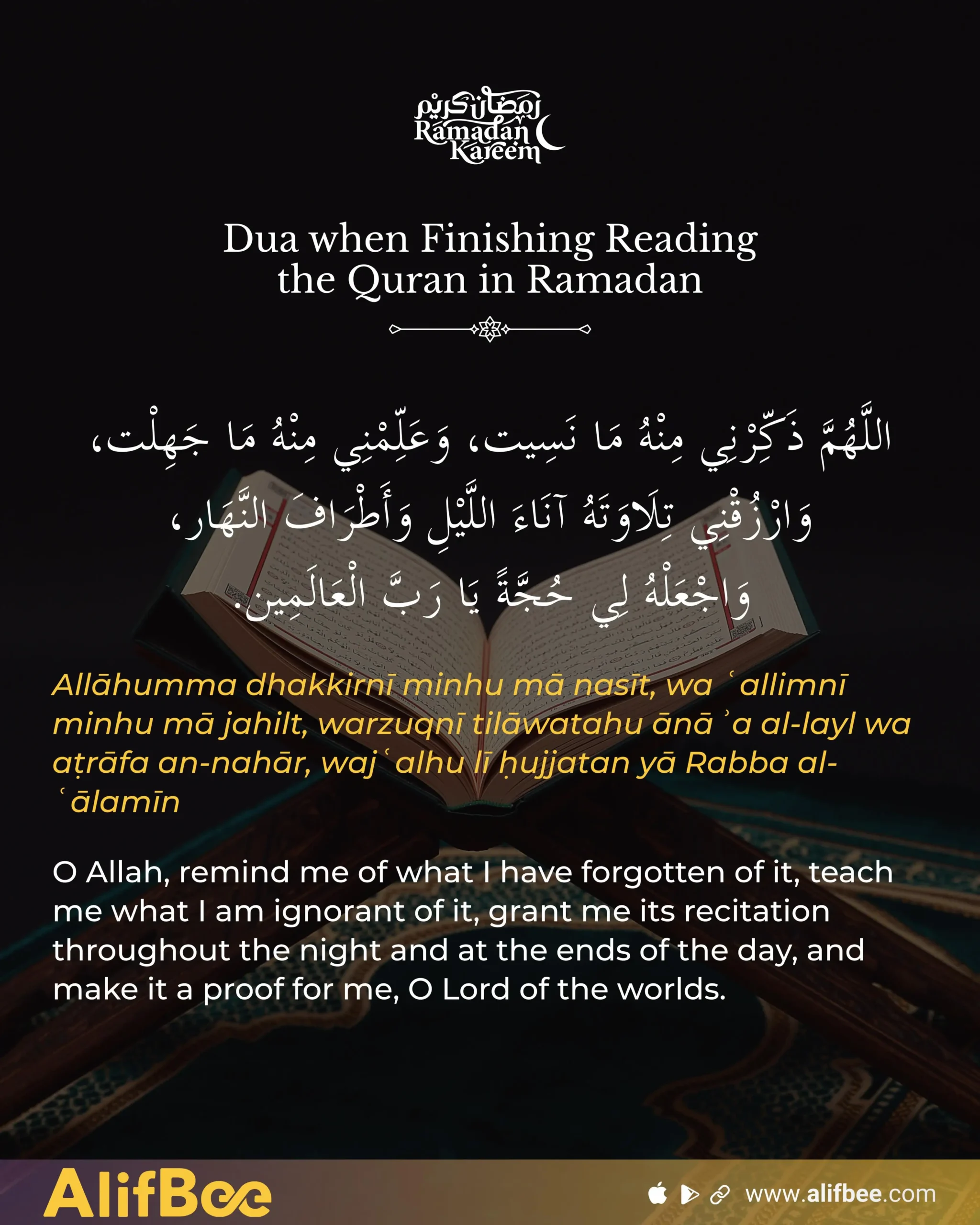
اللَّهُمَّ ذَكِّرْنِي مِنْهُ مَا نَسِيت، وَعَلِّمْنِي مِنْهُ مَا جَهِلْت، وَارْزُقْنِي تِلَاوَتَهُ آنَاءَ اللَّيْلِ وَأَطْرَافَ النَّهَار، وَاجْعَلْهُ لِي حُجَّةً يَا رَبَّ الْعَالَمِين.
Allāhumma dhakkirnī minhu mā nasīt, wa ʿallimnī minhu mā jahilt, warzuqnī tilāwatahu ānāʾa al-layl wa aṭrāfa an-nahār, wajʿalhu lī ḥujjatan yā Rabba al-ʿālamīn
O Allah, remind me of what I have forgotten of it, teach me what I am ignorant of it, grant me its recitation throughout the night and at the ends of the day, and make it a proof for me, O Lord of the worlds.
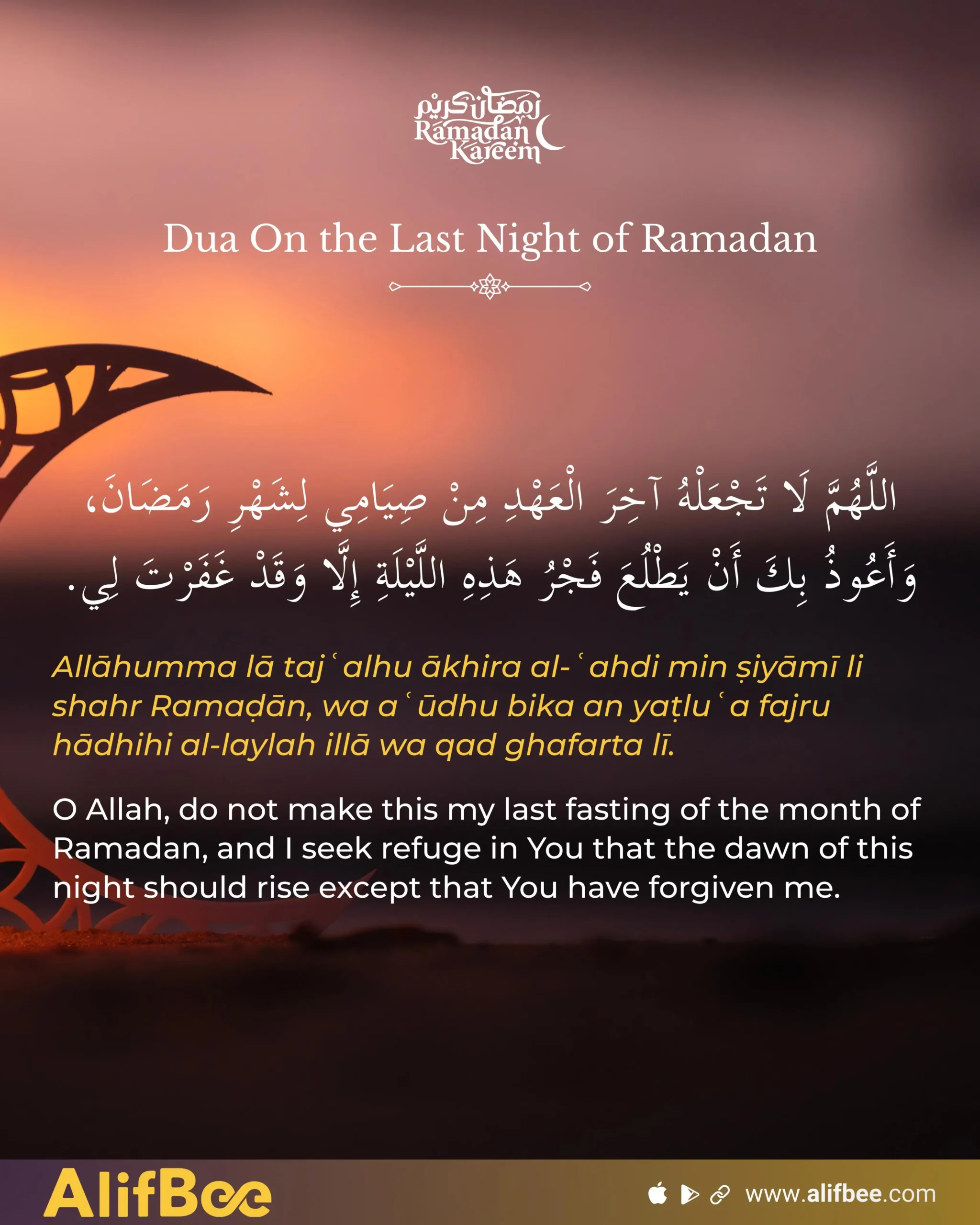
Dua On the Last Night of Ramadan
اللَّهُمَّ لَا تَجْعَلْهُ آخِرَ الْعَهْدِ مِنْ صِيَامِي لِشَهْرِ رَمَضَانَ، وَأَعُوذُ بِكَ أَنْ يَطْلُعَ فَجْرُ هَذِهِ اللَّيْلَةِ إِلَّا وَقَدْ غَفَرْتَ لِي
Allāhumma lā tajʿalhu ākhira al-ʿahdi min ṣiyāmī li shahr Ramaḍān, wa aʿūdhu bika an yaṭluʿa fajru hādhihi al-laylah illā wa qad ghafarta lī
O Allah, do not make this my last fasting of the month of Ramadan, and I seek refuge in You that the dawn of this night should rise except that You have forgiven me.
Review Short Duas for Ramadan


What is the Best Time to Make Dua in Ramadan?
Ramadan brings for every muslim a great opportunity, with plenty of time for Dua.
These specific times are considered highly favorable for prayers to be answered, such as the last third of the night (often 3 AM–4 AM), between the adhan (call to prayer) and iqamah, during prostration, on Fridays (specifically after Asr), and on the day of Arafat.
In Ramadan, the most significant times for Dua are:
- Before Iftar (Breaking the Fast): The moments leading up to breaking the fast are considered the most blessed, as the fasting person’s supplication is not rejected.
- The Last Third of the Night (Suhoor): This time is highly recommended, as it is when Allah descends to the lowest heaven and asks who is calling upon Him so He may answer.
- While fasting: The entire day of fasting is a time of blessing, and the supplication of a fasting person is exceptionally favored.
- Laylat al-Qadr (The Night of Power): This hidden night within the last ten nights of Ramadan is better than a thousand months for worship and prayer.
Learn 30 Ramadan Duas for Every Day in Ramadan (PDF)
These Duas are taken from the Holy Quran, the Holy Sunna, and Hadith narrated by Prophet Muhammad (Peace Be Upon Him).
Keep in mind that these duas are not meant to be recited only on the designated days listed in the table. The plan is for learners of Arabic to learn and recite one dua each day during the month of Ramadan.
Download 30 Ramadan Duas for Every Day in Ramadan 🔗Click here
Happy Ramadan to our dear readers, and we ask Allah to make your duas come true 🙂
Learn Arabic with AlifBee
If you want to practice the Arabic Alphabet, build your Arabic vocabulary, learn grammar, and improve your pronunciation with clear examples, you can explore guided Arabic learning with the AlifBee app and build your skills step by step.