
Written by Dania Ghraoui, a translator and language teacher with 10 years of experience.
At a Glance: Hajj rituals in Arabic follow a clear sequence : al-Ihram (الإحرام), an-Niyyah (النية), Tawaf (الطواف), Sa‘y (السعي), Standing on Arafat (عرفة/عرفات), Pelting al-Jamarat (رمي الجمرات) with key stops at Mina and Muzdalifah and other required steps. For Arabic learners, Hajj is also a useful vocabulary field. It brings together place names, ritual terms, and set phrases that can be helpful for those planning to go on Hajj and Umrah or for Arabic learners in general.
In the Hajj season, you hear words like ihram, tawaf, or Mina and may feel unsure about what each one actually means. That is normal. Many Arabic learners recognize the sound of these words long before they understand the ritual, the place, or the order in which everything happens.
This guide teaches Hajj rituals in Arabic in a simple step-by-step way. You will learn the main words, how to pronounce them, and what each one refers to in context.
Before you go further!
It will be useful to visit Can You perform Hajj if You Don’t Know Arabic for general words and phrases.
If you want to keep building this kind of Islamic Arabic vocabulary, you can continue with 8 Ways to Say Travel Prayer in Arabic for Hajj and Umrah, What Is the Islamic Calendar?, and Learn Key Arabic Phrases & Duaa for Salah.
What Does Hajj Mean in Arabic?
The word الحَجّ (Hajj) means the pilgrimage. It is one of the five pillars of Islam, in which Muslims make the pilgrimage to Makkah in Dhū al-Ḥijjah, the last month of the Islamic calendar.
Hajj is also an important vocabulary topic for Arabic learners because it includes:
- ritual words
- place names
- repeated devotional phrases
- terms that often appear in lessons, articles, and conversations about Islam
Learning these words in sequence makes them much easier to remember.
Essential Hajj Words to Know First
Start with these core terms. They will appear again throughout the article, so this first table gives you a clear base to build on.
| English Meaning | Pronunciation | Arabic word | |
|---|---|---|---|
|
pilgrimage |
Hajj |
الحَجّ |
|
|
Ihram: state of ritual consecration |
Ihram |
الإِحْرَام |
|
|
Niyyah: intention |
Niyyah |
النِّيَّة |
|
|
Miqat: designated point for entering ihram |
Miqat |
المِيقَات |
|
|
the pilgrim’s sacred prayer |
Talbiyah |
التَّلْبِيَة |
|
|
Tawaf: circling the Ka’ba |
al-ṭawāf |
الطَّواف |
|
|
Sa’y: walking between Safa and Marwa hills |
al-saʿi |
السَّعي |
|
|
Standing on Arafat Mount |
al-wuqūfu bi-ʿArafah |
الوُقوفُ بِعَرَفَة |
|
|
Stoning the three pillars (Jamarat) |
ramyu al-jamarāt |
رَميُ الجَمَرات |
|
When learning new Hajj vocabulary, it is a good idea to classify words into clear categories such as place, ritual, prayer, and object. You can also list them in the right sequence to make them easier to remember.
Hajj Rituals in Arabic Step by Step
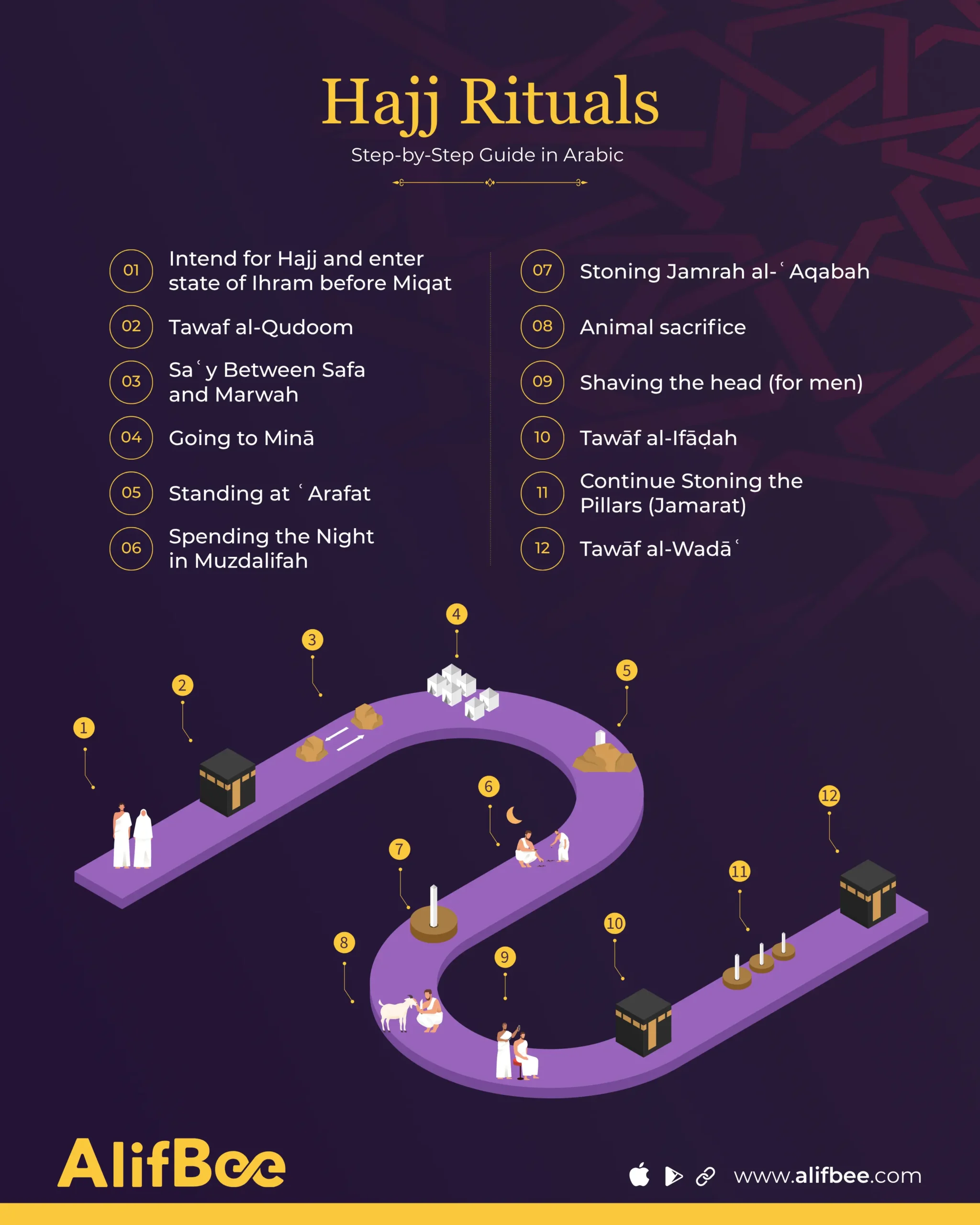
The following sections follow the pilgrimage sequence as most pilgrims experience it. Each step answers three simple questions: What is it? When does it happen? What are the Arabic words you can learn from it?
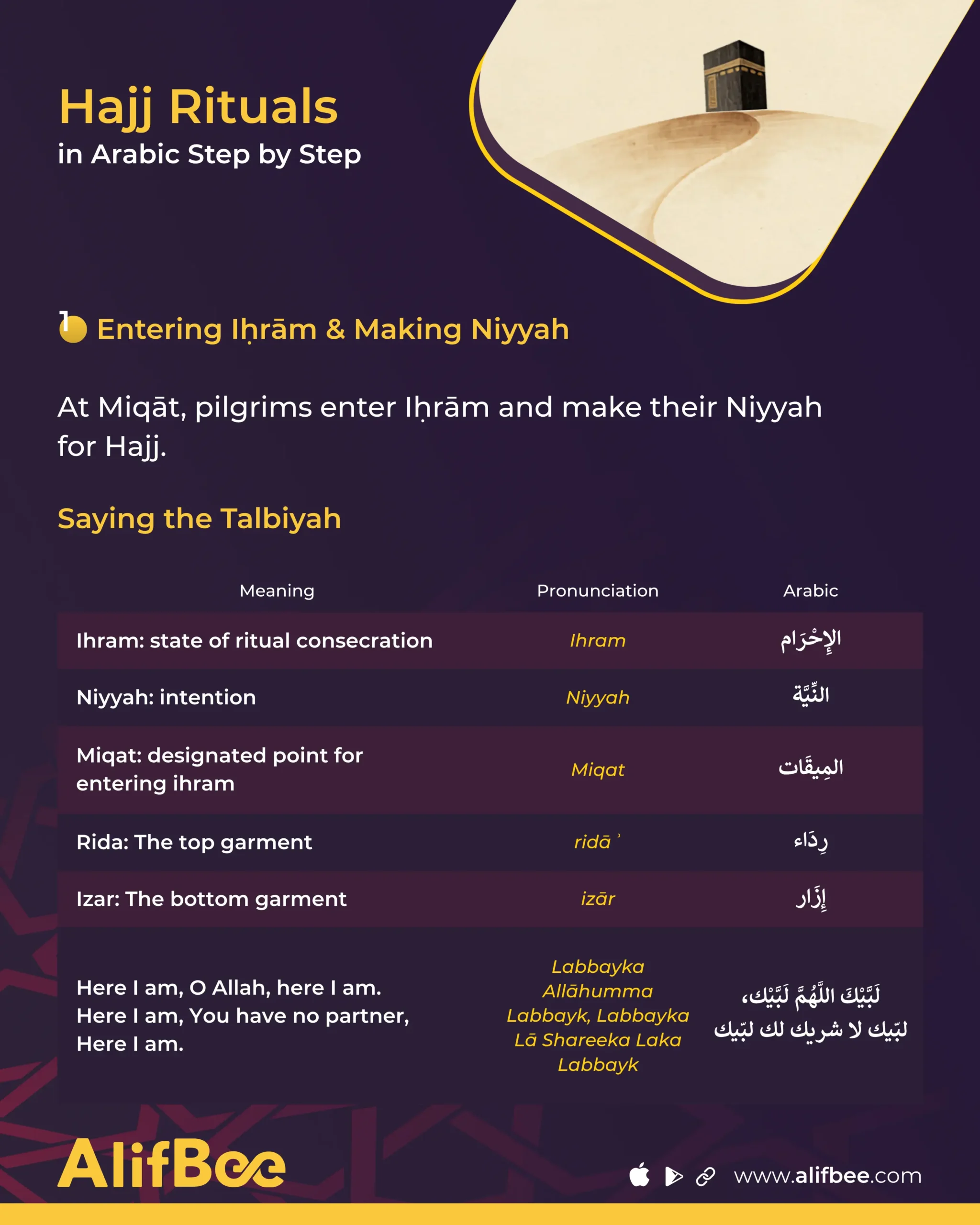
1. Entering Ihraam and Making the Niyyah
Before a pilgrim enters Makkah, they stop at a designated boundary called Miqat. Here, they enter a sacred state known as Ihram.
For men, Ihram is often associated with wearing two seamless white cloths (called Rida and Izar). For women, it means simple, modest clothing without covering the face or hands. But the most important part is Niyyah, which is the internal intention to perform Hajj for the sake of Allah.
For beginners, it helps to remember this simple distinction:
- Ihram: the sacred state of pilgrimage
- Niyyah: the intention to perform Hajj and enter Ihram made at Miqat
- Miqat: the place where Ihram is started
You can learn the following words:
| English | Pronunciation | Arabic word | |
|---|---|---|---|
|
Ihram: state of ritual consecration |
Ihram |
الإِحْرَام |
|
|
Niyyah: intention |
Niyyah |
النِّيَّة |
|
|
Miqat: designated point for entering ihram |
Miqat |
المِيقَات |
|
|
Rida: The top garment |
ridāʾ |
رِدَاء |
|
|
Izar: The bottom garment |
izār |
إِزَار |
|
Beginner note
You will often hear the phrase "he entered ihram" to mean a person has begun the pilgrimage rituals, whether or not the clothing is mentioned.
2. Saying the Talbiyah
Once in Ihram, the pilgrim begins saying the Talbiyah. This phrase is repeated throughout the early stages of Hajj. It is short, powerful, and one of the first complete Arabic phrases a learner can easily memorize.
| English Meaning | Pronunciation | Arabic | |
|---|---|---|---|
|
Here I am, O Allah, here I am. Here I am, You have no partner, Here I am. |
Labbayka Allāhumma Labbayk, Labbayka Lā Shareeka Laka Labbayk |
لَبَّيْكَ اللَّهُمَّ لَبَّيْك، لبّيك لا شريك لك لبّيك |
|
The Talbiyah expresses readiness and response to God’s call. You will hear it spoken softly or aloud, especially from the moment of Ihram until the start of tawaf.
For Arabic learners, it is one of the most memorable phrases in Hajj vocabulary and often one of the first full expressions associated with the pilgrimage.
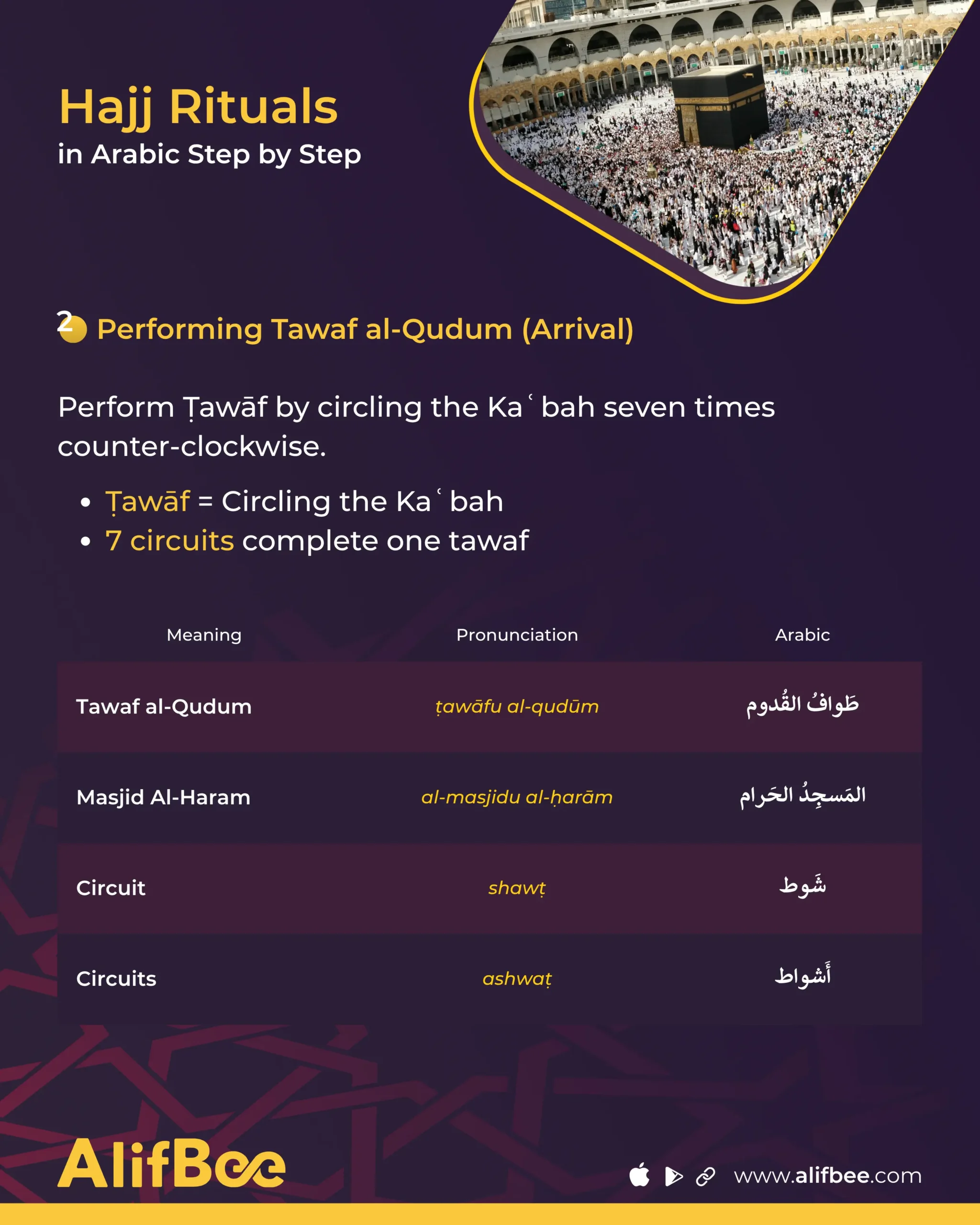
3. Performing Tawaf al-Qudum (Arrival)
When pilgrims arrive at Masjid al-Haram in Makkah, the first ritual is Tawaf al-Qudum. This tawaf is emphasized sunnah in Hajj, but it’s not Fard (obligatory), and it means circling the Ka’ba seven times in a counter‑clockwise direction.
Each circuit is called Shawt (circuit), Ashwat (plural), but as a beginner, focus on tawaf as the core word. Tawaf is also performed at other moments during Hajj, so recognizing this term will help you follow the sequence more easily.
Learn the following words:
| Meaning | Pronunciation | Arabic | |
|---|---|---|---|
|
Tawaf al-Qudum |
ṭawāfu al-qudūm |
طَوافُ القُدوم |
|
|
Masjid Al-Haram |
al-masjidu al-ḥarām |
المَسجِدُ الحَرام |
|
|
Circuit |
shawṭ |
شَوط |
|
|
Circuits |
ashwaṭ |
أَشواط |
|
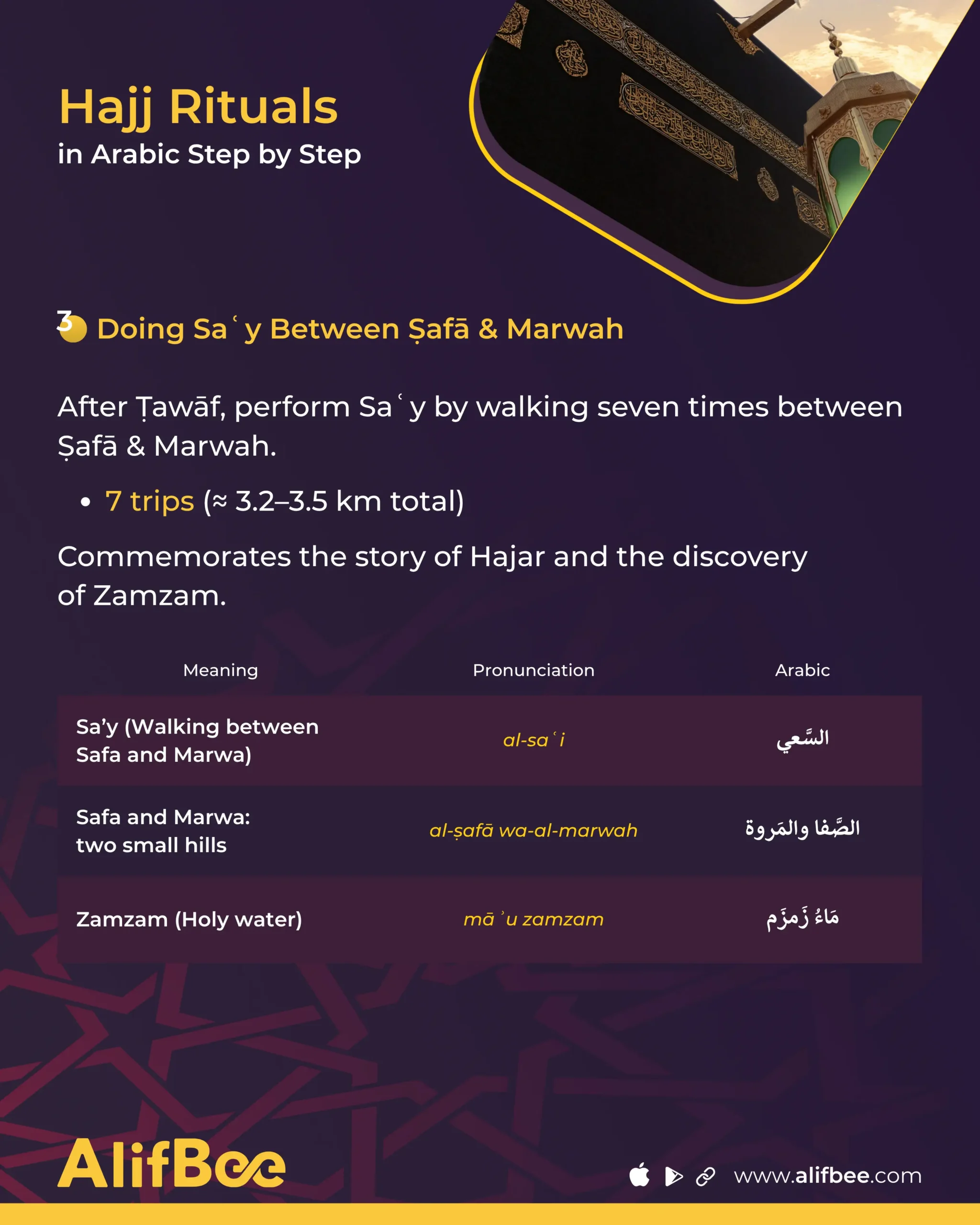
4. Doing Saʿy Between Safa and Marwah
After tawaf, pilgrims walk between two small hills, Safa and Marwa, seven times. This act is called Sa’y, meaning “walking” or “running.”
The single-trip distance is 450-500 m, and the combined distance of all seven trips is 3.2–3.5 km.
Sa’y is also Fard (obligatory) and is done after Tawaf al-Qudum if the pilgrim is doing Hajj Ifrad (Hajj Only). It can also be performed later in Hajj, after Tawaf al-Ifada.
Sa’y commemorates the story of Prophet Ibrahim’s wife, Hajar, and her search for water for her son Ismail. She ran between these two hills seven times, searching for water in the desert for her crying baby, before the Zamzam well was revealed.
Learn the following words:
| Meaning | Pronunciation | Arabic | |
|---|---|---|---|
|
Sa’y (Walking between Safa and Marwa) |
al-saʿi |
السَّعي |
|
|
Safa and Marwa: two small hills |
al-ṣafā wa-al-marwah |
الصَّفا والمَروة |
|
|
Zamzam (Holy water) |
māʾu zamzam |
مَاءُ زَمزَم |
|
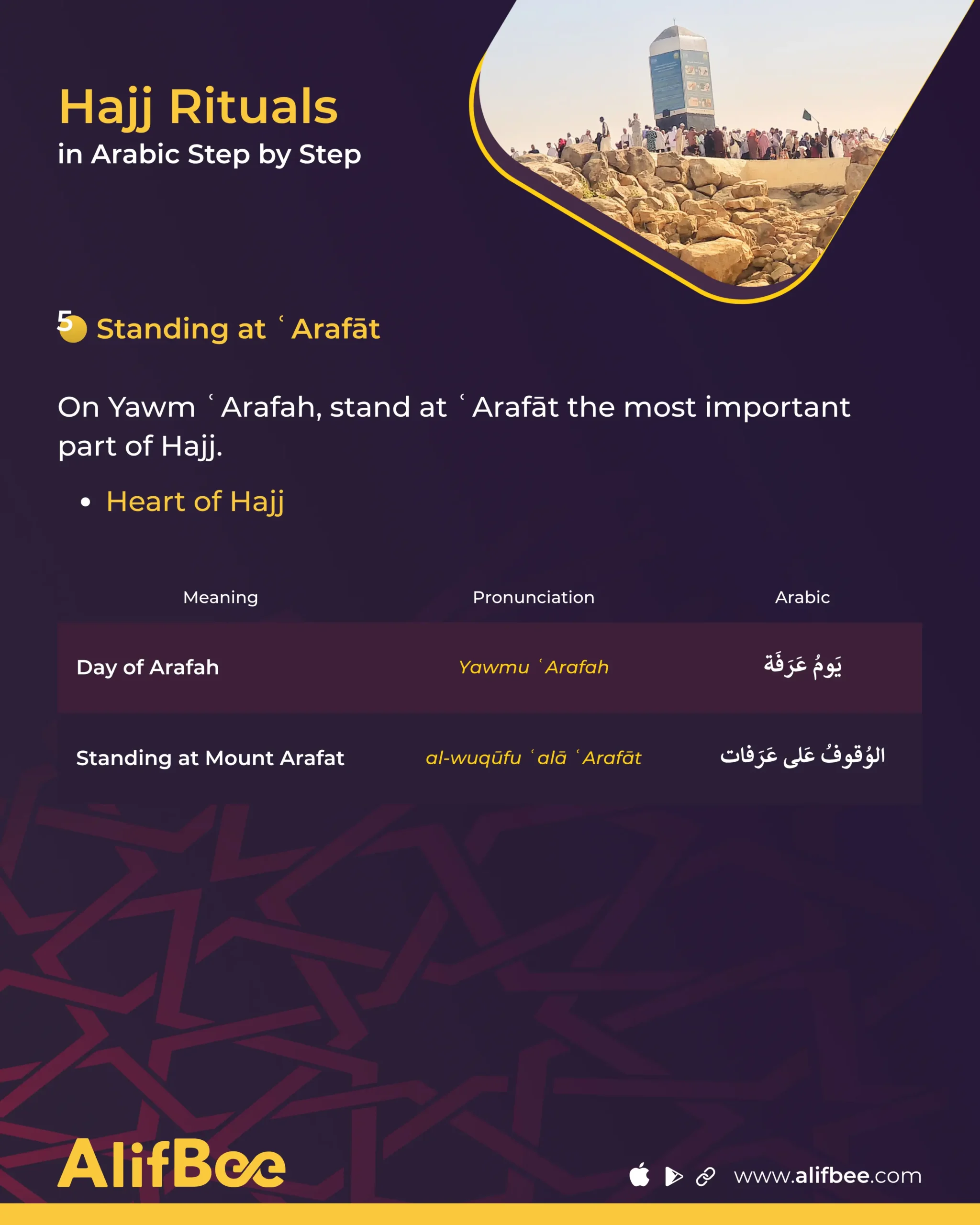
5. Going to Minā, Then Standing at ʿArafat
The next days follow a clear outward journey from Makkah, with two important places:
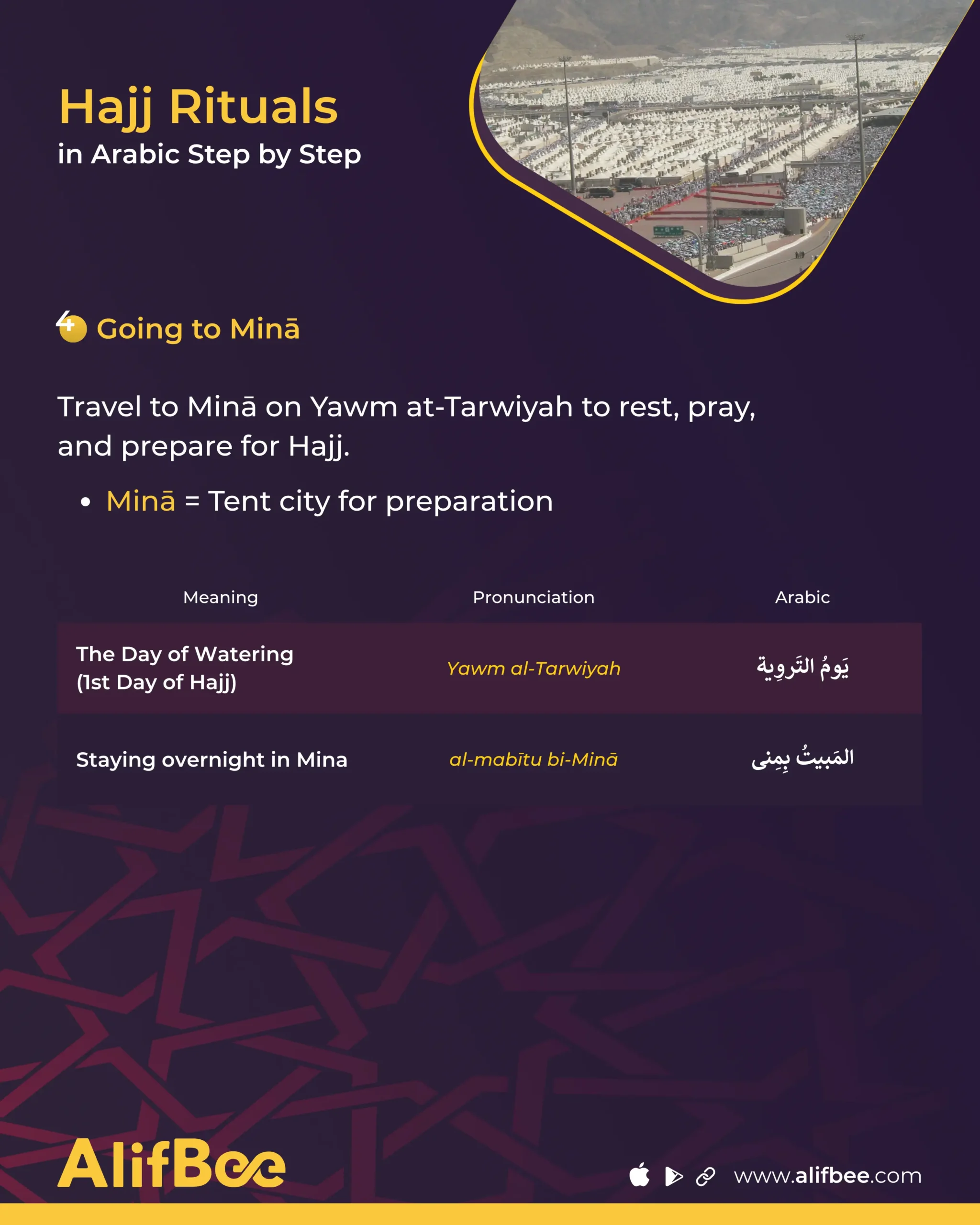
- Mina: a tent city where pilgrims spend time praying and resting.
- Arafat: a sacred mountain and surrounding plain near Makkah.
Pilgrims go to Mina on the 8th of Dhul-Hijjah (Yawm al-Tarwiyah) to begin Hajj, staying in tents to rest, pray, and spiritually prepare for the Day of Arafah. They return to Mina on the 10th-13th of Dhul-Hijjah for Ramy al-Jamarat (stoning the devil), following the Sunnah of Prophet Muhammad.
The ninth day of Dhul Hijjah is called يَوْمُ عَرَفَة (Yawmu ʿArafah), the most important day of Hajj. Standing at Arafat, also called wuquf, is considered the heart of the pilgrimage.
| English Meaning | Pronunciation | Arabic word | |
|---|---|---|---|
|
Staying overnight in Mina |
al-mabītu bi-Minā |
المَبيتُ بِمِنى |
|
|
Standing at Mount Arafat |
al-wuqūfu ʿalā ʿArafāt |
الوُقوفُ عَلى عَرَفات |
|
|
Day of Arafah |
Yawmu ʿArafah |
يَوْمُ عَرَفَة |
|
|
The Day of Watering (1st Day of Hajj) |
Yawm al-Tarwiyah |
يَومُ التَروِية |
|
Did you know?
- Arafah usually refers to the day ("Day of Arafah"), while Arafat often refers to the location ("Mount Arafat" or "Plain of Arafat"), where pilgrims stand during Hajj. Beginners will often see both forms, so it helps to recognize them in context.
- Yawm al-tarwya means the day of Watering. It comes from the historical practice when pilgrims would water their animals and store water for the upcoming days in Arafat.
6. Spending the Night in Muzdalifah
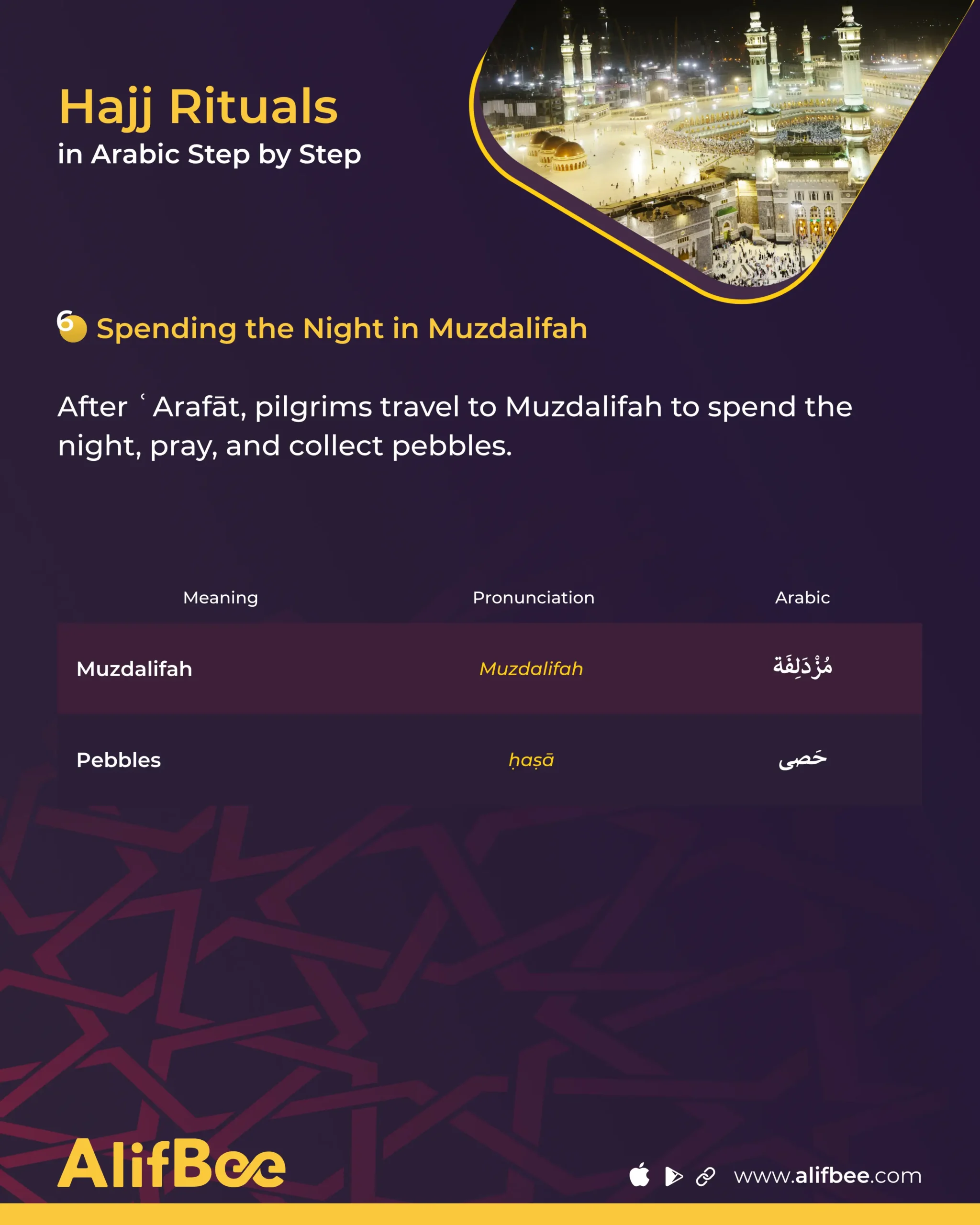
After sunset at Arafah, pilgrims move to Muzdalifah, an open area between Arafah and Mina. Here, they spend the night under the open sky, collect small pebbles, and pray.
| English Meaning | Pronunciation | Arabic word | |
|---|---|---|---|
|
Muzdalifah |
Muzdalifah |
مُزْدَلِفَة |
|
|
pebbles |
ḥaṣā |
حَصى |
|
7. Going Back to Mina
Pilgrims return to Mina to perform the following rituals on the 10th of Dhul Hijjah, on the Day called Nahr Day (Yawm Al-Nahr). It is the first day of Eid al-Adha, the greatest day of Hajj, marking the sacrifice, the culmination of the pilgrimage, and the celebration of Prophet Ibrahim’s obedience to Allah.
It is characterized by slaughtering sacrificial animals (Udhiyah/Qurbani), stoning the Jamarat, and shaving or cutting hair.
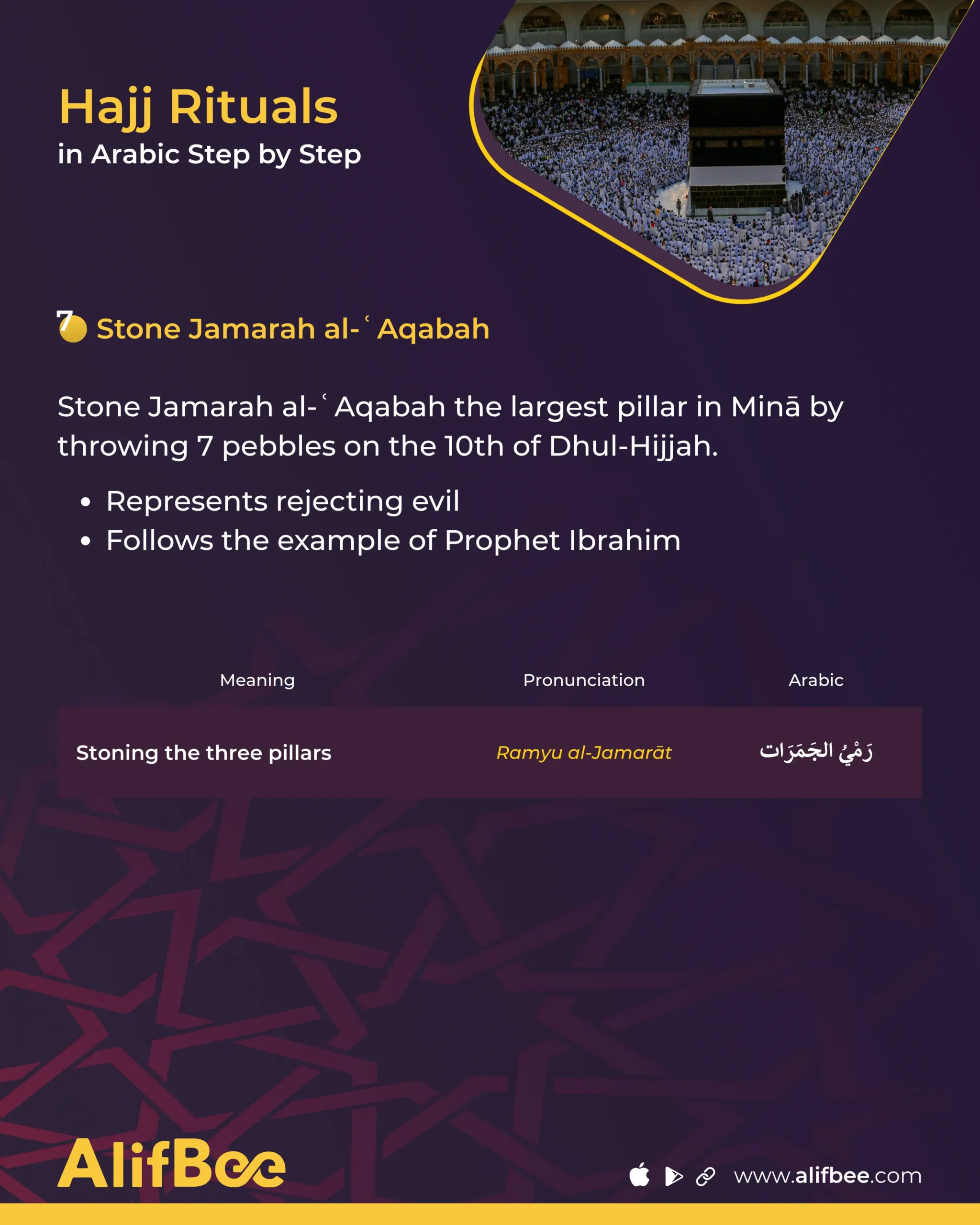
A. Stone Jamarah al-ʿAqabah: This is the largest of three stone pillars in Mina, representing the spot where Prophet Ibrahim (Abraham) stoned the devil. It is a mandatory Hajj ritual in which pilgrims throw seven pebbles on the 10th of Dhu al-Hijjah to reject evil and re-enact the Prophet’s obedience.
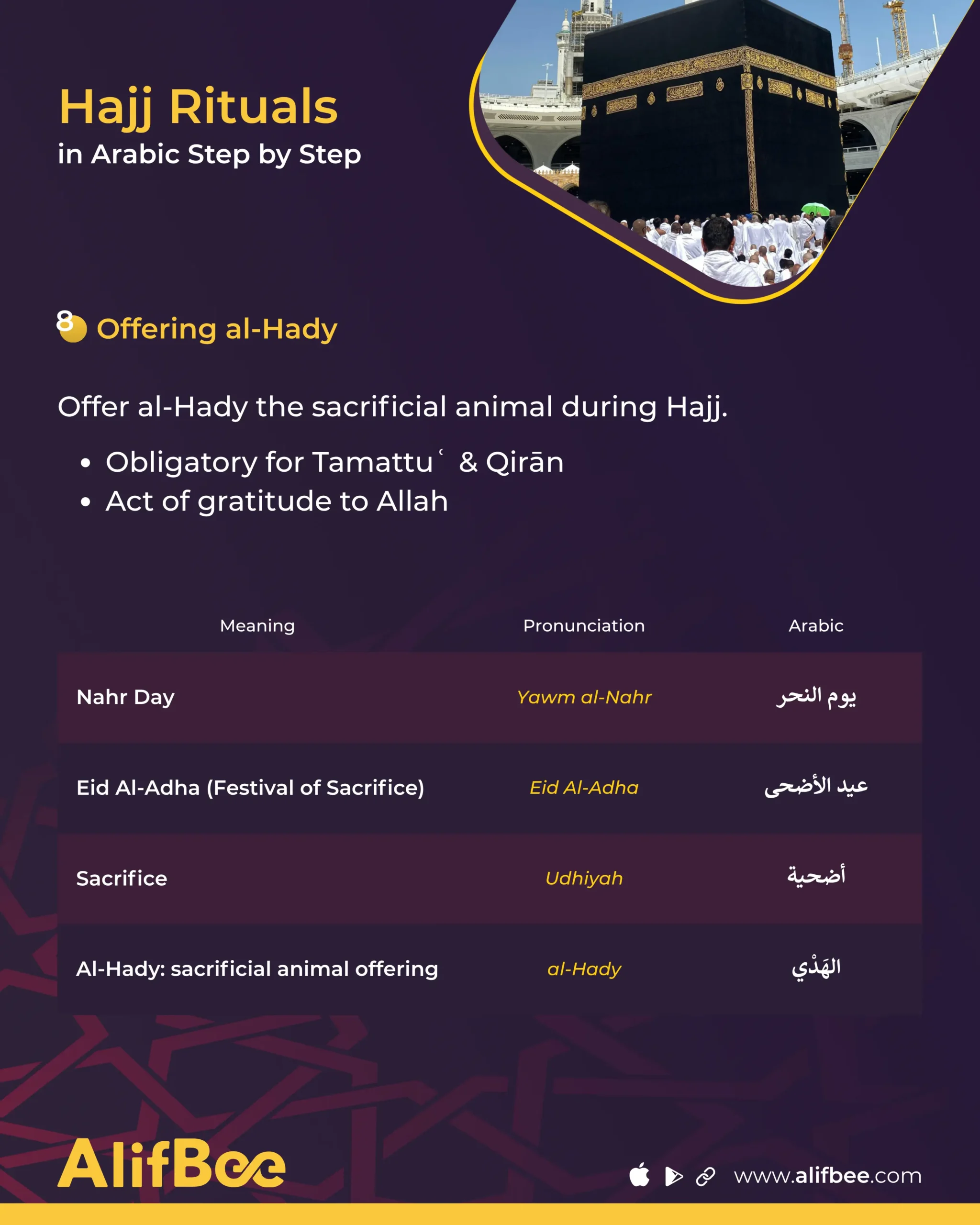
B. Hady (an animal sacrifice): Al-Hady is an obligatory animal sacrifice offered specifically for those performing Hajj Tamattu’ (doing ‘Umrah and Hajj separately) or Hajj Qiran (combining ‘Umrah and Hajj), as an act of gratitude to Allah.
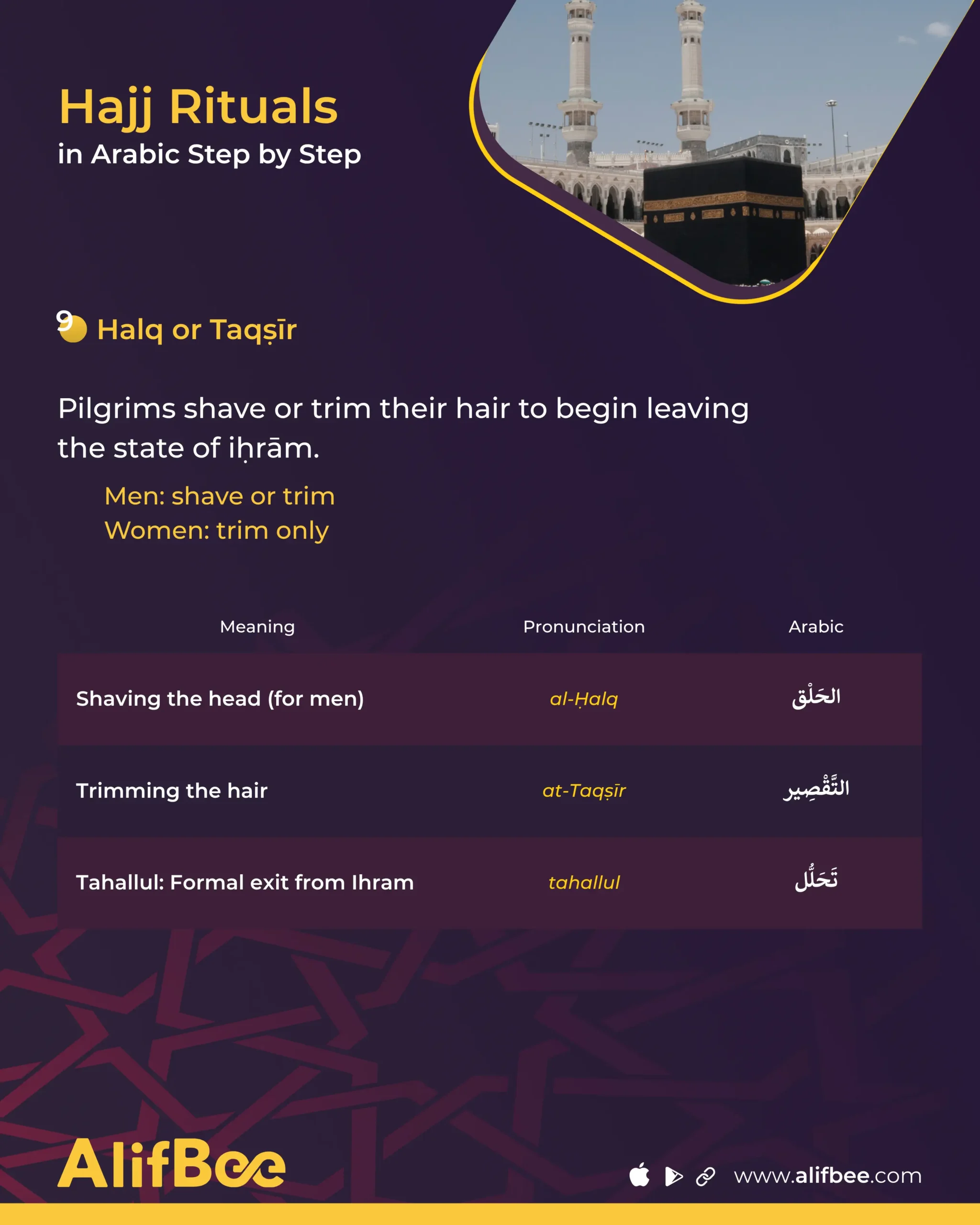
C. Halq or Taqseer (shaving the head or shortening the hair). Men may shave or shorten their hair, but women only shorten their hair (never shave).
After these rituals, pilgrims begin to leave the state of Ihram gradually (called Tahallul). First, most restrictions of Ihram are lifted after shaving or trimming the hair, but full completion of Ihram only happens after the final Tawaf (Tawaf Al-Ifada).
It is useful to learn the ritual words in Arabic:
| English Meaning | Pronunciation | Arabic | |
|---|---|---|---|
|
Nahr Day |
Yawm al-Nahr |
يوم النحر |
|
|
Eid Al-Adha (Festival of Sacrifice) |
Eid Al-Adha |
عيد الأضحى |
|
|
Sacrifice |
Udhiyah |
أضحية |
|
|
stoning the three pillars |
Ramyu al-Jamarāt |
رَمْيُ الجَمَرَات |
|
|
Al-Hady: sacrificial animal offering |
al-Hady |
الهَدْي |
|
|
shaving the head (for men) |
al-Ḥalq |
الحَلْق |
|
|
trimming the hair |
at-Taqṣīr |
التَّقْصِير |
|
|
Tahallul: Formal exit from Ihram |
tahallul |
تَحَلُّل |
|
8. Tawaf Al-Ifada
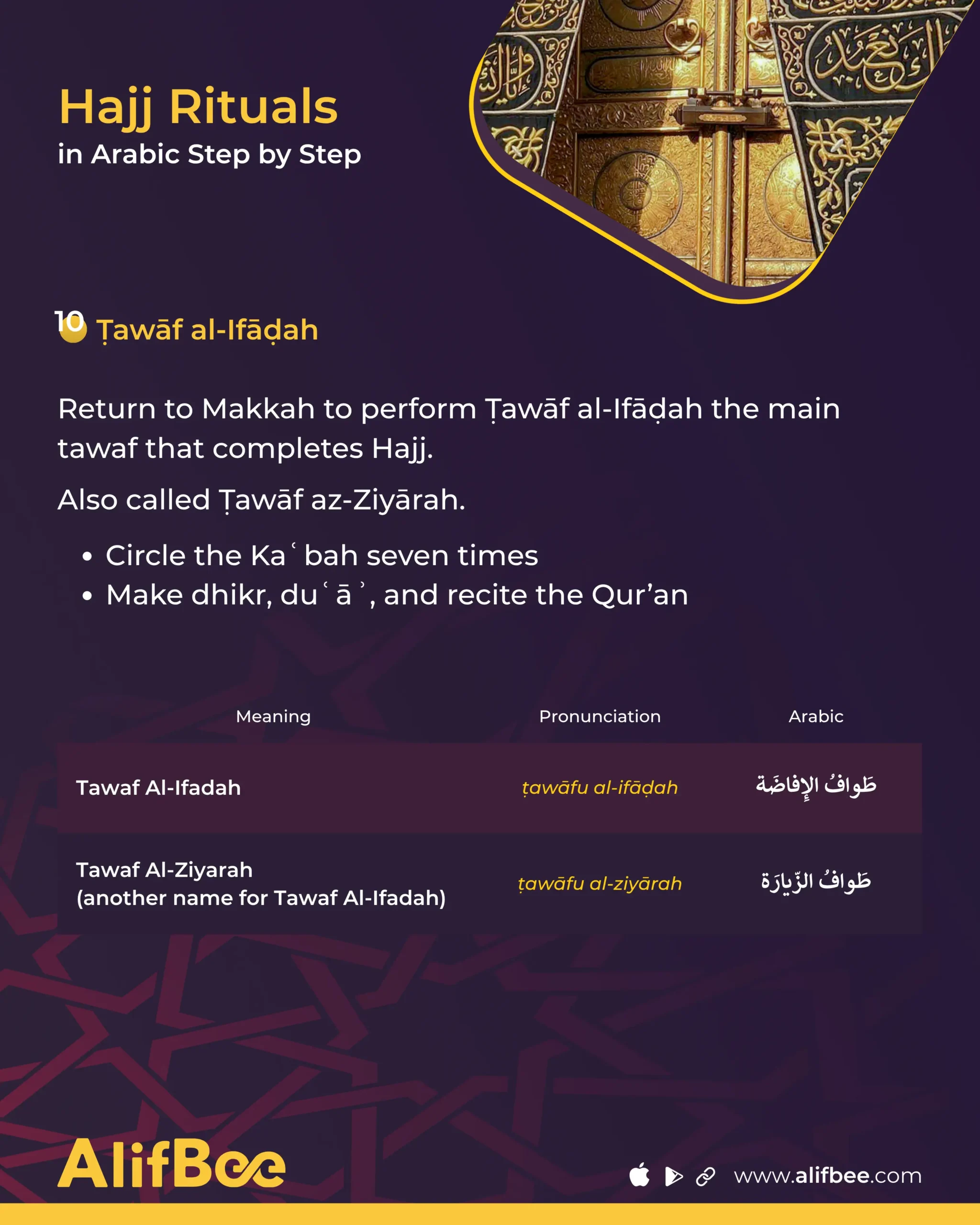
Before finishing Hajj, pilgrims return to Makkah to perform the main tawaf. This tawaf is also called tawaf az-ziyarah (Visit Tawaf). This tawaf represents the pilgrim’s “visit” to the Holy Kaaba to complete their Hajj rites after spending time in Mina, Arafat, and Muzdalifah.
In this tawaf, pilgrims go around the Ka’aba seven times, making dhikr (remembrance), reciting the Quran, and making dua.
| English Meaning | Pronunciation | Arabic | |
|---|---|---|---|
|
Tawaf Al-Ifadah |
ṭawāfu al-ifāḍah |
طَوافُ الإِفاضَة |
|
|
Tawaf Al-Ziyarah
(another name for Tawaf Al-Ifadah) |
ṭawāfu al-ziyārah |
طَوافُ الزّيارَة |
|
9. Continue Pelting Al-Jamarat
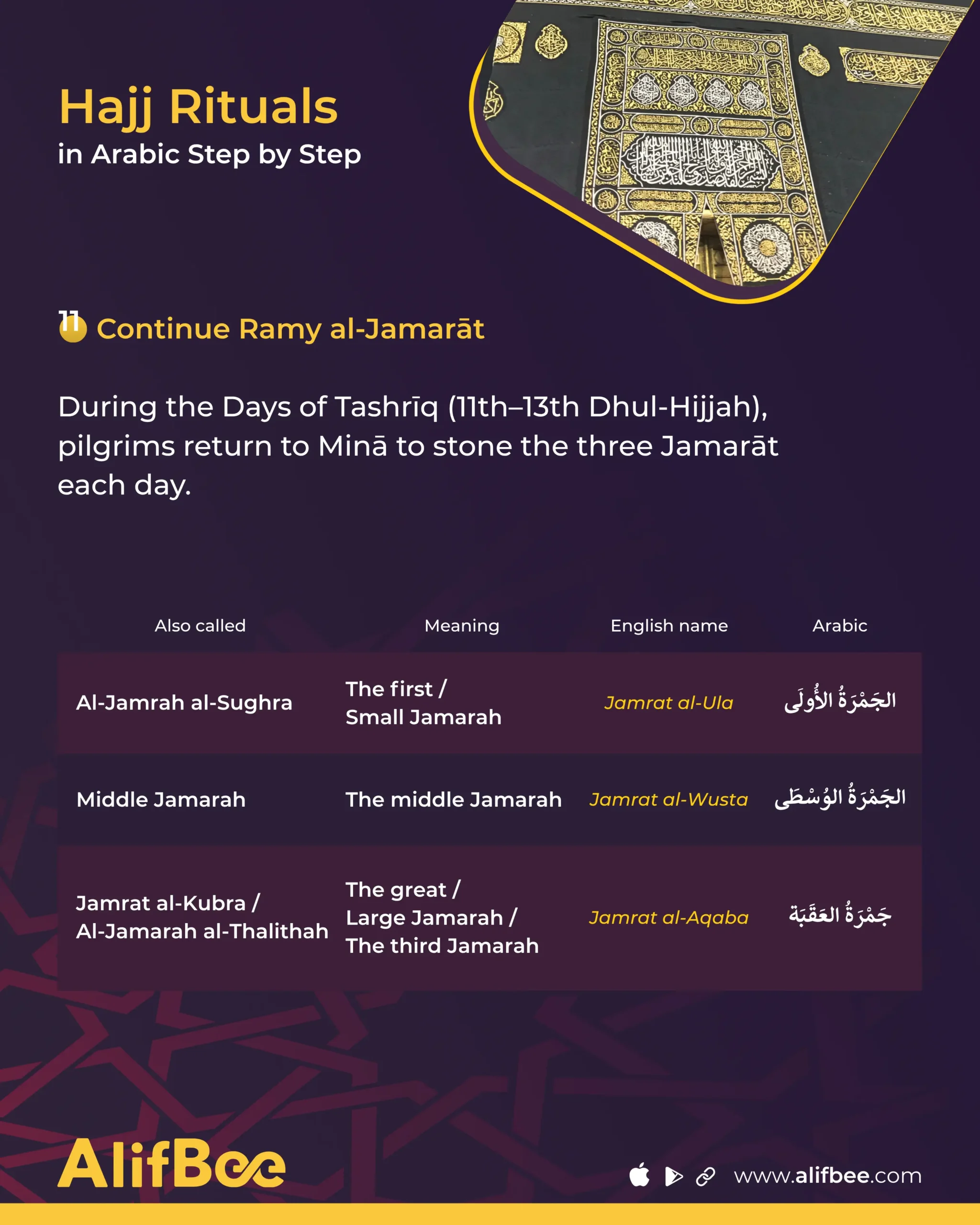
Pilgrims return to Mina and stay there on the 11th, 12th, and 13th of Dhul Hijjah (Days of Tashreeq), throwing pebbles at the three Jamarat each day, with Jamarat al-ʿAqabah being the last one.
It is useful to learn the names of the three Jamarat:
| Also called | Meaning | English name | Arabic | |
|---|---|---|---|---|
|
Al-Jamrah al-Sughra |
The first / small Jamarah |
Jamrat al-Ula |
الجَمْرَةُ الأُولَى |
|
|
Middle Jamarah |
The middle Jamarah |
Jamrat al-Wusta |
الجَمْرَةُ الوُسْطَى |
|
|
Jamrat al-Kubra / Al-Jamarah al-Thalithah |
The great/large Jamarah / the third Jamarah |
Jamrat al-Aqaba |
جَمْرَةُ العَقَبَة |
|
For detailed information on Ramy Al-Jamarat, check this comprehensive guide from the Saudi Ministry of Hajj and Umrah.
10. Perform Tawaf al-Wada’ (Farewell)
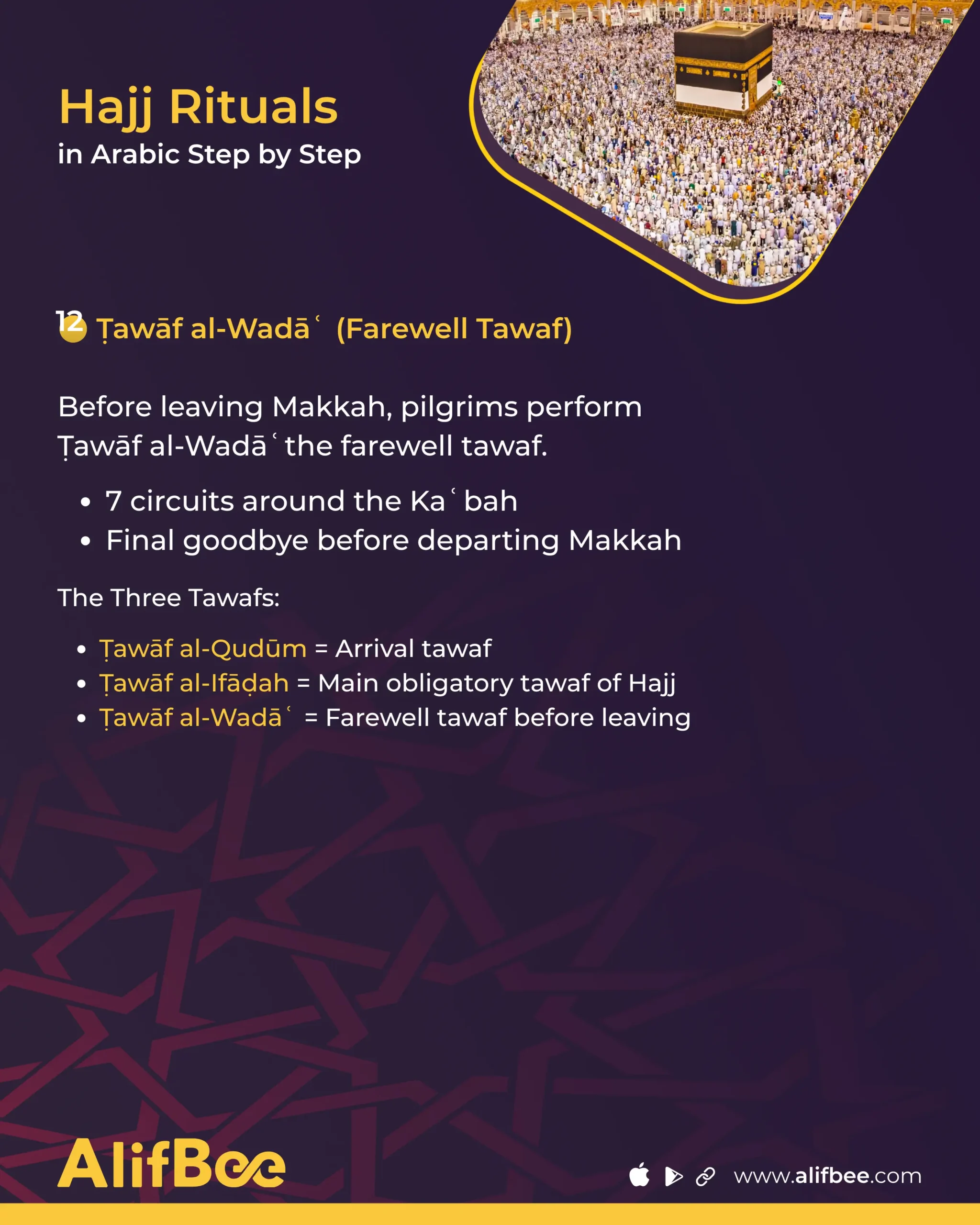
This is the last Hajj ritual performed before leaving Makkah. It is similar to the previous tawaf, involving seven circuits around the Ka’ba.
Notice the difference between the three types of tawaf:
- Tawaf al-Qudum (Arrival Tawaf): a non-obligatory tawaf performed upon arriving in Makkah.
- Tawaf al-Ifadah (Main Pillar Tawaf): the main tawaf performed after the major rites at Arafah and Muzdalifah. It is sometimes called tawaf az-ziyarah. A valid Hajj cannot be completed without it.
- Tawaf al-Wada’ (Farewell Tawaf): the farewell tawaf performed just before leaving Makkah. This tawaf is required in Hajj, and pilgrims who do not perform it must offer Hady.
The difference is simple: Tawaf al-Ifadah is essential for the completion of Hajj, while Tawaf al-Wadaʿ is a final farewell before departure. Both involve the same act of circling the Kaʿbah.
For a clear official and educational overview of Hajj procedures, readers can also consult Nusuk, the Saudi platform overseen by the Ministry of Hajj and Umrah, and Dar al-Ifta’s illustrated guide, which explains the order of the rites in an accessible format.
Hajj vs Umrah in Arabic: What’s the Difference?
It is very common to confuse Hajj and Umrah at first. The two share many of the same rituals. Here is a simple comparison.
| Hajj | Umrah | |
|---|---|---|
|
Timing |
Specific days of Dhul Hijjah
(8th to 12th or 13th) |
Any time of year |
|
Length |
5–6 days |
A few hours to a day |
|
Required rituals |
Iḥrām, Tawaf, Saʿy, Arafah, Muzdalifah, Stoning, etc. |
Iḥrām, Tawaf, Saʿy, then Halq/Taqsir |
Umrah is sometimes called the “lesser pilgrimage.” Both share tawaf and saʿy, but Hajj includes the essential standing at ʿArafāt and additional rituals in Minā.
Arabic Phrases You May Hear During Hajj
| English | Pronunciation | Arabic | |
|---|---|---|---|
|
Here I am, O Allah, here I am |
Labbayk Allahumma Labbayk |
لَبَّيْكَ اللَّهُمَّ لَبَّيْكَ |
|
|
an accepted or blessed Hajj |
Hajj mabrur |
حَجٌّ مَبْرُور |
|
|
the Day of Arafah |
Yawm Arafah |
يَوْمُ عَرَفَة |
|
|
Zamzam water |
Zamzam |
زَمْزَم |
|
If you already know some Arabic, try to notice the difference between:
- terms for rituals
- place names
- Names for Hajj-related objects
This small distinction helps a lot with memory.
Learner tip
When Muslims greet a returning pilgrim, they might say "Hajj mabrour wa dhanb maghfūr" — an accepted Hajj and forgiven sins.
Tips to Learn Hajj Vocabulary More Easily
You do not need to memorize a long list in random order. Try these small shifts instead.
- Learn by sequence – Words stick better when you know which ritual comes before and after.
- Group place names together – Minā, Arafah, and Muzdalifah form a clear cluster.
- Repeat the Talbiyah aloud – The rhythm of Labbayk helps your ear and tongue remember.
- Connect each word to an image or movement – Tawaf is circling, Saʿy is walking, and Ramy is throwing.
Review Hajj Rituals in Arabic
Final word
Hajj vocabulary feels much lighter once you learn it in order. Instead of facing a long list of unfamiliar terms, you start to see a clear journey: entering ihram, reciting the talbiyah, moving through the sacred places, and finishing the major rites with confidence and understanding.
Learn with AlifBee
You can also download the AlifBee App, where you can choose the Arabic for Hajj Course to learn countless words and phrases for this holy journey. Another course in the app teaches Arabic from A to Z for a full path to learn Arabic.
FAQs
1. What does Hajj mean in Arabic?
Ḥajj (الحَجّ) literally means “to set out for a place.” In the Islamic context, it is the annual pilgrimage to Makkah.
2. What are the main Hajj rituals in order?
Iḥrām → Talbiyah → Tawaf → Saʿy → Minā → Arafah → Muzdalifah → Ramy al-Jamarāt → Halq/Taqsir → Tawaf al-Ifadah → Tawaf al-Wadaʿ.
3. What is the difference between Hajj and Umrah in Arabic terms?
Hajj (الحَجّ) has fixed dates and more rituals, including Arafah. Umrah (العُمْرَة) is shorter and can be done any time.
4. What does ihram mean in Arabic?
Iḥrām (الإِحْرَام) means entering a sacred state where certain normal actions become forbidden. It is both a spiritual state and, in common speech, associated with the clothing of the pilgrimage.
5. What is the talbiyah in Hajj?
The Talbiyah (التَّلْبِيَة) is the sacred prayer “Labbayka Allāhumma Labbayk” – “Here I am, O Allah, here I am.”
6. Which Arabic words should a beginner learn before Hajj?
Start with: Ḥajj, Iḥrām, Talbiyah, Tawaf, Saʿy, Arafah, Jamarat, and Tawaf al-Ifadah. Those will cover most of the sequence.