Arabic Prepositions: List, Usage, and Everyday Examples

Reading Time: 8 minutes
Home / Arabic Basics / Arabic Prepositions: List, Usage, and Everyday Examples
Listen to: Arabic Prepositions: List, Usage, and Everyday Examples
Listening Bee

Have you ever said an Arabic sentence and felt so confident about it… but then you got that look like, “What did you just say?” That usually happens when you translate English prepositions directly into Arabic.

Most beginners learning Arabic fall for this same mistake. They think prepositions are easy, so they translate them from English to Arabic word for word, and then they end up with a sentence that’s completely wrong, even though all the words are actually “correct.”

Arabic prepositions are simply small words that connect the noun to the rest of the sentence in order to show how things are related — reason, direction, place, or possession.

But what we should keep in mind is the fact that they follow Arabic logic and not English. Do not worry — AlifBee is here to help. 

In this article, we’ll help you master the most common Arabic prepositions such as في (in), من (from), and إلى (to), which are essential for fluent communication. In addition, we will learn all 21 prepositions in Arabic.

What are prepositions in Arabic?

Prepositions in Arabic, unlike prepositions in English, which mainly indicate relationships between nouns, play an important role in the grammatical case of nouns.

One of the key features that makes Arabic prepositions different from English ones is that they directly affect the grammatical case of the noun that follows them. So, when a noun comes after an Arabic preposition, it automatically appears in the genitive case.

Most Used Arabic Prepositions

What is harf al-jarr in Arabic grammar?

Harf al-jarr (حرف الجرّ) is the Arabic word for a preposition, and it can be a single word or even a single letter that shows the relationship between nouns. As mentioned earlier, when a noun comes after it, harf al-jarr makes it genitive (مجرور) “majrūr”, usually marked with a kasra.

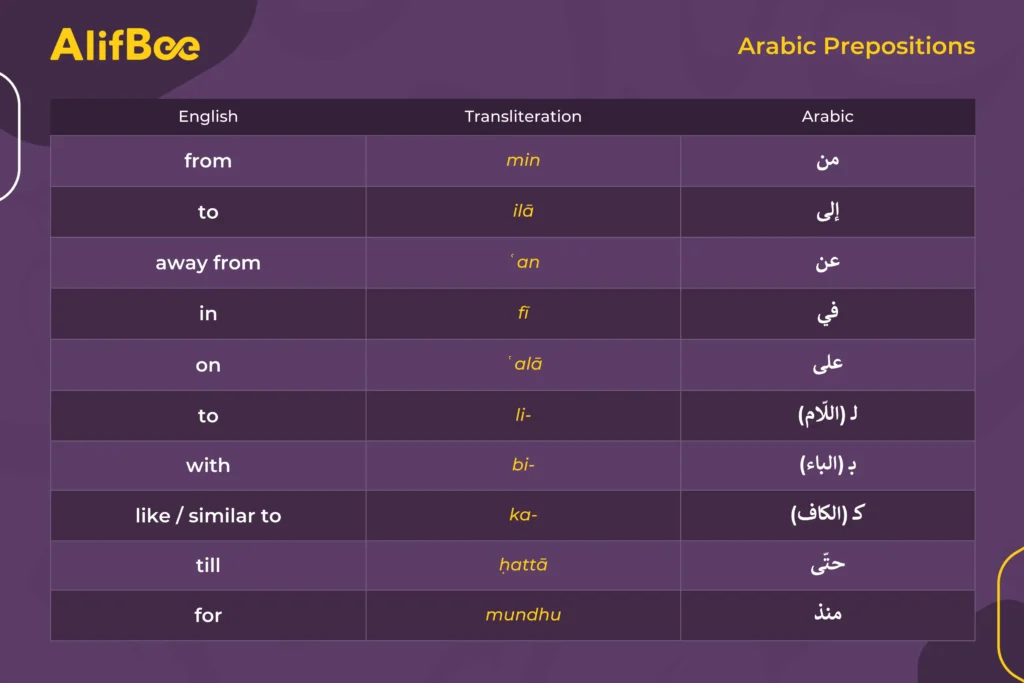
List of Common Arabic Prepositions with Pronunciation

English

Pronunciation

Arabic

from

min

من

to

ilā

إلى

away from

ʿan

عن

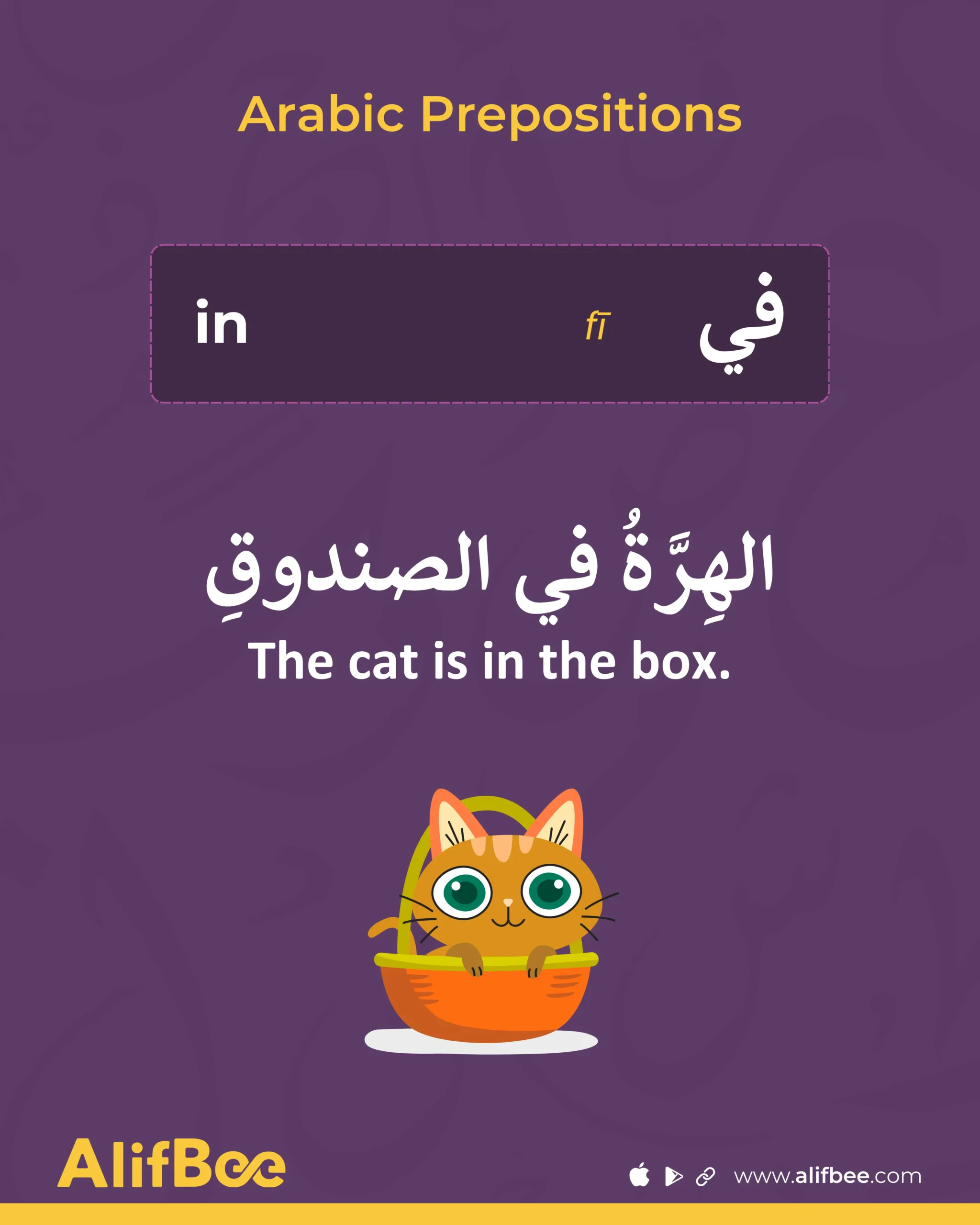
in

في

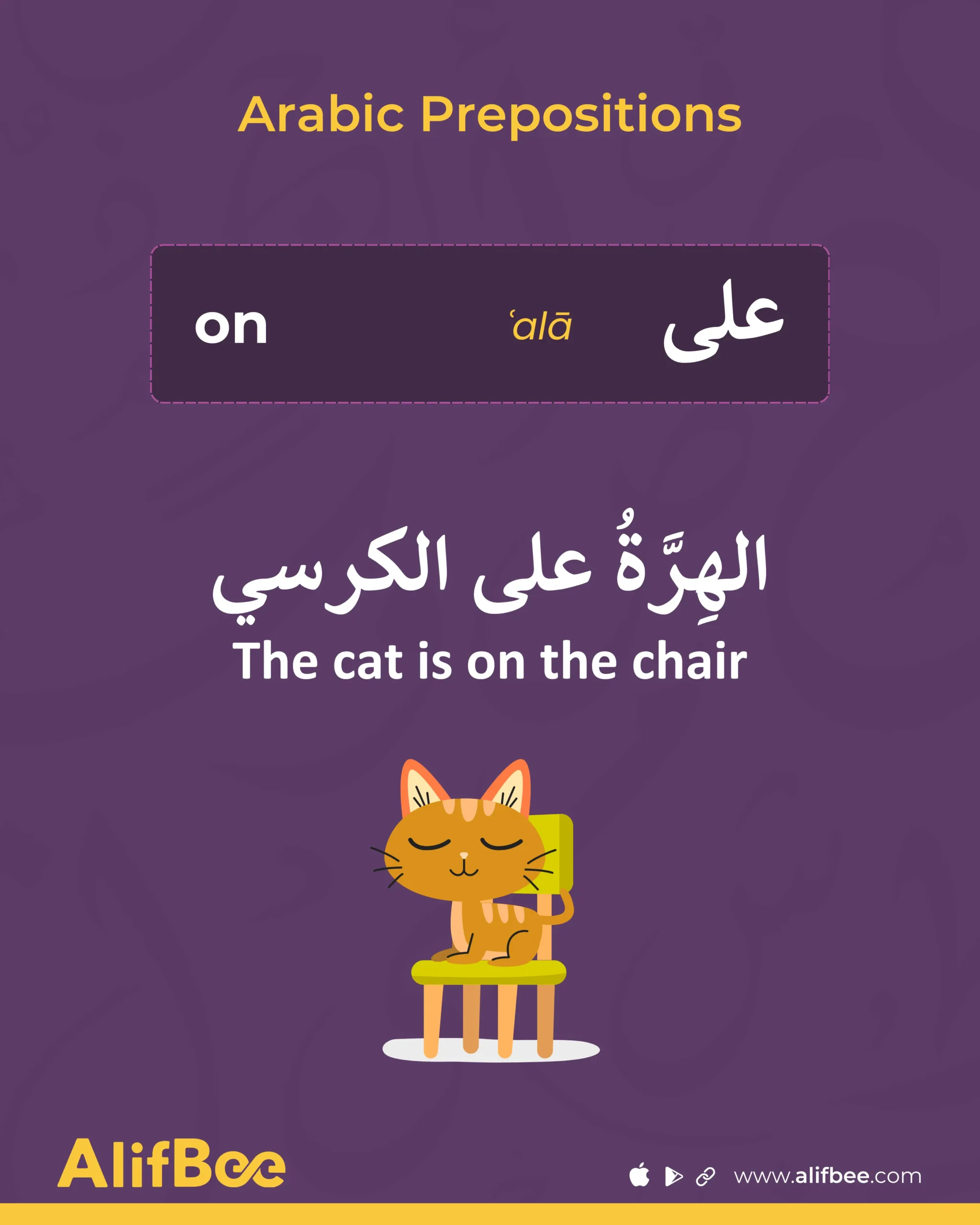
on

ʿalā

على

to

li-

لـ (اللّام)

with

bi-

بـ (الباء)

like/similar to

ka-

كـ (الكاف)

till

ḥattā

حتّى

for

mundhu

منذ

How Arabic Prepositions Are Used in Sentences

When you learn Arabic prepositions, keep in mind that they connect meaning, so don’t try to memorise or focus only on words. 

And this is exactly why you should never translate prepositions word for word, but instead learn which preposition to use depending on the sentence itself.
In Arabic, you can find prepositions:

Prepositions After a Verb

For example, the same verb could have two completely different meanings depending on the preposition that comes right after it:

He looked at the picture

Naẓara ila as-sourati

نظرَ إلى الصّورة

He considered/ examined the topic

Naẓara fi al-al-mawḍūʿi

نظَرَ في الموضوع

In these examples, the same verb naẓara has two completely different meanings in the two sentences, depending on the preposition used in each one.
In addition, some Arabic verbs are considered incomplete if they are not followed by a preposition.

Prepositions After a Noun

A preposition can be used after a noun in order to describe it or complete its meaning.

For example:

A novel about Love

riwāyatun ʿani l-ḥubb

روايةٌ عن الحُبّ

A group of students

majmūʿatun mina t-talāmīdh

مجموعةٌ من التّلاميذ

In these two examples, the prepositions connect two nouns and complete the meaning.

The Most Used Prepositions in Arabic

These are the prepositions essential for beginners to learn to better understand Arabic, as they are the most commonly used in everyday contexts, in books and articles, and even on social media.

1

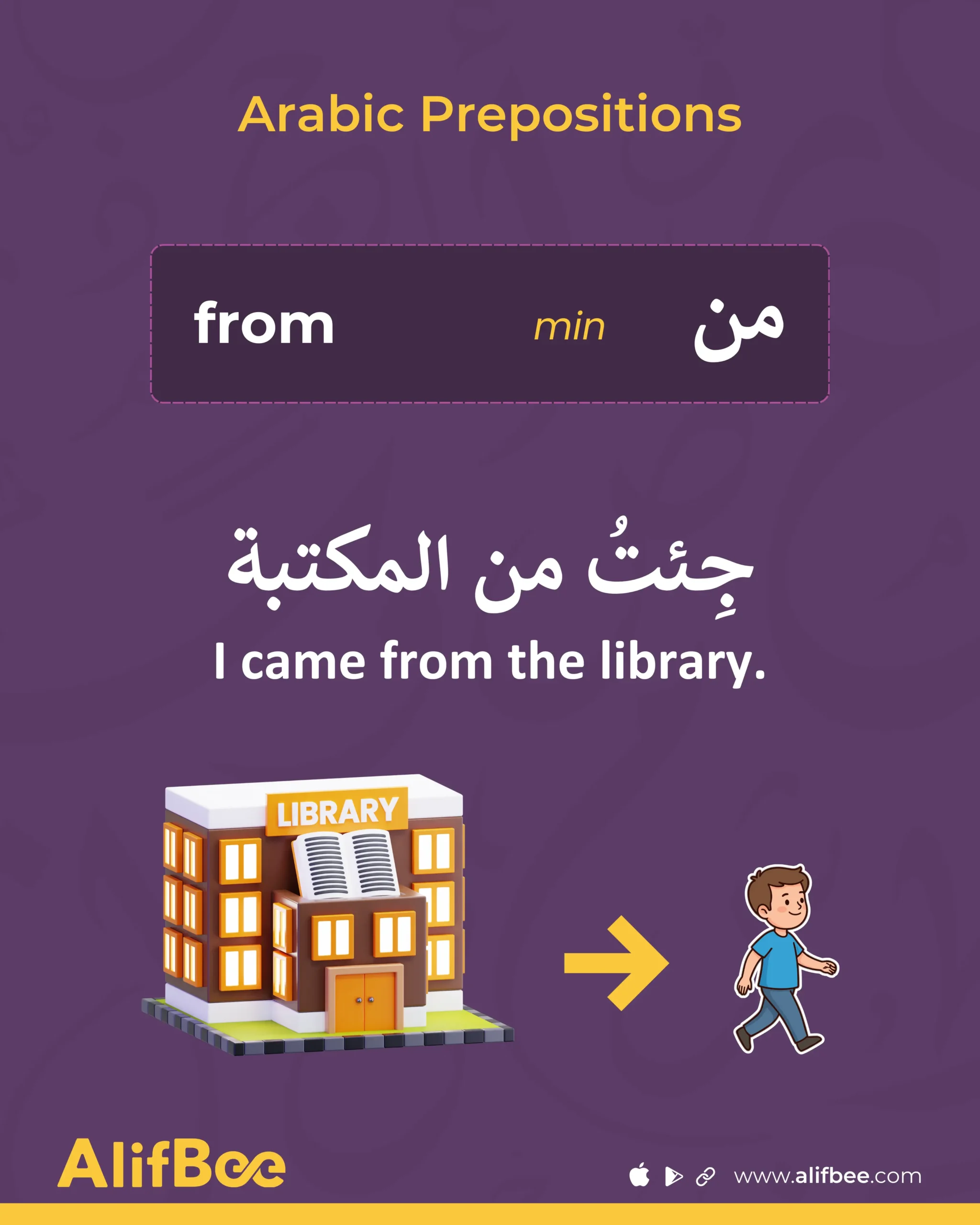
مِن (min) — from / of / some of / than

The preposition min is used to signal a starting point, source, or separation. The reference could be physical, abstract, or comparative. It often answers the question “from where?” or “out of what?”.

Usage

English

Transliteration

Arabic Example

Starting point

I came from the library.

jiʾtu mina al-maktabati

جِئتُ من المكتبة

Origin

I am from Lebanon.

anā min lubnān

أنا من لبنان

Partitive (some of)

I read a surah from the Qur’an.

qaraʾtu sūratan mina al-qurʾān

قرأتُ سورةً من القرآن

Comparison (than)

This car is better than the other.

hādhihi as-sayyāratu afḍalu mina al-ukhrā

هذه السيارة أفضل من الأخرى

2

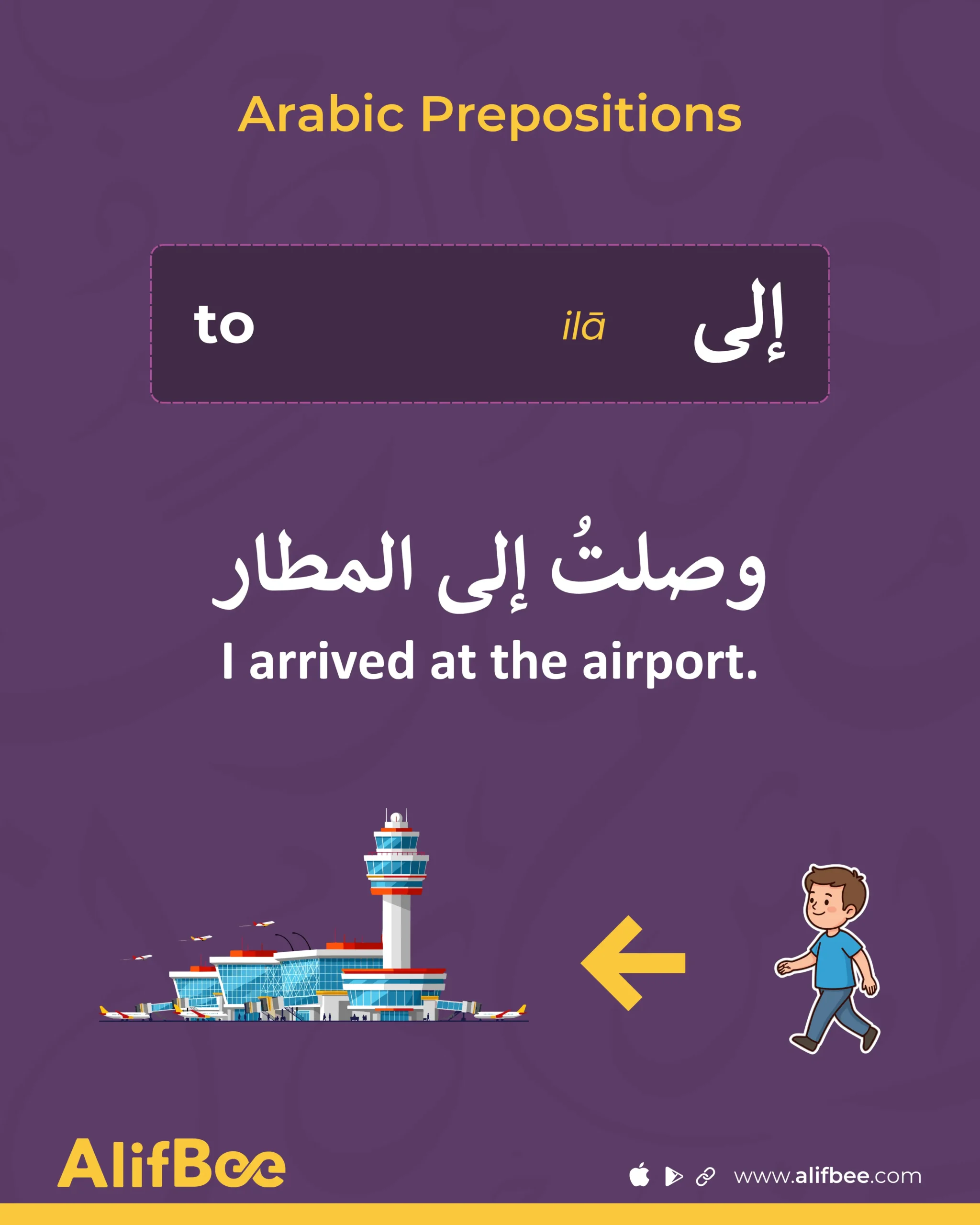
إلى (ilā) — to / until

The preposition ilā shows direction, destination, or an endpoint in space or time. It focuses on where something ends, not where it begins.

Usage

English

Transliteration

Arabic Example

Destination

I arrived at the airport.

waṣaltu ilā al-maṭār

وصلتُ إلى المطار

End of time

They completed the fast until night.

atammū aṣ-ṣiyāma ilā al-layl

أتمّوا الصيام إلى الليل

Adding or joining

He added the money to his own.

ḍamma al-māla ilā mālihi

ضمَّ المالَ إلى مالِه

3

في (fī) — in / within

Use fī to place something inside a space, time, state, or situation. This “space” can be abstract rather than physical.

Usage

English

Transliteration

Arabic Example

Physical location

I spent the vacation at the resort.

qaḍaytu al-ijāzata fī al-maṣīf

قضيتُ الإجازة في المصيف

Abstract or metaphorical state

True richness lies in contentment.

al-ghinā kulluhu fī al-qanāʿa

الغِنى كلُّه في القناعة

Cause or reason

She entered the Fire because of a cat she confined.

dakhalat an-nāra fī hirratin ḥabasathā

دخلتِ النارَ في هرّةٍ حبستْها

4

عن (ʿan) — about / away from

Use ʿan to express distance, separation, or topic. It often answers “away from what?” or “about what?”.

Usage

English

Transliteration

Arabic Example

Distance

I was away from the house for an hour.

baʿudtu ʿani ad-dār sāʿatan

بَعُدتُ عن الدار ساعةً

Topic

We talked about travel.

taḥaddathnā ʿani as-safar

تحدّثنا عن السفر

5

على (ʿalā) — on / upon

 Use على to show contact, responsibility, obligation, or control. It often carries a sense of something resting upon or weighing on someone.

Usage

English

Transliteration

Arabic Example

Physical position

I put the book on the table.

waḍaʿtu al-kitāba ʿalā aṭ-ṭāwila

وضعتُ الكتابَ على الطاولة

Responsibility or favor

He has a favor over me.

lahu ʿalayya faḍl

له عليَّ فضلٌ

Condition or obligation

I’ll lend you the money on the condition that you return it.

uqriḍuka al-māla ʿalā an tuʿīdahu

أقرضُك المالَ على أن تُعيده

6

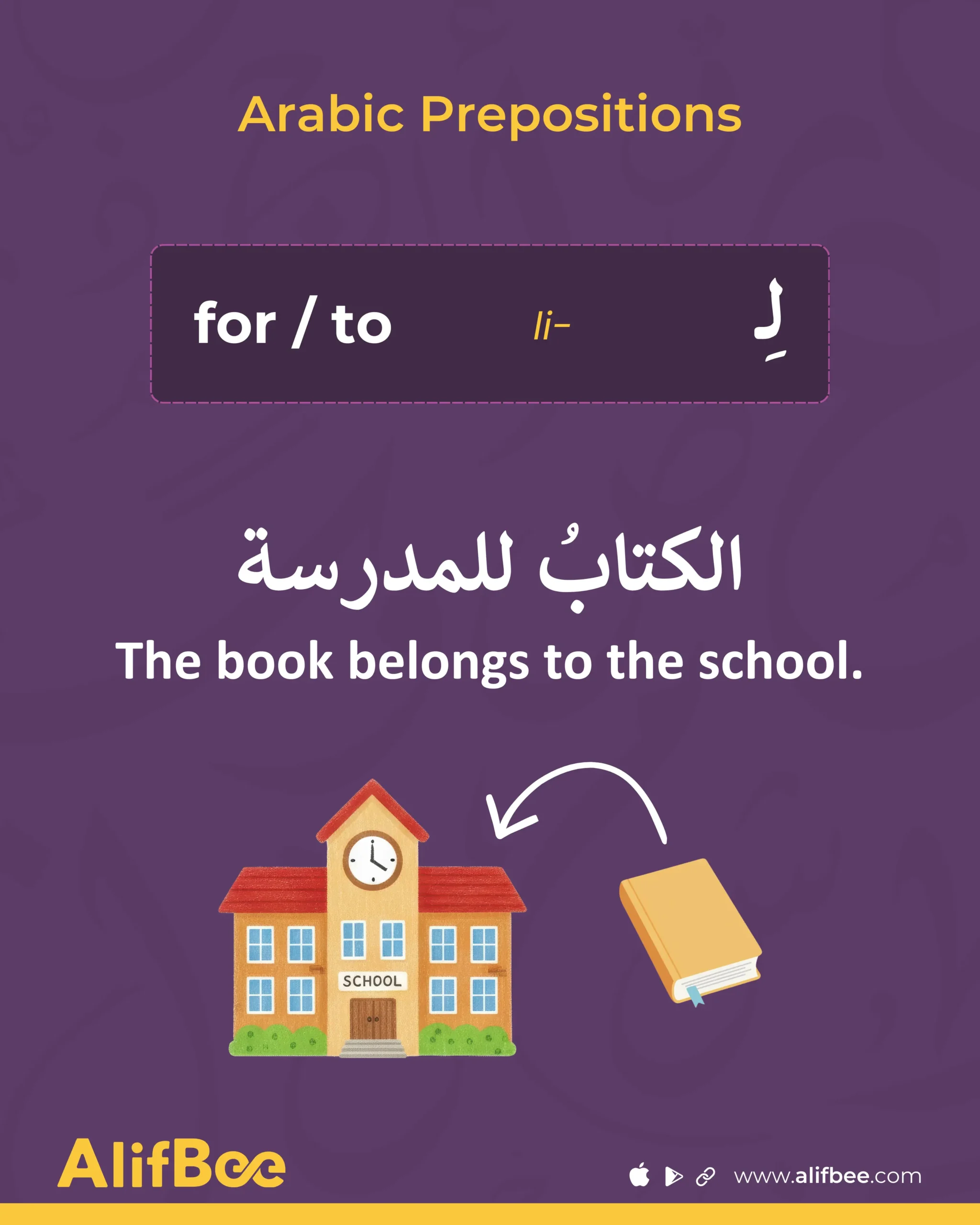
لِـ (li-) — for / to

Use li- to indicate purpose, ownership, entitlement, or direction toward a person or goal. It often answers “for whom?” or “for what purpose?”.

Usage

English

Transliteration

Arabic Example

Ownership or entitlement

The book belongs to the school

al-kitābu li-l-madrasati

الكتابُ للمدرسة

Purpose

I traveled for study.

sāfartu li-d-dirāsa

سافرتُ للدراسة

7

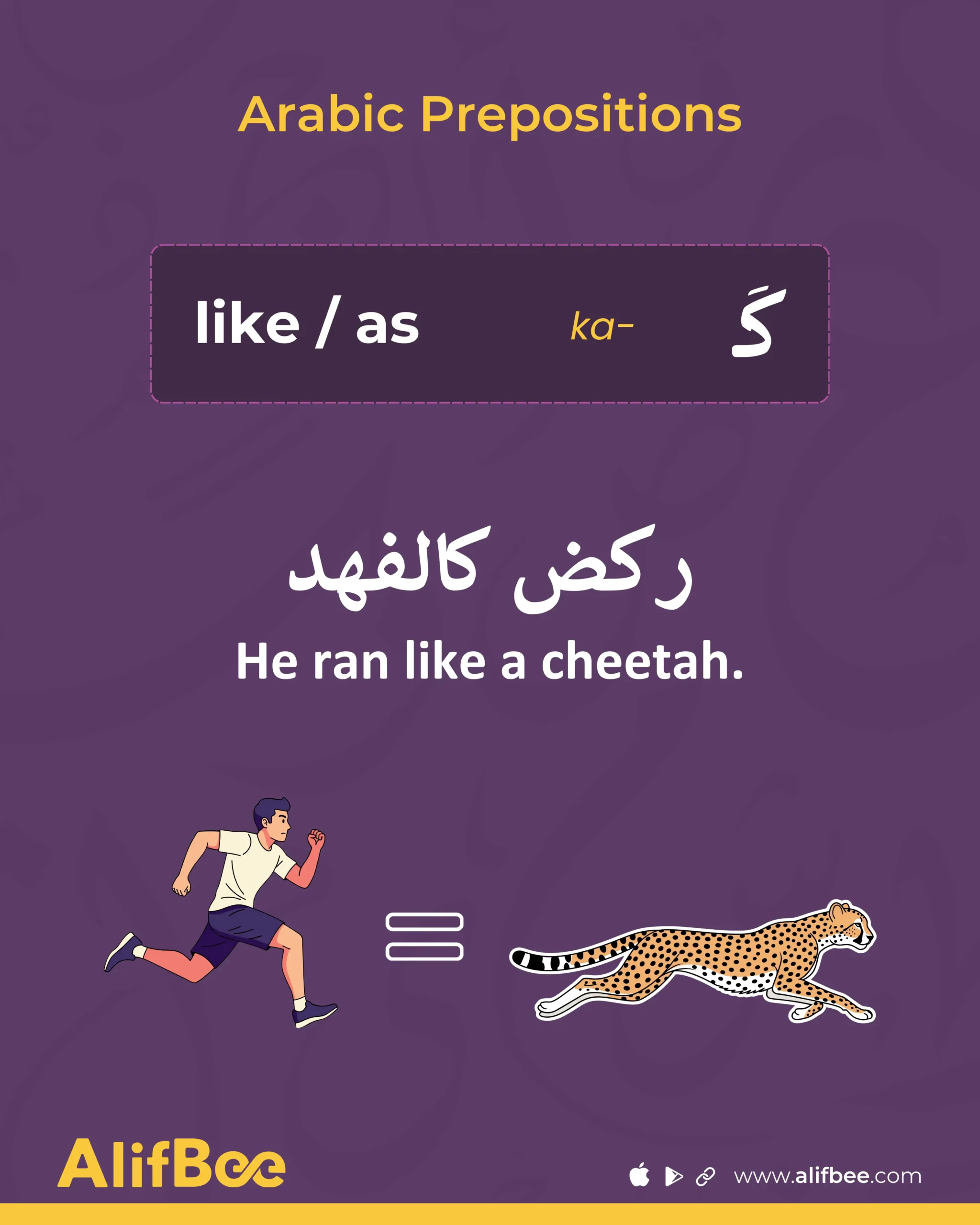
كَـ (ka-) — like / as

 The preposition ka- expresses similarity or comparison. It always introduces an example or likeness, not identity.

English

Transliteration

Arabic Example

He ran like a cheetah.

rakaḍa ka-l-fahd

ركض كالفهد

8

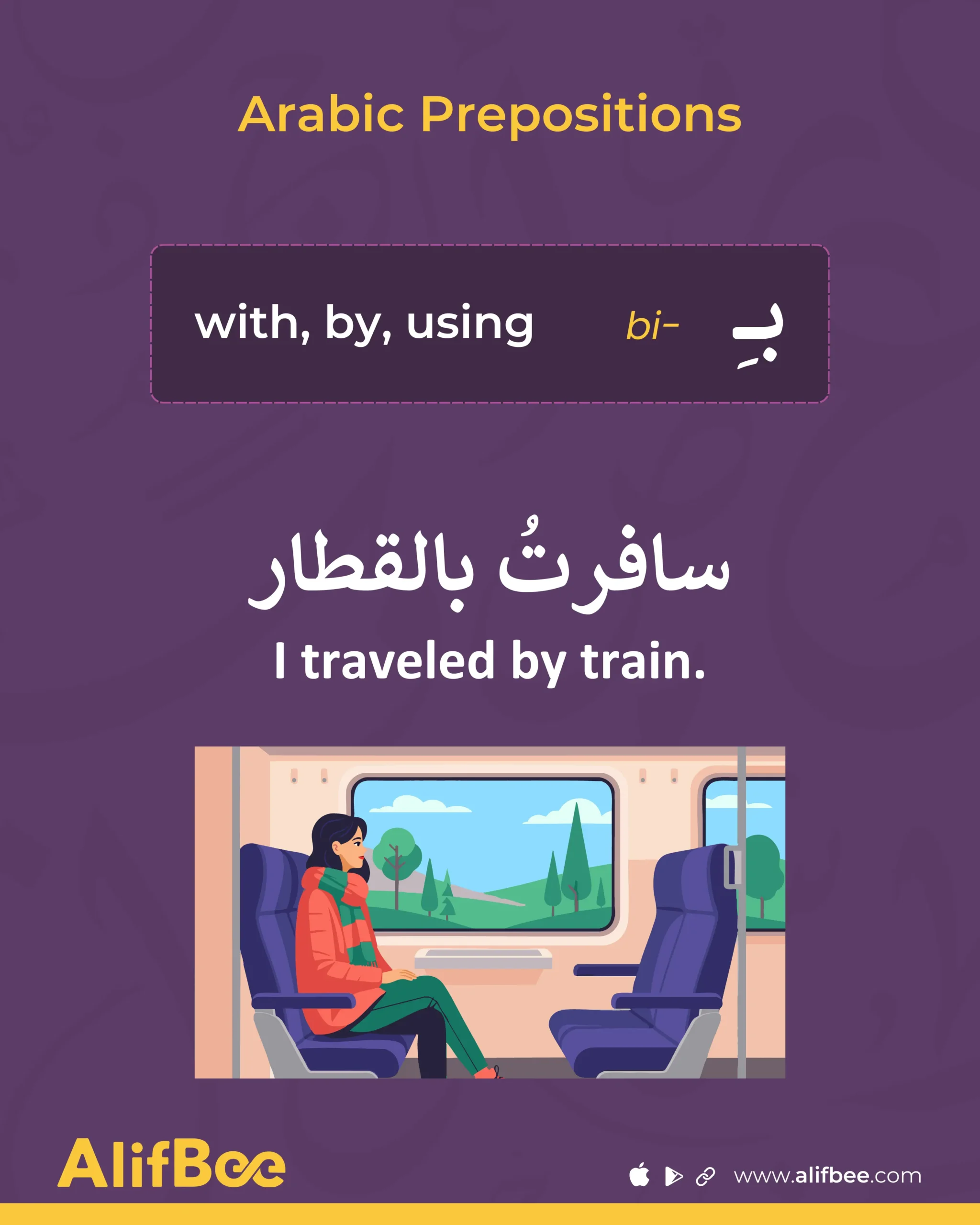
بـِ (Bi-) — with, by, using

Use بِـ to show how something is done, what tool is used, or what someone believes in or relies on.

Usage

English

Transliteration

Arabic Example

Means

I traveled by train

safartu bi-l-qiṭāri

سافرتُ بالقطار

Instrument

I am writing with my pencil

anā aktubu bi-qalamī

أنا أكتبُ بقلمي

Association

I believed in you

u’minu bika

أؤمن بكَ

More Arabic Prepositions with Examples

1

مع (ma’a) - with

Use ma’a when two people or things are together at the same time. It expresses companionship, not a tool or method.

English

Transliteration

Arabic Example

I chatted with my friend

taḥaddathu ma‘a ṣadīqī

تحدّثتُ مع صديقي

I had coffee with cream

sharibtu l-qahwa ma‘a l-kriīmati

شربتُ القهوة مع الكريمة

2

حتّى (ḥattā) — until / up to

The preposition ḥattā emphasizes the final limit or extreme end of an action. It often implies completion or reaching the last point.

Usage

English

Transliteration

Arabic Example

End point in time

We will stay until the rain ends.

sanabqā ḥattā yantahī al-maṭar

سنبقى حتى ينتهي المطر

Extent or completion

I ate the fish, even its head.

akaltu as-samakata ḥattā raʾsihā

أكلتُ السمكةَ حتى رأسِها

3

عند (ʿinda) - at, with

Use ʿinda to show where someone is, what someone has, or when something happens. It often answers “where?” or “with whom?”.

Usage

English

Transliteration

Arabic Example

at

I am at your house

anā ‘inda manzilik

أنا عند منزلك

With (possession)

The book is with Ahmad

al-kitābu ‘inda Aḥmad

الكتابُ عند أحمد

4

خلال (khilāl) - during, throughout

Use khilāl to describe something happening within a time period, not at a single moment.

English

Transliteration

Arabic Example

Throughout my travels

khilāla safari

خلال سفري

During the exam

khilāla l-imtiḥāni

خلال الامتحان

Common Mistakes When Using Arabic Prepositions

As mentioned earlier, the most common mistake learners make with Arabic prepositions is treating them like English ones. Arabic does not work that way.

English often uses a single preposition for several meanings, while Arabic chooses different prepositions based on the underlying idea. This happens because Arabic is concept-based rather than literal.

Another common mistake is assuming that each preposition has only one meaning. This assumption leads learners back to word-for-word translation, which, as we’ve seen, does not reflect how Arabic actually works.

Many beginners also overlook an important grammatical detail: even when the correct preposition is used, the noun that follows it must be in the genitive case, a rule that is frequently ignored.

Finally, learners sometimes add prepositions where Arabic simply does not need them, resulting in sentences that sound unnatural or incorrect.

Key Differences between Arabic and English Prepositions

There are many reasons why direct translation often fails, and it all comes down to one simple fact: a word in Arabic does not equal a word in English, especially when it comes to prepositions.

Given that English prepositions are usually general, while Arabic prepositions are verb- and context-dependent—especially since many Arabic verbs are not complete on their own and are often followed by a preposition and a noun that change the meaning of the verb itself—trying to translate the preposition on its own will lead to mistakes.

In addition, Arabic prepositions often express abstract and metaphorical relationships, not only physical ones, which are not captured by literal translation.

Summary

Even though it might sound complicated at first, getting the hang of Arabic prepositions is only a matter of time. You just need to think differently to use them correctly, and with time, practice, and some help from Alibee, you’ll be able to master them pretty quickly.

Practice Arabic prepositions and all basics in Arabic grammar with AlifBee, which turns dull grammar rules into fun activities and drills. 

Take the chance of the free 14-day trial period that gives you access to the full content of available courses. Download here.

FAQs

1. How many prepositions are there in Arabic?

Around 17 to 21.

2. Can one Arabic preposition have more than one meaning?

Yes, and honestly, it is most likely that it will.

3. Do Arabic prepositions affect the form of the noun that follows them?

Yes, Arabic prepositions significantly affect the noun that follows them, forcing it into the genitive case.

4. Why is it difficult to translate Arabic prepositions into English?

Because of the major difference between the two languages: English uses one preposition for many meanings, while Arabic uses different prepositions depending on the concept.

5. Can prepositions be used with verbs?

Yes, and prepositions often change the meaning of the verb.

Authors

  • Layla AlAhmar

    Layla Alahmar is a writer and proofreader with a master’s degree in Arabic literature and linguistics. At AlifBee, she creates clear and engaging educational content, blending storytelling with practical language insights to make Arabic learning accessible and inspiring.

  • Dania Ghraoui

    Dania is a teacher, translator, and content writer with a passion for making Arabic accessible and enjoyable for learners around the world. As the Blog Manager at AlifBee, she writes educational blogs that blend language tips, cultural insights, and practical learning strategies to support every Arabic learner’s journey.

Picture of Layla AlAhmar
Layla AlAhmar
Layla Alahmar is a writer and proofreader with a master’s degree in Arabic literature and linguistics. At AlifBee, she creates clear and engaging educational content, blending storytelling with practical language insights to make Arabic learning accessible and inspiring.
If you found this article helpful, please share it with your friends to spread the knowledge!
Facebook
LinkedIn
Telegram
X
Start your Arabic Learning Path with AlifBee!
syrian Logo
AlifBee App

Achieve incredible results with our platform Learn Arabic Online with AlifBee

AlifBee-Virtual School
AlifBee Virtual School

Join AlifBee Virtual School and master Arabic at your pace — from guided coaching to interactive self-learning.

AlifBee-Private Arabic Lessons
Private Arabic Lessons

Learn Arabic faster with live, one-on-one sessions tailored to your level and goals.

AlifBee-Books
AlifBee Workbooks Series

Explore AlifBee’s complete range of Arabic learning books for all ages!
Related Posts