
Arabic is a culturally rich language that carries an oral and poetic tradition, making it one of the beautiful languages to learn. It is elegant, rich in vocabulary, and highly expressive. Despite being over 2,000 years old, it remains one of the fastest-growing languages in the world.
Is it a beautiful language? Yes. Is it hard to learn? Also, yes. However, you don’t have to learn everything at once or start speaking fluent Arabic from the get-go. Instead, you can take your time and learn small words at first, such as good morning in Arabic.
In today’s post, we’ll teach you 12 different ways to greet someone in the morning in Arabic and initiate a conversation on a positive note.
How to Say Good Morning in Arabic
In Arabic, greetings are metaphorical, and they depend on the time of the day, the relationship you have with the person you’re greeting, their gender, and the area they are in. Arabic speakers commonly use positive and imagery words, such as light, flowers, and blessings, in their greetings to express emotions with just a few words.
Moreover, common greetings vary from one country to another. You can either learn Modern Standard Arabic (MSA), which is also known as fusha, and be understood by all native speakers. Or, you can pick a regional variation, such as Egyptian and Levantine, which use informal greetings and reflect the Arab culture of these rich regions and the unique Arabic morning that is linked to beauty and serenity.
Regardless of what you choose, we have compiled a comprehensive list so you have Arabic expressions to use in formal and informal situations.
12 Most Common Ways to Say Good Morning in MSA Arabic
The Arabic phrases we will look at are in MSA and key local variations. Let’s start with four phrases that are understood across Arabic-speaking countries. These are heard in the news and formal TV programs or used in formal writing.
صباحُ الخير (Ṣabāḥu l-khayr) — “Good Morning”
Ṣabāḥu l-khayr is the standard way of saying good morning in Arabic and can be used in both formal and informal settings. If someone says Ṣabāḥu l-khayr to you, you can return the greetings with Ṣabāḥu or Ṣabāḥu n-nūr.
صباحُ النور (Ṣabāḥu n-nūr) — “Morning of light”
Ṣabāḥu n-nūr is another way to say Sabah al-khair, and it is one of the most poetic responses to it. It is also one of the most poetic responses to Ṣabāḥu l-khayr. In literal meanings, nūr means “light” while Ṣabāḥu means “morning,” and when you combine the two words, it translates to “morning of light.” However, you can also use it as a standalone metaphorical way to wish someone, especially your close friends and family, a very bright morning.
Moreover, “nūr” culturally also signifies hope. So alternatively, you can also use Ṣabāḥu n-nūr to wish someone a morning full of hope.
أسعدَ اللهُ صباحك (Asʿada Allāh ṣabāḥak) — “May God make your morning happy”
Asʿada Allāh ṣabāḥak is frequently used in both Levantine Arabic and MSA, especially in TV programs and news openings. Asʿada Allāh ṣabāḥak translates to “May God make your morning happy.” If you’re greeting a female, “ṣabāḥak” will become “ṣabāḥuki.” And when greeting a group, or more than one, then “ṣabāḥak” will become “ṣabāḥukum.”
نهارك سعيد (Nahāruka saʿīd) — “Have a nice day”
Nahāruka saʿīd is used in formal speeches, official documents, or TV programs. In literal words, Nahāruka saʿīd translates to “Have a nice day.” While it is less common compared to Ṣabāḥu l-khayr, you can still use Nahāruka saʿīd to close conversations.
Morning Greetings in Egyptian Arabic
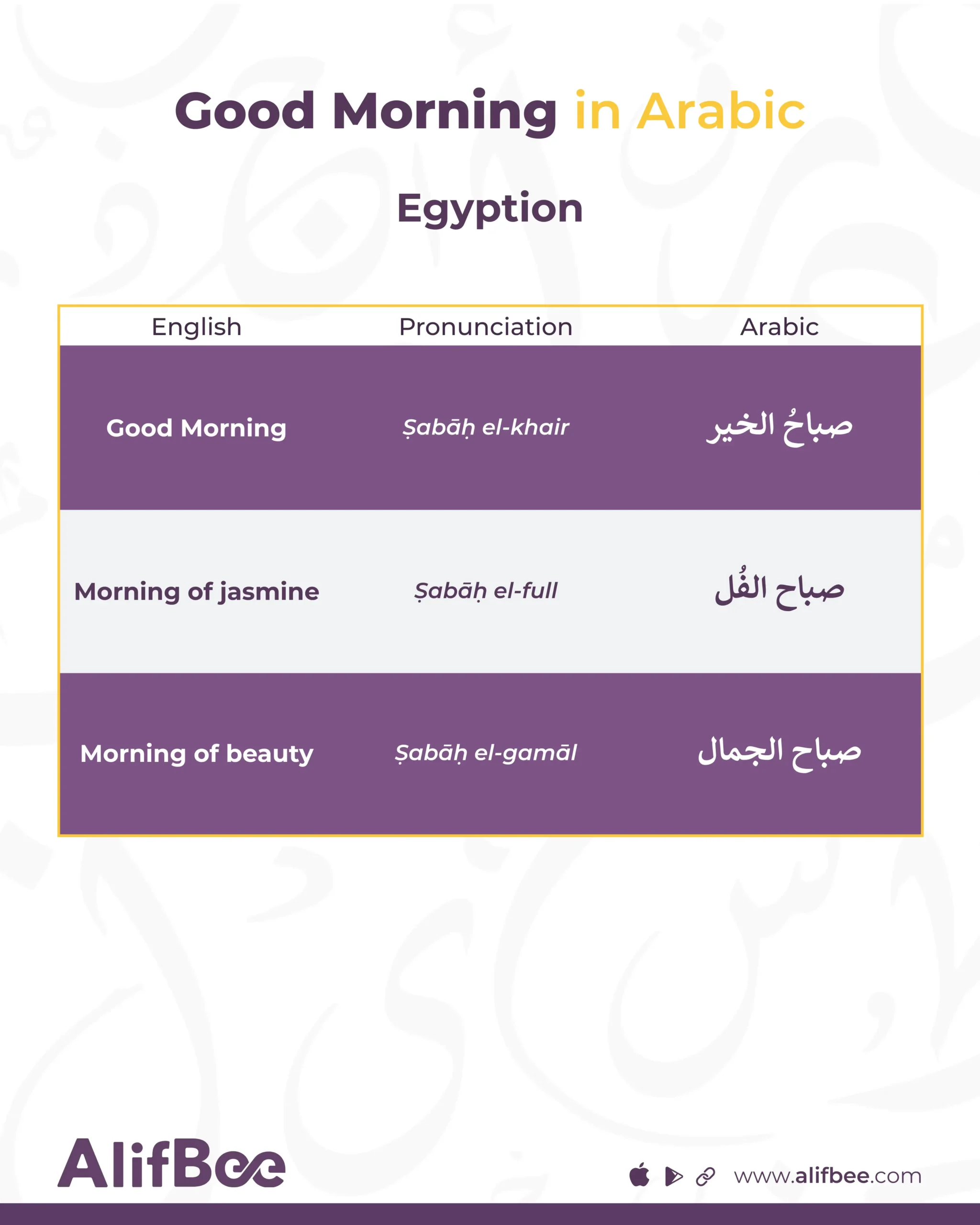
صباح الخير (Ṣabāḥ el-khair) — “Good morning”
Ṣabāḥ el-khair is the alternative MSA pronunciation of Ṣabāḥu l-khayr. While both translate to “good morning,” Ṣabāḥ el-khair is often used in the Egyptian Arabic.
صباح الفُل (Ṣabāḥ el-full) — “Morning of jasmine”
Ṣabāḥ el-full translates to “Morning of jasmine,” and it is very commonly used in Egyptian films to add a romantic and poetic touch to the scene. Arabic speakers usually use this phrase to greet their loved ones in the morning.
صباح الجمال (Ṣabāḥ el-gamāl) — “Morning of beauty”
Similar to Ṣabāḥ el-full or morning of jasmine, Ṣabāḥ el-gamāl is flirty and casual. It translates to “Morning of beauty,” and is commonly used in Egypt.
Morning Greetings in Levantine Arabic
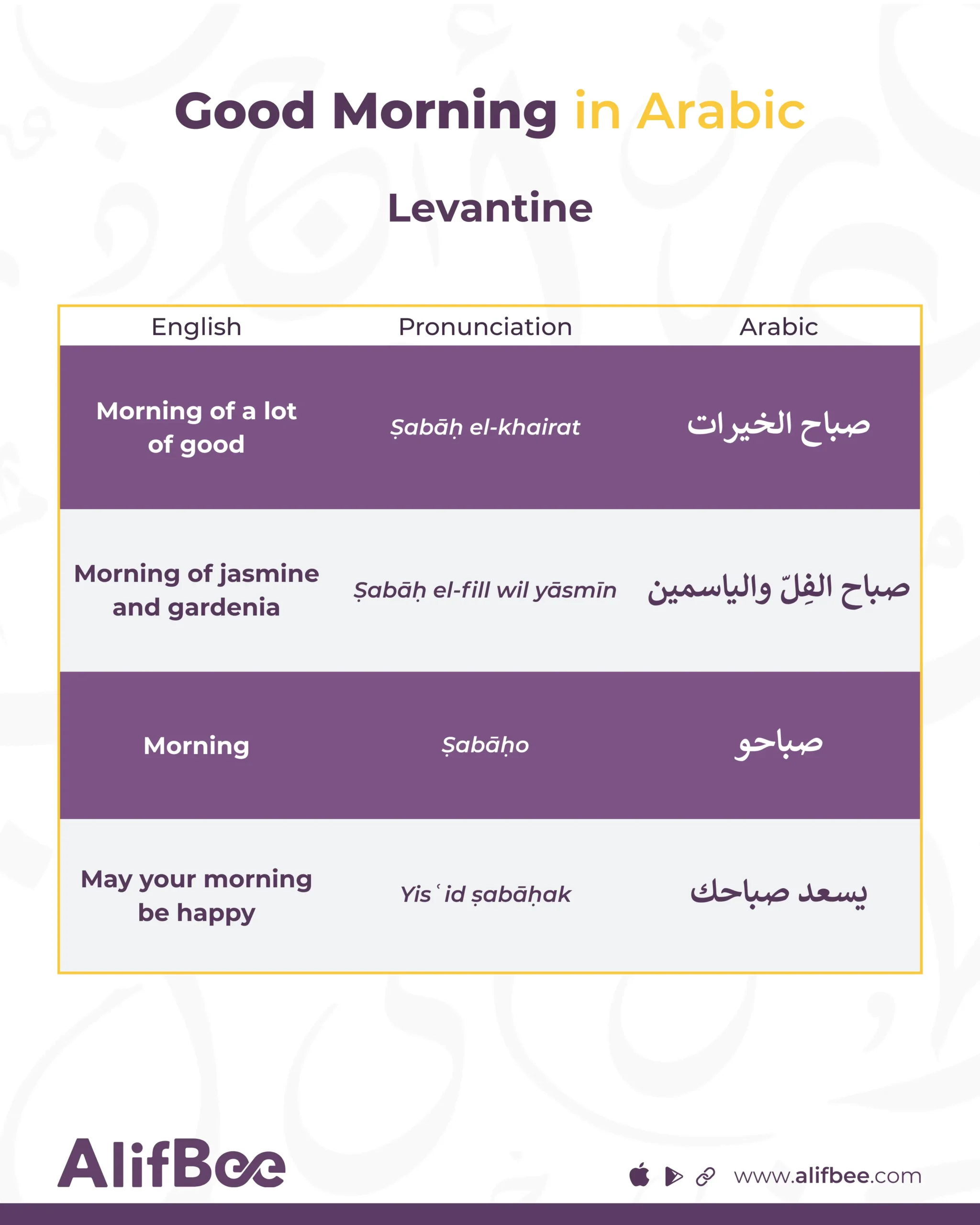
صباح الخيرات (Ṣabāḥ el-khairat) — “Morning of a lot of good”
Ṣabāḥ el-khairat, which translates to “Morning of a lot of good,” is another variation of Ṣabāḥ el-khair, but with more emphasis on the greetings. In the Levantine Arabic, it is used as a response to Ṣabāḥ el-khair.
صباح الفِلّ والياسمين (Ṣabāḥ el-fill wil yāsmīn) — “Morning of jasmine and gardenia”
Ṣabāḥ el-fill wil yāsmīn is an Egyptian Arabic greeting which carries the same sentiment as Ṣabāḥ el-full or “Morning of jasmine.” The literal meaning of Ṣabāḥ el-fill wil yāsmīn is “Morning of jasmine and gardenia.”
Ṣabāḥ el-fill wil yāsmīn is used as a warm and intimate greeting among family members in the Levantine region, especially in Damascus. Damascus is also known as the city of jasmine.
صباحو (Ṣabāḥo) — “Morning”
Ṣabāḥo is one of the most common and informal ways used to greet someone in the morning or wish someone a good day, especially amongst family and friends. The literal meaning of Ṣabāḥo is “Morning,” which is a shortened version of Ṣabāḥu l-khayr or Ṣabāḥu n-nūr.
You can use Ṣabāḥo when you are in a hurry and don’t have time to indulge in a long conversation. For instance, when getting late for work in the morning and you see your neighbor, you can say Ṣabāḥo with a smile. In reply to Ṣabāḥo, you can say “Ṣabāḥo” back.
يسعد صباحك (Yisʿid ṣabāḥak) — “May your morning be happy”
Yisʿid ṣabāḥak is commonly used in Levantine, and it translates to “May your morning be happy” or “Have a happy morning.” You can use it as both casual and formal morning greetings. However, the greeting will change depending on the gender you are speaking to. When talking to a female, ṣabāḥak will become ṣabāḥek, and when greeting a group or more than one person, you will use “ṣabāḥakum.”
Morning Arabic Greetings in Gulf Arabic
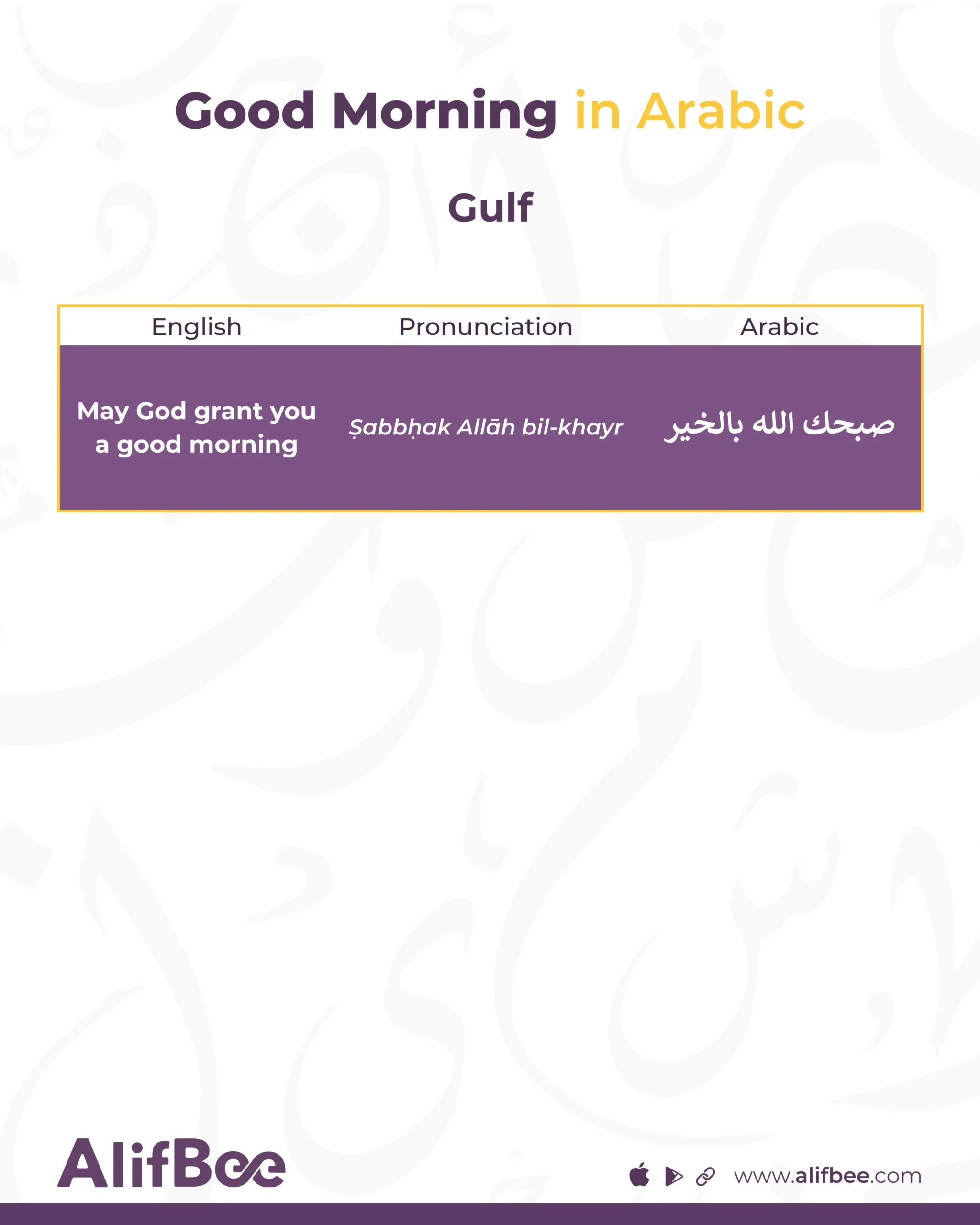
صبحك الله بالخير (Ṣabbḥak Allāh bil-khayr) — “May God grant you a good morning”
If you want to greet someone in a traditional, polite, and respectful way, you can say Ṣabbḥak Allāh bil-khayr, which literally means “May God grant you a good morning.” It is a common way in the Gulf region for respectfully greeting close friends or family members. It is also a common way to say good morning in muslim communities.
Morning Greetings Summary Chart
Type
English Translation
Pronunciation
Arabic Phrase
MSA
Good Morning
Ṣabāḥu l-khayr
صباحُ الخير
MSA
Morning of light
Ṣabāḥu n-nūr
صباحُ النور
MSA
May God make your morning happy
Asʿada Allāh ṣabāḥak
أسعدَ اللهُ صباحك
MSA
Have a nice day
Nahāruka saʿīd
نهارك سعيد
Egyption
Good morning
Ṣabāḥ el-khair
صباح الخير
Egyption
Morning of jasmine
Ṣabāḥ el-full
صباح الفُل
Egyption
Morning of beauty
Ṣabāḥ el-gamāl
صباح الجمال
Levantine
Morning of a lot of good
Ṣabāḥ el-khairat
صباح الخيرات
Levantine
Morning of jasmine and gardenia
Ṣabāḥ el-fill wil yāsmīn
صباح الفِلّ والياسمين
Levantine
Morning
Ṣabāḥo
صباحو
Levantine
May your morning be happy
Yisʿid ṣabāḥak
يسعد صباحك
Gulf
May God grant you a good morning
Ṣabbḥak Allāh bil-khayr
صبحك الله بالخير
Review Morning Greetings

Cultural Meaning of Morning Greetings in Arab Countries
Arabic is one of the oldest as well as fastest-growing languages in the world. While the MSA or Fusha Arabic has remained consistent, there have been differences in other dialects that were developed over centuries due to various cultural and regional influences. But despite these slight differences, greetings have always held the highest importance in the Arab world.
Arab people value family relationships and communities, which is why morning greetings are so important and central to their culture. Morning greetings in Arabic are often polite, warm, and reflect kindness and hospitality. For instance, when you say Ṣabāḥu n-nūr or “morning of light” to someone, it evokes emotions and expresses warmth and politeness.
However, before learning the good morning Arabic phrases, it’s important to know the greeting differences between Arab regions, including the Gulf, the Levant, Egypt, and North Africa.
Gulf Region (Saudi Arabia, UAE, Qatar, Kuwait)
The Gulf region, including Saudi Arabia, Bahrain, Qatar, Oman, the United Arab Emirates, and Kuwait, has much more MSA influence compared to other regions. Therefore, in the Gulf, you will find formal greetings more common. Moreover, in this part of the region, greetings have an Islamic influence. For instance, Ṣabbḥak Allāh bil-khayr, which translates to “May God grant you a good morning,” is a way of saying good morning in Islam.
Levant (Lebanon, Syria, Jordan, Palestine)
In the Levantine region, which includes Lebanon, Syria, Jordan, and Palestine, greetings are used as a more metaphorical and poetic way to express oneself. You can say a simple Ṣabāḥo to greet someone in the Levantine dialect. However, if you’re speaking to someone very close, like a family member or friend, you can greet them with Ṣabāḥ el-fill wil yāsmīn.
Apart from being more poetic, Levantine Arabic has a bit different pronunciation features compared to other dialects. In Levantine, “qaf” (ق) is pronounced as a glottal stop, which is a sound made by stopping the airflow in your throat.
Egypt & North Africa
Besides the MSA, the Egyptian dialect is the most spoken form of Arabic, with over 90 million Egyptians speaking it daily. Unlike MSA, Egyptian Arabic is fast-paced, much more relaxed, and is locally used in everyday conversations. Moreover, the Egyptian dialect is full of unique phrases that you will not hear in MSA. For instance, Egyptians commonly say Izzayak (ازيك), which translates to “How are you?” You will not find this phrase in MSA or any other dialect.
But do you know, Egypt is not the only country with its unique Arabic dialect. Other Arab countries in North Africa, including Algeria, Libya, Morocco, Sudan, and Tunisia, all have their own local dialect.
When and How to Use These Greetings (Real-Life Examples)
Knowing different Arabic greetings is only half of the learning. The next part is knowing when and how to use these greetings in real life.
For instance, if you’re in the office using a lift and a colleague joins you, you can use a casual and more relaxed phrase to greet them, such as Ṣabāḥo. It will help initiate a conversation and maintain a positive vibe. On the other hand, when greeting friends and family at a morning tea, you can go one step ahead and use Ṣabāḥu l-khayr.
But when you really have the chance to greet someone in Arabic, why not use that opportunity to be more poetic? You can use poetic greetings, such as “Ṣabāḥ el-full” and “Ṣabāḥ el-fill wil yāsmīn,” when meeting a close friend or a family member and you want to express your joy to see them and appreciation to have them in your life.
Final word
Arabic is a beautiful language that is spoken by hundreds of millions of people across the world. When you think about talking to an Arabic speaker, the best and right way to start a conversation is with a greeting. Greetings in the Arabic culture reflect respect, hospitality, and connection.
These were only some of the most common greetings that we covered in this post. However, your learning doesn’t stop here. Now think of how many ways you can say goodbye in Arabic! Learning Arabic is a fun and exciting journey, especially when you can do it at your own pace and from anywhere in the world.
Ready to learn Arabic online with AlifBee? Click here to download the app and start your journey with a free trial!