Levantine Arabic or MSA? A Guide for Arabic Learners to Choose the Right Arabic Dialect

Reading Time: 8 minutes
Home / Arabic Learning Strategies / Levantine Arabic or MSA? A Guide for Arabic Learners to Choose the Right Arabic Dialect
Loading audio...

When it comes to learning Arabic, many new learners get a bit confused—and that’s totally normal! Unlike many other languages, the Arabic “tree” branches out into many different dialects, each representing a distinct regional form, but all stemming from the same root.

In the past, Arabic was spoken much like it is written. Of course, there were minor pronunciation differences across regions, but Arabic speakers could generally understand one another without much difficulty. Over time, however, each region developed its own unique dialect, influenced by various historical, cultural, and social factors. Today, these differences can sometimes make mutual understanding a challenge.

That said, there is one form of Arabic that is widely understood, even if they don’t use it daily: Modern Standard Arabic (MSA). This is the formal version of the language, used in writing, official communication, media, and formal speeches.

Because of this, many new learners—especially those who want to communicate in everyday situations—choose to learn a dialect (Most commonly Levantine or Egyptian) instead of MSA. This is where the beauty of the Levantine accent comes in, also known as the “common tongue,” which is widely spoken in the Levant: Lebanon, Syria, Jordan, and Palestine.

In this article, we’ll explore the key differences between MSA and Levantine Arabic to give beginners an idea of what they will encounter on their adventure in learning Arabic!

What is Modern Standard Arabic?

MSA is the standardized and formal version of Arabic used across the Arab world. It’s the form taught in schools and used in writing, official documents, and formal communication.

It is based on Classical Arabic but modernized for contemporary use, and it is understood by Arabic speakers everywhere—simply put, it is the universal Arabic language.

This is probably the main reason most learners start with MSA: it teaches you how to read, write, and pronounce the Arabic alphabet correctly.

Learning MSA is straightforward because you follow structured lessons. It’s similar to learning any other language: you start with the alphabet, practice pronouncing and writing the letters, learn how to form sentences with proper grammar, and gradually expand your vocabulary through practice. There are many courses, apps, and BLOGS available to guide you along the way.

What is Levantine Arabic?

As we mentioned earlier, Levantine Arabic is a dialect spoken in Lebanon, Syria, Jordan, and Palestine. It is also known as the “common tongue” or the “white dialect,” because it is considered the easiest Arabic dialect to understand for most, if not all, Arabic speakers.

Unlike some other dialects, such as Maghrebi Arabic, Levantine was not heavily influenced by other languages, which makes it closer to Classical Arabic. Often described as calm, smooth, and melodic, it is more relaxed and easier to pronounce, making it the top choice for new learners interested in conversational Arabic.

Learning Levantine is arguably the best way to start learning Arabic. It is simpler than MSA, doesn’t strictly follow formal rules or grammar, and is easier to pick up when interacting with native speakers. You can also learn it through TV shows, movies, and conversation. Over time, mastering Levantine can be a strong stepping stone toward learning MSA.

MSA vs. Levantine: key differences every Arabic learner should know.

When it comes to grammar, MSA has simple rules you can follow to switch from one tense to another. Levantine, on the other hand, doesn’t really follow strict rules—you just get used to it with practice.

Notice how Levantine is smoother and easier to pronounce.

The real challenge comes with continuous and future tenses, which can be a bit more complicated. But fear nothing! I’m going to introduce you to two key words—consider them your new best friends when learning Levantine:

Meet رح (raḥ) and عم (ʿam):

رح (raḥ): used before the verb to indicate it will happen in the future.

عم (ʿam): used before the verb to indicate it is happening right now

 Example with MSA:

Tense

English

MSA

Pronunciation

Continuous

I’m writing

Ana aktubu

أنا أكتُبُ

Future

I will write

Ana sa-aktubu

أنا سأكتُبُ

With Levantine Dialect:

Tense

English

Levantine dialect

Pronunciation

Continuous

I’m writing

ʿam bektob

عم بكتب

Future

I will write

raḥ ektob

رح إكتب

Pronunciation: How the Levantine Dialect Softens MSA Pronunciation

When it comes to pronunciation, the Levantine dialect is smoother and much easier for foreign learners, since it replaces some of the harder letters to pronounce with softer and easier alternatives, making it overall more flowy.

  • Stress and rhythm: MSA is more formal and less melodic, while Levantine is more melodic and stress tends to fall naturally on certain syllables.
  • Vowel sounds: In MSA, both long and short vowels are clearly pronounced, while in Levantine the vowels are often shortened and sometimes altered.

Example: MSA: كَتَبَ (kataba) → LD: كتب (ktab).

  • The letter ق (qaf): In MSA, the letter (qaf) is a hard sound from the back of the throat. It is transformed into a simple أ (a) in Levantine dialect.

Example: The word “heart,” MSA: قلب (qalb) → LD: ألب (ʾalb).

  • The letter ذ (th as in “this”): Which is replaced in Levantine with د (d).

Example: The word “gold,” MSA: ذهب (thahab) → LD: دَهَب (dahab).

  • The letter ث (th as in “theater”): Which is replaced in Levantine with ت (t).

Example: The word “fox,” MSA: ثعلب (tha’alab) → LD: تَعْلَب (ta’alab).

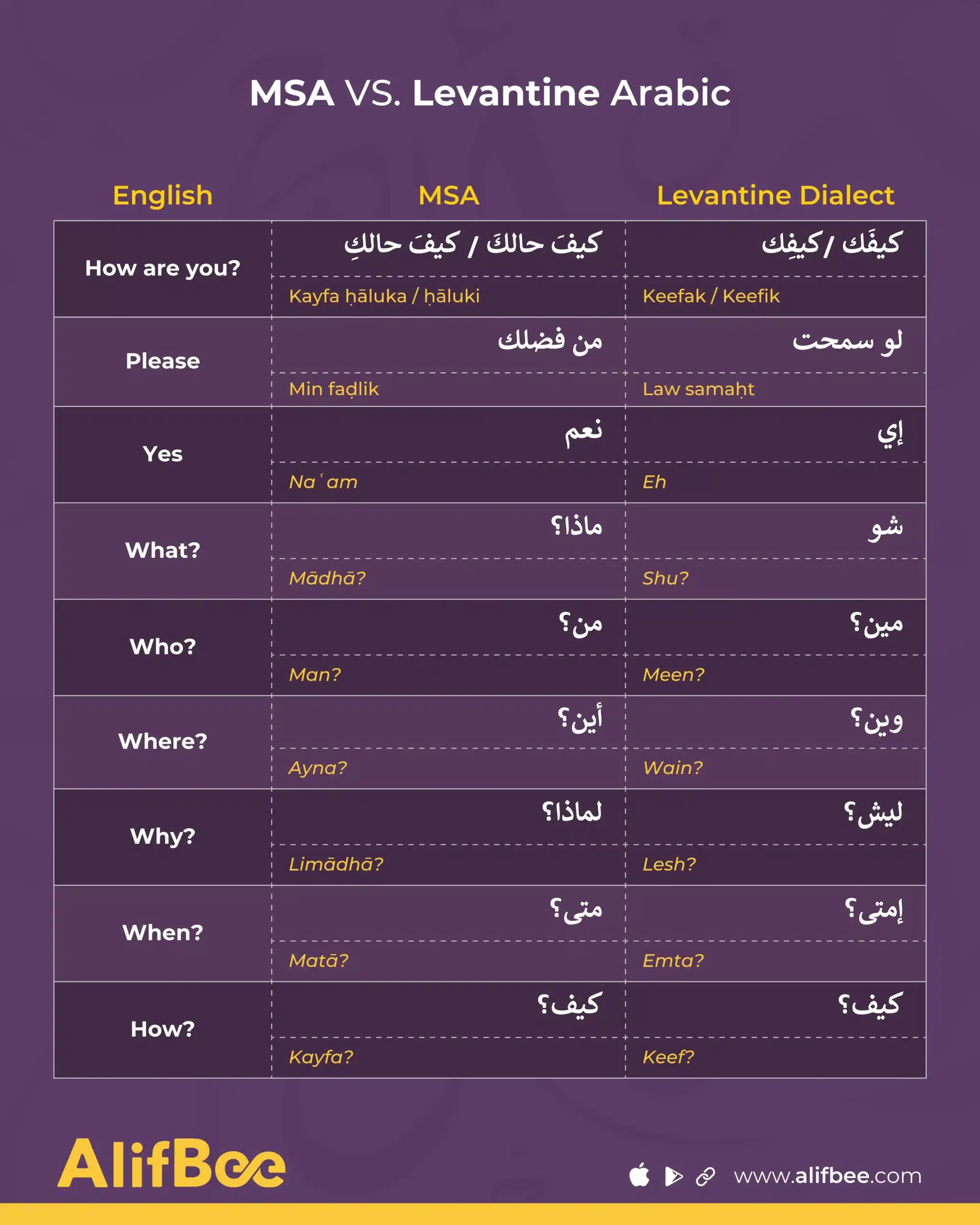
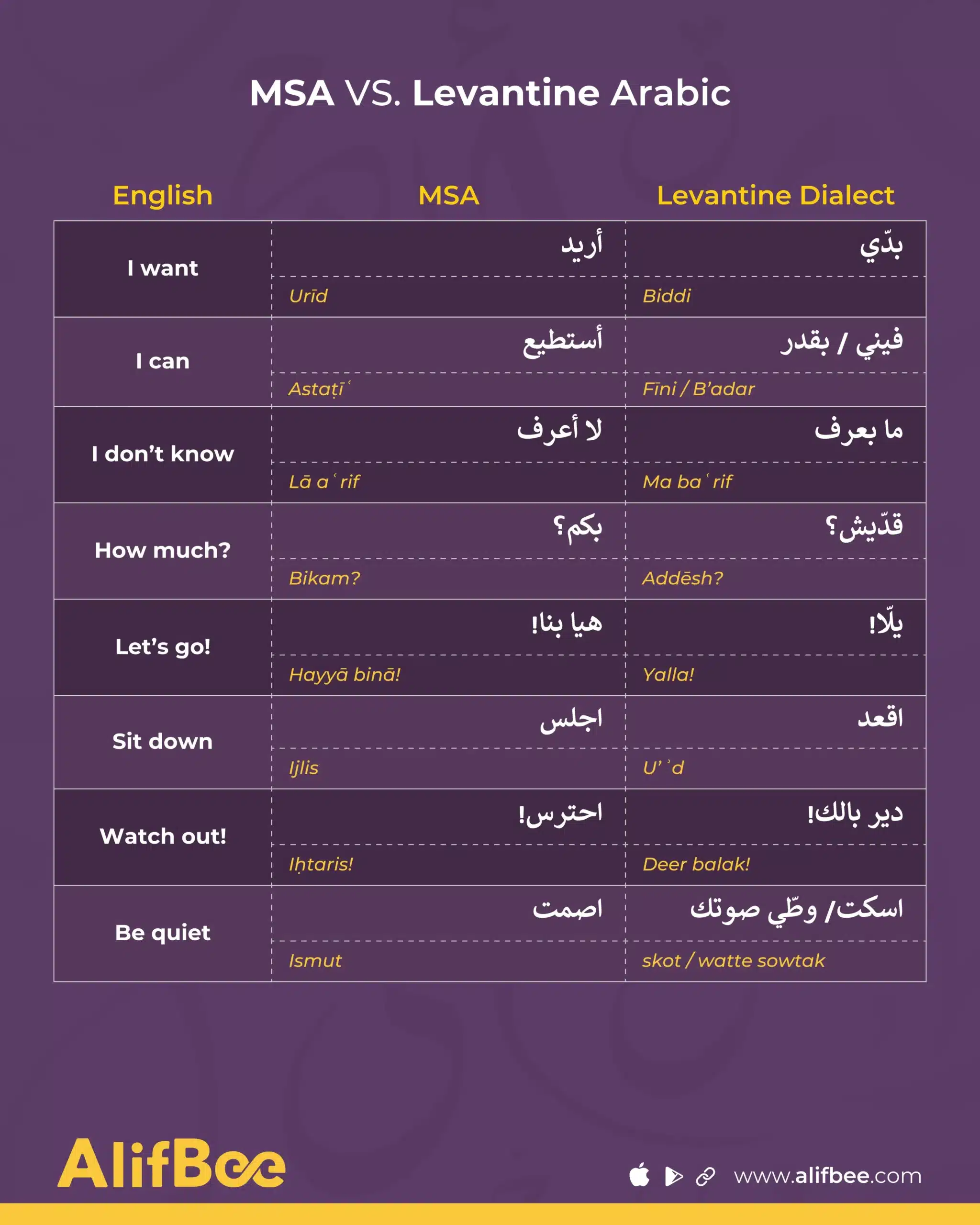
Vocabulary: Main Distinctions Between MSA and Levantine Words

Here’s a list of common everyday words and expressions in the Levantine Dialect and MSA:

English

MSA

Pronunciation

Levantine Dialect

Pronunciation

how are you? M

Kayfa ḥāluka

كيفَ حالكَ

Keefak

كيفَك

how are you? F

Kayfa ḥāluki

كيفَ حالكِ

Keefik

كيفِك

Please

Min faḍlik

من فضلك

Law samaḥt

لو سمحت

yes

Naʿam

نعم

Eh

إي

What?

Mādhā?

ماذا؟

Shu?

شو

Who?

Man?

من؟

Meen?

مين؟

Where?

Ayna?

أين؟

Wain?

وين؟

Why?

Limādhā?

لماذا؟

Lesh?

ليش؟

When?

Matā?

متى

Emta?

إمتى؟

How?

Kayfa?

كيف؟

Keef?

كيف؟

I want

Urīd

أريد

Biddi

بدّي

I can

Astaṭīʿ

أستطيع

Fīni

فيني

I can

Astaṭīʿ

أستطيع

B’adar

بقدر

I don’t know

Lā aʿrif

لا أعرف

Ma baʿrif

ما بعرف

How much?

Bikam?

بكم؟

Addēsh?

قدّيش؟

Let’s go!

Hayyā binā!

هيا بنا!

Yalla!

يلّا

Sit down

Ijlis

اجلس

U’ʾd

اقعد

Watch out!

Iḥtaris!

احترس!

Deer balak!

دير بالك!

Be quiet

Ismut

اصمت

skot

اسكت

Be quiet

Ismut

اصمت

watte sowtak

وطّي صوتك

Which Arabic dialect should you learn first?

Learn MSA if you want a strong language foundation:

If your goal is writing and reading in Arabic, or even studying it academically, then MSA is the way to go. Since it starts with the Arabic alphabet, it gives you a strong and steady foundation to begin building your Arabic language knowledge.

It’s also very helpful if you want to learn spoken dialects later on, as it gives you a solid command of letter sounds. After all, it is the original form of Arabic from which all other dialects developed.

Learn Levantine dialect if you want to speak Arabic quickly:

If your goal is to learn quickly and connect with other speakers—maybe for tourism, traveling, or just to chat with an Arab friend—Levantine is the way to go, as you’ll definitely pick it up much faster than MSA.

Choosing the right path:

Choosing the right path can be confusing for beginners, and that’s totally okay—especially since some of them don’t want to pick one over the other. The truth is, you don’t have to; you can get the best of both worlds.

Many learners, in fact, use methods that combine both. The easiest way to do this is to learn the Arabic alphabet while learning Levantine dialect by watching subtitled Arabic shows. With each new word you learn, you can check how it’s pronounced in both MSA and Levantine dialect. With practice, you’ll start getting the hang of it bit by bit.

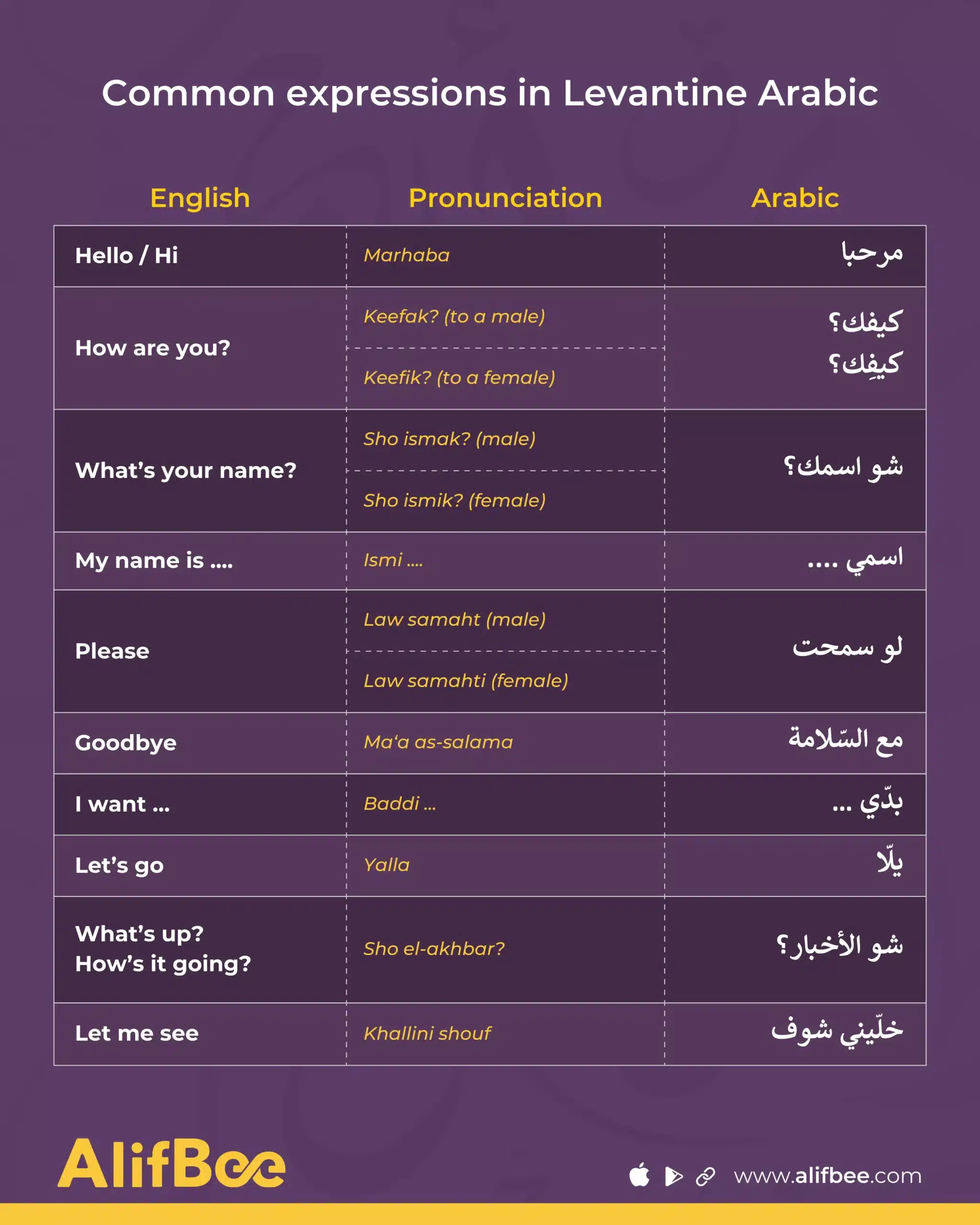
Common expressions in Levantine Arabic

English

Pronunciation

Arabic Phrase

Hello / Hi

Marhaba

مرحبا

How are you? (M)

Keefak?

كيفك؟

How are you? (F)

Keefik

كيفِك؟

What’s your name? (M)

Sho ismak?

شو اسمَك؟

What’s your name? (F)

Sho ismik?

شو اسمِك؟

Please (M)

Law samaht

لو سمحتَ

Please (F)

Law samahti

لو سمحتِ

My name is…

Ismi…

اسمي

Goodbye

Ma‘a as-salama

مع السّلامة

I want…

Baddi…

بدّي…

Let’s go

Yalla

يلّا

What’s up? / How’s it going?

Sho el-akhbar?

شو الأخبار؟

Let me see

Khallini shouf

خلّيني شوف

Is Levantine Arabic the easiest Arabic Dialect?

Levantine is arguably the easiest Arabic dialect, and that shows in how quickly new learners pick it up. But the real question is: what makes it easier?

  • Softer pronunciation
  • Simple verb conjugation
  • Melodic and flowy
  • Every day usefulness
  • Shorter words
  • Beginner-friendly rhythm
  • Strong media exposure

And if you’re still confused on which one you should learn first, you can ask yourself one simple question, and you’ll find the right path in your own answer:

Why are you learning Arabic?

If your answer was to be able to read and write it, then you should probably prioritize learning MSA.

However, if your answer was ‘I want to be able to communicate with other speakers,’ then you should start your learning journey with a spoken Arabic dialect.

Either way, whatever path you choose will lead you to the other soon enough.

Review Levantine Arabic or MSA?

Final Word

The Arabic language is rich and beautiful, no matter which variety you choose to learn. You’ll find yourself carried away by the melodic flow of its words, and being able to communicate in Arabic will make you feel part of something magnificent—something far beyond letters and words.

Now that you have everything you need to know, you can begin your new journey. We’re here to support you every step of the way—explore more blogs on AlifBee and get started today.

Picture of Layla AlAhmar
Layla AlAhmar
Layla Alahmar is a writer and proofreader with a master’s degree in Arabic literature and linguistics. At AlifBee, she creates clear and engaging educational content, blending storytelling with practical language insights to make Arabic learning accessible and inspiring.
If you found this article helpful, please share it with your friends to spread the knowledge!
Facebook
LinkedIn
Telegram
X
Start your Arabic Learning Path with AlifBee!
syrian Logo
AlifBee App

Achieve incredible results with our platform Learn Arabic Online with AlifBee

AlifBee-Virtual School
AlifBee Virtual School

Join AlifBee Virtual School and master Arabic at your pace — from guided coaching to interactive self-learning.

AlifBee-Private Arabic Lessons
Private Arabic Lessons

Learn Arabic faster with live, one-on-one sessions tailored to your level and goals.

AlifBee-Books
AlifBee Workbooks Series

Explore AlifBee’s complete range of Arabic learning books for all ages!

Related Posts