Simple Introduction to Tajweed Rules for Arabic Learners

|
Reading Time: 10 minutes
Home / Islamic Arabic / Simple Introduction to Tajweed Rules for Arabic Learners
Listen to: Simple Introduction to Tajweed Rules for Arabic Learners
Listening Bee

Tajweed is an Islamic science that focuses on the correct pronunciation of Arabic letters when reading the Holy Quran. In simple terms, Tajweed means pronouncing letters clearly in both sound and articulation while reciting each verse.

Tajweed rules help Muslims recite the Quran accurately and better understand its meanings. However, these rules are not limited to religious recitation; they are also useful for anyone learning Arabic, as they help learners pronounce difficult letters correctly and improve their speech.

In this article, we will explore Tajweed for beginners, covering Noon Sakinah and Tanween, Meem Sakinah Rules, Madd, Qalqalah and pause and start rules. We end with common mistakes learners often make.

If you are completely new to Quranic reading, it helps to start with Noorani Qaida before diving deeper into Tajweed rules. Our guide to Learn Arabic with Noorani Qaida explains how this step-by-step method teaches Arabic letters, harakat, tanween, sukoon, shaddah, and basic Tajweed foundations for accurate recitation. It is especially useful for beginners who want a clearer path toward reading the Quran with confidence.

If you are still building your Arabic foundation, it helps to pair this lesson with a few related AlifBee guides. Our post on Arabic for Beginners gives you a broader starting point, 50 Easy Arabic Words for Beginners adds useful everyday vocabulary, and Top 10 Basic Arabic Sentences for Beginners shows you how simple words come together in real communication. Reading them alongside this article can help you understand the topic more clearly and use the new vocabulary in context.

Did You Know?

The linguistic meaning of tajweed is "to improve" or "to make beautiful". The technical meaning is to give every letter its proper pronunciation, ensuring the correct point of articulation and qualities of each letter.

What Are Tajweed Rules?

The rules of Tajweed help readers pronounce Quranic words correctly and clearly. They explain how the letters of the Arabic alphabet should be pronounced when reciting the Quran, guiding readers to pronounce them from their correct articulation point (makhraj), while taking into account their natural characteristics and the changes that may occur in different contexts.

Tajweed helps readers: 

  • Pronounce Arabic letters correctly.
  • Preserve the meaning of Qur’anic words and reflect on them.
  • Maintain the proper rhythm of recitation, making memorizing the Qur’an easier.

Why Learning Tajweed Is Important

Learning Tajweed rules is essential for Muslims reciting the Quran, but it is also important for all Arabic language learners. Whether for religious or linguistic reasons, Tajweed benefits both groups because it:

  •  Prevents mispronunciation of Arabic letters, helping learners sound more accurate and confident.
  • Preserves the meaning of Quranic words, so the sacred text is recited as intended.
  • Improves fluency when reciting the Quran, making the reading smoother and easier to follow.

The Most Important Tajweed Rules for Beginners

While Tajweed rules are numerous and complex, beginners should start with the most common and frequently used ones. By mastering these rules, learners can cover a large part of the most commonly encountered Tajweed rules when reading the Quran.

Noon Sakinah and Tanween

This is one of the most important tajweed rules. But before discussing the rules, what exactly do we mean by Noon Sakinah?

Noon Sakinah (نُون سَاكِنَة) is the letter ن (noon) that carries a sukoon ( ْ ), meaning it is free from any vowel markers (harakat) such as Fatha, Damma, or Kasra. It can appear in the middle of a word or at the end, but never at the beginning, because Arabic words do not begin with a consonant.

The same “n” sound can also come from Tanween (تنوين), which are double vowel signs: tanween fatḥ (ً), tanween ḍamm (ٌ), or tanween kasr (ٍ). In this case, the “n” sound appears at the end of the word even though the letter ن is not written.

Therefore, whether you see a Noon Sakinah (نْ) or the tanween signs, these Tajweed rules apply.

1. Izhaar (الإظهار)

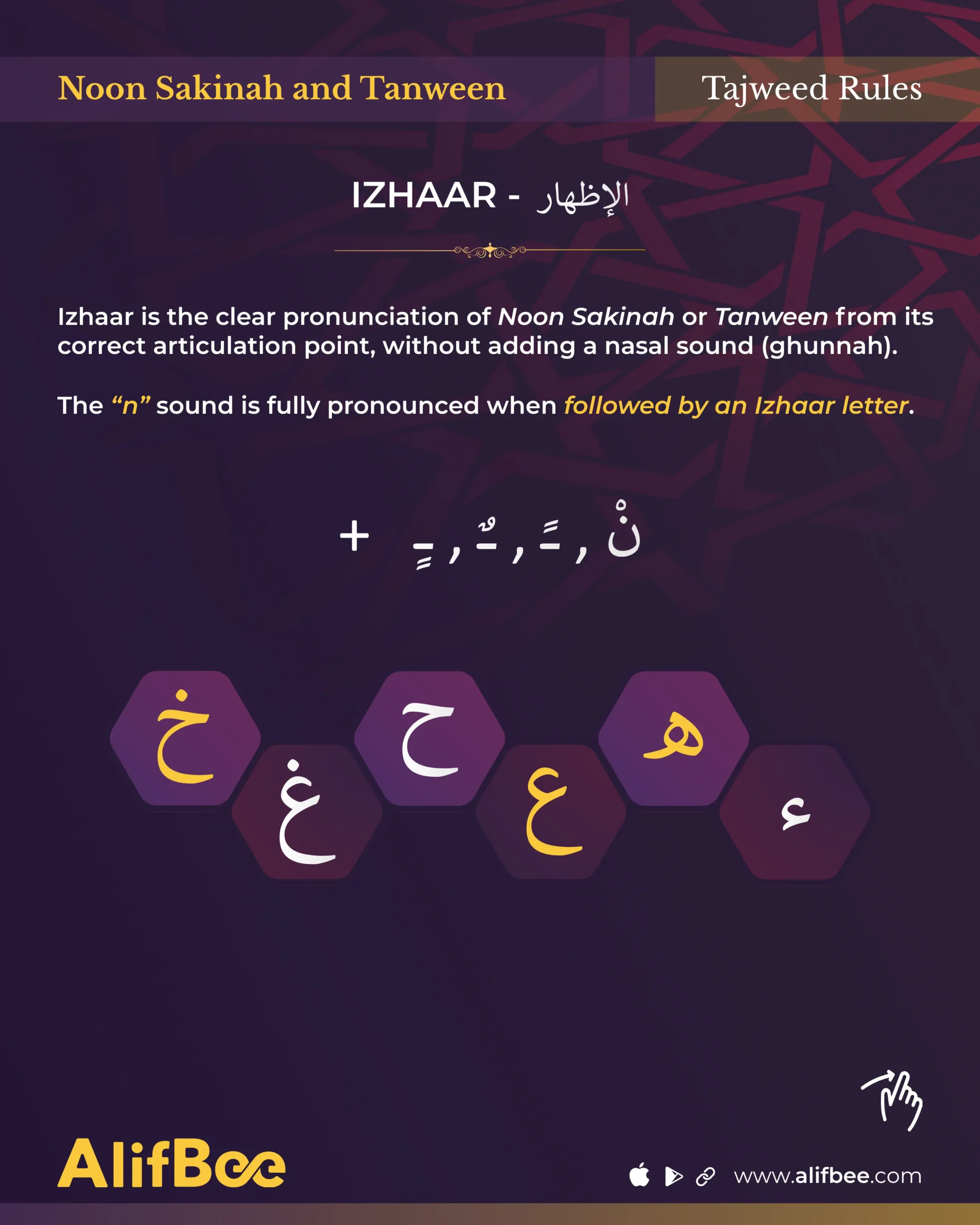
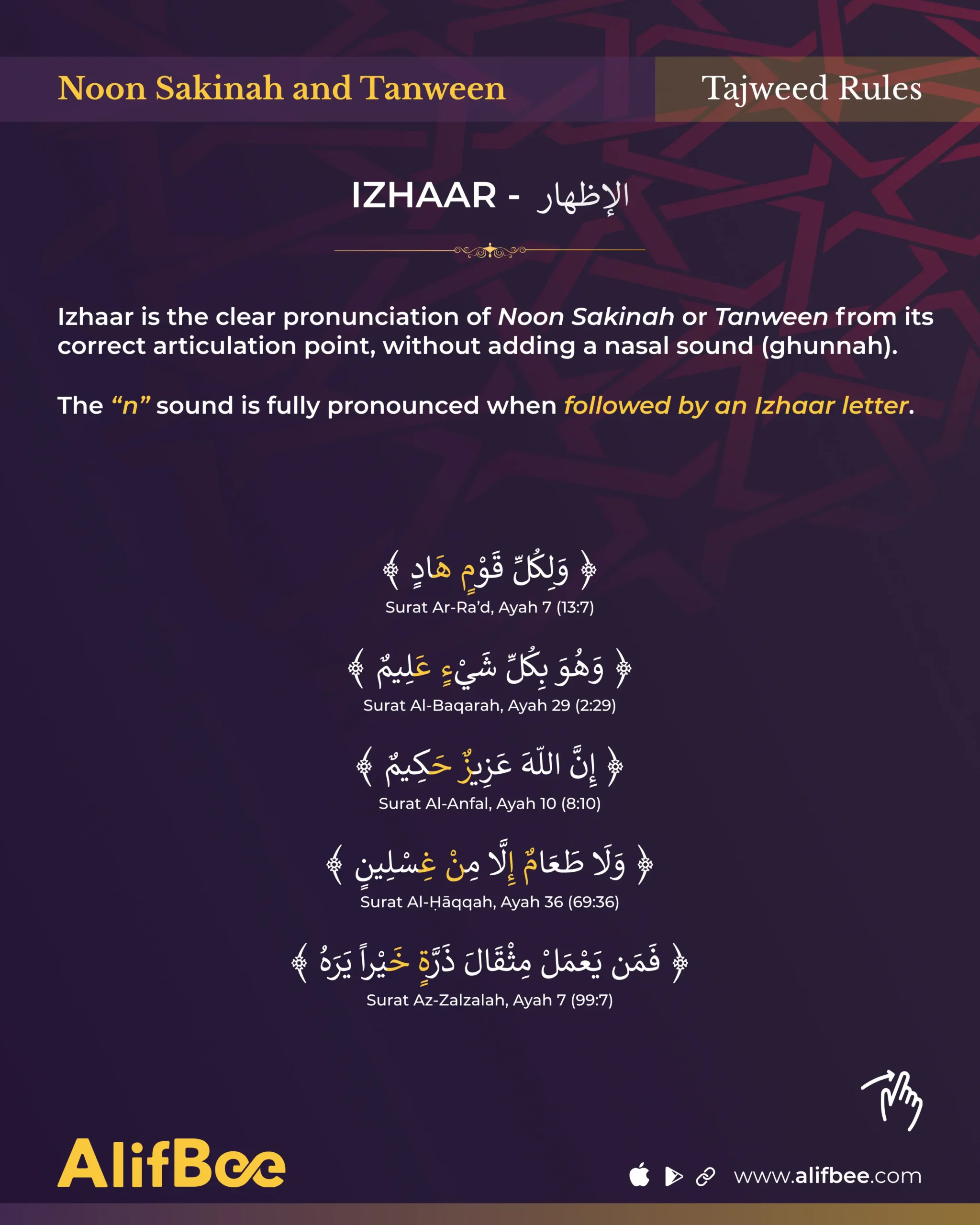
Izhaar means pronouncing the Noon Sakinah or Tanween clearly from its correct articulation point without adding a nasal sound. The ‘n’ sound is pronounced clearly before the next letter.

This rule applies when one of the Izhaar letters follows a Noon Sakinah or tanween. There are only six Izhaar letters:

ء – ه – ع – ح – غ – خ

Look at the following examples of Izhaar where the “n” sound from tanween or noon Sakinah is followed by one of the Izhaar letters. (Click on the verse number in the table to visit the source and listen to its recitation)

Verse number Surah Arabic verse
Ar-Raʿd

Al-Ḥāqqah

هاد

2. Idghaam (الإدغام)

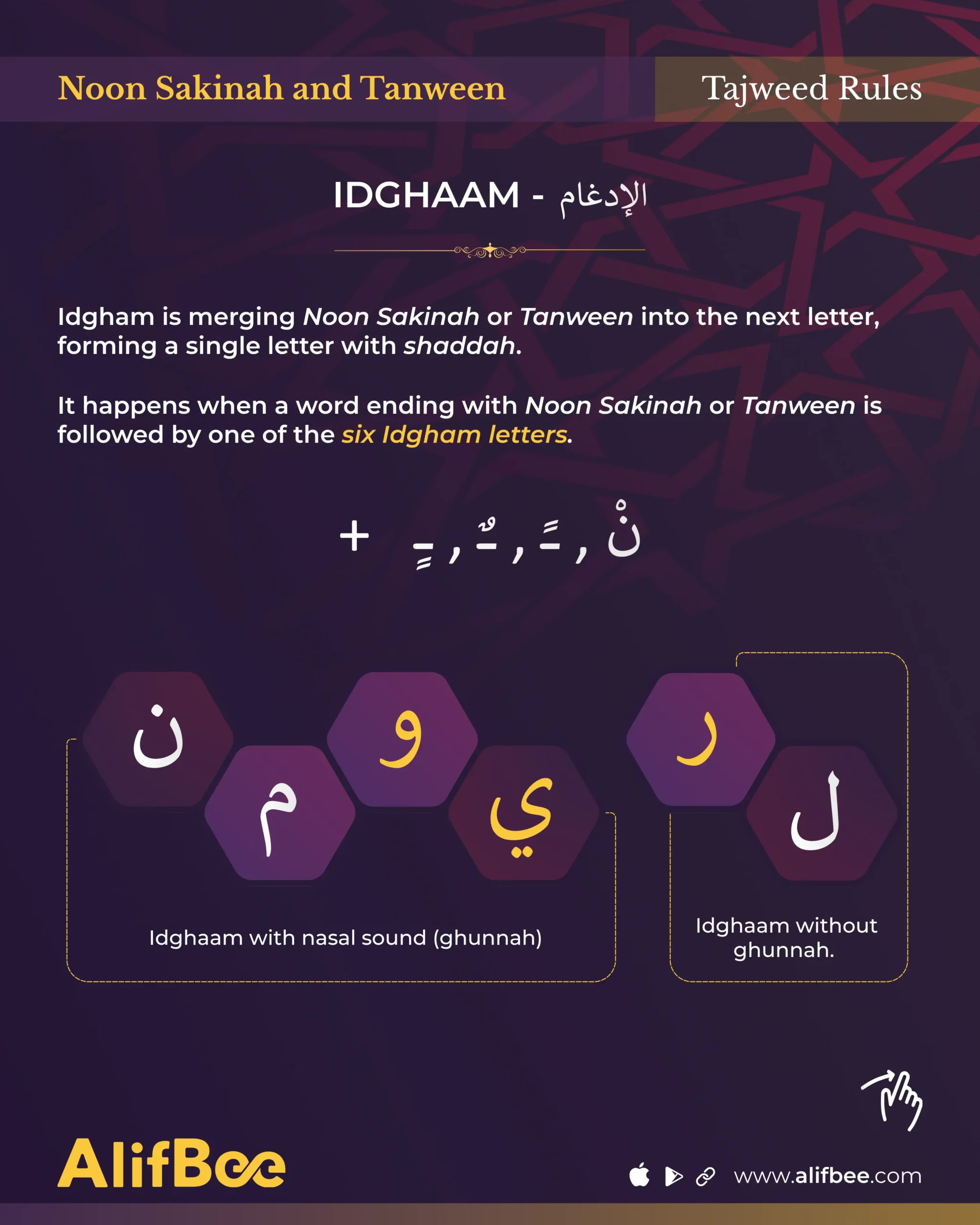
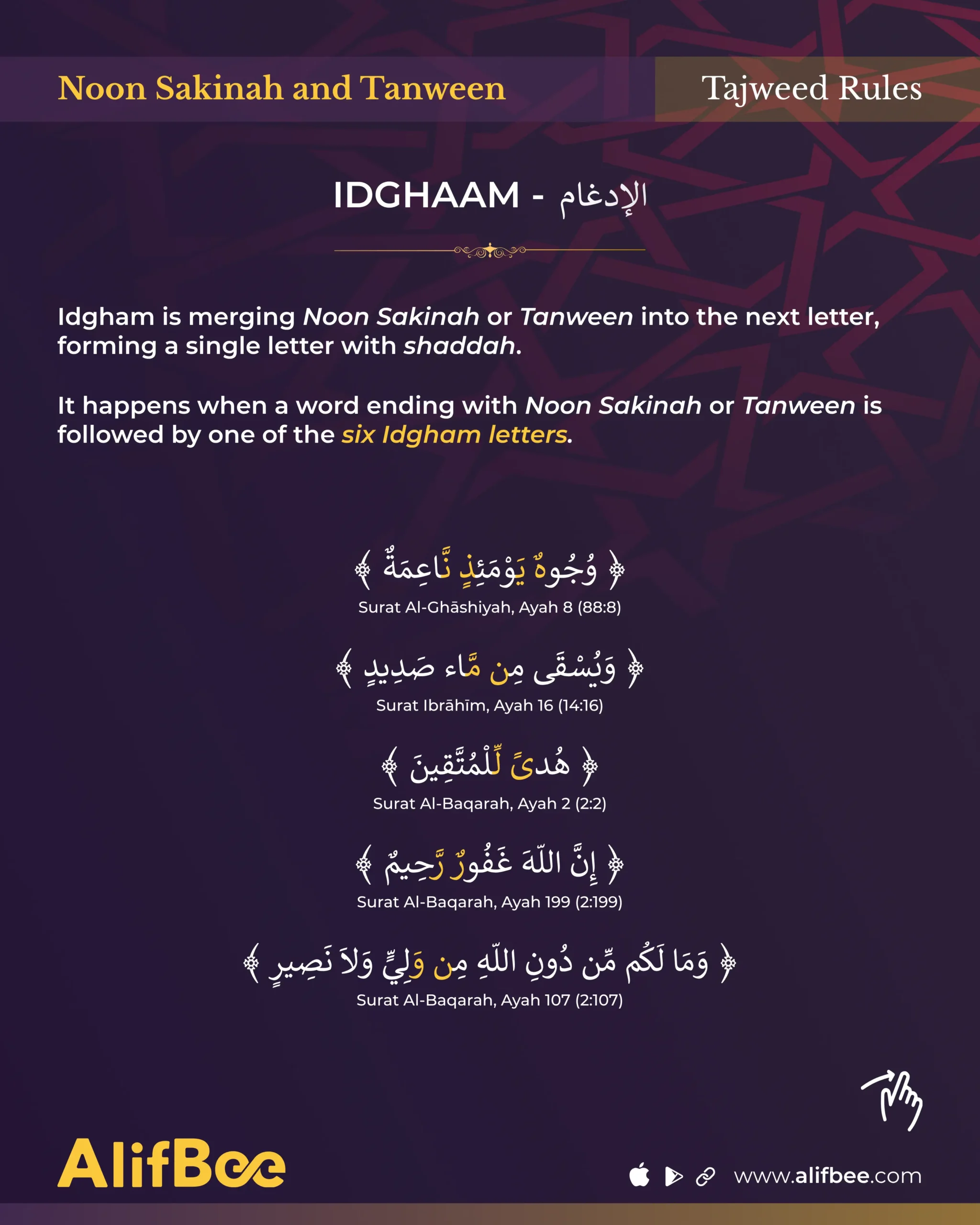
Idghaam is the merging of the sound of Noon Sakinah or Tanween with the following letter so that they become a single letter with shaddah. That means the noon or tanween sound blends into the next letter.

Idgham occurs only when a Noon Sakinah or Tanween appears at the end of one word, and the next word begins with one of the six Idgham letters:

ي – ر – م – ل – و – ن

There are two types of Idghaam: 

  • Idghaam with nasal sound (ghunnah) with the letters ي – و – م – ن
  • Idghaam without ghunnah with the letters ل – ر


These are examples of Idgham from Quran. (Click on the verse number in the table to visit the source and listen to its recitation)

Verse number Surah Arabic verse
Al-Ghāshiyah

idgham-1

Ibrāhīm

idgham-2

3. Iqlab (الإقلاب)

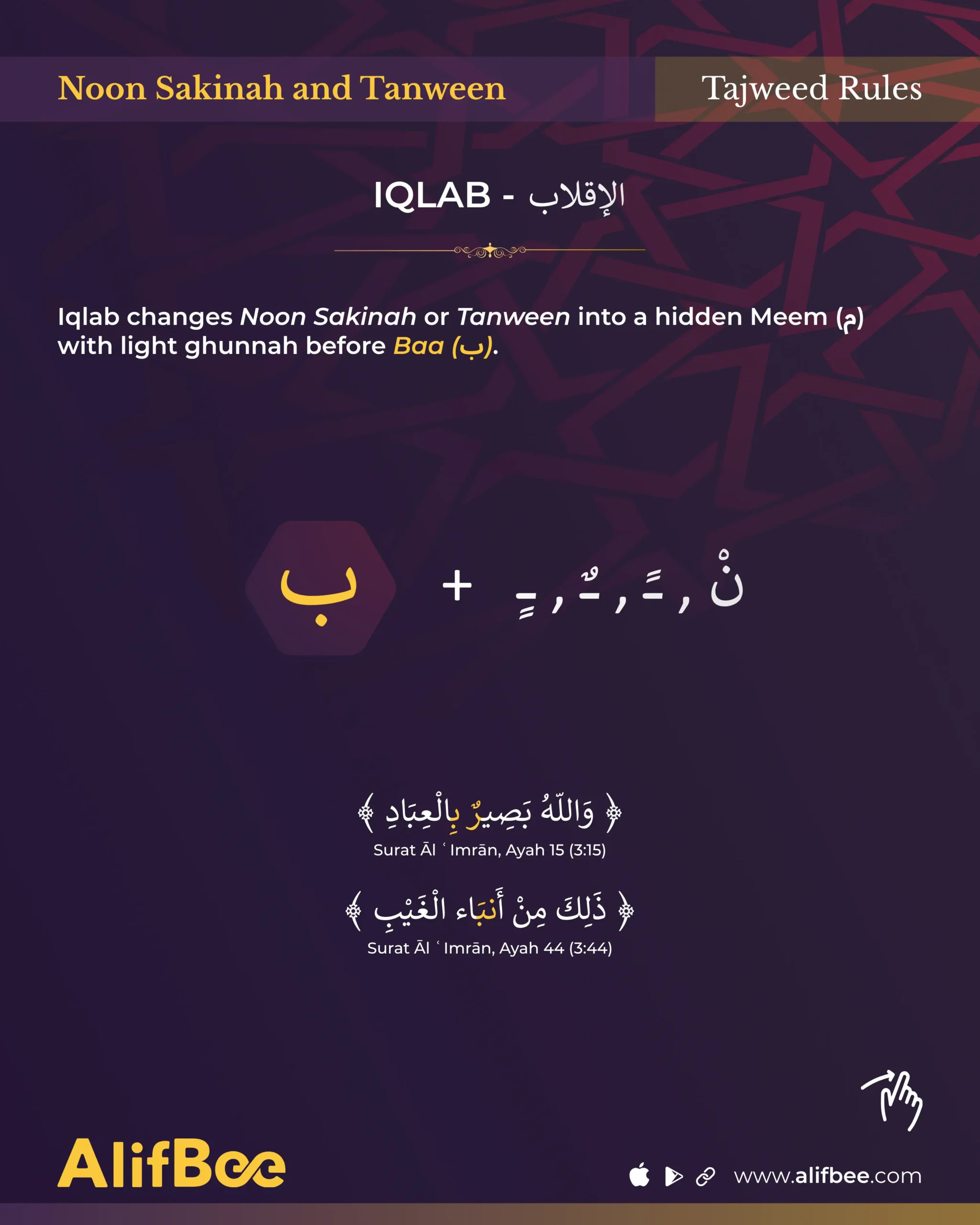
Iqlab is the changing of the sound of Noon Sakinah or Tanween into a meem (م) when it is followed by the letter baa (ب) with a vowel. The meem sound is not pronounced clearly; instead, it is hidden and pronounced with a light nasal sound (ghunnah).

These are examples of Iqlab. (Click on the verse number in the table to visit the source and listen to its recitation)

Verse number Surah Arabic verse
Āl ʿImrān

iqlab-1

Āl ʿImrān

iqlab-2

4. Ikhfaa (الإخفاء)

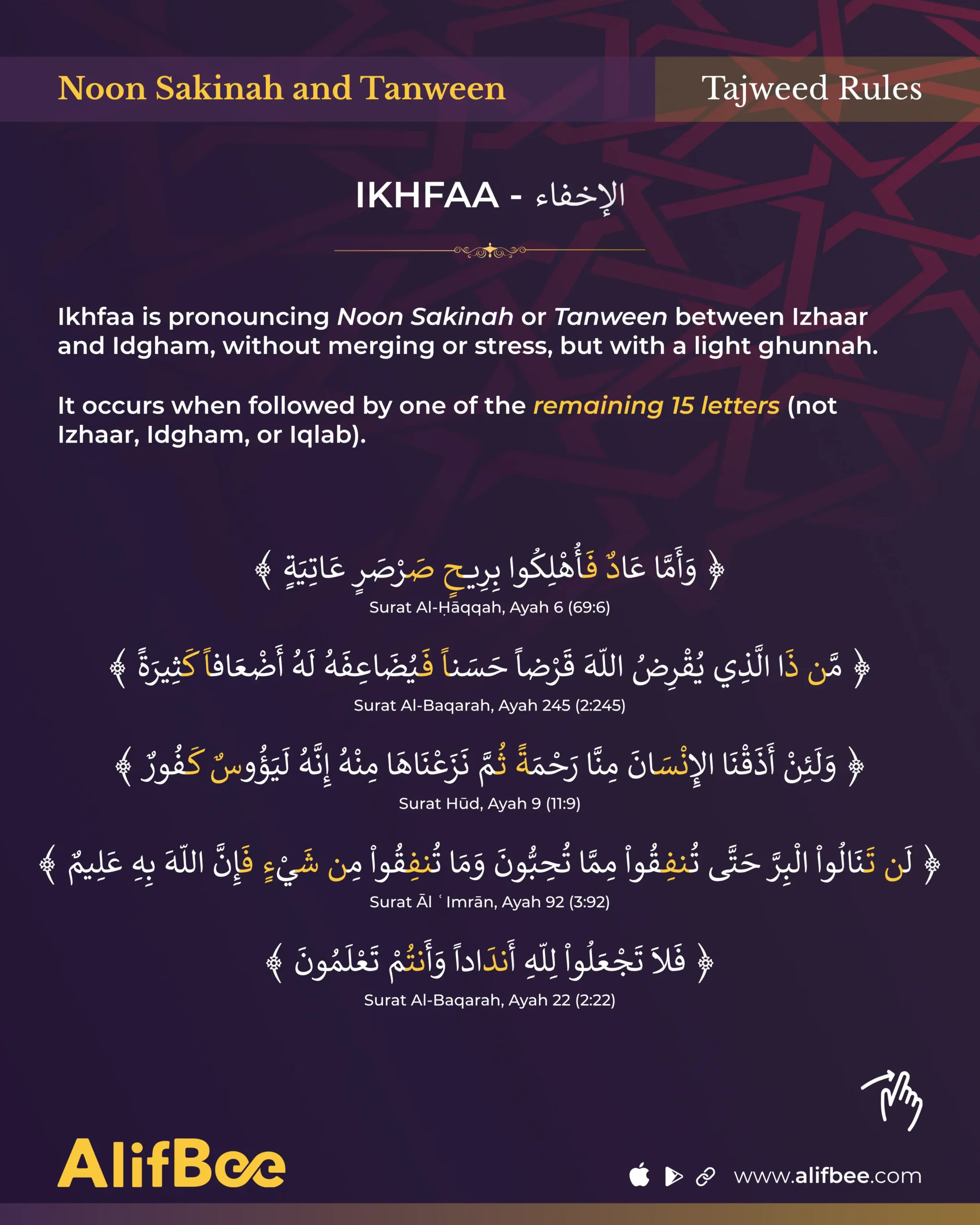
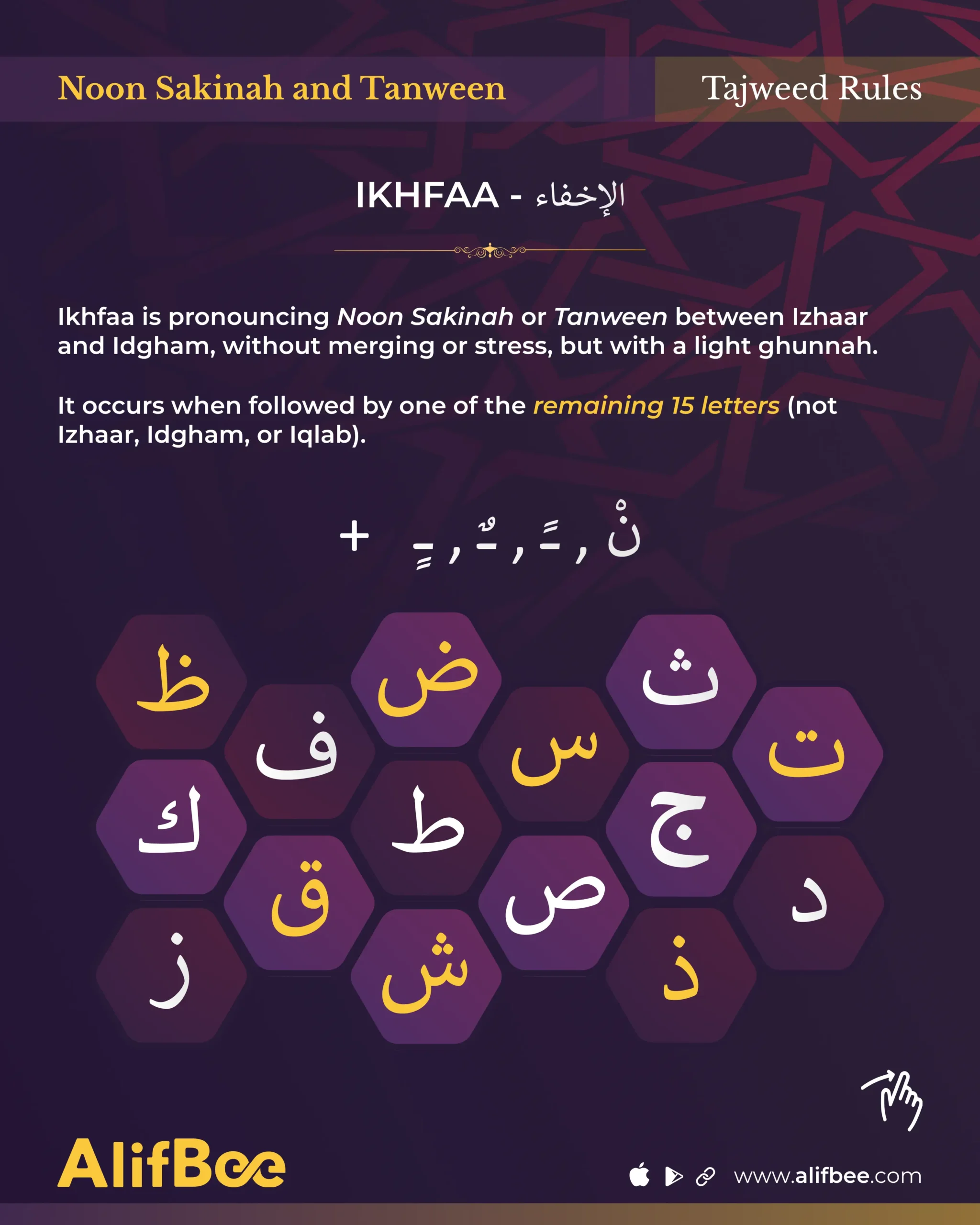
Ikhfaa is the pronunciation of Noon Sakinah or Tanween in a state between Izhaar and Idgham, without merging the letters or adding any stress (tashdeed), but with a light nasal sound (ghunnah).

It happens when the Noon Sakinah or Tanween is followed by any of the remaining 15 letters that are not part of Izhaar, Idgham, or Iqlab. The Ikhfaa letters are:

ت – ث – ج – د – ذ – ز – س – ش – ص – ض – ط – ظ – ف – ق – ك

Look at the following examples of Ikhfaa. (Click on the verse number in the table to visit the source and listen to its recitation)

Verse number Surah Arabic verse
Al-Ḥāqqah

ikhfaa-1

Al-Baqarah

ikhfaa-2

Meem Sakinah Rules

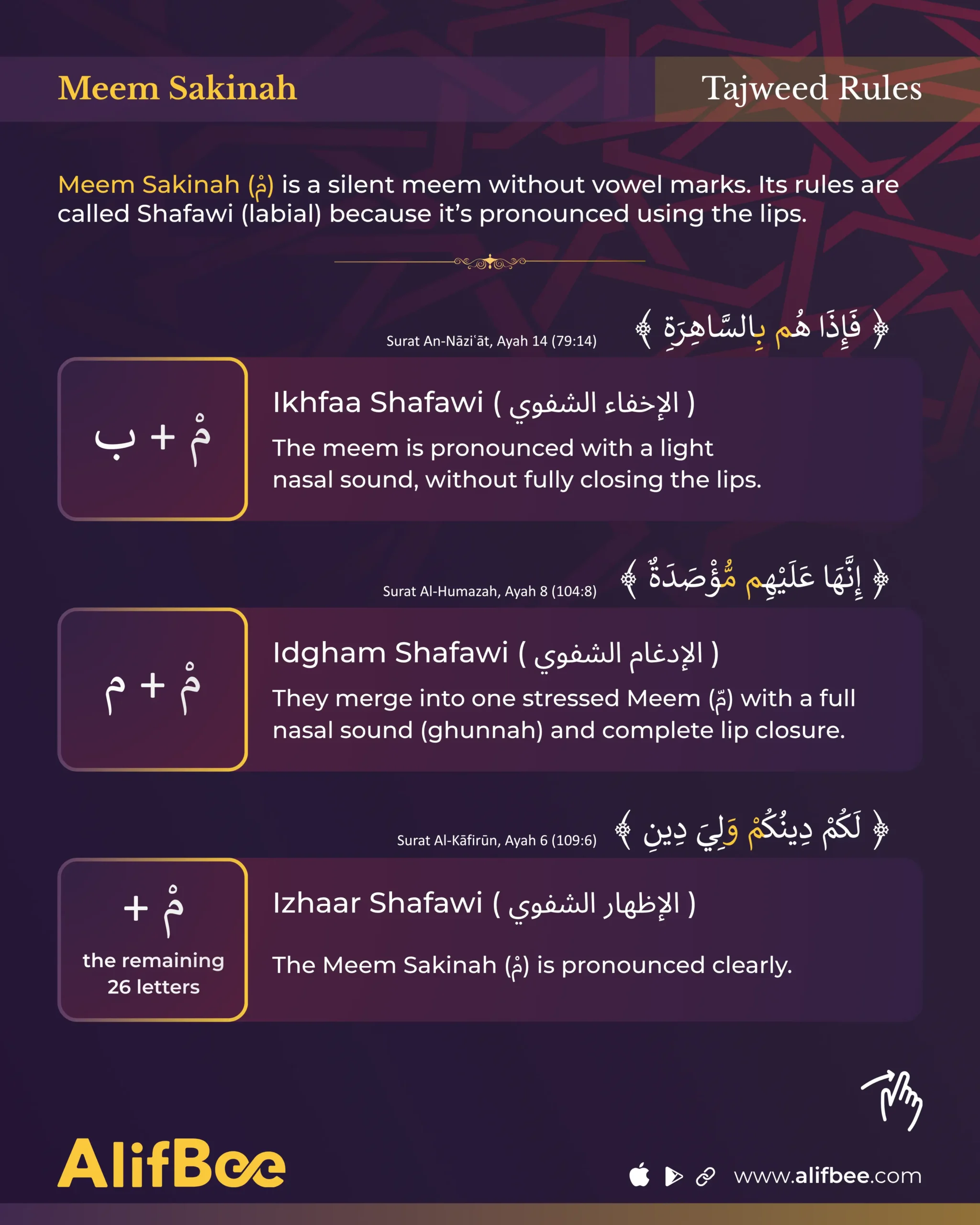
This rule is about the letter meem (مْ) that is free from any vowel markers (harakat) and has a fixed silent sound.

All rules related to Meem Sakinah are described as “Shafawi” (labial), since the letter meem is a labial letter, meaning it is pronounced by closing the lips.

There are three primary rules for Meem Sakinah:

  •   Ikhfaa Shafawi (الإخفاء الشفوي): It occurs when the letter Baa (ب) follows a Meem Sakinah. In this case, the meem is pronounced with a light nasal sound without fully closing the lips.
  •   Idgham Shafawi (الإدغام الشفوي): It is the merging of a Meem Sakinah (مْ) with a Meem that carries a vowel (م), so they become one stressed Meem (مّ) with a full nasal sound (ghunnah) and complete closing of the lips.
  •   Izhaar Shafawi (الإظهار الشفوي): It is pronouncing the Meem Sakinah (مْ) clearly when it is followed by any of the remaining 26 letters of the Arabic alphabet.


These are 3 examples for Meem Sakinah rules appearing in same order above. (Click on the verse number in the table to visit the source and listen to its recitation)

Verse number Surah Arabic verse
An-Nāziʿāt

meem-sakinah-1

Al-Humazah

meem-sakinah-2

Al-Kāfirūn

meem-sakinah-3

Madd (Elongation)

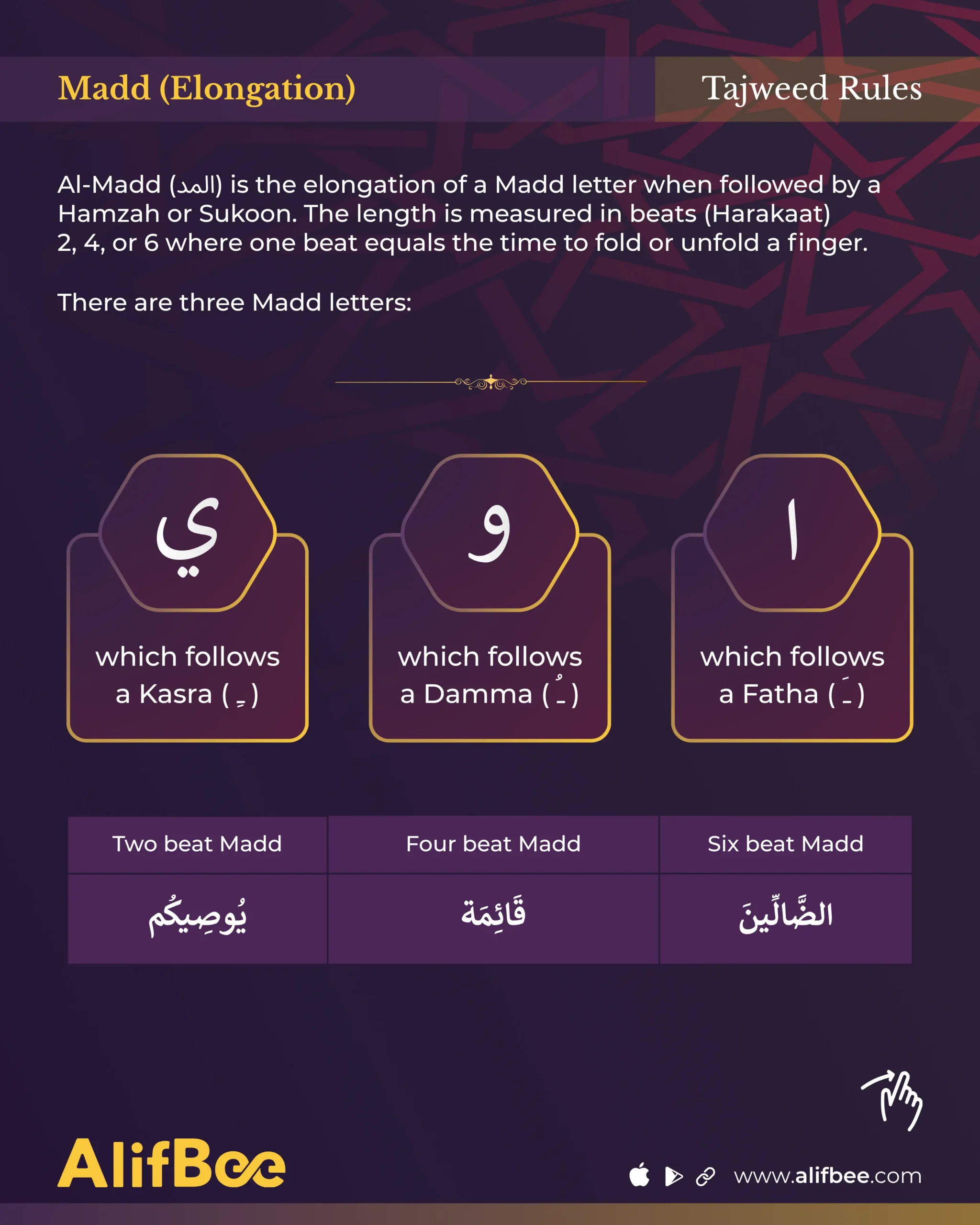
Al-Madd (المد) refers to the elongation of the sound of a Madd letter when a reason is present, such as Hamzah or Sukoon.
The duration of this elongation is measured in Beats (Harakaat), which can range from 2, 4, or 6 beats depending on the type of Madd. A single Harakah is defined as the time it takes to fold or unfold a finger.
The letters of Madd are three: 

  • Alif (ا), which follows a Fatha 
  • Waw (و), which follows a Damma 
  • Yaa (ي), which follows a Kasra

Read more about Arabic Short Vowels.

Look at the following examples with three types of Madd, appearing respectively: 

1. Madd Asli (Natural)

2. Madd Muttasel (Connected)

3. Madd Lazim (Compulsory)

The first example has two instances of the same type. 


Madd Length Example from the Quran
Two beat Madd

madd-1

Four beat Madd

madd-2

Six beat Madd

madd-3

Qalqalah

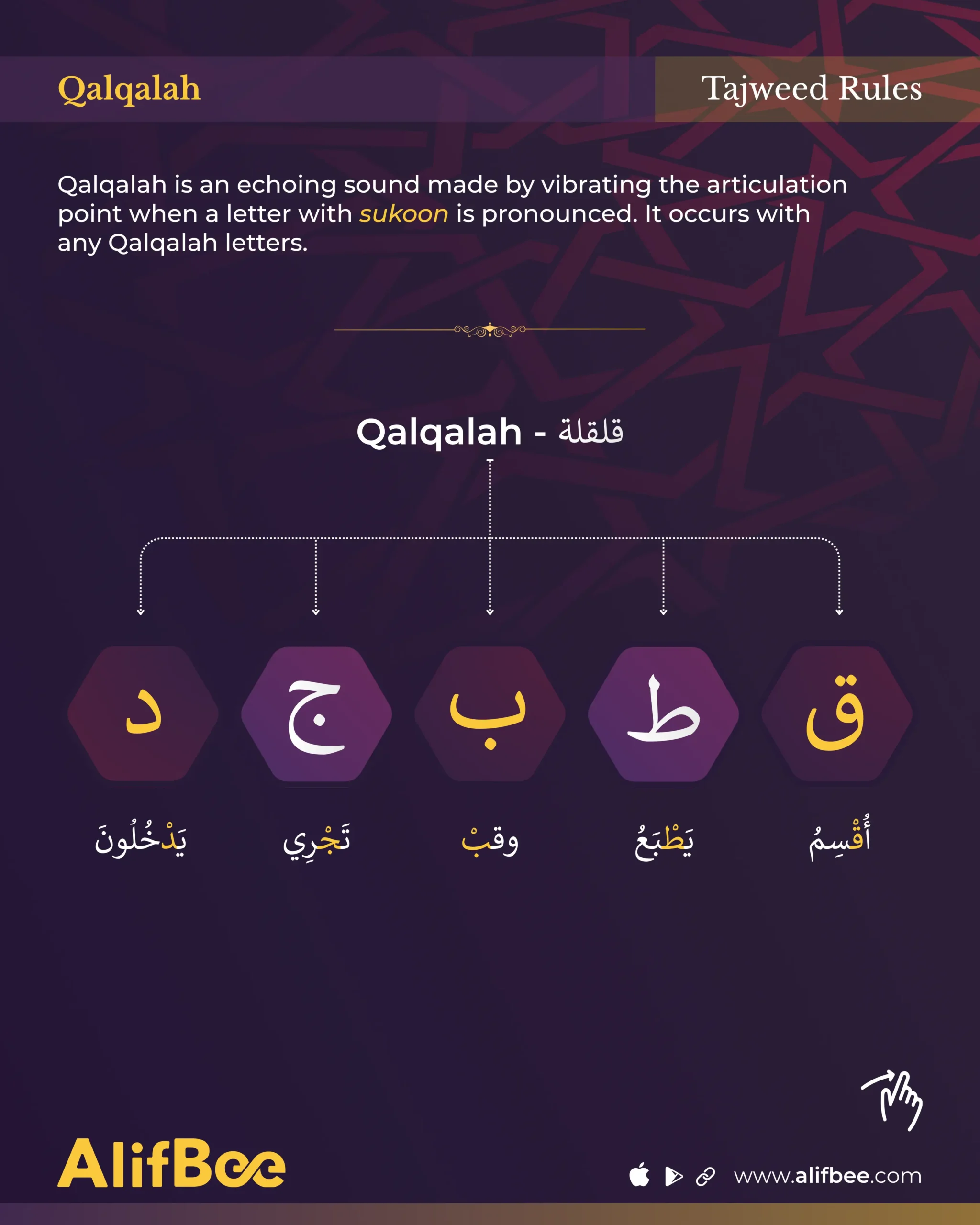
Qalqalah is an echoing sound produced by the vibration of the articulation point when pronouncing a letter with sukoon. This sound appears when any of the qalqalah letters carry a sukoon.

There are five Qalqalah letters:

ق – ط – ب – ج – د

Qalqalah Letter Example
ق

qalqalah-1

ط

qalqalah-2

ب

qalqalah-3

ج

qalqalah-4

د

qalqalah-5

Waqf and Ibtida (Pause and Start)

These are essential rules for the recitation of the Quran that help preserve the correct meaning of its verses.

  • Waqf refers to stopping the voice at the end of a word for a brief period, long enough for the reciter to take a breath, with the intention of continuing the recitation rather than ending it. It can occur at the end of a verse (ayah) or in the middle of one. However, it cannot occur in the middle of a single word.
  • Ibtida means beginning the recitation after a stop or pause. If the recitation resumes after a complete stop, it is preceded by Isti’adhah and then the basmalah if starting at the beginning of a surah. The beginning must also be grammatically and semantically correct, so it is not permissible to start with a subject without its verb or an adjective without the noun it describes.

Review Tajweed Rules for Arabic Learners

Common Mistakes Beginners Make When Learning Tajweed

Beginner learners of Tajweed often fall into specific traps that can affect the quality and accuracy of their recitation.

  •   Reading too fast or too slowly: Reading too fast may cause the loss of the proper characteristics of letters, while excessive slowness can also affect the natural flow of recitation.
  •   Pronouncing some letters too weakly or too strongly, which affects their correct articulation.
  •   Not observing the correct length of elongation (Al-Madd), either by shortening the required Madd or prolonging it incorrectly.
  •   Incorrect or exaggerated nasal sounds (ghunnah) in the letters noon and meem.
  •   Not following the stopping signs (waqf signs) in the Quran or not knowing how to resume again may affect the meaning and clarity of the verses for reciters.

How Beginners Can Start Learning Tajweed

If you are a beginner and want to start your journey of learning the Quran with tajweed but do not know where to begin, you can follow these simple steps:

  1. Learn the Arabic alphabet first, both in writing and pronunciation, as it is the foundation of Tajweed.
  2. Train your ear by listening regularly to professional Quranic reciters, and after a while, begin repeating after them to develop accurate pronunciation
  3. Begin studying Tajweed by learning the basic rules to understand the sounds of the letters and how to apply them in practice.
  4. Start slowly by practicing the Quran with Tajweed. Apply what you learn by reciting and memorizing short surahs as part of learning the Quran. It is highly recommended to do this with a teacher or in a Tajweed course to receive immediate feedback.
  5. Practice regularly. Remember that consistent practice is the key to improving your recitation and mastering Tajweed.

Final Thoughts

Learning Tajweed is essential and goes hand in hand with learning the Quran. Tajweed rules illustrate how the words of Allah should be pronounced during recitation.

After this comprehensive guide, you now have the basics to begin your journey. Start step by step, practice regularly, and you will see steady progress over time.

Check QuranBee from AlifBee. It is an interactive mobile app for studying the Quran, featuring personalised reading plans, memorisation challenges, and collaborative group study options.


Download the AlifBee app to improve your Arabic and benefit from a 14-day free trial.


Authors

  • Asil Kazoun

    Asil Kazoun holds a Bachelor’s degree in Language Interpretation and Translation from Damascus University. With expertise in Arabic language education, translation, and content writing, she creates clear, learner-focused content that helps students build strong Arabic skills with confidence and ease.

  • Dania Ghraoui

    Dania is a teacher, translator, and content writer with a passion for making Arabic accessible and enjoyable for learners around the world. As the Blog Manager at AlifBee, she writes educational blogs that blend language tips, cultural insights, and practical learning strategies to support every Arabic learner’s journey.

If you found this article helpful, please share it with your friends to spread the knowledge!
Facebook
LinkedIn
Telegram
X
Start your Arabic Learning Path with AlifBee!
Related Posts