
Written by Dania Ghraoui, a translator and language teacher with 10 years of experience.
And Asil Kazoun, an Arabic teacher and translator with experience in education and content writing.
At a Glance: Nouns in Arabic are words that name people, things, places, qualities, or ideas, and they are marked by features such as gender, number, definiteness, and case. Arabic nouns can be masculine or feminine, singular, dual, or plural, and definite or indefinite, while their endings may change depending on their role in the sentence.
Arabic nouns play a central role in communication. They cover a wide range of vocabulary, which makes them one of the richest and most essential parts of the language to master.
In this lesson, we will explore nouns in Arabic, their key features, and their most common types. We will also highlight typical mistakes learners make so you can build a stronger foundation.
Before you go further!
You may want to build a stronger base with a few related lessons from the AlifBee blog. Our guide to Arabic basics for beginners gives you a clear starting point, while our article on Arabic vowels helps you understand the vowel marks that appear throughout noun forms. You can also read our guide to Arabic pronouns to better understand how nouns connect with other key parts of the sentence.
What Is a Noun in Arabic Grammar?
In Arabic, a noun (الاسم) is any word that carries a specific, understood meaning. Arabic nouns can be grouped by meaning into several types, such as names of people, animals, plants, things, places, times, qualities, and abstract ideas.
It is also important to note that Arabic nouns are classified not only by meaning, but also by key grammatical features such as gender, case, and number.
Arabic Nouns at a Glance
| Feature | What it Means | Arabic Example |
|---|---|---|
|
Gender |
masculine / feminine |
طالب / طالبة |
|
Number |
singular / dual / plural |
كتاب / كتابان / كتب |
|
Definiteness |
specific / non-specific |
كتاب / الكتاب |
|
Case |
role in sentence |
الولدُ / الولدَ / الولدِ |
Main Characteristics of Nouns in Arabic
Arabic nouns have features that distinguish them from verbs or particles.
When examining a word, look for these common signs:
How to Identify a Noun in Arabic
- Following a preposition: Only a noun can come after a preposition such as مِن (min, “from”) or فِي (fī, “in”).
- Tanwīn: The double vowel endings that produce an n sound usually appear on indefinite nouns.
- The vocative (النِّداء): Nouns are the words normally addressed directly with the particle يَا (yā).
- The definite article (الـ): Only nouns can take the prefix الـ (al-) to become definite.
- Accepting grammatical case: Nouns can show case endings such as ـُ / ـَ / ـِ or their equivalent markers in the dual and sound plural.
Keep in mind that a word does not need to show all of these signs to be a noun. In many cases, even one clear sign is enough to identify it.
Examples of Arabic Nouns for Beginners
| English | Transliteration | Arabic |
|---|---|---|
|
Book |
kitāb |
كتاب |
|
Boy |
walad |
ولد |
|
Girl |
bint |
بنت |
|
School |
madrasah |
مدرسة |
|
City |
madīnah |
مدينة |
In short, Arabic nouns are identified by their meaning and by grammar signals such as gender, number, definiteness, and case. Once you understand these four features, reading and building Arabic sentences becomes much easier.
Gender in Arabic Nouns
Arabic nouns can be grouped not only by their meaning but also by their grammatical features. One of the most important ways to classify them is by gender.
In Arabic, every noun is either masculine or feminine. This rule applies to everything—whether the word refers to humans or non-humans.
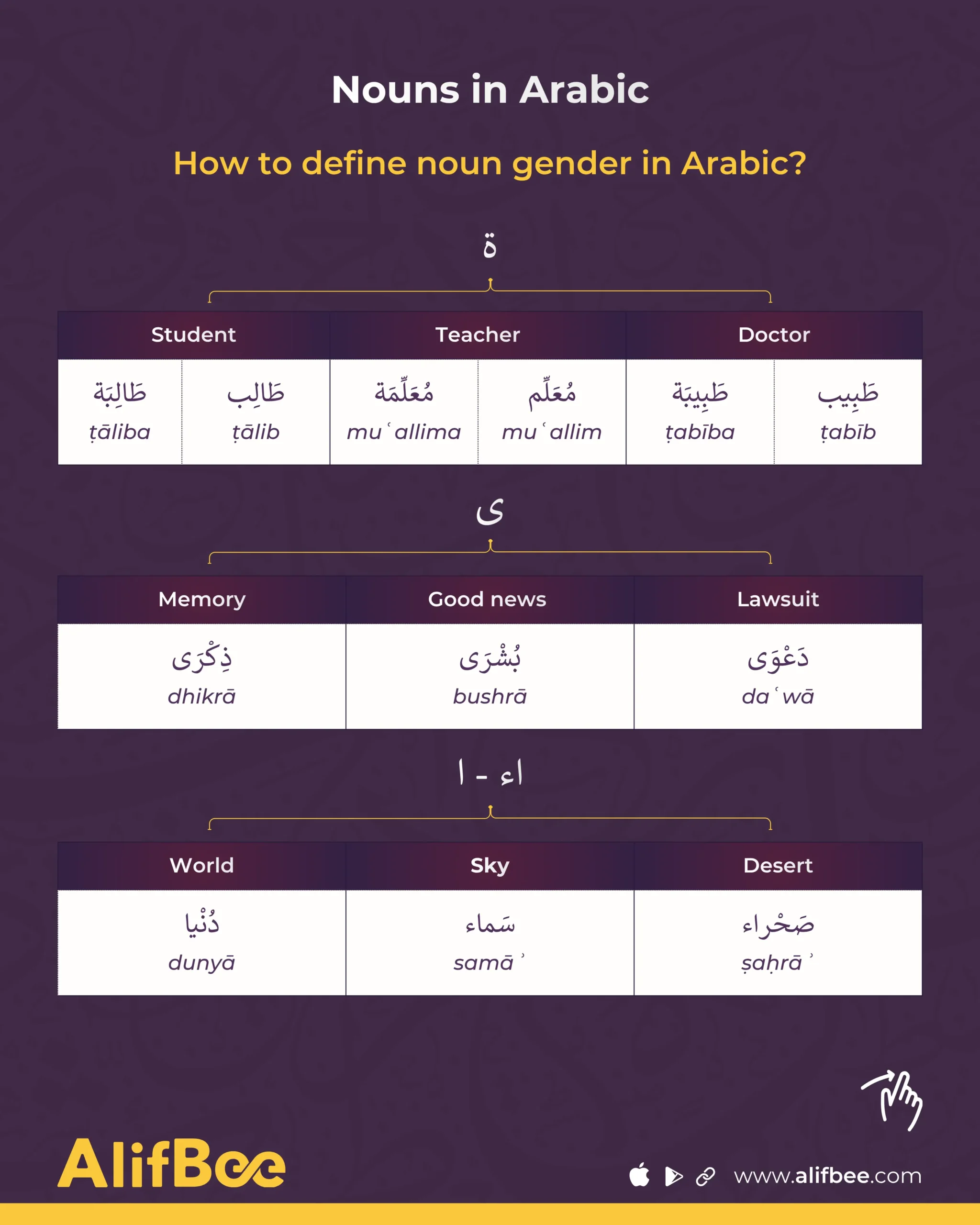
How to define noun gender in Arabic?
In general, most nouns that do not carry specific feminine markers are considered masculine by default. Feminine nouns can often be recognized by certain endings, such as:
1. taa marbuta (ة)
| English | Pronunciation | Masculine | Pronunciation | Feminine | ||
|---|---|---|---|---|---|---|
|
student |
ṭālib |
طَالِب |
|
ṭāliba |
طَالِبَة |
|
|
teacher |
muʿallim |
مُعَلِّم |
|
muʿallima |
مُعَلِّمَة |
|
|
doctor |
ṭabīb |
طَبِيب |
|
ṭabība |
طَبِيبَة |
|
2. Alif maqsura (ى)
| English | Pronunciation | Arabic | |
|---|---|---|---|
|
memory |
dhikrā |
ذِكْرَى |
|
|
good news |
bushrā |
بُشْرَى |
|
|
lawsuit |
daʿwā |
دَعْوَى |
|
3. alif mamduda (ا) /alif mamduda and hamza ending (اء)
| English | Pronunciation | Arabic | |
|---|---|---|---|
|
world |
dunyā |
دُنْيا |
|
|
sky |
samāʾ |
سَماء |
|
|
desert |
ṣaḥrāʾ |
صَحْراء |
|
Singular, Dual, and Plural Forms for Nouns in Arabic
Another grammatical way to classify Arabic nouns is by number. This applies to both human and non-human nouns, whether masculine or feminine.
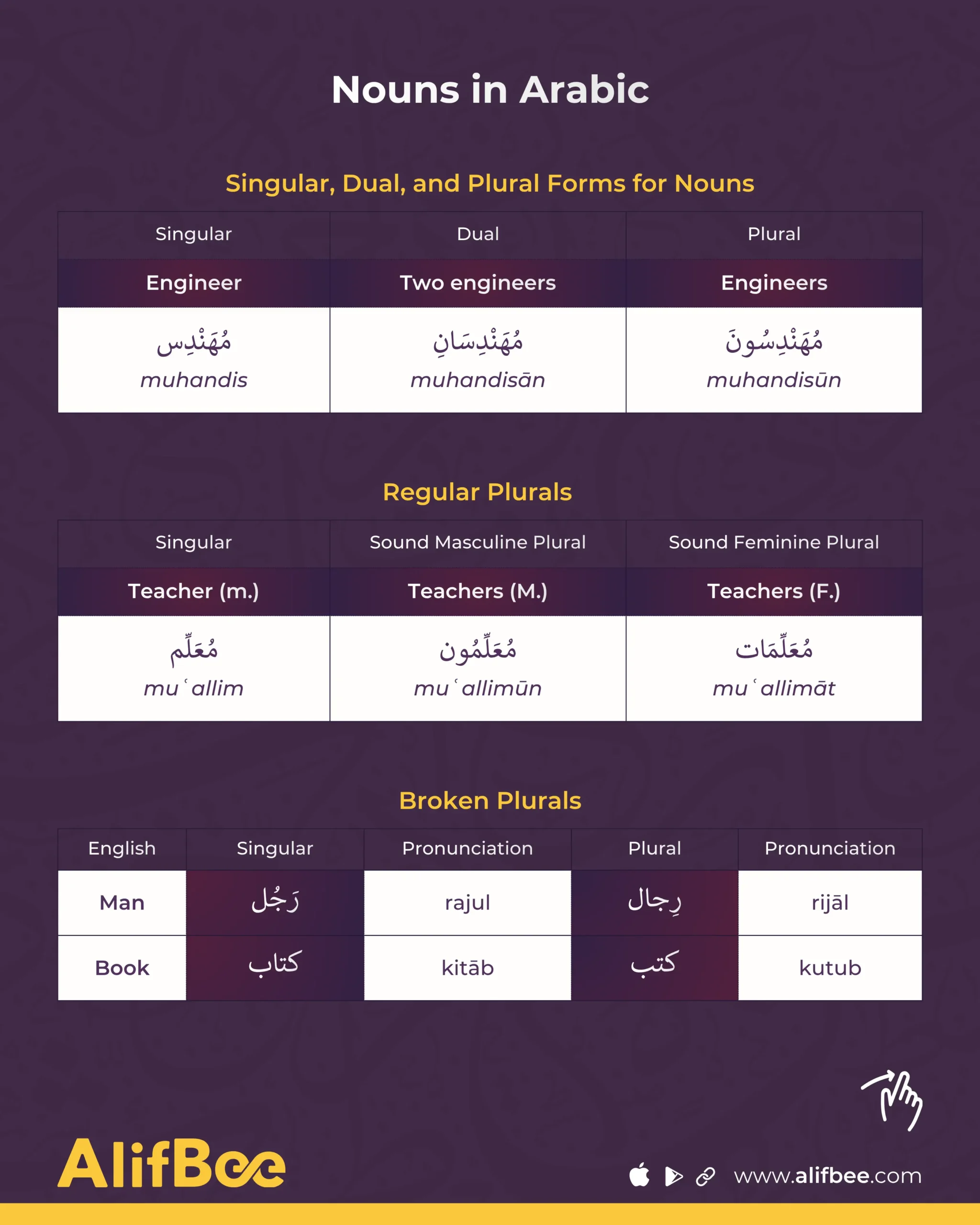
Arabic nouns fall into three number categories: singular, dual, and plural.
- The singular (المفرد) refers to one person or thing.
- The dual (المثنى) refers to two people or things and is usually formed by adding -ان (-ān) or -ين (-ayn) to the end of the singular noun.
- The plural (الجمع) refers to three or more and has two main types in Arabic: the sound plural and the broken plural.
Arabic Singular vs Dual vs Plural Nouns
| Noun | English | Pronunciation | Arabic | |
|---|---|---|---|---|
|
Singular |
Engineer |
muhandis |
مُهَنْدِس |
|
|
Dual |
two engineers |
muhandisān |
مُهَنْدِسَانِ |
|
|
Plural |
Engineers |
muhandisūn |
مُهَنْدِسُونَ |
|
Regular Plurals
In the sound plural, the basic form of the singular noun remains intact, and a regular suffix is added to the end.
The sound plural has two main types: masculine and feminine. The sound masculine plural (جمع المذكر السالم) is formed by adding -ون (-ūn) in the nominative case (الرفع) and -ين (-īn) in the accusative and genitive cases (النصب والجر). The sound feminine plural (جمع المؤنث السالم) is usually formed by adding -ات (-āt) to the end of the singular noun.
| English | Pronunciation | Arabic | ||
|---|---|---|---|---|
|
Singular |
teacher (m.) |
muʿallim |
مُعَلِّم |
|
|
Sound Masculine Plural |
teachers (m.) |
muʿallimūn |
مُعَلِّمُون |
|
|
Sound Feminine Plural |
teachers (f.) |
muʿallimāt |
مُعَلِّمَات |
|
Broken Plurals
Just as English has irregular plurals, Arabic has broken plurals. They are called “broken” because the pattern of the singular noun changes when it becomes plural. This change may involve adding letters, dropping letters, or changing the internal vowel pattern (الحركات) of the word.
Broken plurals are very common in Arabic and are usually learned through exposure, practice, and regular dictionary use.
Look at the following examples:
| English | Pronunciation | Singular | Pronunciation | Plural | ||
|---|---|---|---|---|---|---|
|
man |
rajul |
رَجُل |
|
rijāl |
رِجال |
|
|
book |
kitāb |
كتاب |
|
kutub |
كتب |
|
Definite and Indefinite Nouns in Arabic
In Arabic, nouns are classified into two types based on definiteness: indefinite (نَكِرَة) and definite (مَعْرِفَة).
1. An indefinite noun (نَكِرَة) refers to a non-specific person, place, or thing, similar to a or an in English. For example: كِتَابٌ — a book; وَلَدٌ — a boy.
2. A definite noun (مَعْرِفَة) refers to a specific or identified person, place, or thing, similar to the in English. One of the most common ways to make a noun definite in Arabic is by adding the prefix الـ (al-): الكِتَابُ — the book; الوَلَدُ — the boy. It is important to note that tanwīn (تنوين) normally appears only with indefinite nouns, while الـ marks definiteness, so they do not occur together in the same word.
Because Tanween indicates indefiniteness, a noun in Arabic is either definite or indefinite, never both at the same time.
Definite and Indefinite Nouns Example
| English | Pronunciation | Arabic | |
|---|---|---|---|
|
a house (indefinite, with tanwīn) |
baytun |
بَيْتٌ |
|
|
the house (definite, with الـ) |
al-bayt |
البَيْت |
|
Case Endings in Arabic Nouns
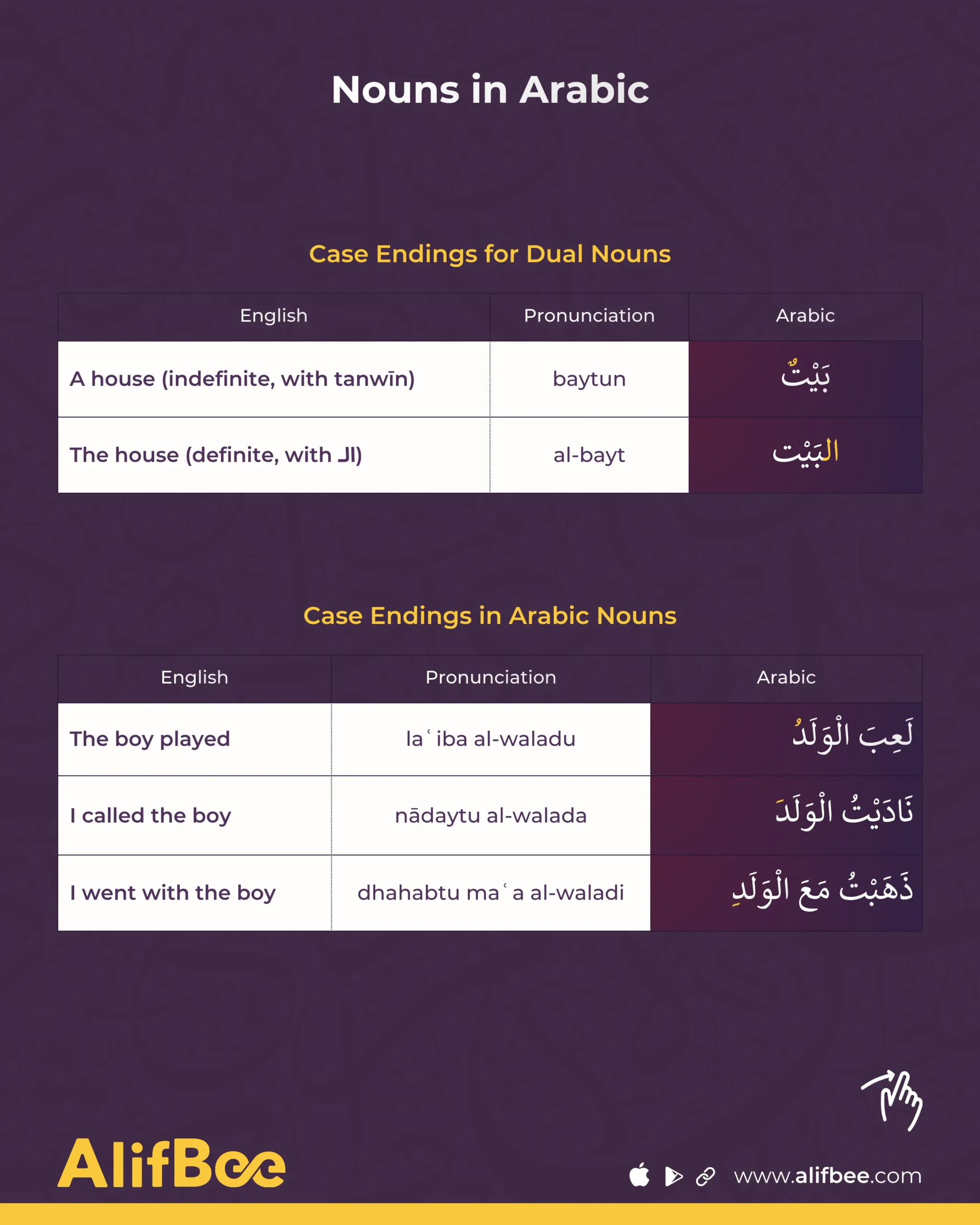
In Arabic, a noun does not have a fixed ending. Instead, its grammatical case changes depending on its role in the sentence.
Case Endings for Singular Nouns
For singular nouns (المفرد), the case is indicated by the final vowel:
- Ḍamma for nominative
- Fatḥa for accusative
- Kasra for genitive.
| English | Pronunciation | Arabic | |
|---|---|---|---|
|
The boy played |
laʿiba al-waladu |
لَعِبَ الْوَلَدُ |
|
|
I called the boy |
nādaytu al-walada |
نَادَيْتُ الْوَلَدَ |
|
|
I went with the boy |
dhahabtu maʿa al-waladi |
ذَهَبْتُ مَعَ الْوَلَدِ |
|
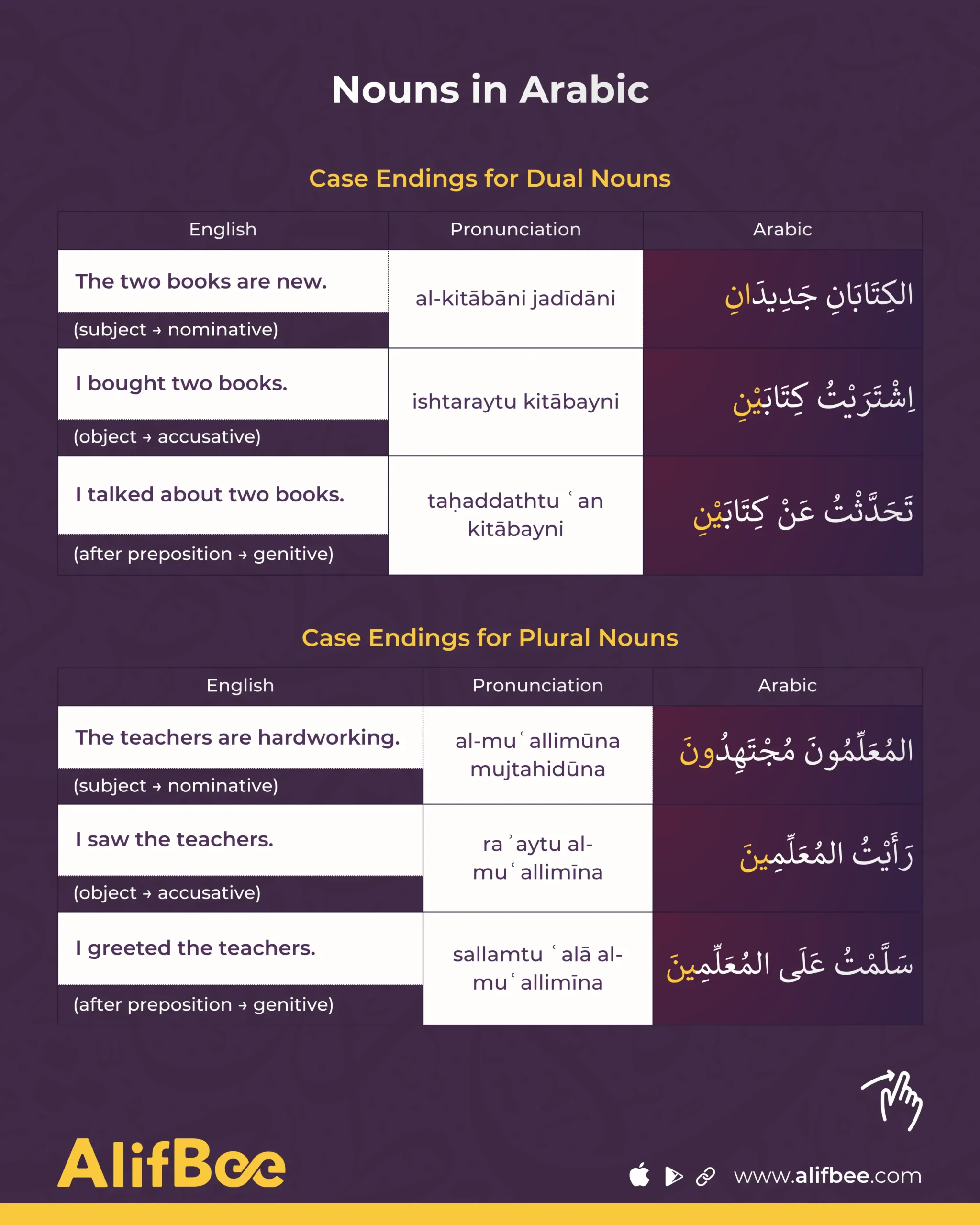
Case Endings for Dual Nouns
For the dual (المثنّى), grammatical case is often shown by adding letters to the end of the word rather than by changing only the final vowel.
The dual (المثنّى) takes:
ـانِ (-āni) in the nominative case and ـيْنِ (-ayni) in the accusative and genitive cases.
For example:
كِتَابَانِ (kitābāni) — nominative
كِتَابَيْنِ (kitābayni) — accusative/genitive
Look at the following examples:
| English | Pronunciation | Arabic | |
|---|---|---|---|
|
The two books are new.
(subject → nominative) |
al-kitābāni jadīdāni |
الكِتَابَانِ جَدِيدَانِ |
|
|
I bought two books.
(object → accusative) |
ishtaraytu kitābayni |
اِشْتَرَيْتُ كِتَابَيْنِ |
|
|
I talked about two books.
(after preposition → genitive) |
taḥaddathtu ʿan kitābayni |
تَحَدَّثْتُ عَنْ كِتَابَيْنِ |
|
Case Endings for Plural Nouns
The grammatical case in plural nouns is also shown by adding letters to the end of the word, but only in the masculine plural.
The sound masculine plural (جمع المذكر السالم) takes
- ـونَ for nominative
- ـينَ for accusative and genitive
Example:
- مُعَلِّمُونَ — nominative
- مُعَلِّمِينَ — accusative/genitive
Notice the following examples:
| English | Pronunciation | Arabic | |
|---|---|---|---|
|
The teachers are hardworking.
(subject → nominative) |
al-muʿallimūna mujtahidūna |
المُعَلِّمُونَ مُجْتَهِدُونَ |
|
|
I saw the teachers.
(object → accusative) |
raʾaytu al-muʿallimīna |
رَأَيْتُ المُعَلِّمِينَ |
|
|
I greeted the teachers.
(after preposition → genitive) |
sallamtu ʿalā al-muʿallimīna |
سَلَّمْتُ عَلَى المُعَلِّمِينَ |
|
Common Arabic Nouns Used in Everyday Speech
To help you build a solid foundation, here is a list of essential Arabic nouns grouped by category.
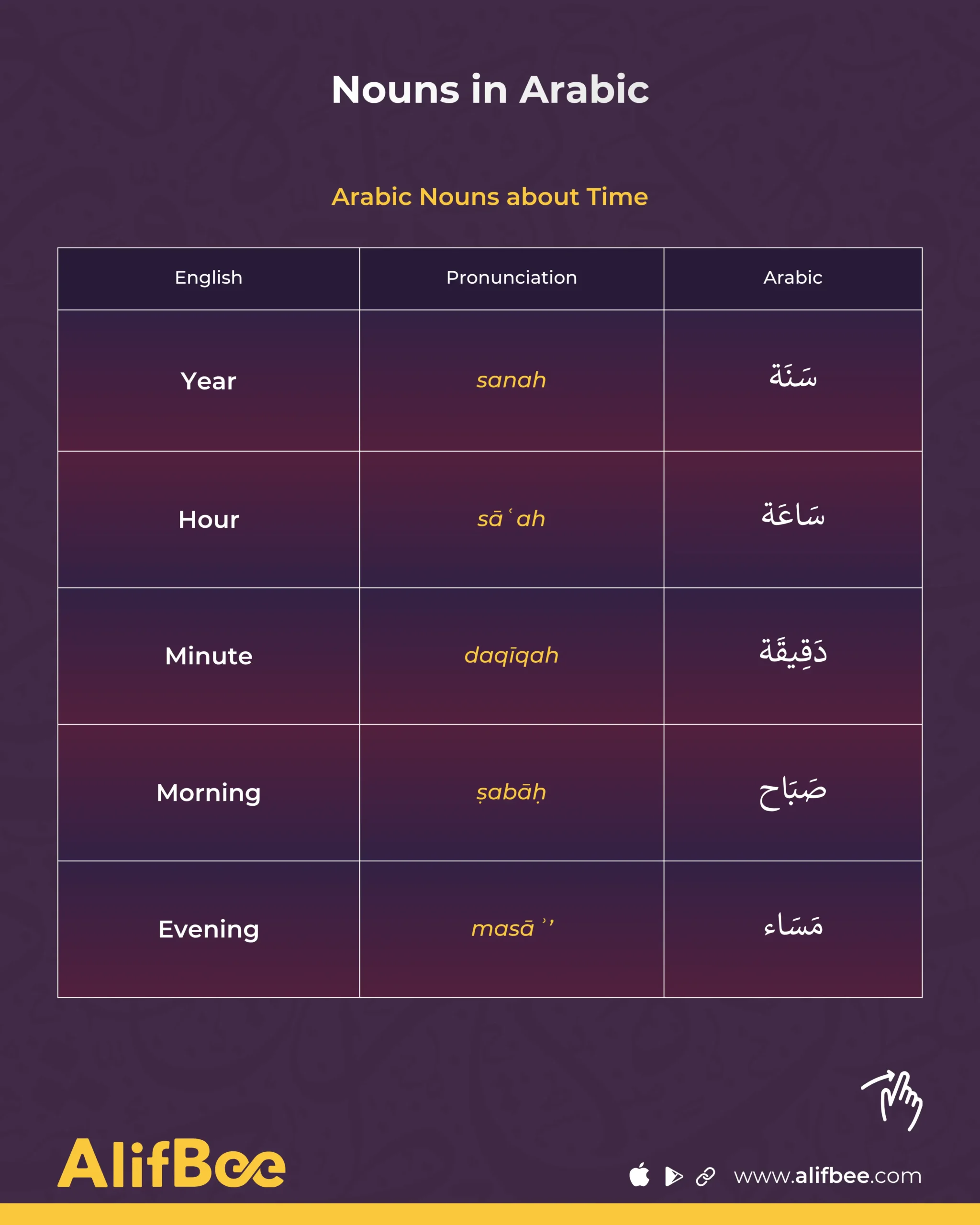
Arabic Nouns about Time
| English | Pronunciation | Arabic | |
|---|---|---|---|
|
Year |
sanah |
سَنَة |
|
|
Hour |
sāʿah |
سَاعَة |
|
|
Minute |
daqīqah |
دَقِيقَة |
|
|
Morning |
ṣabāḥ |
صَبَاح |
|
|
Evening |
masāʾ’ |
مَسَاء |
|
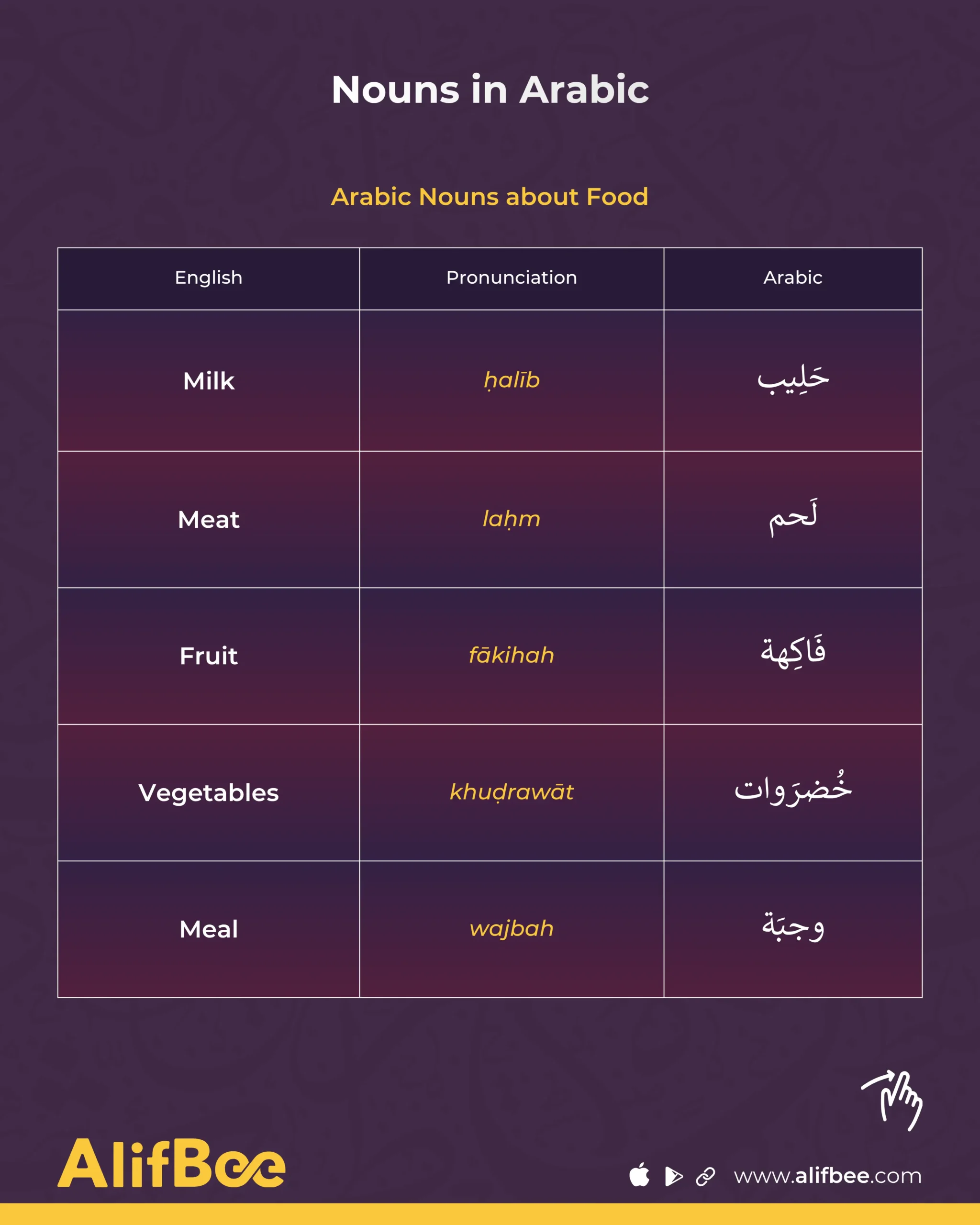
Arabic Nouns about Food
| English | Pronunciation | Arabic | |
|---|---|---|---|
|
Milk |
ḥalīb |
حَلِيب |
|
|
Meat |
laḥm |
لَحم |
|
|
Fruit |
fākihah |
فَاكِهة |
|
|
Vegetables |
khuḍrawāt |
خُضرَوات |
|
|
Meal |
wajbah |
وجبَة |
|
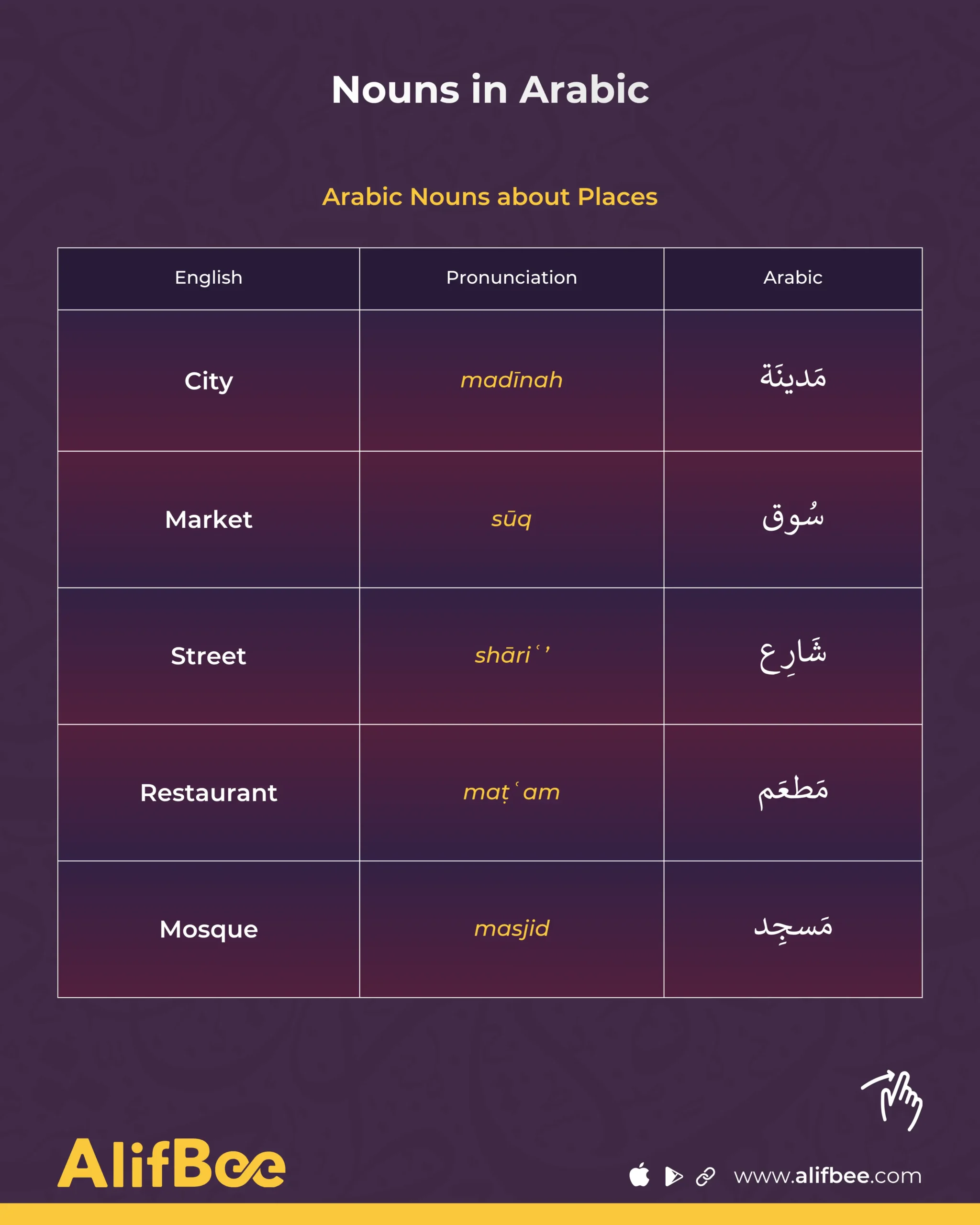
Arabic Nouns about Places
| English | Pronunciation | Arabic | |
|---|---|---|---|
|
City |
madīnah |
مَدينَة |
|
|
Market |
sūq |
سُوق |
|
|
Street |
shāriʿ’ |
شَارِع |
|
|
Restaurant |
maṭʿam |
مَطعَم |
|
|
Mosque |
masjid |
مَسجِد |
|
Review Nouns in Arabic
Common Mistakes Learners Make with Arabic Nouns
Despite the importance of mastering nouns, many students make mistakes that can affect the whole sentence. Here are the most common mistakes:
- Confusing Masculine and Feminine: Every noun in Arabic has a gender. Not knowing the noun’s gender can affect the rest of the sentence. For example, if a noun is feminine, the adjective describing it must also be feminine.
| English | Pronunciation | Arabic |
|---|---|---|
|
Smart girl (feminine – incorrect) |
fatātun dhakiyyun |
فَتَاة ذَكِيّ |
|
Smart girl (feminine – correct) |
fatātun dhakiyyatun |
فَتَاة ذَكِيَّة |
- Using the Wrong Plural: Students often use the same pattern for every plural, without knowing which ending should be used or forgetting that many Arabic words have broken plurals.
| English | Pronunciation | Arabic |
|---|---|---|
|
books (incorrect) |
kitābāt |
كِتَابَات |
|
books (correct) |
kutub |
كُتُب |
- Misuse of the Definite Article: A common mistake is using al- with an indefinite noun or combining it with tanween.
| English | Pronunciation | Arabic |
|---|---|---|
|
the book (incorrect) |
al-kitābun |
الكِتابٌ |
|
the book (correct) |
al-kitāb |
الكِتاب |
Final word
Arabic nouns may seem like a lot at first, but they give you a strong foundation for understanding how Arabic works. The more you read, listen, and practice, the easier it becomes to recognize nouns, notice their patterns, and use them naturally.
Ready to take the next step? Download the AlifBee app for more lessons and interactive exercises, and continue your Arabic learning journey today.
FAQs
1. What are nouns in Arabic?
Nouns in Arabic (الأسماء) are words that name a person, place, thing, quality, or idea. Arabic nouns can be identified by features such as gender, number, definiteness, and case.
2. How do Arabic nouns show gender?
Arabic nouns are either masculine or feminine. Many feminine Arabic nouns end with ة, but some feminine nouns also end with ى or اء, while others must be learned individually.
3. Do nouns in Arabic have singular and plural forms?
Yes. Nouns in Arabic can be singular, dual, or plural. The plural may be a sound plural with a regular ending or a broken plural with an internal change in the word.
4. What is the difference between definite and indefinite nouns in Arabic?
An indefinite noun refers to something non-specific, such as كِتَابٌ (a book). A definite noun refers to something specific, often marked by الـ, such as الكِتَابُ (the book).
5. Why do Arabic nouns change their endings?
Arabic nouns change their endings to show their grammatical role in the sentence. These case endings help indicate whether the noun is the subject, object, or comes after a preposition.
6. Are Arabic nouns difficult for beginners?
Arabic nouns can feel challenging at first because they involve gender, number, plurals, and case endings. However, once you learn the basic patterns, nouns in Arabic become much easier to recognize and use correctly.