
Written by Dania Ghraoui, a translator and language teacher with 10 years of experience.
And Asil Kazoun, an Arabic teacher and translator with experience in education and content writing.
At a Glance: Arabic plurals are formed in two main ways: sound plurals (regular endings) and broken plurals (internal changes). While sound plurals are predictable, broken plurals follow patterns that must be learned through exposure and practice.
If you have started learning Arabic, you already know that forming plurals isn’t as simple as just adding -s or -es at the end, as we do in English. In Arabic, the system is richer—and sometimes more complex.
While some plurals follow regular patterns by adding a suffix to the end of a word, others change the word’s internal structure entirely. These are called broken plurals, and they are one of the most common challenges for new learners.
Do not worry, though. Once you begin to recognize the patterns, they become easier to understand. This guide will walk you through the two main types of plurals in Arabic, ensuring that you can identify and use them correctly.
Note: This article and the examples discuss plurals in Modern Standard Arabic only. Arabic dialects have similar plural forms, but they tend to apply them less strictly and pronunciation can be different.
Before you go further!
Review our guide to Learn Modern Standard Arabic Basics, which gives you a helpful foundation in noun gender, number, and common plural patterns.
Also read Arabic Pronouns: Complete Guide with Examples to see how singular, dual, and plural forms connect to real sentence use and agreement.
What Are Plurals in Arabic?
In Arabic, a plural is a noun form that refers to three or more, while two is treated separately as the dual. Arabic has two main kinds of plurals: sound plurals, which add a regular ending, and broken plurals, which change the structure of the singular word:
- Sound Plurals (al-jam‘u as-sālim): These are formed by adding a specific suffix to the singular word, while keeping the word’s root intact and unchanged.
- Broken Plurals (jam‘u at-taksīr): These involve changes to the internal structure of the word. This process may include shifts in vowels (ḥarakāt), the addition or removal of letters, and changes to consonants, sometimes all occurring together.
Let’s look at each type closely.
Sound Plurals in Arabic
What is a sound plural in Arabic?
A sound plural is formed by adding a suffix to the singular word: ـُونَ (-ūna) or ـِينَ (-īna) to make the Masculine form and ـَات (*-āt*) to make the feminine form.
Sound plurals are called “sound” because the structure of the singular word remains unchanged. You simply attach a fixed ending. These endings change depending on whether the noun is masculine or feminine and on its grammatical case in the sentence.
Masculine Sound Plurals
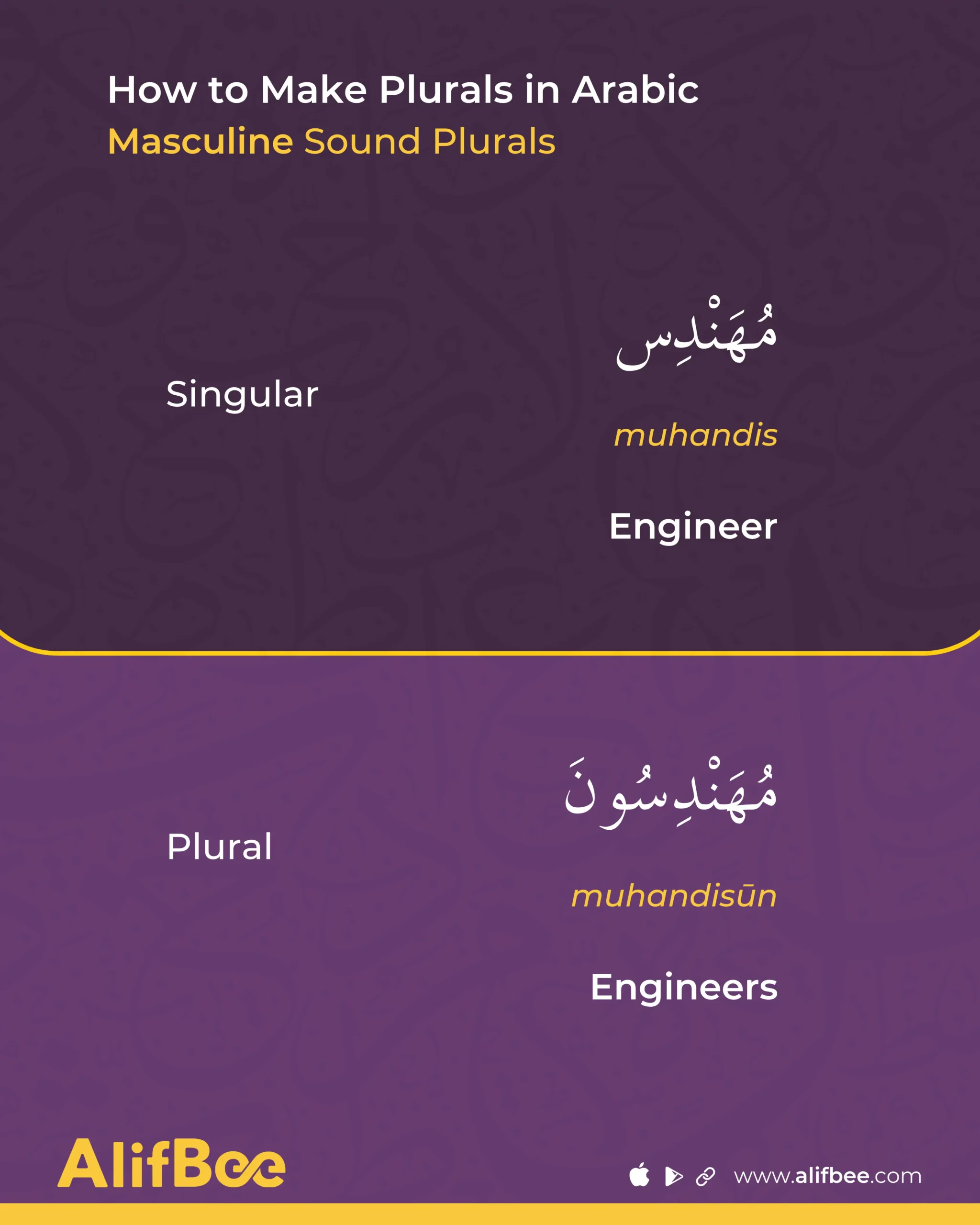
For masculine nouns, you usually add ـُونَ (-ūna) in the nominative case or ـِينَ (-īna) in the accusative and genitive cases. Most masculine sound plurals are used for male human beings, including their professions and their attributes.
| English | Pronunciation | Arabic (Singular) | English | Pronunciation | Arabic (Plural) | ||
|---|---|---|---|---|---|---|---|
|
teacher |
mudarris |
مُدَرِّس |
|
teachers |
mudarrisūn |
مُدَرِّسُونَ |
|
|
engineer |
muhandis |
مُهَنْدِس |
|
engineers |
muhandisūn |
مُهَنْدِسُونَ |
|
|
Muslim |
muslim |
مُسْلِم |
|
Muslims |
muslimūn |
مُسْلِمُونَ |
|
|
traveler |
musāfir |
مُسافِر |
|
travelers |
musāfirūn |
مُسافِرُونَ |
|
|
player |
lāʿib |
لاعِب |
|
players |
lāʿibūn |
لاعِبُونَ |
|
A few masculine nouns do not follow this pattern, even when they refer to people. You simply have to learn them as you go.
Feminine Sound Plurals
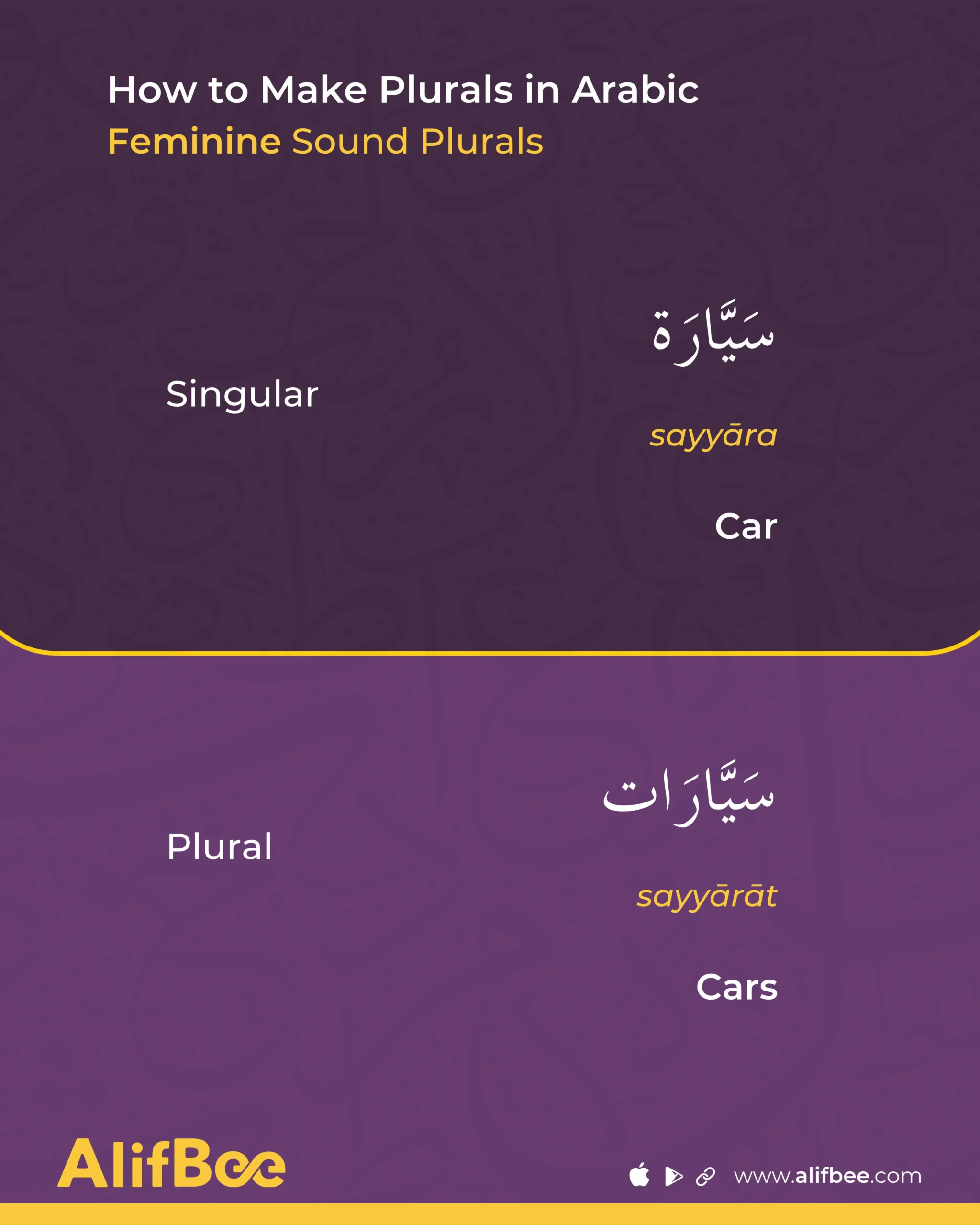
Feminine sound plurals are very common. For most feminine nouns, you remove the ة (tā’ marbūṭa) at the end of the singular form and add ـَات (*-āt*).
Unlike the masculine plural form, this pattern is used for both rational (human) and non-rational (non-human) nouns, as well as their attributes.
| English | Pronunciation | Arabic (Singular) | English | Pronunciation | Arabic (Plural) | ||
|---|---|---|---|---|---|---|---|
|
student |
ṭāliba |
طَالِبَة |
|
students |
ṭālibāt |
طَالِبَات |
|
|
teacher |
mudarrisa |
مُدَرِّسَة |
|
teachers |
mudarrisāt |
مُدَرِّسَات |
|
|
language |
lugha |
لُغَة |
|
languages |
lughāt |
لُغَات |
|
|
page |
ṣafḥa |
صَفْحَة |
|
pages |
ṣafaḥāt |
صَفَحَات |
|
|
car |
sayyāra |
سَيَّارَة |
|
cars |
sayyārāt |
سَيَّارَات |
|
This pattern is reliable. When you see a feminine noun ending with *-a* (ة), chances are high that its plural will follow this form. However, not all feminine nouns end with ة, and some form their plurals differently, often by taking broken plurals instead.
Common Mistakes with Sound Plurals
Even though the grammar of forming sound plurals is straightforward, some beginner Arabic learners find it confusing and tend to make the same mistakes.
Many learners usually:
- overuse ـُونَ (-ūna) in the nominative case and neglect ـِينَ (-īna) for the accusative and genitive cases because they are unsure of the grammatical function of the noun.
- use the masculine sound plural when they have to use the broken plural. For example, saying طالبون instead of طلاب for the noun طالب.
- use the feminine sound plural for all new nouns they encounter, like تفاحات and موزات instead of the broken plural تفاح and موز.
Broken Plurals in Arabic
What is a broken plural in Arabic?
A broken plural is a plural form that does not follow the regular pattern of sound plurals, where there is a fixed suffix to add to the noun. Broken plurals are more common than regular or sound plurals, and they follow unique patterns.
How is a broken plural formed?
Broken plurals do not add a suffix. Instead, they are formed through internal changes to the singular word. This can involve shifts in vowels, the addition or removal of letters, or a combination of these changes.
If you are a beginner, this may seem challenging at first. But here is the good news: broken plurals follow common patterns. Once you start to recognize these, you will often be able to predict the plural.
Broken plurals apply to:
- Many masculine and feminine nouns
- Most non-human (inanimate) objects
- Some abstract concepts
Common Broken Plural Patterns
Let’s look at the most common patterns. Although each pattern has a name, it is often more helpful for beginners to learn them through examples.
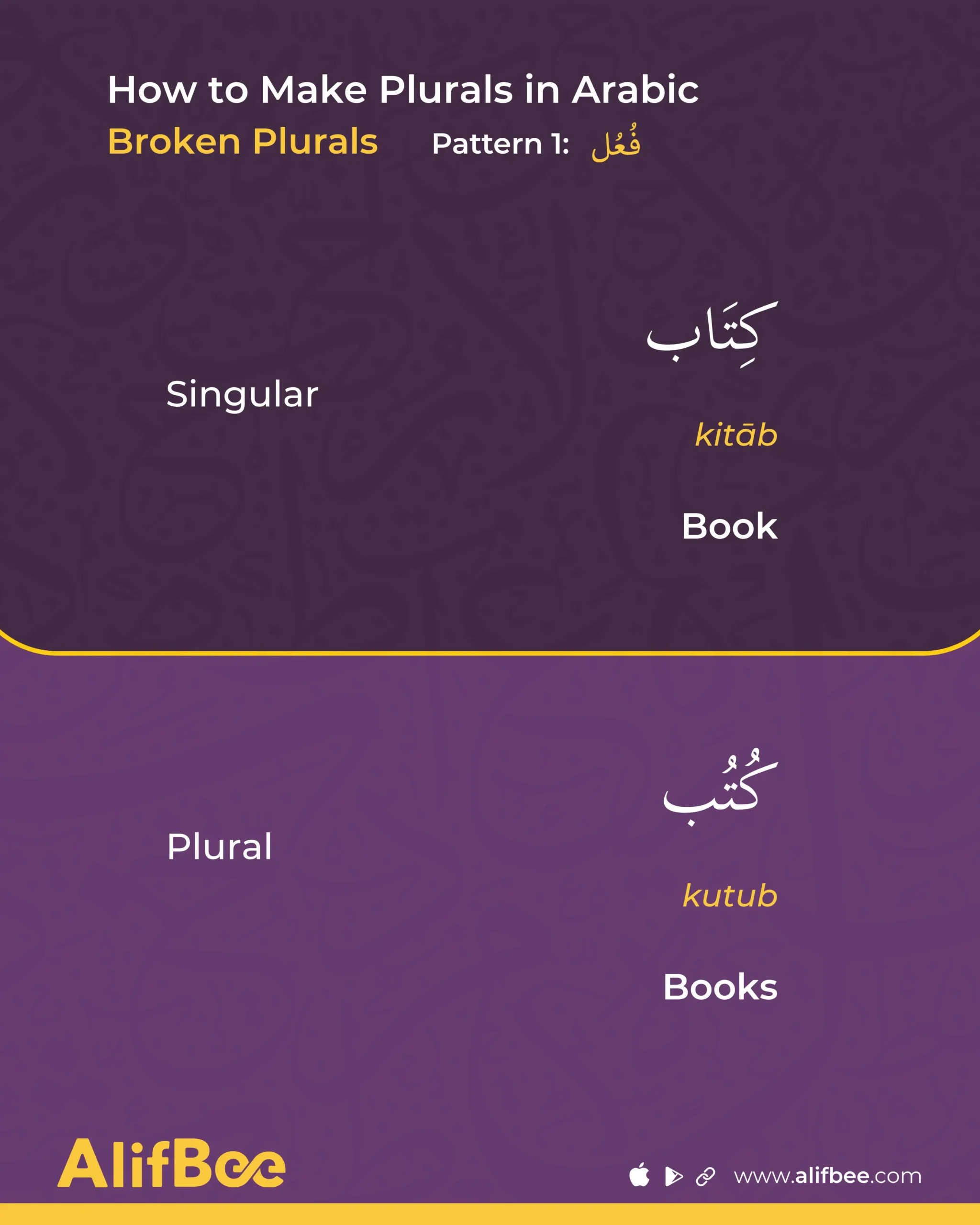
Pattern 1: فُعُل (Fu‘ul)
This pattern appears in some nouns, and it is best learned through examples. In this pattern, the long vowels that appear in the singular form are omitted, and dammah (a short vowel) is added to the three root letters.
| English | Pronunciation | Arabic (Singular) | English | Pronunciation | Arabic (Plural) | ||
|---|---|---|---|---|---|---|---|
|
city |
madīna |
مَدِينَة |
|
cities |
mudun |
مُدُن |
|
|
book |
kitāb |
كِتَاب |
|
books |
kutub |
كُتُب |
|
|
ship |
safīna |
سَفِينَة |
|
ships |
sufun |
سُفُن |
|
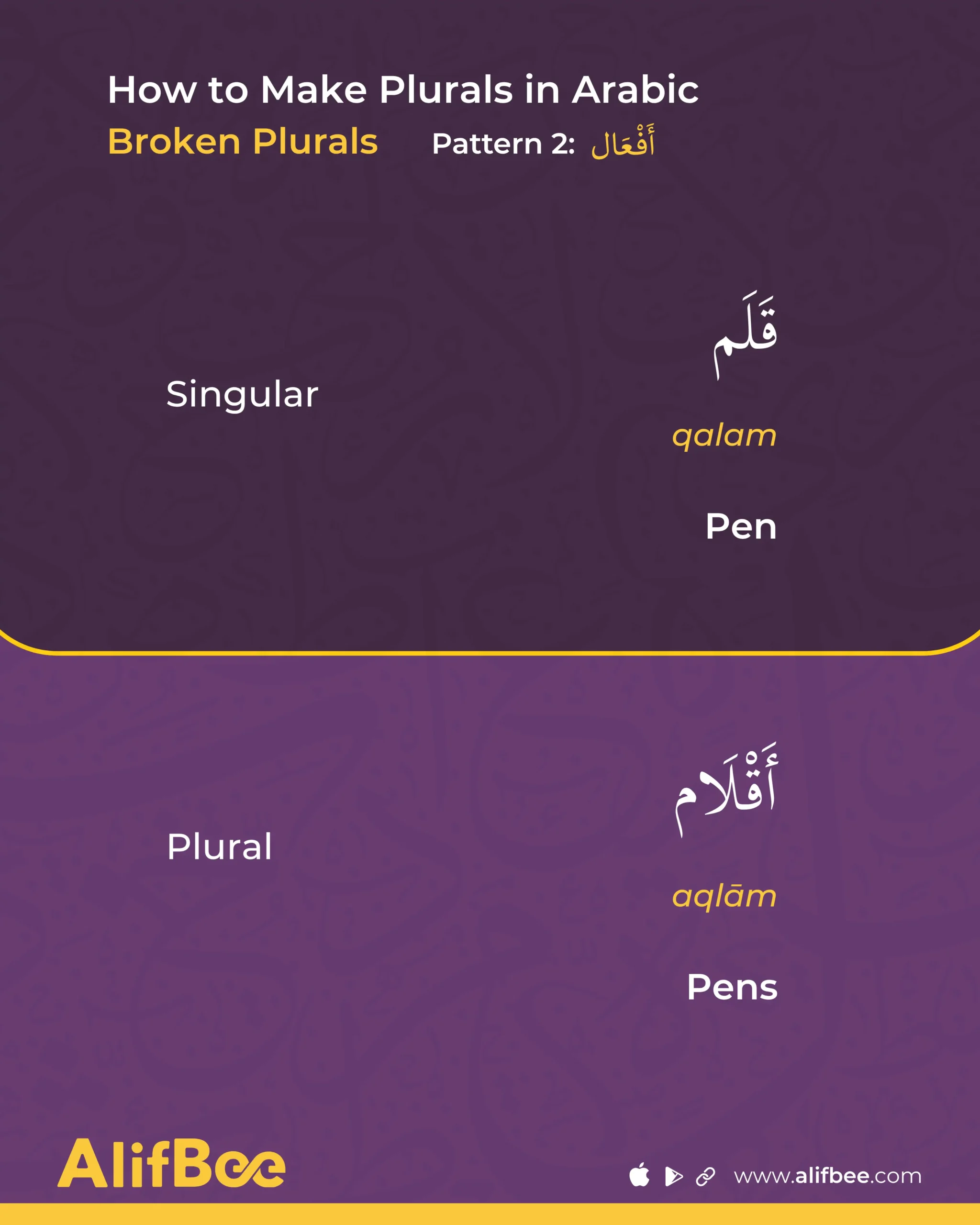
Pattern 2: أَفْعَال (Af‘āl)
This is one of the most common broken plural patterns. It appears with many nouns, especially those with three-letter roots. In this pattern, the letter أ or Hamza with alif is added to the beginning of the singular form, and the long vowel (ā) is added before the last letter.
| English | Pronunciation | Arabic (Singular) | English | Pronunciation | Arabic (Plural) | ||
|---|---|---|---|---|---|---|---|
|
pen |
qalam |
قَلَم |
|
pens |
aqlām |
أَقْلَام |
|
|
boy |
walad |
وَلَد |
|
boys |
awlād |
أَوْلَاد |
|
|
tower |
burj |
بُرج |
|
towers |
abrāj |
أَبرَاج |
|
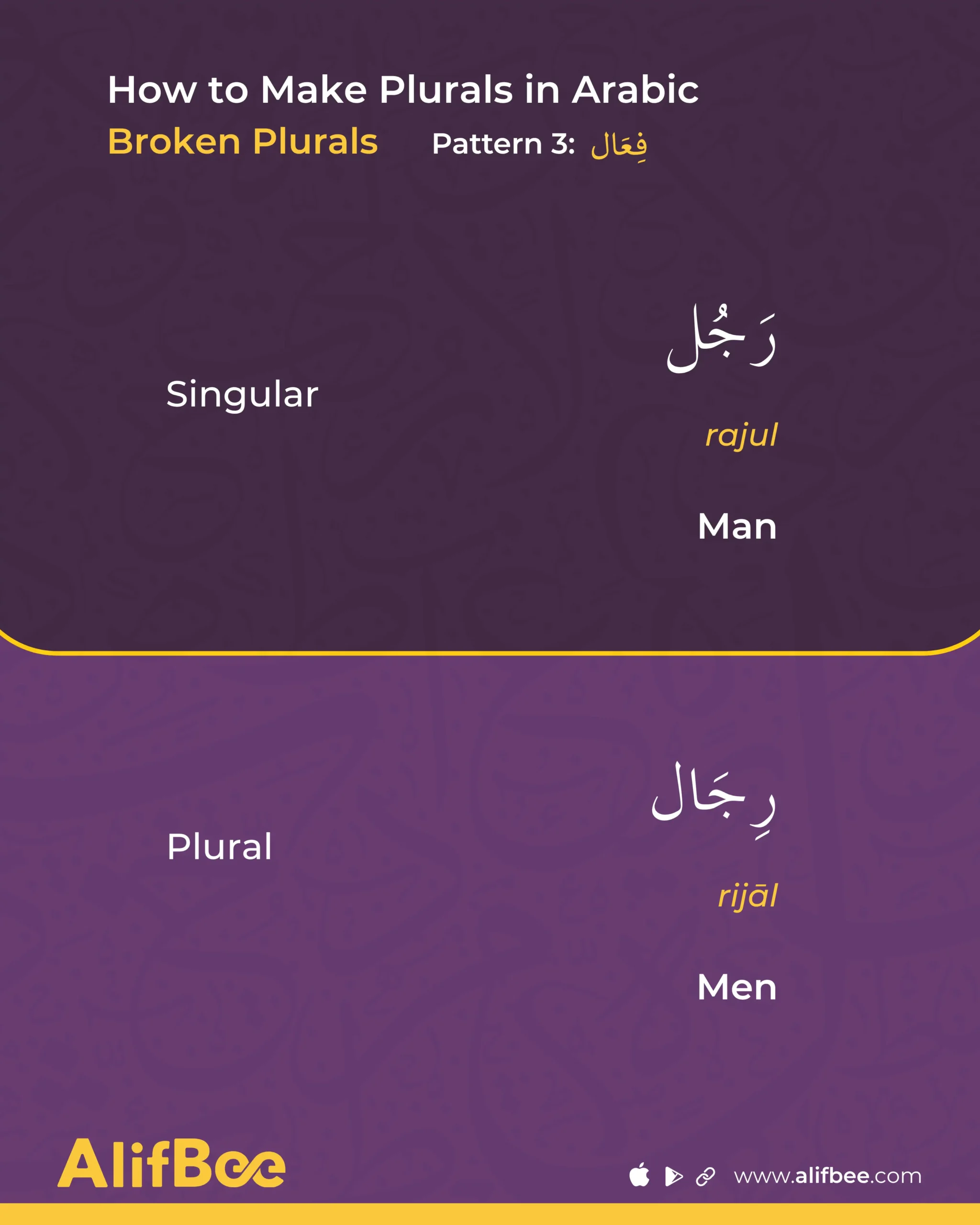
Pattern 3: فِعَال (Fi‘āl)
This pattern is commonly used with nouns derived from three-letter roots. The singular form uses short vowels above the three consonants, and the plural form adds the long vowel (ā) to the second syllable.
| English | Pronunciation | Arabic (Singular) | English | Pronunciation | Arabic (Plural) | ||
|---|---|---|---|---|---|---|---|
|
camel |
jamal |
جَمَل |
|
camels |
jimāl |
جِمَال |
|
|
man |
rajul |
رَجُل |
|
men |
rijāl |
رِجَال |
|
|
country |
balad |
بَلَد |
|
countries |
bilād |
بِلاد |
|
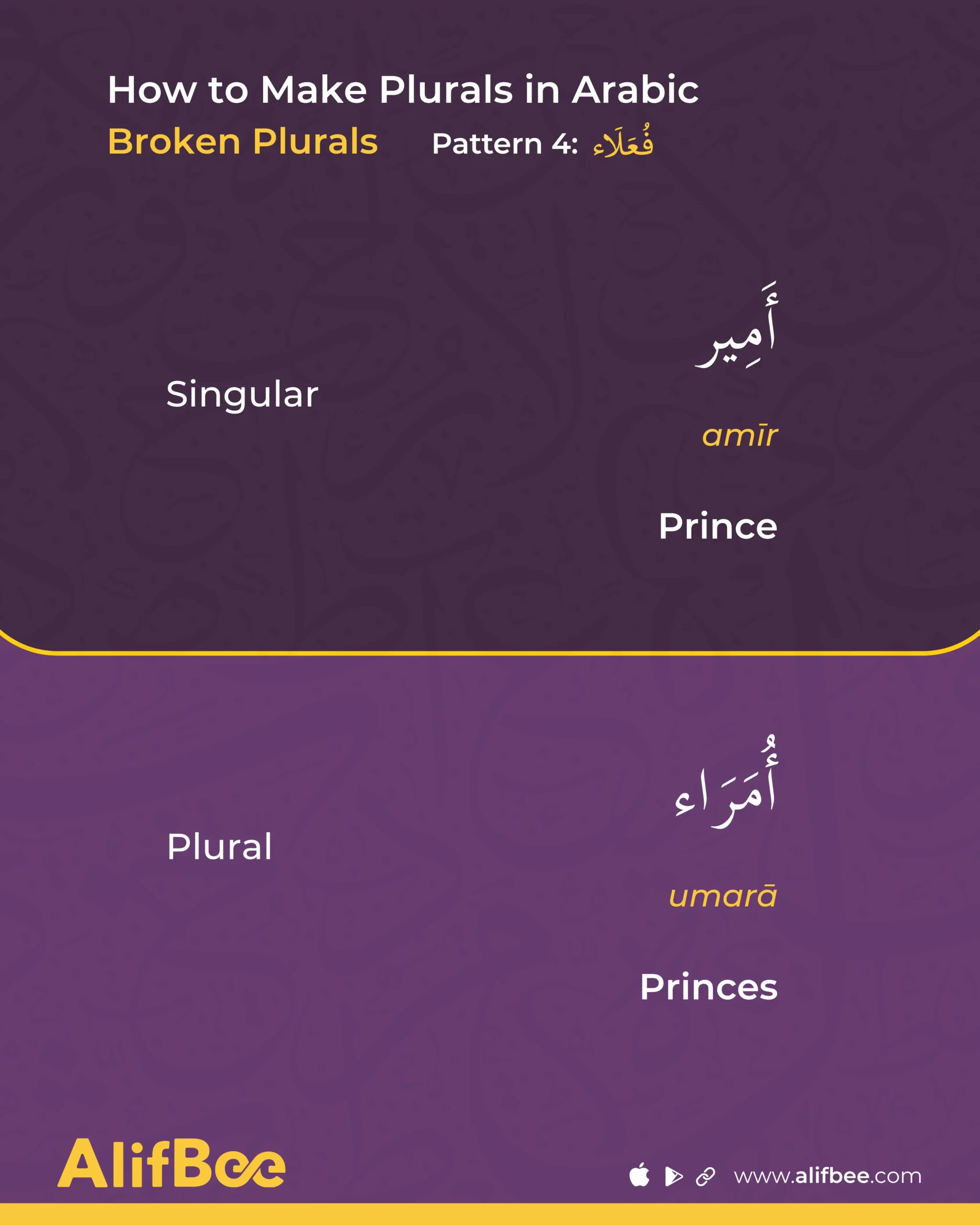
Pattern 4: فُعَلَاء (Fu‘alā’)
This pattern is commonly used for adjectives describing people, especially personal qualities. Pay attention to the long vowel (ī) in the singular form and how we add Hamza to the beginning of the word, and also alif with Hamza to the end of the plural form.
| English | Pronunciation | Arabic (Singular) | English | Pronunciation | Arabic (Plural) | ||
|---|---|---|---|---|---|---|---|
|
prince |
Amīr |
أَمِير |
|
Princes |
Umarā |
أُمَرَاء |
|
|
poor |
faqīr |
فَقِير |
|
poor (people) |
fuqarā |
فُقَرَاء |
|
|
minister |
wazīr |
وَزِير |
|
ministers |
wuzarāʾ |
وُزَرَاء |
|
Why Broken Plurals Matter
You cannot become fluent in Arabic without understanding broken plurals.
Broken plurals are essential because:
- They make up a large portion of the Arabic vocabulary
- They are used in daily speech, media, and writing
- They are essential for fluency
The best approach is not to memorize every plural individually. Instead, focus on learning common patterns and notice how they repeat. When you learn a new noun, try to learn its plural at the same time. Over time, your ear will start to predict the correct form.
How to Know Which Plural to Use
Beginners often ask: How do I know if a word takes a sound plural or a broken plural?
Here are some helpful guidelines:
- Feminine nouns ending with ة (tā’ marbūṭa) usually take the feminine sound plural (*-āt*).
- Masculine nouns that describe professions or people often take the masculine sound plural (*-ūn* / *-īn*), but many also take broken plurals.
- Inanimate objects and abstract nouns usually take broken plurals.
- Many short adjectives often follow broken plural patterns.
There are exceptions, as in any language. But these rules will help you make a good guess when you encounter a new word.
Pluralizing Adjectives
In Arabic, adjectives must agree with the nouns they describe in gender and number. This means you need to use the correct plural form for adjectives, too.
Let’s start with a golden rule,
Key Rule: Non-human plurals = feminine singular adjective
Now, let’s see an example and see two other cases of noun-adjective agreement:
- Non-human plurals in Arabic are treated as feminine singular, not feminine plural. The non-human plural كُتُبٌ takes the feminine singular adjective جَدِيدَةٌ.
| Adjective | English Meaning | Pronunciation | Plural | |
|---|---|---|---|---|
|
Feminine singular adjective |
new books |
kutubun jadīda |
كُتُبٌ جَدِيدَةٌ |
|
- Here we have a broken plural adjective أَذْكِيَاءُ matching the masculine plural noun أَوْلَادٌ.
| Adjective | English Meaning | Pronunciation | Plural | |
|---|---|---|---|---|
|
Broken plural adjective |
smart boys |
awlādun adhkiyā’ |
أَوْلَادٌ أَذْكِيَاءُ |
|
- Both the noun مُدَرِّسُونَ and the adjective مُجْتَهِدُونَ use the masculine sound plural ending.
| Adjective | English Meaning | Pronunciation | Plural | |
|---|---|---|---|---|
|
Masculine sound plural |
hardworking teachers |
mudarrisūna mujtahidūn |
مُدَرِّسُونَ مُجْتَهِدُونَ |
|
This agreement takes practice. Pay attention to how adjectives change depending on the noun, especially when reading or listening.
Arabic Dual Form
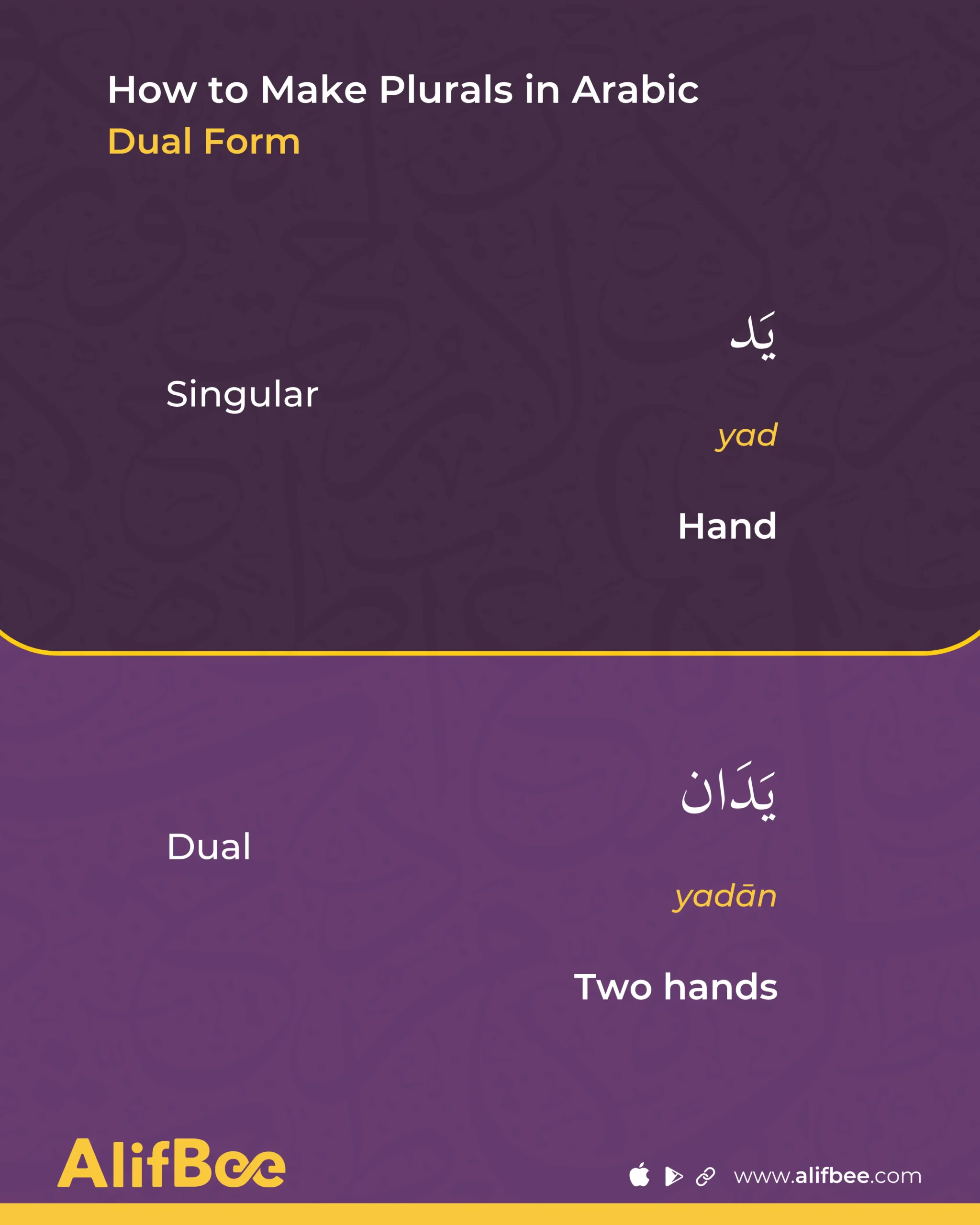
Unlike English, Arabic uses a specific dual form to indicate exactly two items, formed by adding the suffixes -āni (ـَانِ) or -ayni (ـَيْنِ) to the noun. Understanding this form is very helpful for Arabic learners as it allows them to express exactly two items more precisely.
| English | Pronunciation | Singular | English | Pronunciation | Dual | ||
|---|---|---|---|---|---|---|---|
|
hand |
yad |
يَد |
|
two hands |
yadān |
يَدَان |
|
|
book |
kitāb |
كِتَاب |
|
two books |
kitābayn |
كِتَابَيْنِ |
|
|
girl |
fatāh |
فَتاة |
|
Two girls |
fatātān |
فَتَاتَان |
|
|
tree |
shajarah |
شَجَرَة |
|
Two trees |
shajaratān |
شَجَرَتان |
|
|
bird |
ʿuṣfūr |
عُصْفور |
|
Two birds |
ʿuṣfūrān |
عُصفُورَان |
|
The dual form is not a plural but a separate grammatical category. It sits between singular and plural. Using it correctly will make your Arabic sound more natural.
Arabic Vs. English Plurals
Here is a quick, simple comparison of English plurals and Arabic plurals.
| Feature | English | Arabic |
|---|---|---|
|
Regular plurals |
Very common |
Limited |
|
Irregular plurals |
Few |
Very common |
|
Pattern system |
Weak |
Strong |
|
Dual rule |
No dual form |
Dual form for two |
|
Pluralising adjectives |
No change |
Adjectives agree in singular,
dual, or plural forms |
Review How to Make Plurals in Arabic
Quick Practice of Arabic Plurals
Try answering the following exercises to see if you understand Arabic plurals.
Turn the singular nouns into plural.
كِتَاب
رَجُل
مَدِينَة
أَمِير
- كُتُب
- رِجَال
- مُدن
- أُمرَاء
Choose the correct pattern for the noun: شجرة → ?
A. شَجَرَات
B. أَشجَار
C. شَجرُون
B. أَشجَار
Choose the correct pattern for the noun: خبير → ?
A. خَبيرَات
B. خَبيرُون
C. خُبرَاء
C. خُبرَاء
Fix the mistake: أَلوَاح → لَوحَة
Correct: ______
فُقرَاء
Fix the mistake: فَقيرُون → فقير
Correct: ______
لَوحَات
Common Mistakes Learners Make With Arabic Plurals
For learners spending little time to understand Arabic plurals fully, these are the common mistakes they usually make:
- Confusing sound plurals with broken plurals
- Adding a sound plural suffix to every new noun
- Assuming every noun ending in tāʾ marbūṭa takes -ات
- Mixing up broken plural patterns by applying the pattern of one word family to a different noun.
- Forgetting the non-human agreement rule
- Trying to guess plurals without learning the common patterns
How to Learn Arabic Plurals Faster
We have compiled the top tips to avoid confusion when learning Arabic plurals and to quickly start using them:
- Learn each new noun with its plural, not by itself.
- Memorize common broken plural patterns as word families, not as random words.
- Notice the ending -ون / -ين for many masculine human nouns.
- Notice the ending -ات for many feminine nouns.
- Expect many common everyday words to use broken plurals.
- Group words by pattern so your brain sees the shape faster.
- Read short Arabic texts and highlight every plural you find.
- Make flashcards with the singular on one side, the plural on the other.
- Practice singular to plural and plural to singular both ways.
- Learn nouns together with matching adjectives to spot agreement.
- Review a little every day, because plurals need repetition more than rules.
Final word
Arabic plurals may seem complex at first, but they become predictable when you focus on patterns, not memorization.
Start with:
- Feminine sound plural (-āt)
- Masculine sound plural (-ūn / -īn)
- Most common broken patterns
With consistent practice, you’ll begin to recognize plural forms naturally.
Learn Faster with AlifBee
If you want structured practice with real examples, the AlifBee app helps you:
- learn patterns step-by-step
- hear native pronunciation
- practice with interactive exercises
Start your Arabic journey today with a 14-day free trial.
FAQs
There are many broken plural patterns in Arabic, but around 8 to 10 are commonly used in everyday speech.
Sometimes. If you know the root letters and recognize a common pattern, you can make a good guess. However, broken plurals are not fully predictable, so it is best to learn the plural form together with each new noun.
Most do, but some nouns are used only in the singular and do not commonly take a plural, such as ḥalīb (milk). Others are used only in the plural, like nās (people).
Learn each new noun together with its plural. Write them side by side, and group words that share the same plural pattern. Read simple Arabic texts and highlight every plural you notice.