
At a Glance: Modern Standard Arabic, or MSA, is the formal Arabic used in books, news, education, official documents, and formal speech across the Arab world. It is not usually the Arabic people speak at home every day, but it is the shared form learners study for reading, writing, and formal communication.
If you have just started learning Arabic, you have probably seen the phrase Modern Standard Arabic or MSA more than once. Then, a few minutes later, you may hear someone say that people in Egypt, Jordan, Morocco, or the Gulf do not speak exactly the same Arabic at home.
That can feel confusing at first. Are you learning the “right” Arabic? Will people understand you? Should you study MSA or a dialect?
In this blog, we will answer all your questions. We will learn the meaning of Modern Standard Arabic or Fusha, where MSA is used, how it differs from dialects and Classical Arabic, and which resources can help beginners start learning MSA.
Before You Go Further!
If you are learning Modern Standard Arabic, it helps to build the basics in the right order. Start with our guide to Arabic basics for beginners for a simple learning path. Then, read our Arabic alphabet chart with pronunciation to understand how Arabic letters and sounds work. You may also find our guide to Arabic sentence structure useful, especially if you want to see how MSA sentences are formed before moving into longer reading and writing practice.
What is Modern Standard Arabic (MSA)?
It is the standard language used across the Arabic-speaking world for formal writing and communication. It is the form used in education, official documents, news broadcasts, formal speeches, and most contemporary Arabic publications.
MSA is also the variety most beginner Arabic learners study when they want a broad foundation rather than one local dialect.
Furthermore, Arabic is one of the official languages of the United Nations, where formal Arabic is used in official communication and interpretation.
Where Is Modern Standard Arabic Used?
Arabic is an official language in many Arab countries, and MSA is the formal written and educational standard used across them.
You may study MSA and then use it to read materials from Egypt, Syria, Saudi Arabia, Lebanon, Morocco, the UAE, or other Arabic-speaking countries.
In short, you will usually meet MSA in these places:
| Context | How MSA Is Used |
|---|---|
|
News |
TV news, online articles, formal reports |
|
Education |
Schoolbooks, Arabic courses, exams, academic materials |
|
Books |
Nonfiction, novels, children’s books, textbooks |
|
Official settings |
Government documents, speeches, laws, announcements |
|
Online content |
Formal websites, educational content, subtitles |
|
Public speaking |
Lectures, conferences, prepared talks |
MSA is one of the most useful starting points for learners because it appears in stable, structured materials. It also helps you understand the Arabic script, sentence structure, vocabulary building, and formal pronunciation.
Is Modern Standard Arabic the Same as Classical Arabic?
No, it’s not exactly the same in use. MSA developed from Classical Arabic and retains much of its grammatical structure, but its vocabulary has continued to expand to describe and adapt to modern life.
To put it simply:
- Classical Arabic is the older formal Arabic connected with the Quran, early Arabic literature, classical poetry, and traditional scholarship.
- Modern Standard Arabic developed from that base and adapted to modern life, including topics such as politics, science, education, technology, media, and current events.
For example, the Academy of the Arabic Language in Cairo records حَاسُوب (ḥāsūb) as an Arabic term for “computer.”
Moreover, scholars often describe MSA as the modern standardized form that developed in the Arab world in the late 19th and early 20th centuries.
This is a comparison of the features of the two:
| Feature | Classical Arabic | Modern Standard Arabic |
|---|---|---|
|
Main association |
Quran, early literature, classical scholarship |
News, education, books, official communication |
|
Time period |
Older historical form |
Modern formal standard |
|
Vocabulary |
Traditional and classical |
Classical base plus modern terms |
|
Learner use |
Useful for religious/classical texts |
Useful for reading, writing, media, and formal Arabic |
Many Arabic speakers use Fuṣḥā to refer broadly to both Classical Arabic and MSA. The distinction is more common in academic and language-learning contexts.
Modern Standard Arabic vs Quranic Arabic
Quranic Arabic is the classical form of Arabic, which includes early grammar and vocabulary. It is sometimes referred to as the ‘golden’ form of Arabic. For this reason, it contains archaic vocabulary and verb forms, and it often requires interpretation. In contrast, we know that Modern Standard Arabic has been standardized to be used today.
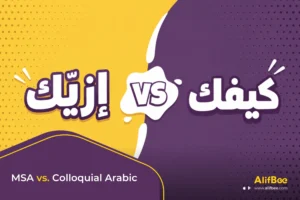
Modern Standard Arabic vs Spoken Dialects (Colloquial Arabic)
Spoken dialects are the local Arabic varieties native speakers use naturally at home and in daily life. An Egyptian speaker may say things differently from a Syrian, Moroccan, Iraqi, or Emirati speaker. These differences appear in pronunciation, grammar, vocabulary, and even common phrases.
For example, the phrase “How are you?” changes from one region to another:
| Meaning | Pronunciation | Arabic | |
|---|---|---|---|
|
How are you? MSA, to a male |
kayfa ḥāluka? |
كَيْفَ حَالُكَ؟ |
|
|
How are you? Egyptian Arabic |
izzayyak? |
إِزَّيَّك؟ |
|
|
How are you? Levantine Arabic |
kīfak? |
كِيفَك؟ |
|
|
How are you? Gulf/Iraqi usage |
shlōnak? |
شْلُونَك؟ |
|
This is one reason learners sometimes feel confused. They may learn one phrase in MSA, then hear a completely different version in a TV show or a real conversation.
To read more about the differences between MSA and Arabic dialects, check our helpful guides:
Why Learn Modern Standard Arabic First?
Because it gives you structure as you start learning Arabic. You cover the Arabic alphabet, grammar, and common vocabulary in a form that works across countries and formal settings.
MSA helps you:
- Read Arabic books, articles, signs, and learning materials.
- Understand formal videos, news, and educational content.
- Build a strong grammar foundation.
- Recognize Arabic roots and word patterns.
- Move into dialects later with less confusion.
- Study Arabic in a structured way from beginner to advanced levels.
Arabic dialects can vary a lot. If you start with one dialect only, it may help you speak in one region, but it may not give you the same access to formal Arabic texts or cross-country materials.
If your main goal is family conversation or travel to one specific country, you can add that dialect early. But even then, a basic MSA foundation makes the Arabic script and grammar much easier to understand.
Useful Resources for Learning Modern Standard Arabic
You do not need to use every Arabic resource you find. A better approach is to choose one structured course as your main learning path, then add separate resources for listening, reading, and vocabulary practice.
1. AlifBee: A Structured MSA Course
AlifBee teaches Modern Standard Arabic through a progressive curriculum that develops reading, writing, listening, and speaking. Learners can take a placement test, begin at the appropriate level, and practice new vocabulary, grammar, and complete sentences through interactive exercises.
Best for: Beginners through advanced learners who want one organized course
How to use it: Complete a short lesson each day and use the review activities to revisit older vocabulary.
2. Al Jazeera Learning Arabic: Free Interactive Lessons
Al Jazeera Learning Arabic is a free resource that uses media reports, everyday topics, literary texts, grammar explanations, and listening activities. Learners can show or hide the transcript, add or remove Arabic vowel marks, complete exercises, look up vocabulary, and take a placement test.
Best for: Learners who can already read the Arabic alphabet
How to use it: Choose material at your level, listen once without the transcript, and then listen again while following the Arabic text.
3. Aswaat Arabiyya: MSA Listening Practice
Aswaat Arabiyya is a free listening project from the University of Texas at Austin. It contains authentic audio and video from across the Arab world, organized from novice to superior level. Each unit includes activities to complete before, during, and after listening.
Best for: Developing listening comprehension
How to use it: Listen to the full recording first, note the words you recognize, and then replay shorter sections while completing the exercises.
4. Arabic with Sam: Short Audio Lessons
The Arabic with Sam podcast includes short lessons on Arabic vocabulary, grammar, sentence structure, and pronunciation. Some episodes focus more heavily on Quranic or Classical Arabic, so MSA learners should select episodes about Standard Arabic and general grammar.
Best for: Extra listening practice during a commute or walk
How to use it: Choose one short episode, write down two or three useful expressions, and try to use them in your own sentences.
5. Ahlan wa Sahlan: A Complete MSA Textbook Course
Ahlan wa Sahlan: Functional Modern Standard Arabic for Beginners is a structured textbook course published by Yale University Press. The series includes beginner and intermediate books, alphabet practice, workbooks, audio, and video materials.
Best for: Learners who prefer textbooks or are studying with a teacher
How to use it: Work through the chapters in order and complete the written and audio exercises rather than using the book only as a grammar reference.
6. Arabic Collections Online: Advanced Reading Material
Arabic Collections Online is a free digital library supported by New York University Abu Dhabi and several partner universities. It provides access to thousands of public-domain Arabic books covering literature, history, science, culture, and other subjects.
Best for: Upper-intermediate and advanced readers
How to use it: Choose a subject you already know something about, read a short passage, and look up only the words that prevent you from understanding the main idea.
The most effective combination is usually one main course, one listening resource, and one source of reading material. For example, you could use AlifBee for your daily lessons, Aswaat Arabiyya twice a week for focused listening, and Al Jazeera Learning Arabic for a short reading or video at the weekend.
Final word
Modern Standard Arabic gives learners a shared foundation for reading, writing, news, education, and formal communication across the Arabic-speaking world. It may not be the variety you hear in every casual conversation, but it helps you understand how Arabic works and makes it easier to explore a spoken dialect later.
Start with the basics, practice regularly, and do not wait until every grammar rule feels perfect before using what you know.
Learn Arabic with AlifBee
Learners can use the AlifBee app to study Modern Standard Arabic through a structured path that develops reading, writing, listening, and speaking together.
Lessons introduce vocabulary and grammar gradually, with native audio, speaking practice, interactive exercises, and regular review to help the new language stick.
A placement test also helps learners begin at the right level and build a solid MSA foundation at their own pace.
FAQs
1. What is Modern Standard Arabic?
Modern Standard Arabic, or MSA, is the formal Arabic used in books, news, education, official documents, and formal speeches. It is the shared written and formal form of Arabic used across the Arab world.
2. Is MSA the same as Classical Arabic?
No. MSA developed from Classical Arabic and still keeps much of its structure, but it uses modern vocabulary for topics like education, technology, politics, and media. Classical Arabic is more closely connected with the Quran, early Arabic literature, and traditional scholarship.
3. Is Modern Standard Arabic spoken every day?
Not usually. Native Arabic speakers normally use local dialects in daily conversation. MSA is spoken in formal settings such as news broadcasts, speeches, lectures, classrooms, and official interviews.
4. What is MSA used for?
MSA is used for reading, writing, education, news, books, official documents, formal speeches, and many Arabic learning programs. It is also useful for learners who want a strong foundation before studying a spoken dialect.
5. What countries use Modern Standard Arabic?
Modern Standard Arabic is used formally across Arabic-speaking countries, including Egypt, Saudi Arabia, Jordan, Lebanon, Syria, Iraq, Morocco, Algeria, Tunisia, the UAE, Qatar, Kuwait, Oman, Bahrain, Yemen, Palestine, Sudan, Libya, Mauritania, Djibouti, Somalia, and Comoros. Daily speech still varies by local dialect.
6. Should I learn MSA or a dialect first?
Learn MSA first if you want to read, write, understand formal Arabic, follow news, or build a broad foundation. Learn a dialect early if your main goal is speaking with family, traveling to one country, or understanding local conversations. Many learners start with MSA, then add the dialect they need most.