
Written by Dania Ghraoui, a translator and language teacher with 10 years of experience.
At a Glance: Arabic numbers appear in prices, dates, time, phone numbers, addresses, ages, and quantities. You may see Arabic-Indic digits or Western digits, depending on the country, context, and platform. The examples below use Modern Standard Arabic and show how common numbers are used in complete sentences.
Memorizing a number chart is a useful first step, but numbers become practical when you can use them in real situations. A shop assistant may tell you a price, a friend may share a phone number, or a receptionist may give you a room number or an appointment time. Each situation has its own common pattern.
This guide focuses on Modern Standard Arabic (MSA), so the examples use forms that are widely understood across the Arabic-speaking world. Spoken dialects may change the pronunciation or wording, and everyday speech usually leaves out formal case endings.
Arabic-Indic and Western Digits
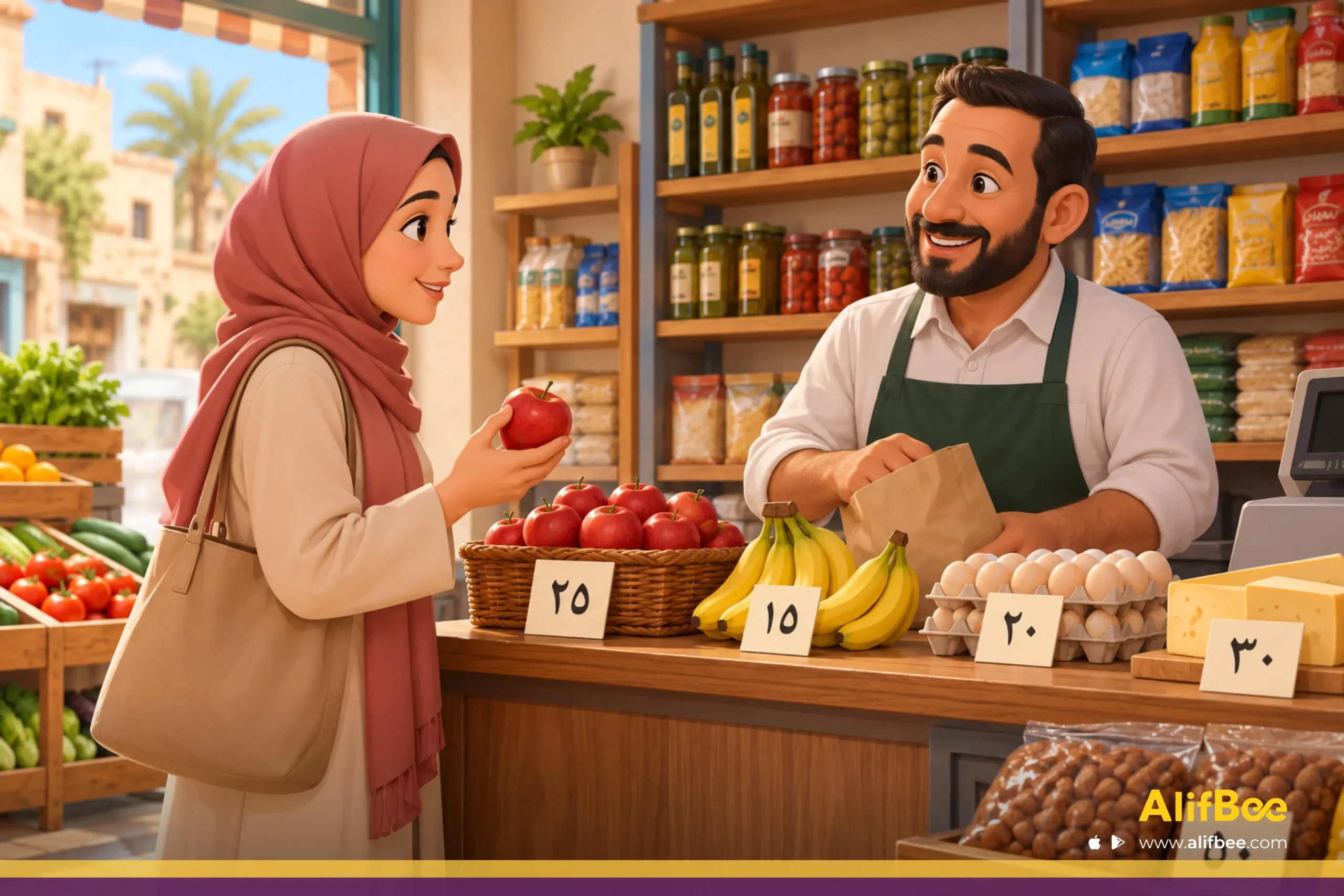
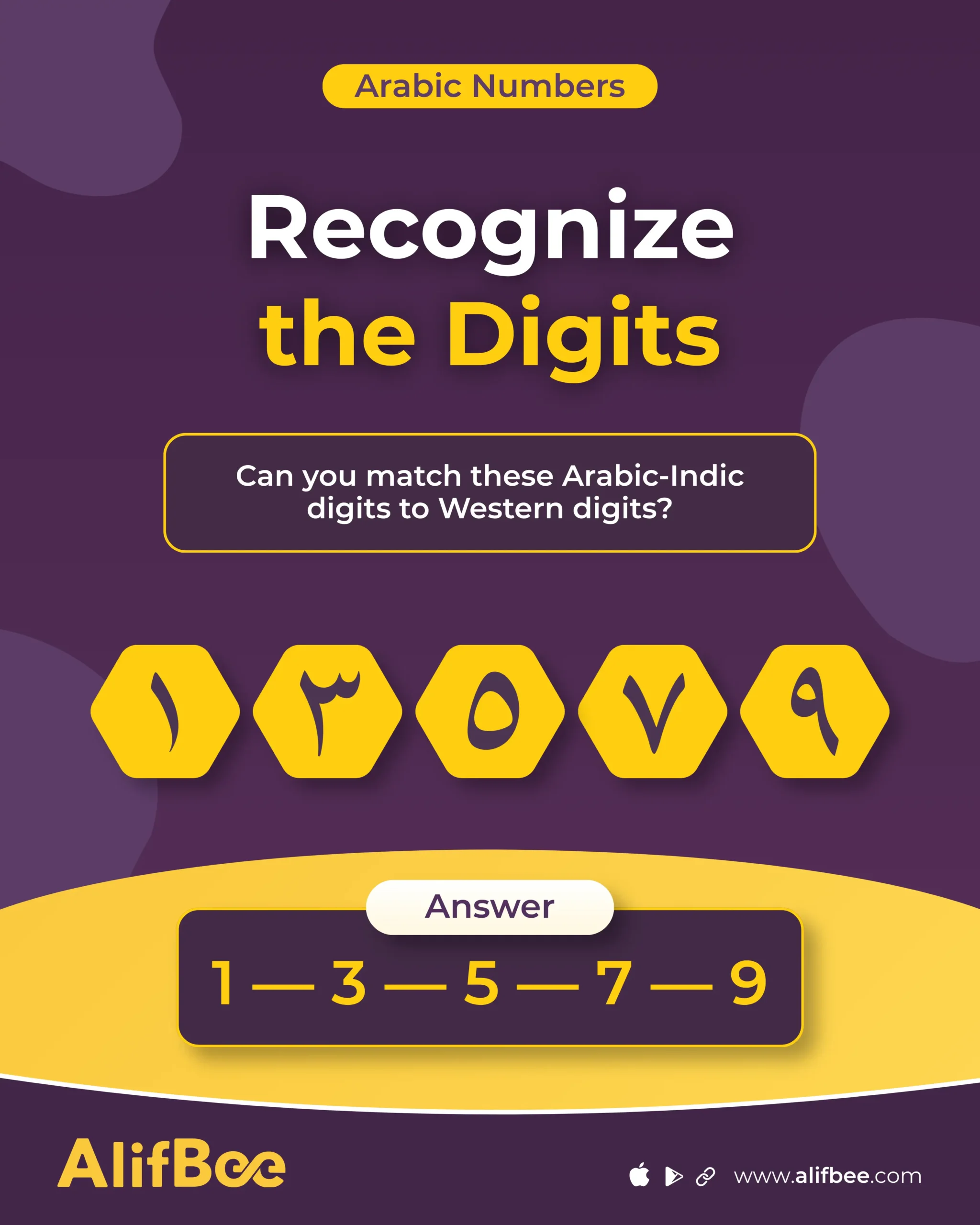
Arabic texts may use Arabic-Indic digits, Western digits, or a mixture of both. Learn to recognize both systems because their use varies by region and setting.
| Western | Arabic-Indic | Arabic word | Pronunciation | Meaning | |
|---|---|---|---|---|---|
|
0 |
٠ |
صِفْر |
ṣifr |
zero |
|
|
1 |
١ |
وَاحِد |
wāḥid |
one |
|
|
2 |
٢ |
اِثْنَان |
ithnān |
two |
|
|
3 |
٣ |
ثَلَاثَة |
thalātha |
three |
|
|
4 |
٤ |
أَرْبَعَة |
arbaʿa |
four |
|
|
5 |
٥ |
خَمْسَة |
khamsa |
five |
|
|
6 |
٦ |
سِتَّة |
sitta |
six |
|
|
7 |
٧ |
سَبْعَة |
sabʿa |
seven |
|
|
8 |
٨ |
ثَمَانِيَة |
thamāniya |
eight |
|
|
9 |
٩ |
تِسْعَة |
tisʿa |
nine |
|
Need the complete patterns for larger numbers? Review Arabic Numbers 1 – 100 and How to Form Arabic Numbers.
How to Use Arabic Numbers for Prices
When talking about prices in Arabic, you usually say the number followed by the currency, such as khamsūna dirhaman (خَمْسُونَ دِرْهَمًا), meaning “50 dirhams.”
In Modern Standard Arabic (MSA), the currency word changes depending on the number. After numbers from 3 to 10, it is generally plural, as in khamsatu darāhima (خَمْسَةُ دَرَاهِمَ), meaning “five dirhams.” After numbers from 11 to 99, it is singular and typically ends in -an, as in khamsūna dirhaman (خَمْسُونَ دِرْهَمًا).
Here are some useful phrases for asking about prices, understanding costs, and negotiating when shopping.
| Meaning | Pronunciation | Arabic | |
|---|---|---|---|
|
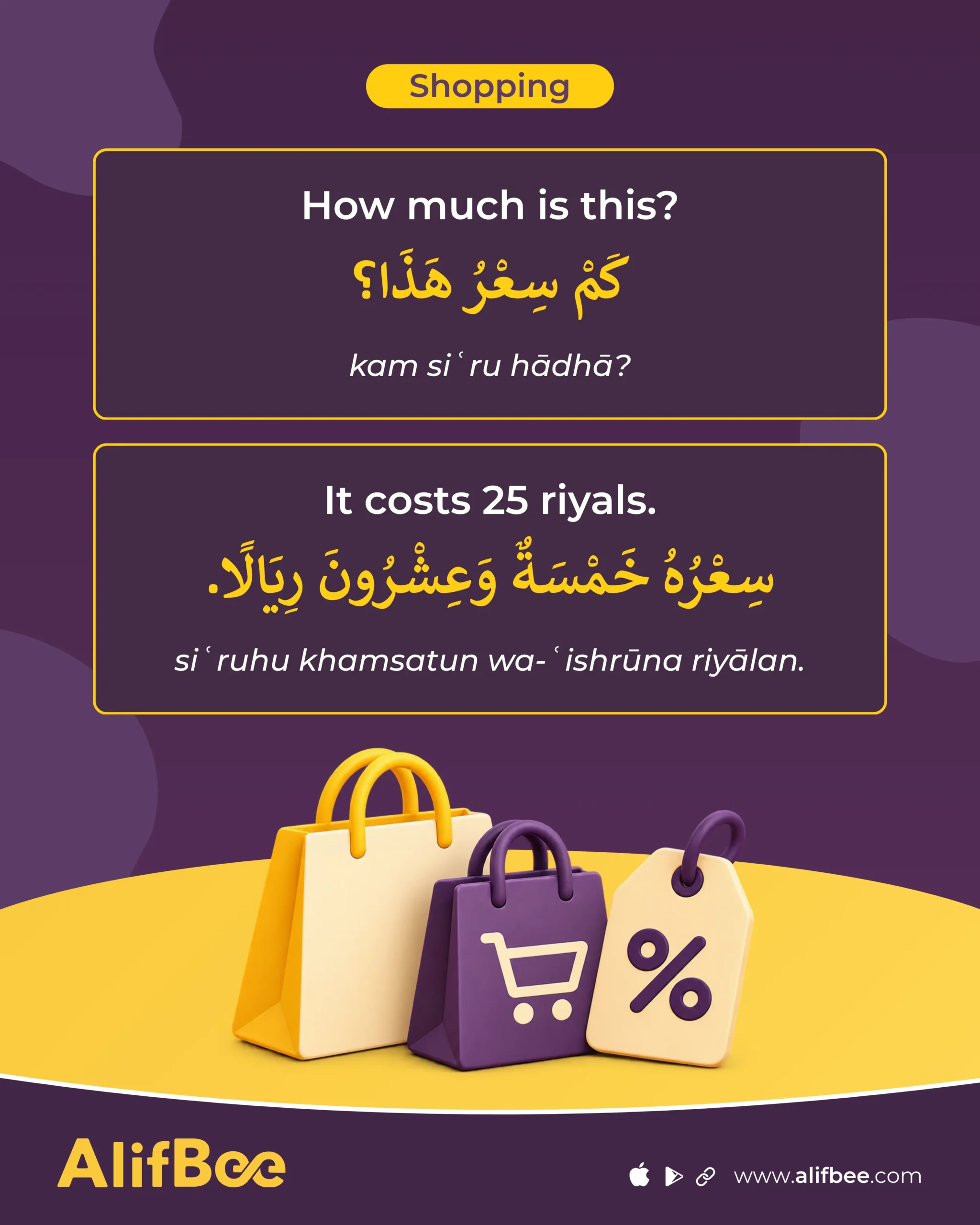
How much is this?
|
kam siʿru hādhā?
|
كَمْ سِعْرُ هَذَا؟
|
|
|
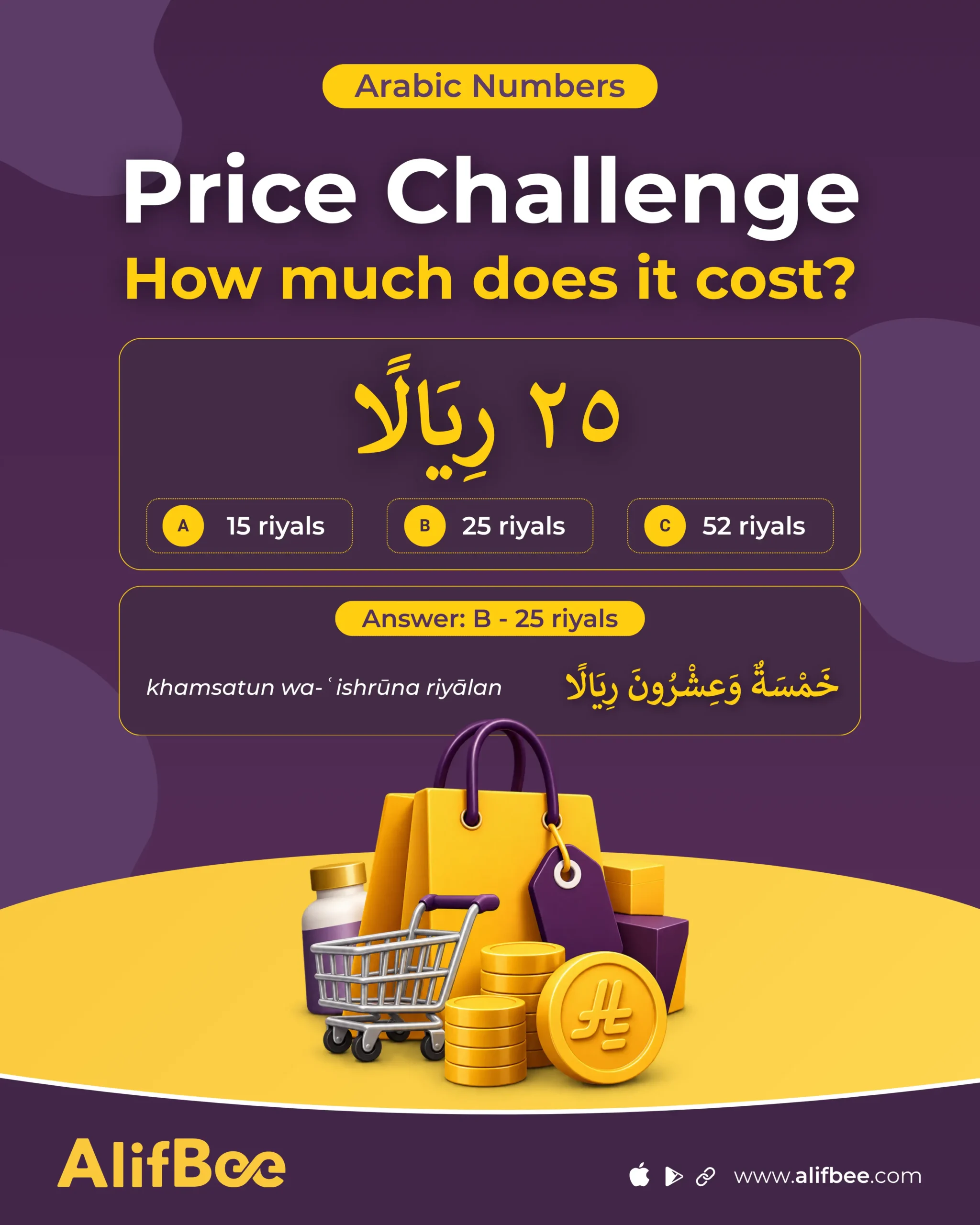
It costs 25 riyals.
|
siʿruhu khamsatun wa-ʿishrūna riyāl.
|
سِعْرُهُ خَمْسَةٌ وَعِشْرُونَ رِيَالًا. |
|
|
This is 50 dirhams.
|
hādhā bi-khamsīna dirham.
|
هَذَا بِخَمْسِينَ دِرْهَمًا.
|
|
|
Can the price be reduced to 40 dirhams?
|
hal yumkinu khafḍu al-siʿri ilā arbaʿīna dirham?
|
هَلْ يُمْكِنُ خَفْضُ السِّعْرِ إِلَى أَرْبَعِينَ دِرْهَمًا؟
|
|
For more Arabic phrases you can use in stores and markets, see At the Shops: 9 Arabic Phrases for a Smooth Shopping Experience.
How to Read Phone Numbers in Arabic
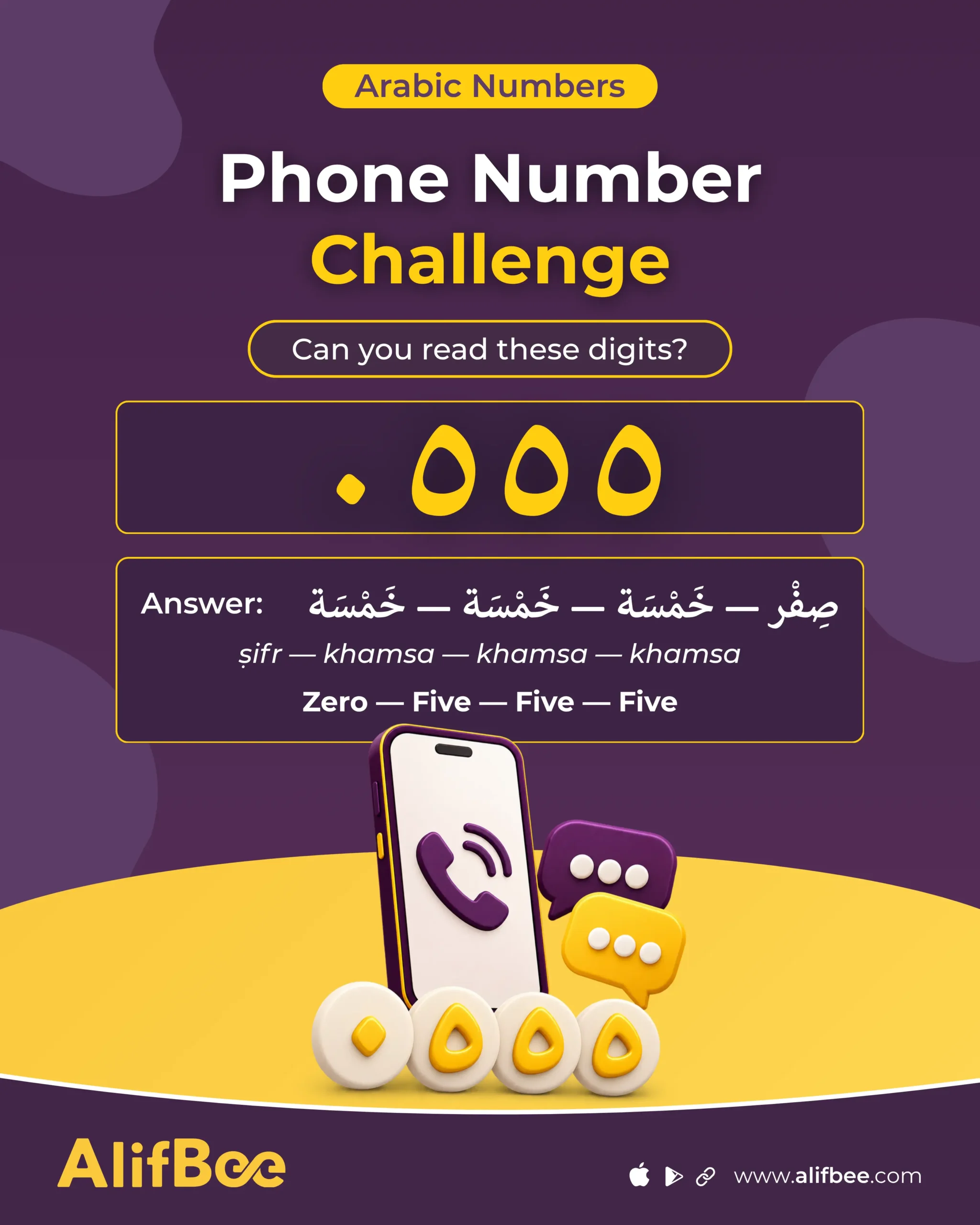
Phone numbers are normally read one digit at a time. Pause between groups to make a long number easier to follow, and repeat the number back to confirm it.
| Meaning | Pronunciation | Arabic | |
|---|---|---|---|
|
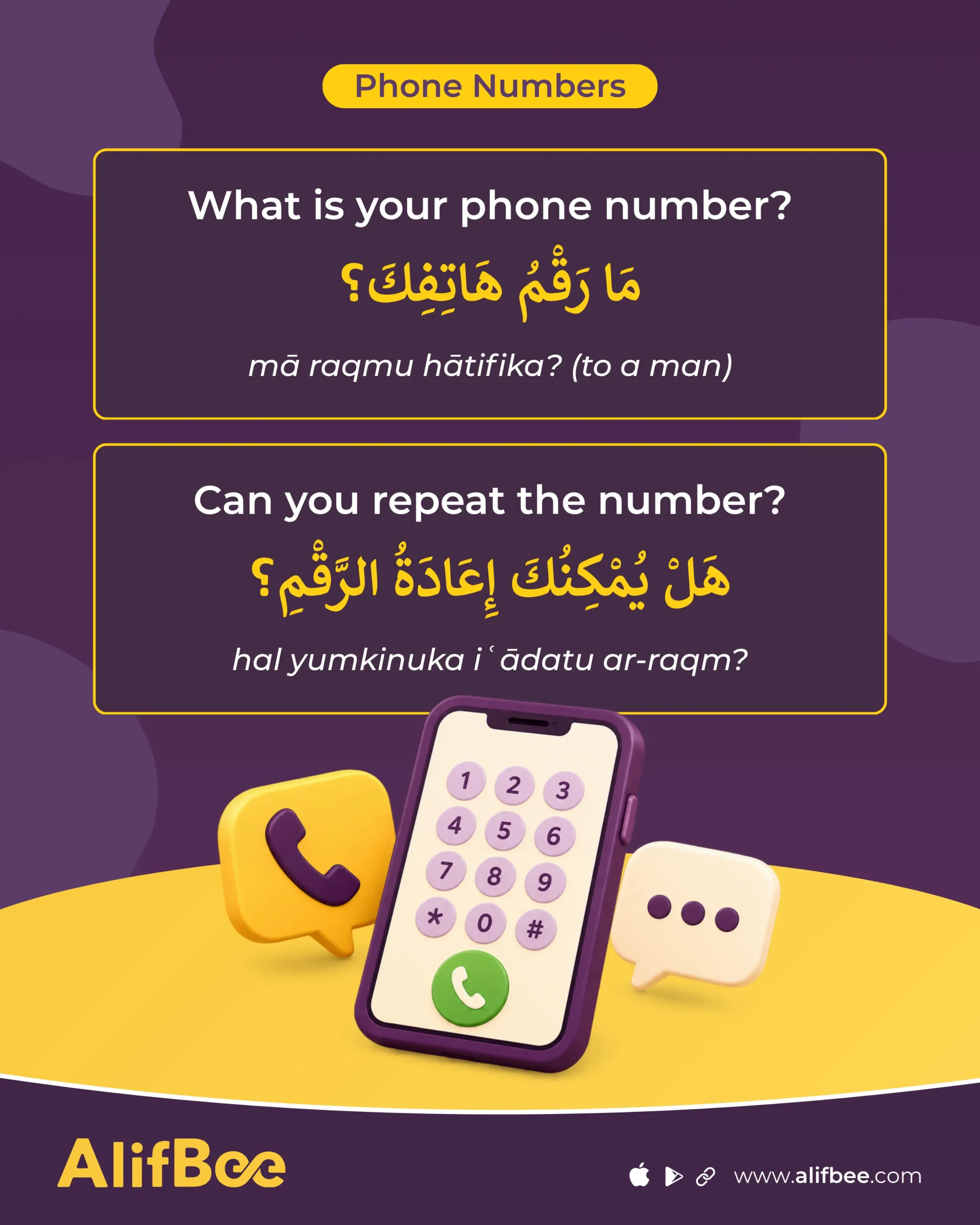
What is your phone number? (to a man)
|
mā raqmu hātifika?
|
مَا رَقْمُ هَاتِفِكَ؟
|
|
|
What is your phone number? (to a woman)
|
mā raqmu hātifiki?
|
مَا رَقْمُ هَاتِفِكِ؟
|
|
|
My phone number is 0555 123 456. |
raqmu hātifī huwa ṣifr khamsa khamsa khamsa, wāḥid ithnān thalātha, arbaʿa khamsa sitta. |
رَقْمُ هَاتِفِي هُوَ .
٠٥٥٥١٢٣٤٥٦
|
|
|
Can you repeat the number?
|
hal yumkinuka iʿādatu al-raqm?
|
هَلْ يُمْكِنُكَ إِعَادَةُ الرَّقْم؟
|
|
Build the rest of the conversation with Master Arabic Phone Vocabulary: Essential Phrases & Tips.
How to Say Dates and Years in Arabic
When giving a date in Arabic, you usually mention the day first, followed by the month, as in al-khāmis ʿashar min Māris (الْخَامِس عَشَر مِنْ مَارِس), meaning “March 15.”
The day of the month commonly uses an ordinal number, such as al-khāmis (الْخَامِس) for “the fifth” or al-ʿishrūn (الْعِشْرُون) for “the twentieth.” For dates from 11 to 19, Arabic uses compound ordinal forms, such as al-khāmis ʿashar (الْخَامِس عَشَر) for “the fifteenth.”
Years, however, use cardinal numbers. For example, 2005 is alfān wa-khamsah (أَلْفَان وَخَمْسَة), meaning “two thousand and five.” The form changes to alfayni wa-khamsah (أَلْفَيْنِ وَخَمْسَة) after the preposition fī (فِي).
Here are some useful expressions for giving dates and talking about years:
| English meaning | Pronunciation | Arabic | |
|---|---|---|---|
|
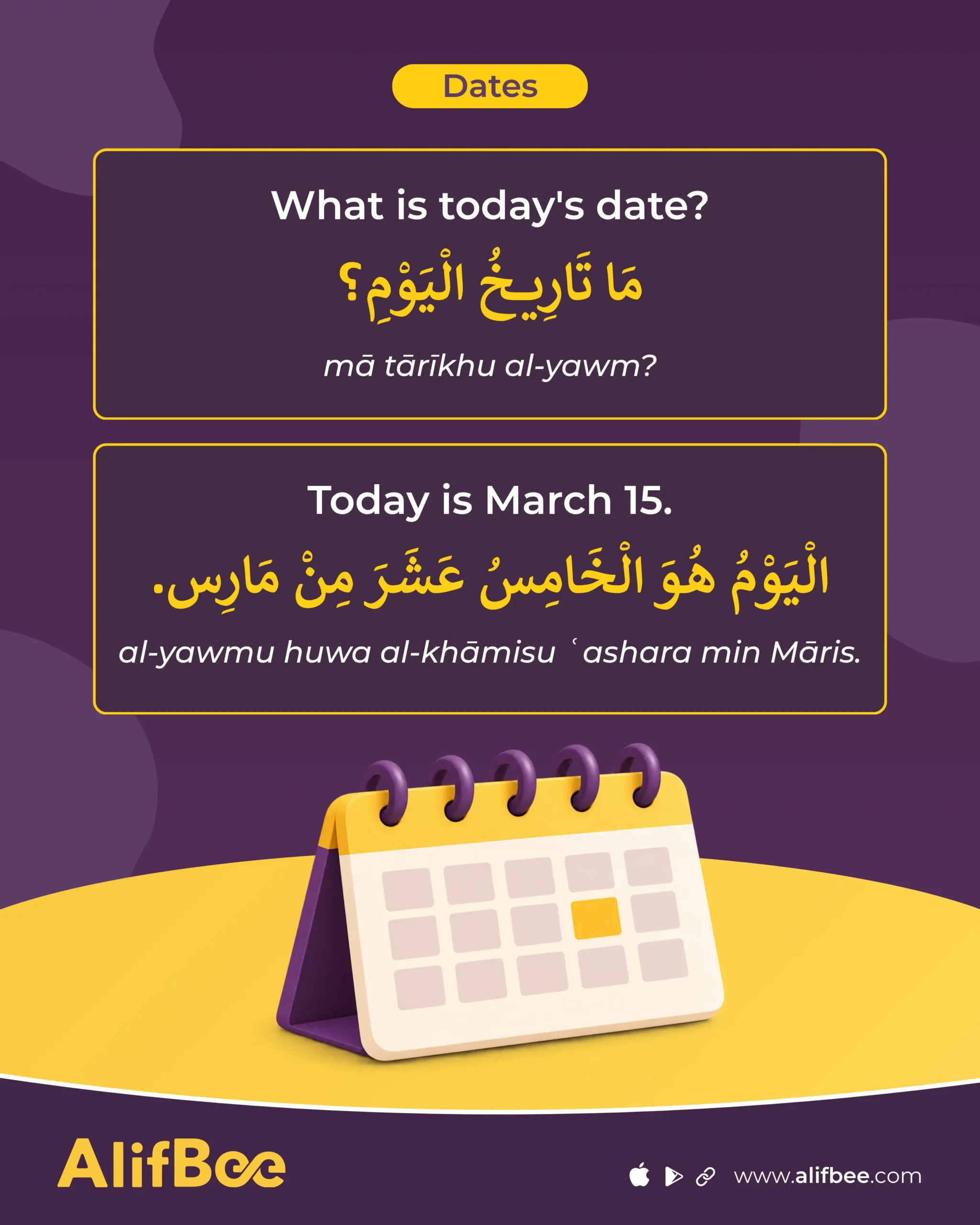
What is today’s date?
|
mā tārīkhu al-yawm?
|
مَا تَارِيخُ الْيَوْم؟
|
|
|
Today is March 15.
|
al-yawmu huwa al-khāmisu ʿashara min Māris.
|
الْيَوْمُ هُوَ الْخَامِسُ عَشَرَ مِنْ مَارِس.
|
|
|
I was born in 2005.
|
wulidtu fī ʿāmi alfayni wa-khamsa.
|
وُلِدْتُ فِي عَامِ أَلْفَيْنِ وَخَمْسَة.
|
|
|
Our appointment is on September 21.
|
mawʿidunā yawma al-ḥādī wa-al-ʿishrīna min Sibtambar.
|
مَوْعِدُنَا يَوْمَ الْحَادِي وَالْعِشْرِينَ مِنْ سِبْتَمْبَر.
|
|
For calendar vocabulary and month names, explore Learn About the Islamic Calendar and Hijri Months.
How to Tell Time in Arabic
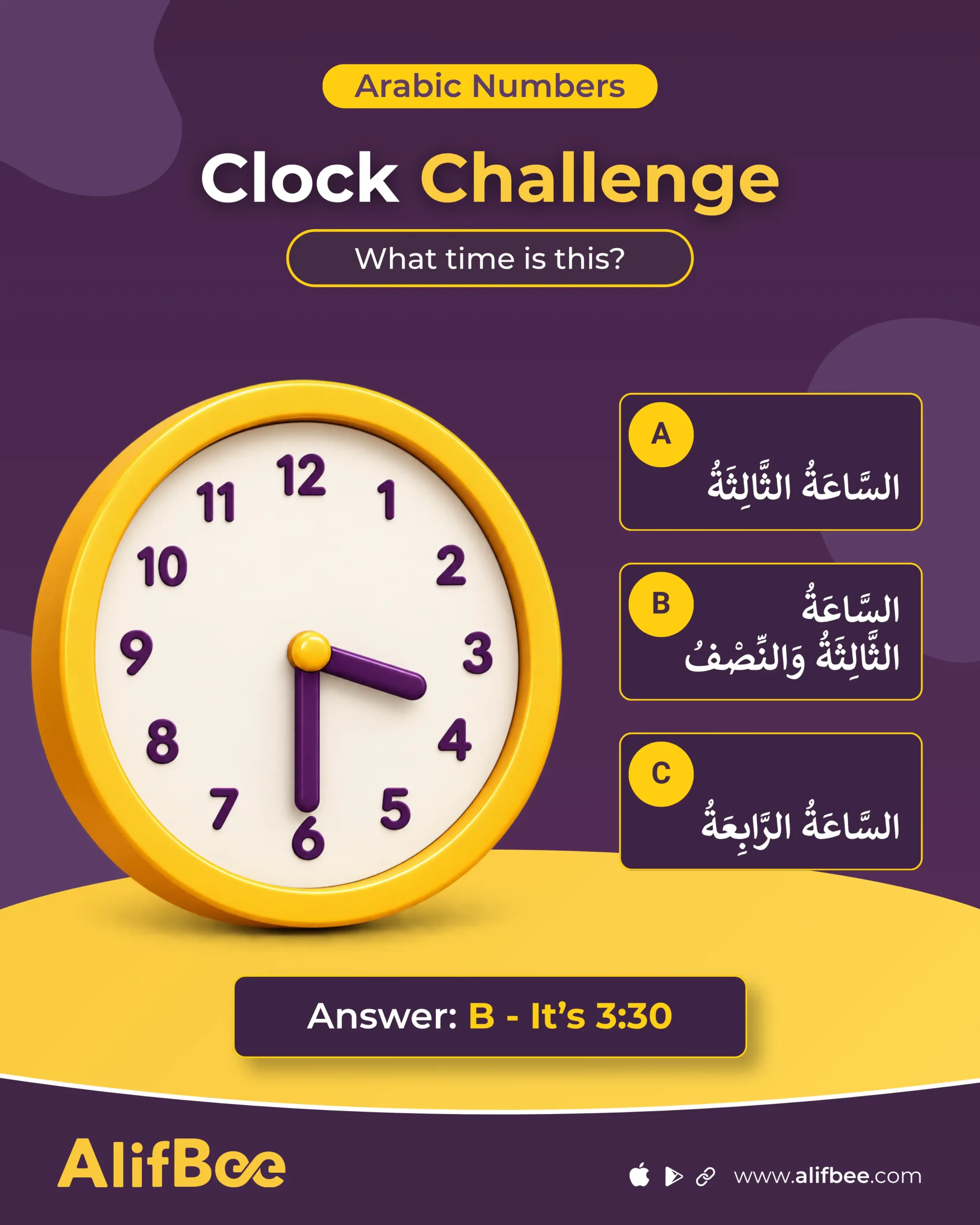
To tell time in Arabic, use as-sāʿah (السَّاعَة), meaning “the hour,” followed by an ordinal number from one to twelve. For example, 3:00 is as-sāʿah ath-thālithah (السَّاعَة الثَّالِثَة), literally “the third hour.”
To add minutes, you can use these common expressions:
- وَالرُّبْع (wa-ar-rubʿ): Quarter past, as in 3:15.
- وَالنِّصْف (wa-an-niṣf): Half past, as in 3:30.
- إِلَّا رُبْعًا (illā rubʿan): Quarter to, as in 3:45 when followed by “four o’clock.”
For example, 3:45 is as-sāʿah ar-rābiʿah illā rubʿan (السَّاعَة الرَّابِعَة إِلَّا رُبْعًا), literally “a quarter to the fourth hour.”
Here are some expressions you can use when asking about the time or arranging appointments:
| Meaning | Pronunciation | Arabic | |
|---|---|---|---|
|
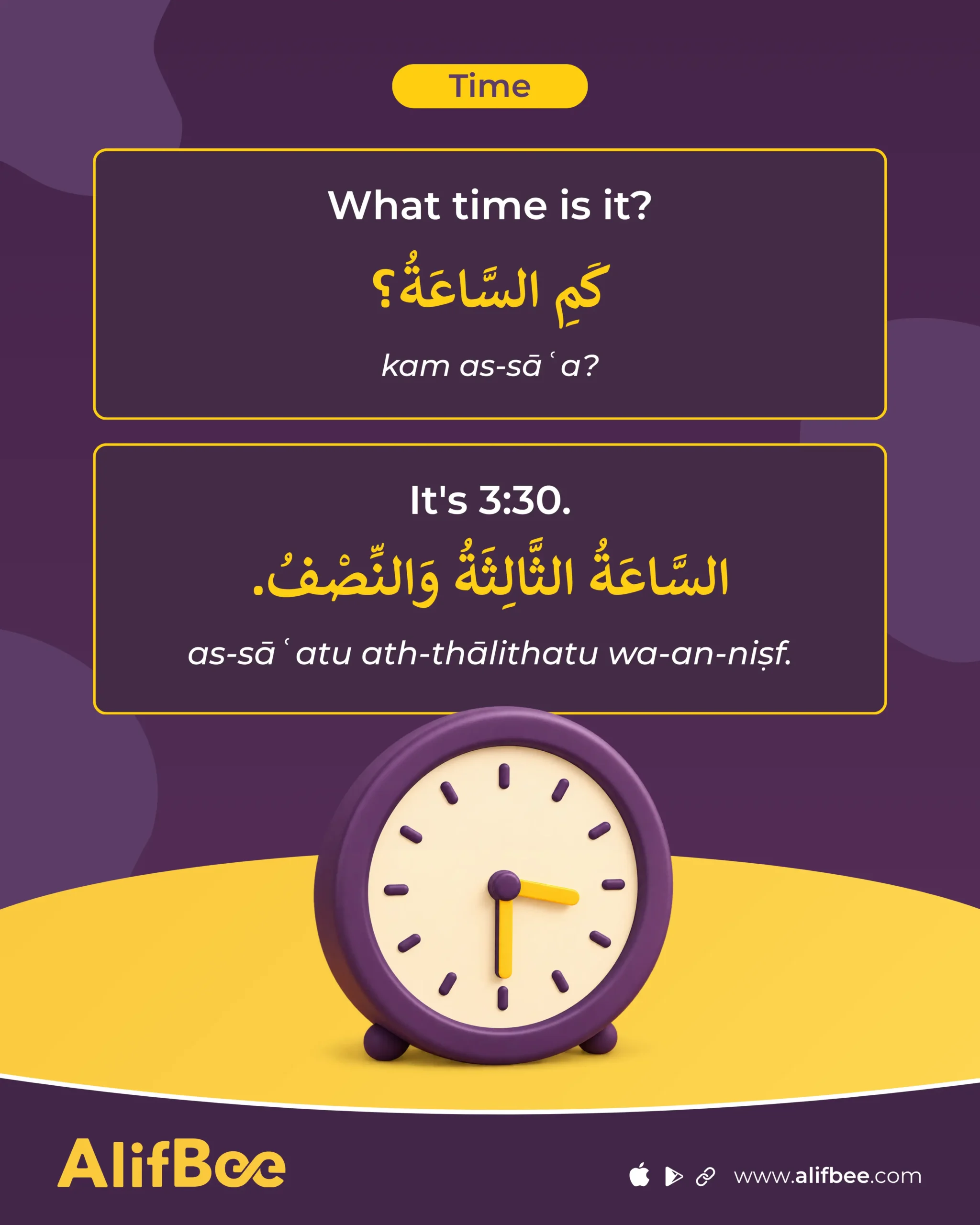
What time is it?
|
kam al-sāʿa?
|
كَمِ السَّاعَة؟
|
|
|
It is 3:00.
|
al-sʿatu al-thālithah.
|
السَّاعَةُ الثَّالِثَة.
|
|
|
It is 3:30.
|
al-sāʿatu al-thālithatu wa-al-niṣf.
|
السَّاعَةُ الثَّالِثَةُ وَالنِّصْف.
|
|
|
The appointment is at 7:15.
|
al-mawʿidu fī al-sāʿati al-sābiʿati wa-al-rubʿ.
|
الْمَوْعِدُ فِي السَّاعَةِ السَّابِعَةِ وَالرُّبْع.
|
|
Learn the full set of hour, minute, and appointment expressions in How to Tell the Time in Arabic: A Beginner’s Guide.
How to Talk About Age in Arabic
To ask about age in Arabic, we use the word عُمْر (ʿumr, age) rather than the English verb “to be.” Literally, كَمْ عُمْرُكَ؟ (kam ʿumruka?) means “How much is your age?” The English equivalent is “How old are you?”
The number is followed by a form of سَنَة (sanah, year), such as سَنَة (sanah, year) or سَنَوَات (sanawāt, years), depending on the number.
| Meaning | Pronunciation | Arabic | |
|---|---|---|---|
|
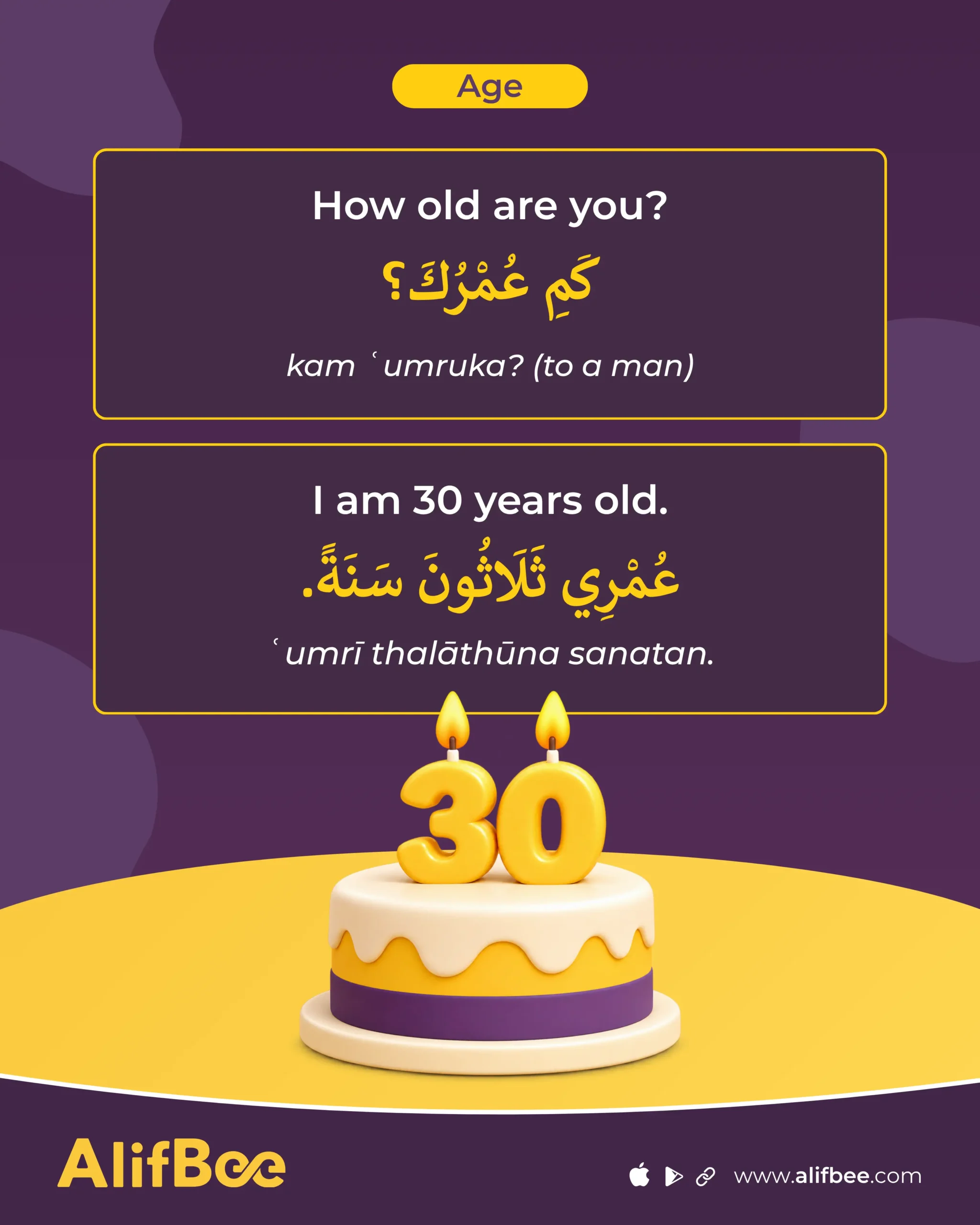
How old are you? (to a man)
|
kam ʿumruka?
|
كَمْ عُمْرُكَ؟
|
|
|
How old are you? (to a woman)
|
kam ʿumruki?
|
كَمْ عُمْرُكِ؟
|
|
|
I am 25 years old.
|
ʿumrī khamsun wa-ʿishrūna sanah.
|
عُمْرِي خَمْسٌ وَعِشْرُونَ سَنَة.
|
|
|
My son is ten years old.
|
ʿumru ibnī ʿashru sanawāt.
|
عُمْرُ ابْنِي عَشْرُ سَنَوَات.
|
|
How to Use Numbers in Addresses, Floors, and Rooms
When giving an address in Arabic, you often use the word raqm (رَقْم), meaning “number,” followed by the building, apartment, or room number. For example, raqm ash-shaqqah ithnā ʿashar (رَقْمُ الشَّقَّةِ اِثْنَا عَشَرَ) means “apartment number 12.”
The way you say a number depends on what it identifies:
- Building and apartment numbers: Usually use cardinal numbers, such as sabʿah (سَبْعَة) for building 7.
- Floor numbers: Use ordinal numbers, such as aṭ-ṭābiq ath-thālith (الطَّابِق الثَّالِث) for the third floor.
- Room numbers: You can read the complete number or say each digit separately. For example, room 215 can be miʾatān wa-khamsata ʿashar (مِئَتَانِ وَخَمْسَةَ عَشَرَ) or ithnān, wāḥid, khamsah (اِثْنَان، وَاحِد، خَمْسَة).
Here are some useful expressions for giving addresses or finding your way around a building:
| English meaning | Pronunciation | Arabic | |
|---|---|---|---|
|
My apartment number is 12.
|
raqmu shaqqatī ithnā ʿashara.
|
رَقْمُ شَقَّتِي ١٢.
|
|
|
My room number is 215.
|
ghurfatī raqmuhā mi’atan wa-khamsata ‘ashar.
|
غُرْفَتِي رَقْمُهَا ٢١٥.
|
|
|
The office is on the third floor.
|
al-maktabu fī al-ṭābiqi al-thālith.
|
الْمَكْتَبُ فِي الطَّابِقِ الثَّالِث.
|
|
|
The building number is seven.
|
al-mabnā raqmuhu sabʻah. |
الْمَبْنَى رَقْمُهُ سَبْعَة.
|
|
How to Express Quantities and Measurements
When buying groceries, following a recipe, or talking about distances, you need to combine Arabic numbers with measurement units such as kīlūghrām (كِيلُوغْرَام), meaning “kilogram,” and kīlūmitr (كِيلُومِتْر), meaning “kilometer.”
In Modern Standard Arabic, the measurement unit changes according to the number:
- One: Use the singular unit, as in kīlūghrām wāḥid (كِيلُوغْرَام وَاحِد), meaning “one kilogram.”
- Three to ten: Generally use the plural unit, as in thalāthatu kīlūghrāmāt (ثَلَاثَةُ كِيلُوغْرَامَات), meaning “three kilograms.”
- Eleven to ninety-nine: Use a singular unit in the accusative case, as in ʿishrūna daqīqatan (عِشْرُونَ دَقِيقَةً), meaning “twenty minutes.”
Here are some examples you can use when shopping, measuring distances, or talking about time:
| Meaning | Pronunciation | Arabic | |
|---|---|---|---|
|
I want three kilograms of apples.
|
urīdu thalāthata kīlūghrāmāt mina al-tuffāḥ.
|
أُرِيدُ ثَلَاثَةَ كِيلُوغْرَامَاتٍ مِنَ التُّفَّاح.
|
|
|
The distance is five kilometers.
|
al-masāfatu khamsatu kīlūmitrāt.
|
الْمَسَافَةُ خَمْسَةُ كِيلُومِتْرَات.
|
|
|
We need 20 minutes.
|
naḥtāju ilā ʿishrīna daqīqah.
|
نَحْتَاجُ إِلَى عِشْرِينَ دَقِيقَة.
|
|
Percentages, Scores, and Temperatures
Arabic numbers are also used to describe discounts, exam results, sports scores, and temperatures. Each situation has a slightly different way of expressing numbers.
- Percentages: Add fī al-miʾah (فِي الْمِئَة), meaning “percent,” after the number. For example, ʿishrūna fī al-miʾah (عِشْرُونَ فِي الْمِئَة) means “20 percent.” You can use this when discussing discounts or exam grades.
- Sports scores: Use li- (لِـ), meaning “to,” between two numbers. For example, thalāthah li-ithnayn (ثَلَاثَة لِاثْنَيْن) means “three to two.” The order of the numbers tells you which team scored more.
- Temperatures: Say the number followed by darajah (دَرَجَة), meaning “degree.” For example, thalāthūna darajah (ثَلَاثُونَ دَرَجَةً) means “30 degrees.” In weather reports, this usually refers to degrees Celsius.
Here are some examples you may hear in everyday conversations:
| Meaning | Pronunciation | Arabic | |
|---|---|---|---|
|
The discount is 20%.
|
al-khaṣmu ʿishrūna fī al-miʼah.
|
الْخَصْمُ عِشْرُونَ فِي الْمِئَة.
|
|
|
The score is 3–2.
|
al-natījatu thalāthatun li-ithnayn.
|
النَّتِيجَةُ ثَلَاثَةٌ لِاثْنَيْن.
|
|
|
The temperature is 30 degrees.
|
darajatu al-ḥarārati thalāthūna darajah.
|
دَرَجَةُ الْحَرَارَةِ ثَلَاثُونَ دَرَجَة.
|
|
|
I got 90%.
|
ḥaṣaltu ʿalā tisʿīna fī al-miʼah.
|
حَصَلْتُ عَلَى تِسْعِينَ فِي الْمِئَة.
|
|
Three Short Conversations with Arabic Numbers
Short exchanges help you connect a question with the kind of number you should expect in the answer.
1. At a Shop
| Speaker | Arabic | Pronunciation | English | |
|---|---|---|---|---|
|
A |
كَمْ سِعْرُ هَذَا الْكِتَاب؟
|
kam siʿru hādhā al-kitāb?
|
How much is this book?
|
|
|
B |
سِعْرُهُ خَمْسَةٌ وَعِشْرُونَ رِيَالًا.
|
siʿruhu khamsatun wa-ʿishrūna riyālan.
|
It costs 25 riyals.
|
|
2. Confirming a Meeting Time
| Speaker | Arabic | Pronunciation | English | |
|---|---|---|---|---|
|
A |
مَتَى الْمَوْعِد؟
|
matā al-mawʿid?
|
When is the appointment?
|
|
|
B |
السَّاعَةُ الرَّابِعَةُ وَالنِّصْف.
|
al-sāʿatu al-rābiʿatu wa-al-niṣf.
|
At 4:30.
|
|
3. Asking About Age
| Speaker | Arabic | Pronunciation | English | |
|---|---|---|---|---|
|
A |
كَمْ عُمْرُكَ؟
|
kam ʿumruka?
|
How old are you?
|
|
|
B |
عُمْرِي ثَلَاثُونَ سَنَةً.
|
ʿumrī thalāthūna sana.
|
I am 30 years old.
|
|
Modern Standard Arabic and Dialect Differences
Arabic numbers can sound quite different depending on where you are. In Modern Standard Arabic (MSA), three is thalāthah (ثَلَاثَة). In Egyptian Arabic, it becomes talāta, while in Levantine Arabic, you may hear tlāte. Gulf Arabic often keeps a pronunciation closer to MSA, such as thalātha.
Here is how some common numbers compare across four varieties of Arabic:
| Meaning | MSA | Egyptian Arabic | Levantine Arabic | Gulf Arabic |
|---|---|---|---|---|
|
Two |
اِثْنَان (ithnān)
|
اِتْنِين (itnēn)
|
تْنِين (tnēn)
|
اِثْنَيْن (ithnēn)
|
|
Three |
ثَلَاثَة (thalāthah) |
تَلَاتَة (talāta)
|
تْلَاتِة (tlāte) |
ثَلَاثَة (thalātha)
|
|
Five |
خَمْسَة (khamsah)
|
خَمْسَة (khamsa)
|
خَمْسِة (khamse)
|
خَمْسَة (khamsa)
|
|
Eight |
ثَمَانِيَة (thamāniyah)
|
تَمَانْيَة (tamānya)
|
تْمَانْيِة (tmānye)
|
ثَمَانِيَة (thamāniya)
|
Notice how the th sound in thalāthah (three) becomes t in Egyptian and many Levantine varieties. Gulf Arabic commonly preserves the th sound.
Numbers can also change when followed by nouns. For example, thalāthatu kutubin (ثَلَاثَةُ كُتُبٍ) means “three books” in fully vocalized MSA. In everyday Levantine Arabic, you might hear tlāt kotob (تْلَات كُتُب), with a shorter number form and no formal case endings.
These examples represent common pronunciations, but there are differences within each region. Learning MSA helps you recognize the written numbers, while familiarizing yourself with a local dialect helps you understand them in everyday conversations.
Review How to Use Arabic Numbers in Daily Life
Final word
Arabic numbers are part of everyday conversations, from telling time and giving dates to discussing prices, distances, and measurements. Learning how to use them in real situations will help you speak more naturally and understand what you hear.
If you need to review the rules behind Arabic numbers, visit our guide on How to Form Arabic Numbers.
Learn with AlifBee
Want to put your Arabic number skills into practice? The AlifBee app offers interactive lessons and listening exercises to help you build your Arabic vocabulary and use it with greater confidence.
Frequently Asked Questions
1. Which number symbols are used in Arabic?
Arabic may be written with Arabic-Indic digits such as ٠١٢٣٤٥٦٧٨٩ or Western digits such as 0123456789. Usage varies by country, context, and digital platform, so you should recognize both.
2. Are Arabic phone numbers read as full numbers?
Usually not. Phone numbers, verification codes, and similar identifiers are generally read digit by digit. A quantity such as 205 books, however, is read as a complete number.
3. How do you ask “How much is it?” in Arabic?
A common form in MSA is كَمْ سِعْرُ هَذَا؟ (kam siʿru hādhā?), which means “How much is this?” You may hear different phrases in regional dialects.
4.Do Arabic number words change with gender?
Yes. Several number groups change according to the grammatical gender of the counted noun. The patterns differ for 1 and 2, 3 to 10, 11 to 19, and compound numbers.
5.What is the best way to practice Arabic numbers?
Practice by context rather than by list alone. Read prices, say phone numbers digit by digit, state dates and times, and use quantities in short sentences. Frequent recall in realistic phrases builds speed.