
Written by Dania Ghraoui, a translator and language teacher with 10 years of experience.
At a Glance
- Modern Standard Arabic (MSA) is the standardized variety used in books, education, news, official documents, and formal speeches.
- Spoken Arabic dialects are the regional varieties used in everyday conversation, and their pronunciation, grammar, and vocabulary differ from one region to another.
- Study MSA if you want to read Arabic and communicate in formal settings; add a dialect when you want natural conversation in a particular country or community.
If your course teaches kayfa ḥāluka? and a friend greets you with kīfak?, both phrases mean “How are you?” The first is MSA; the second is Levantine Arabic. They come from different varieties of Arabic and are used in different situations.
Across Arabic-speaking countries, MSA is the shared variety used in formal writing and speech. Most everyday conversations take place in a local dialect. Linguists call this pattern diglossia: speakers choose a more formal or more local variety depending on the situation and the person they are speaking to.
The seven differences below will help you recognize what you are hearing and choose what to study first.
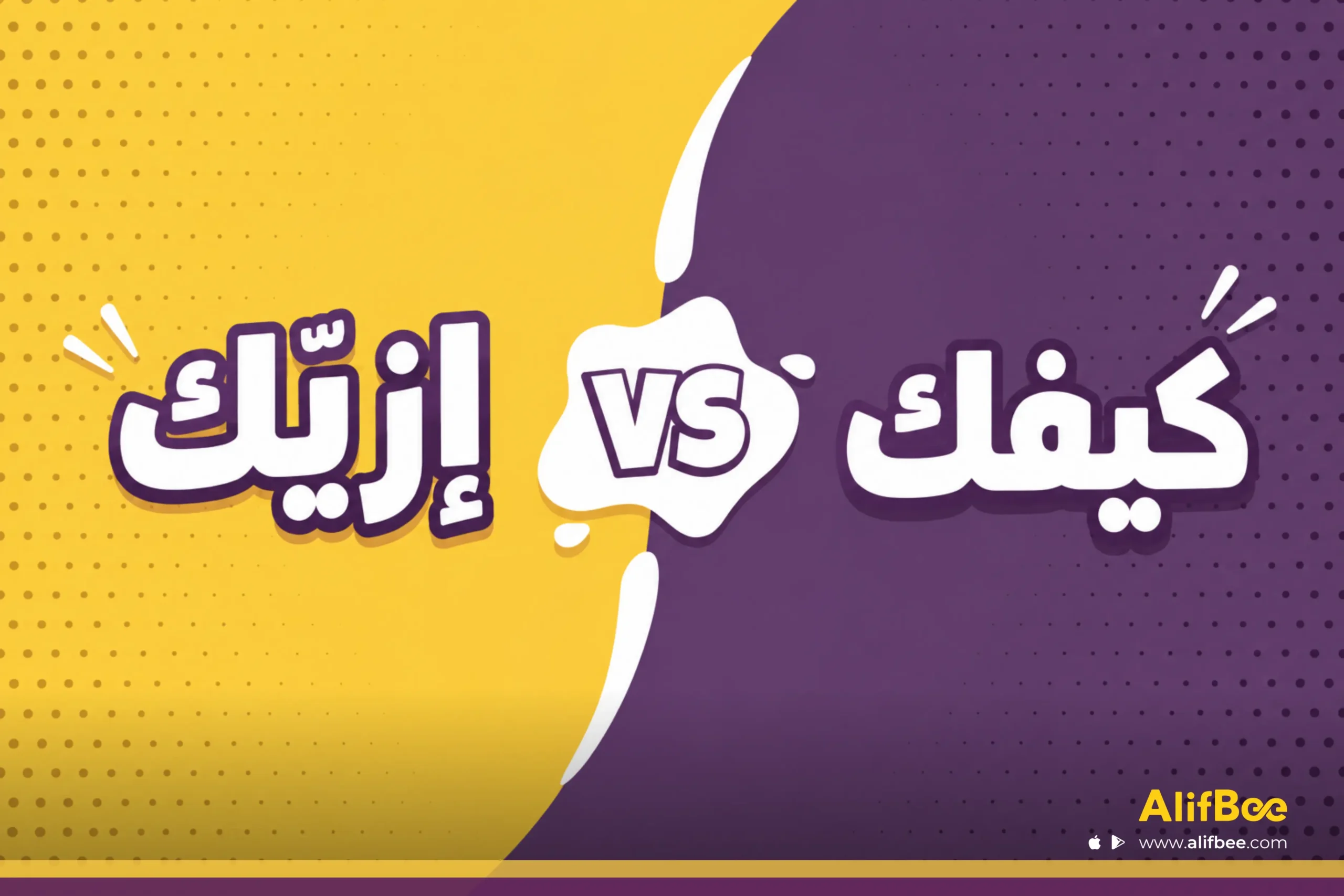
MSA vs. Colloquial Arabic: Quick Comparison
What is Modern Standard Arabic?
Modern Standard Arabic is the standardized variety used today in formal writing and speech. It grew out of Classical Arabic and shares most of its grammar and core vocabulary, but has expanded to include modern words for education, technology, politics, media, and daily life. You may also hear it called Fuṣḥā. Some speakers also use Fuṣḥā for Classical Arabic, so the exact meaning depends on the context.
If you want a fuller introduction, read AlifBee’s guide to Modern Standard Arabic.
What are spoken Arabic Dialects or Colloquial Arabic?
Spoken dialects are the regional varieties of Arabic that people usually learn naturally at home. Egyptian, Levantine, Gulf, Iraqi, Sudanese, Yemeni, and Maghrebi Arabic are broad labels. Speech can vary from one city or village to another and across generations and social groups within the same country.
Colloquial Arabic is often called ʿāmmiyya, local dialects, or, especially in North Africa, dārija. You will hear them in conversation, songs, films, comedy, informal podcasts, messages, and social media. AlifBee’s Arabic dialect guide can help you compare the major regional groups.
| Feature | Modern Standard Arabic | Spoken dialects |
|---|---|---|
|
Main use
|
Books, news, education, formal writing, and speeches
|
Family talk, daily conversation, local media, and informal online writing
|
|
How it is learned
|
Mainly through school, reading, and formal settings
|
Usually learned first at home and in the community
|
|
Standardization |
Shared conventions across countries
|
Varies by country, region, city, and social group
|
|
Grammar |
Uses case endings and more formal agreement patterns
|
Uses regional grammar without the MSA case-ending system
|
|
Pronunciation |
More consistent in formal contexts, though pronunciation still varies by speaker
|
Changes noticeably by region and local speech pattern
|
|
Vocabulary |
Broad formal and modern vocabulary
|
Local everyday words, idioms, and loanwords
|
|
Writing |
Standard for most formal and published writing
|
Common in messages, social media, dialogue, and some creative writing
|
|
Understanding
|
Broadly understood through education and media
|
Depends on how far apart the dialects are and how familiar speakers are with them
|
1. MSA and Colloquial Arabic Are Used in Different Situations
Open a newspaper, a government website, or a school textbook, and you will usually find MSA. Listen to a family talking over dinner, a taxi conversation, or friends teasing one another, and you will usually hear a dialect.
The same speaker may switch varieties as the setting changes. A news presenter may read a report in MSA, then use a dialect during a relaxed interview. A lecturer may give a talk in MSA and answer an informal question in the local dialect. The speaker may switch again within the same conversation as the tone becomes more or less formal.
2. Native Speakers Learn Them in Different Ways
Most native speakers are exposed to their local dialect from infancy. They usually learn MSA later through school, books, cartoons, dubbed programs, news, religious instruction, and other formal settings. This helps explain why many speakers understand MSA well but don’t use it in everyday conversation.
Many adult learners start in the opposite order: Arabic script and MSA first, then a spoken variety. This helps you learn the script and build formal vocabulary, but you will still need separate listening practice for a dialect.
3. MSA Uses More Grammatical Endings
MSA grammar includes case endings, verb endings, dual forms, and formal agreement patterns. You will see these features most clearly in texts written with full vowel marks. In less formal spoken MSA, speakers may leave some final endings unpronounced.
Most dialects do not use the MSA case-ending system. They have their own pronouns, verb forms, ways of forming negatives, and sentence patterns. Egyptian and Levantine Arabic, for example, each follow consistent rules that differ from each other and from MSA.
To review the formal patterns behind MSA sentences, use AlifBee’s Arabic sentence structure guide.
4. Pronunciation Changes by Region
A familiar word may sound unfamiliar because one consonant is pronounced differently. The letter jīm is commonly taught with a “j” sound in MSA, like the j in job. In much of Egypt, it is pronounced like “g,” in go, while many Levantine speakers use a sound like the “s” in “vision.”” The letter qāf is pronounced in MSA with a deep “k” sound made farther back in the mouth. In many urban Egyptian and Levantine varieties, it becomes a glottal stop, like the brief catch in the middle of “uh-oh.” In many Gulf and Bedouin varieties, it is pronounced like the g in go.
Pronunciation also varies within the same country. These sounds may give you clues about a speaker’s region, but do not assume everyone in that region speaks the same way. AlifBee’s Arabic pronunciation guide can help you practice the main Arabic sounds before comparing regional versions.
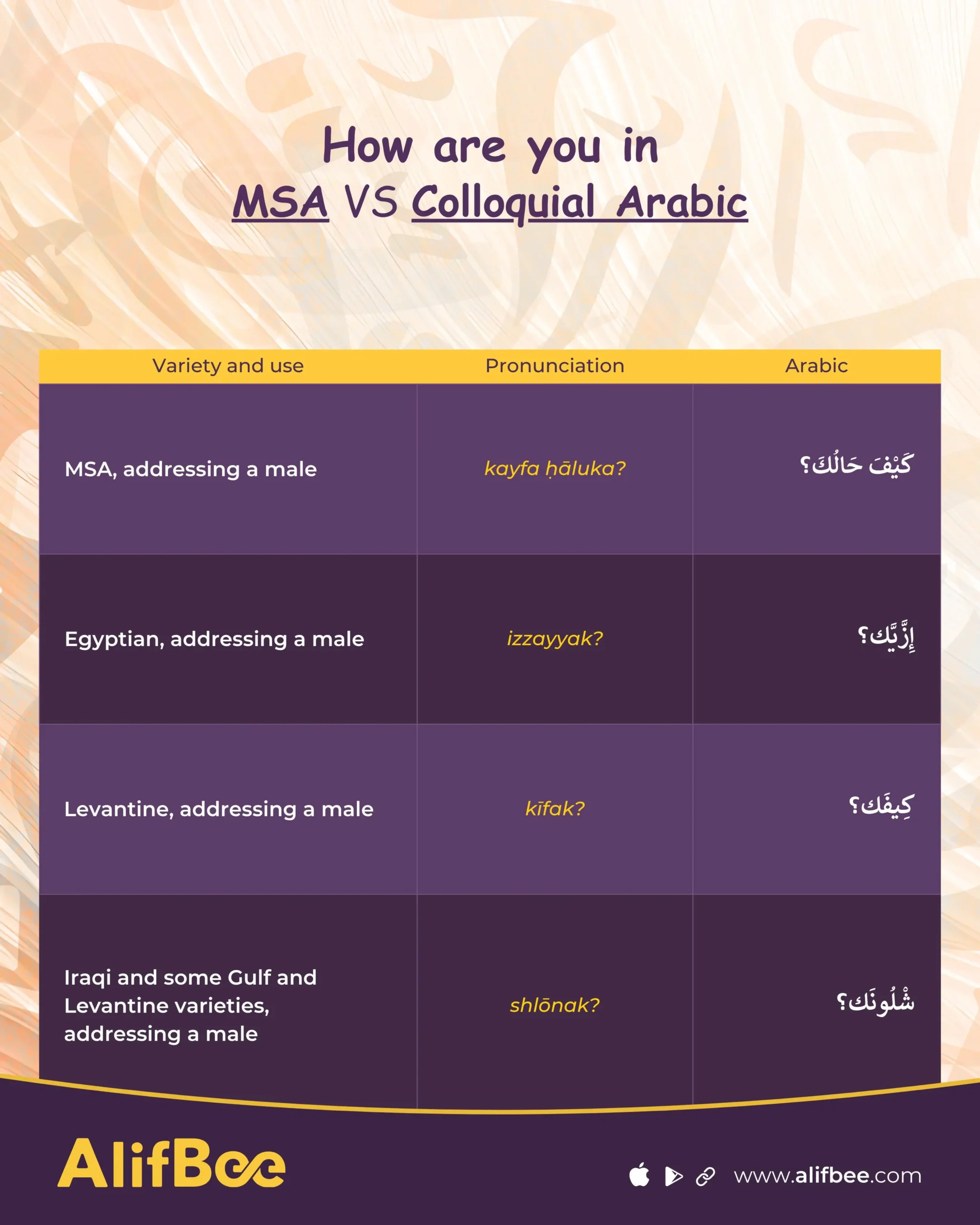
How are you in MSA VS Colloquial Arabic
| Variety and use | Meaning | Pronunciation | Arabic | |
|---|---|---|---|---|
|
MSA, addressing a male
|
How are you?
|
kayfa ḥāluka?
|
كَيْفَ حَالُكَ؟
|
|
|
Egyptian, addressing a male
|
How are you?
|
izzayyak?
|
إِزَّيَّك؟ |
|
|
Levantine, addressing a male
|
How are you?
|
kīfak |
كِيفَك؟ |
|
|
Iraqi and some Gulf and Levantine varieties, addressing a male
|
How are you?
|
shlōnak?
|
شْلُونَك؟ |
|
Note: The forms above address a male. Feminine forms change by variety.
5. Everyday Vocabulary Can Be Very Different
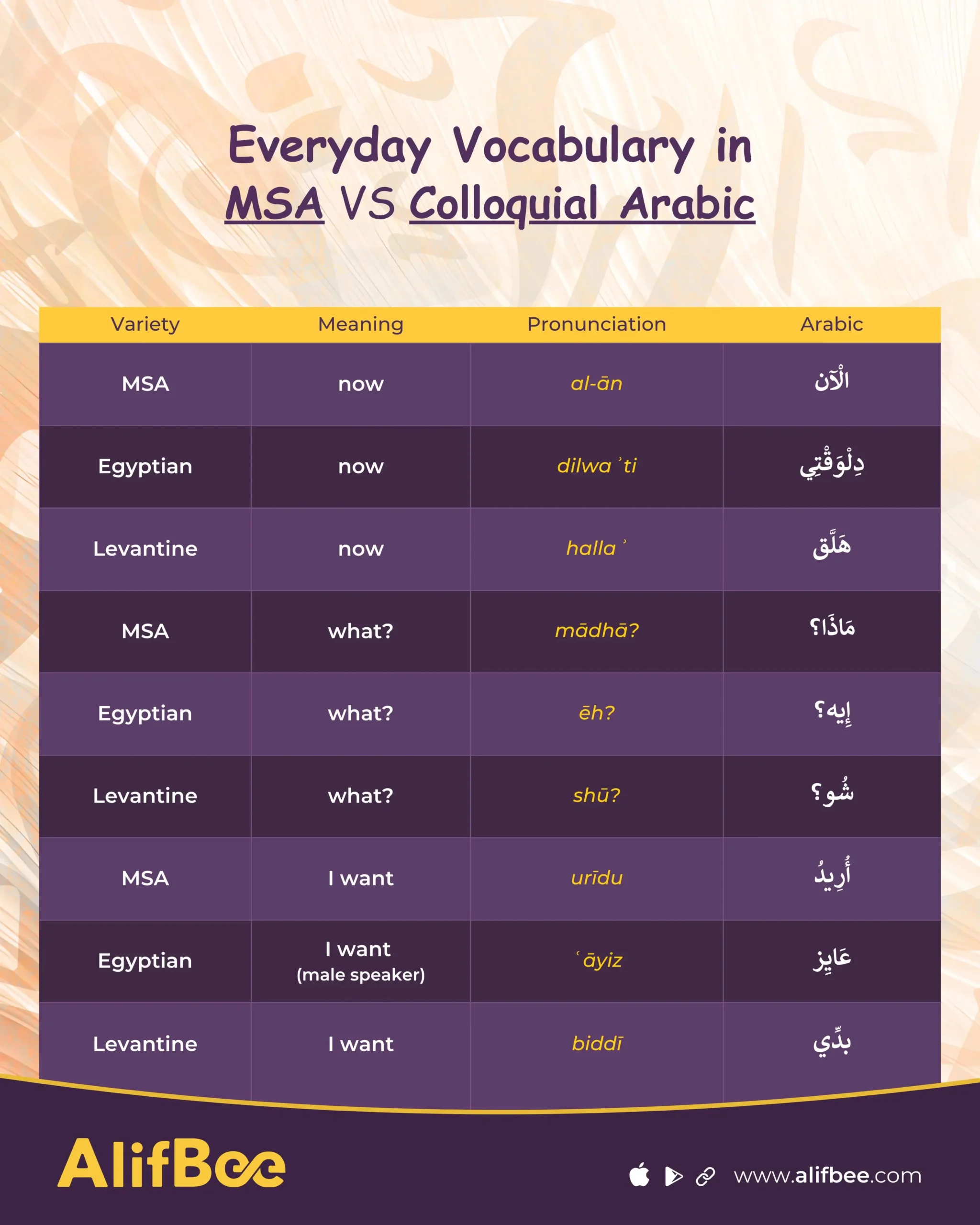
MSA and dialects share many roots and core words, but some of the words used most often in conversation can be very different. A phrase learned from a textbook may be replaced by a much shorter regional form.
Everyday Vocabulary in MSA vs Colloquial Arabic
| Variety | Meaning | Pronunciation | Arabic | |
|---|---|---|---|---|
|
MSA |
now |
al-ān
|
الْآن |
|
|
Egyptian |
now |
dilwaʾti |
دِلْوَقْتِي |
|
|
Levantine |
now |
hallaʾ |
هَلَّق |
|
|
MSA |
what?
|
mādhā?
|
مَاذَا؟ |
|
|
Egyptian |
what?
|
ēh?
|
إِيه؟ |
|
|
Levantine |
what?
|
shū?
|
شُو؟ |
|
|
MSA |
I want
|
urīdu |
أُرِيدُ |
|
|
Egyptian |
I want
(male speaker)
|
ʿāyiz |
عَايِز |
|
|
Levantine |
I want
|
biddī |
بدِّي |
|
Regional history also shapes everyday vocabulary. You may hear words influenced by Turkish, French, English, Persian, Amazigh languages, or other languages, depending on the region. Many other differences developed within Arabic itself over centuries.
Use AlifBee’s Arabic vocabulary lists for beginners to build your MSA vocabulary, then keep a separate list of the dialect words you hear most often.
6. Distance and Familiarity Affect Understanding
Neighboring dialects often share enough vocabulary and pronunciation for conversation to flow. People from distant regions may need more time to understand one another. Yet location is only one factor. How often people hear other dialects in media, along with travel, family background, topic, speaking speed, and individual experience, affects how easily they understand each other.
Georgetown University’s overview of Arabic diglossia for language learners notes that speakers of some nearby dialects can understand one another without much adjustment. Linguists call this mutual intelligibility. Distant dialects may be harder to follow. When communication becomes difficult, speakers often slow down, avoid strongly local words, or choose words that are also used in MSA.
7. MSA and Dialect Often Mix in Real Speech
A conversation can move naturally between MSA and a dialect. During an interview, a speaker may use formal vocabulary with dialect grammar. A teacher may read a sentence in MSA, then explain it in dialect. An online comment may combine MSA spelling, a regional expression, and an English word.
A study published in 2025 by the Association for Computational Linguistics describes Arabic dialects as a continuum, or a range of varieties with gradual differences between them. This helps explain why a sentence can sound partly formal and partly local. Label each new word or phrase by variety, then notice how speakers shift between MSA and dialect in formal and informal settings.
Should You Learn MSA or a Dialect First?
Think about where you expect to use Arabic first. Then choose which variety to focus on.
| Your main goal | Start with | Why |
|---|---|---|
|
Read books, news, websites, or academic material
|
MSA |
It gives you the shared written variety used across countries.
|
|
Speak with family or a heritage community
|
Their dialect
|
It matches the Arabic you will hear and use with them. Add MSA for reading and writing.
|
|
Travel to or live in one Arab country
|
Local dialect + basic MSA
|
The dialect supports daily conversation; MSA helps with signs, forms, and formal settings.
|
|
Work across several Arabic-speaking countries
|
MSA, then a relevant dialect
|
MSA supports formal communication, while a dialect helps with local relationships.
|
|
Explore Arabic without a fixed regional goal
|
MSA |
It gives you a broad foundation before you choose a dialect.
|
You can study MSA and a dialect at the same time. Label each expression by variety and use separate listening sources until you can recognize which variety each form belongs to.
Common Mistakes When Choosing Between MSA and a Dialect
Choosing between Modern Standard Arabic and a dialect becomes easier when you start with where and how you expect to use Arabic. These are some common mistakes learners make.
Choosing a dialect just because it is popular
Egyptian and Levantine Arabic are widely heard in the media, but popularity doesn’t automatically make either the best choice for you. If your family, workplace, or travel plans connect you to the Gulf or North Africa, another dialect may be more useful.
Expecting MSA to be the language of everyday conversation
MSA is essential for reading, formal communication, news, education, and many professional settings. In ordinary daily conversation, however, Arabic speakers usually use a regional dialect.
Mixing MSA and dialect without knowing which is which
It is normal for learners to encounter both. The problem comes when you memorize forms without recognizing their variety or register. Label new words and expressions as MSA, Egyptian, Levantine, Gulf Arabic, or another variety so you know where they fit.
Learning a dialect that does not match your community
A dialect is most useful when it connects you with the people you actually expect to speak with. If your relatives are Syrian, for example, learning Moroccan Arabic simply because you found a good course may leave you with fewer chances to practice naturally.
Review MSA vs. Colloquial Arabic
Final word
MSA gives you access to newspapers, books, education, and formal communication across borders. Colloquial Arabic helps you follow the jokes, interruptions, family talk, and quick exchanges of daily life.
Decide which situations you want to handle first, focus on the variety used there, and add the other when you are ready to use Arabic in more settings.
Learn MSA with AlifBee
If you want a structured MSA foundation, you can learn Arabic online with AlifBee. The level-based curriculum combines letters, pronunciation, vocabulary, grammar, reading, listening, speaking, and writing. The MSA you learn will also help you recognize shared roots, words, and patterns when you start learning a dialect.
Frequently Asked Questions
1. Is MSA spoken in everyday life?
You will hear MSA in news broadcasts, speeches, lectures, formal interviews, and other formal settings. In everyday conversation, native speakers usually use a dialect or a form of speech that blends MSA with dialect.
2. Which Arabic dialect is the most useful?
Choose the dialect connected to the people, country, or media you care about. Egyptian and Levantine Arabic have many learning resources and media. Gulf, Iraqi, Sudanese, Yemeni, or Maghrebi Arabic will be more useful if your family, travel, or work involves those regions.
3. Can Arabic speakers understand MSA?
Most Arabic speakers understand MSA to some degree through school and media, although comfort levels vary. Understanding a formal broadcast and speaking MSA without preparation are different skills.
4. Does MSA make dialects easier to learn?
MSA gives you the Arabic script, many shared roots, and a large core vocabulary. A dialect still requires focused listening because common words, sounds, and grammar patterns may work differently.