
Written by Dania Ghraoui, a translator and language teacher with 10 years of experience.
At a Glance: Islamic New Year greetings in Arabic include kullu ʿāmin wa antum bikhayr, ʿāmun hijriyyun saʿīd, and mubārak ʿalaykum al-ʿām al-hijrī al-jadīd. These phrases help you wish someone a blessed Hijri New Year or welcome the month of Muharram.
In the Hijri calendar, the Islamic New Year begins on 1 Muharram, a meaningful date for many Muslim communities around the world. It is also a good time to share kind wishes, thoughtful greetings, and warm prayers with family and friends.
In this blog, you will learn useful Islamic New Year wishes and greetings in Arabic, with clear meanings and simple pronunciation to help you say them with confidence.
Before you go further!
These related AlifBee guides can help you understand the Islamic calendar and greeting language around this topic:
What Is the Islamic New Year?
The Islamic New Year marks the beginning of a new year in the Hijri lunar calendar. It begins on 1 Muharram, the first month of the Islamic calendar. Unlike the Gregorian calendar, the Islamic New Year does not fall on the same Gregorian date each year because the Hijri calendar follows the lunar cycle, so the exact date may vary based on local moon sightings.
In 2026, the Islamic New Year 1448 AH is expected to begin in mid-June, around June 16 or 17, depending on moon sighting and location.
The Hijri calendar was introduced by ʿUmar ibn al-Khaṭṭāb (RA), the second caliph. It counts years from the year of the Prophet Muhammad’s Hijrah, or migration, from Makkah to Madinah in 622 CE.
What is the Islamic New Year called in Arabic?
The Islamic New Year can be called raʾs al-sanah al-hijriyyah, meaning the beginning of the Hijri year. You may also hear al-ʿāmu al-hijrī al-jadīd, meaning the new Hijri year.
The word raʾs means “head”, which refers to the top or the starting point of something. The word Hijri comes from the Hijrah of the Prophet Muhammad (PBUH) and his companions to Madinah.
As for the word “year,” it can be either sanah or ʿām in Arabic. Sanah is a feminine noun that takes feminine adjectives, whereas ʿām is a masculine noun that takes masculine adjectives:
| Meaning | Pronunciation | Arabic | |
|---|---|---|---|
|
Head (start of) |
raʾs |
رَأْس |
|
|
Year |
ʿām |
عَام |
|
|
Year |
sanah |
سَنَة |
|
|
Hijri (Masculine) |
hijrī |
هِجْرِيّ |
|
|
Hijri (Feminine) |
hijriyyah |
هِجْرِيَّة |
|
|
Hijri New Year / beginning of the Hijri year |
raʾsu al-sanah al-hijriyyah |
رَأْسُ السَّنَةِ الهِجْرِيَّةِ |
|
|
the new Hijri year |
al-ʿāmu al-hijrī al-jadīd |
العَامُ الهِجْرِيُّ الجَدِيدُ |
|
You can use both phrases when talking about the Islamic New Year, but there is a slight difference:
- رَأْسُ السَّنَةِ الهِجْرِيَّةِ refers more specifically to the occasion or the beginning of the Hijri year.
- العَامُ الهِجْرِيُّ الجَدِيد refers to the new Hijri year itself.
Both are Modern Standard Arabic forms and are widely understood. In everyday dialects, people may pronounce them with softer sounds and usually drop the final case endings.
How Do You Say Happy Islamic New Year in Arabic?
A simple way to say Happy Islamic New Year in Arabic is kullu ʿāmin wa antum bikhayr. It means “May you be well every year.”
| Meaning | Pronunciation | Arabic | |
|---|---|---|---|
|
May you be well every year / Happy New Year |
kullu ʿāmin wa antum bikhayr |
كُلُّ عَامٍ وَأَنْتُمْ بِخَيْرٍ |
|
This expression is flexible, polite, and easy to use with many people. You can also say ʿāmun hijriyyun saʿīd, which means “Happy Hijri year.”
| Meaning | Pronunciation | Arabic | |
|---|---|---|---|
|
Happy Hijri year |
ʿāmun hijriyyun saʿīd |
عَامٌ هِجْرِيٌّ سَعِيدٌ |
|
The first phrase sounds more natural for greetings, but it changes slightly depending on whom you address. Use anta for one male, anti for one female, and antum for a group or respectful formal address.
The second is used in formal greetings on cards and in social media messages.
Common Islamic New Year Greetings in Arabic
Arabic greetings often do more than simply say “happy.” They may include a wish, a blessing, or a short dua asking Allah for goodness.
| Meaning | Pronunciation | Arabic | |
|---|---|---|---|
|
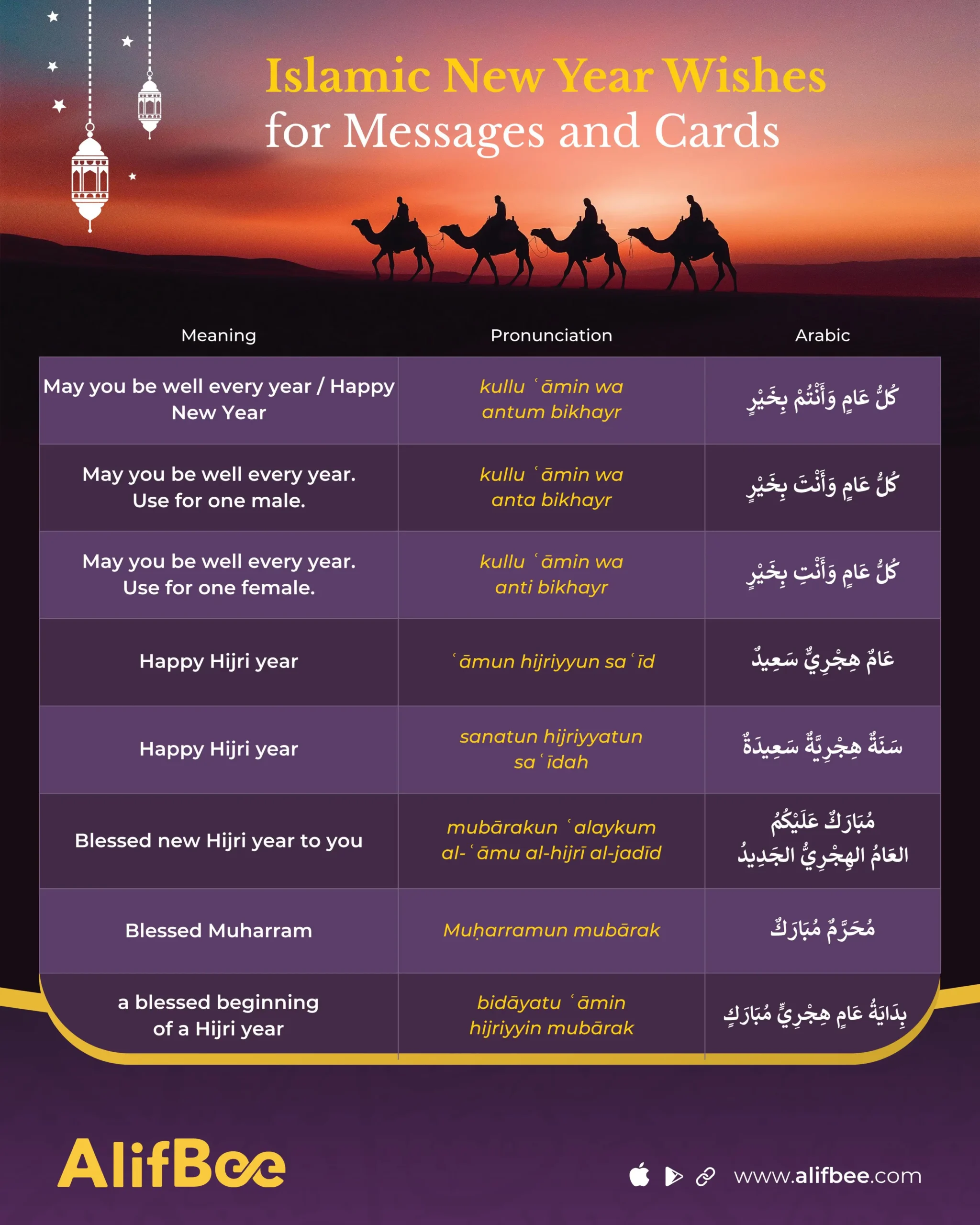
May you be well every year / Happy New Year |
kullu ʿāmin wa antum bikhayr |
كُلُّ عَامٍ وَأَنْتُمْ بِخَيْرٍ |
|
|
May you be well every year. Use for one male. |
kullu ʿāmin wa anta bikhayr |
كُلُّ عَامٍ وَأَنْتَ بِخَيْرٍ |
|
|
May you be well every year. Use for one female. |
kullu ʿāmin wa anti bikhayr |
كُلُّ عَامٍ وَأَنْتِ بِخَيْرٍ |
|
|
Happy Hijri year |
ʿāmun hijriyyun saʿīd |
عَامٌ هِجْرِيٌّ سَعِيدٌ |
|
|
Happy Hijri year |
sanatun hijriyyatun saʿīdah |
سَنَةٌ هِجْرِيَّةٌ سَعِيدَةٌ |
|
|
Blessed new Hijri year to you |
mubārakun ʿalaykum al-ʿāmu al-hijrī al-jadīd |
مُبَارَكٌ عَلَيْكُمُ العَامُ الهِجْرِيُّ الجَدِيدُ |
|
|
Blessed Muharram |
Muḥarramun mubārak |
مُحَرَّمٌ مُبَارَكٌ |
|
|
a blessed beginning of a Hijri year |
bidāyatu ʿāmin hijriyyin mubārak |
بِدَايَةُ عَامٍ هِجْرِيٍّ مُبَارَكٍ |
|
Start with one or two simple phrases, then add more formal greetings as you become comfortable using them. These Islamic New Year wishes are in Modern Standard Arabic or widely understood formal Arabic.
Can You Say Muharram Mubarak?
Yes, some people say Muḥarram Mubārak to wish someone a blessed Muharram. Still, usage varies by community, and other greetings for the Islamic New Year are more common, such as kullu ʿāmin wa antum bikhayr.
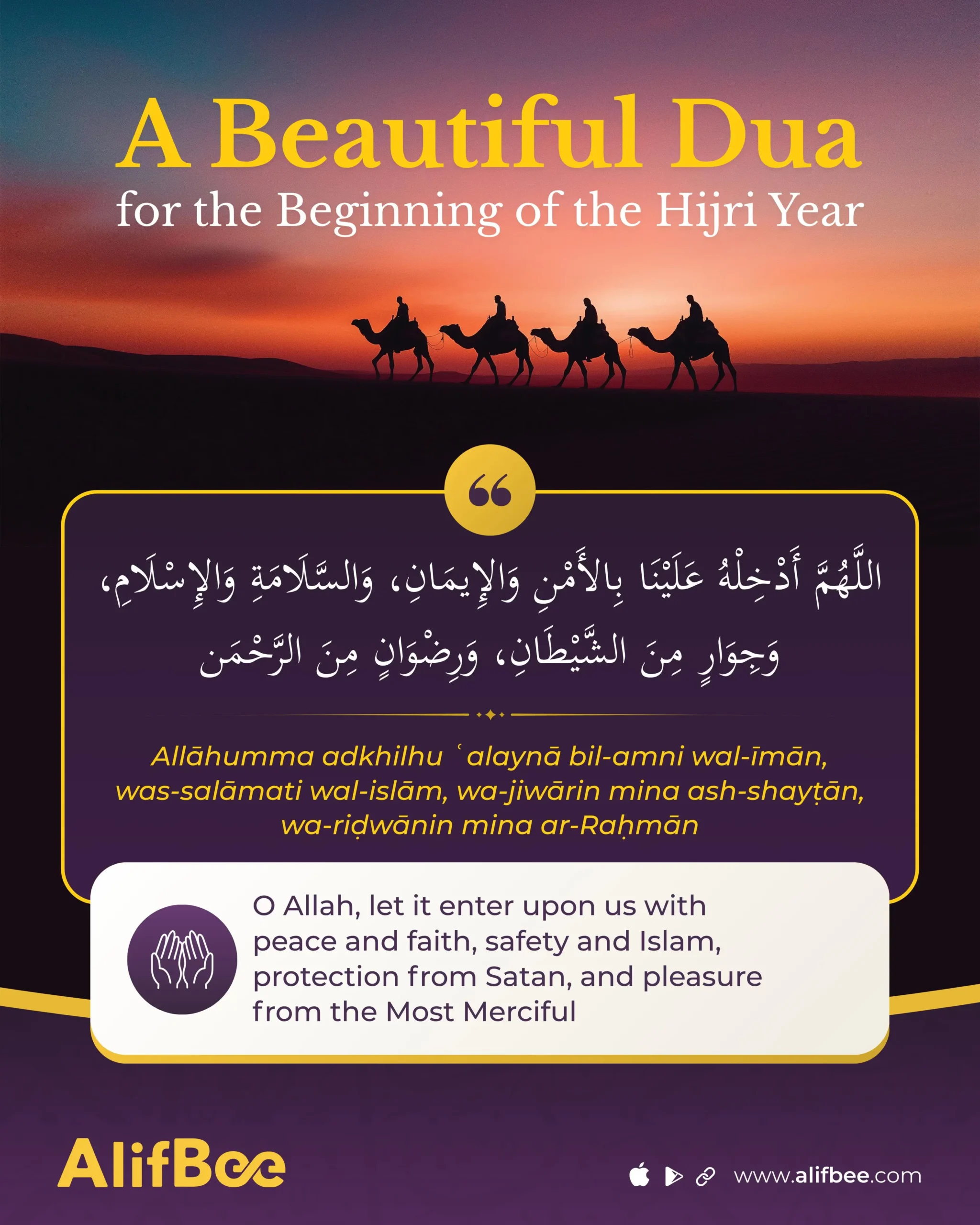
A Beautiful Dua for the Beginning of the Hijri Year
Along with Islamic New Year wishes and greetings, many Muslims like to begin the new Hijri year with a dua. One beautiful dua reported from the Companions is:
| Meaning | Pronunciation | Arabic | |
|---|---|---|---|
|
O Allah, let it enter upon us with peace and faith, safety and Islam, protection from Satan, and pleasure from the Most Merciful |
Allāhumma adkhilhu ʿalaynā bil-amni wal-īmān, was-salāmati wal-islām, wa-jiwārin mina ash-shayṭān, wa-riḍwānin mina ar-Raḥmān |
اللَّهُمَّ أَدْخِلْهُ عَلَيْنَا بِالأَمْنِ وَالإِيمَانِ، وَالسَّلَامَةِ وَالإِسْلَامِ، وَجِوَارٍ مِنَ الشَّيْطَانِ، وَرِضْوَانٍ مِنَ الرَّحْمَن |
|
This dua is suitable to mention at the beginning of the Hijri year because it asks Allah for the most important blessings a person needs in a new year: safety, faith, peace, protection, and Allah’s pleasure. It is more than a simple “Happy New Year” greeting. It is a spiritual prayer for a blessed beginning.
Reference note: This dua is reported from ʿAbdullāh ibn Hishām, who said that the Companions of the Prophet ﷺ used to learn this supplication when a month or year began. It is cited in Muʿjam al-Ṣaḥābah by al-Baghawī and in al-Muʿjam al-Awsaṭ by al-Ṭabarānī, with slight differences in wording.
Islamic New Year Wishes for Messages and Cards
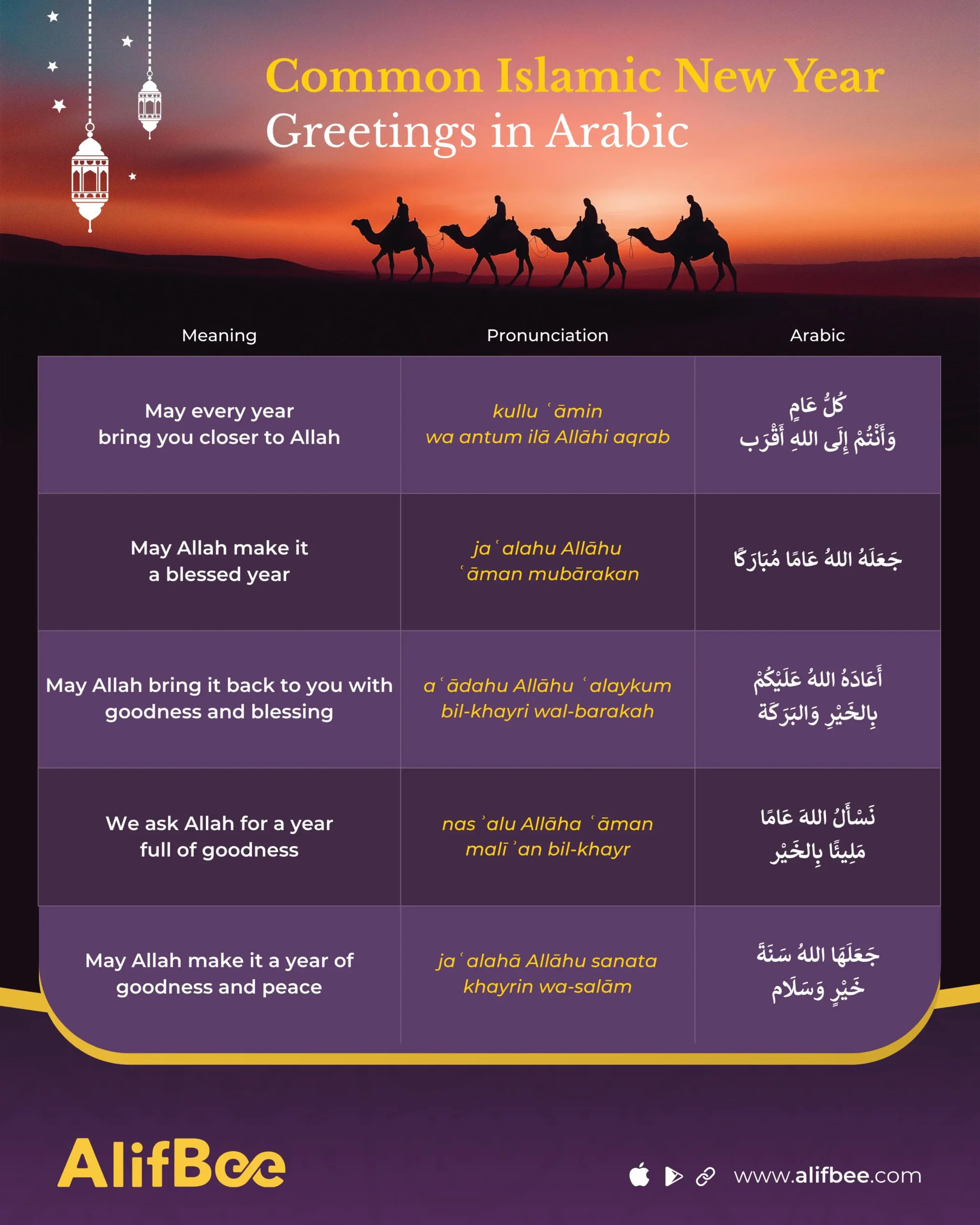
For messages, you can use slightly longer phrases that sound warm but not overly decorated.
We have picked the following beautiful wishes:
| Meaning | Pronunciation | Arabic | |
|---|---|---|---|
|
May every year bring you closer to Allah |
kullu ʿāmin wa antum ilā Allāhi aqrab |
كُلُّ عَامٍ وَأَنْتُمْ إِلَى اللهِ أَقْرَب |
|
|
May Allah make it a blessed year |
jaʿalahu Allāhu ʿāman mubārakan |
جَعَلَهُ اللهُ عَامًا مُبَارَكًا |
|
|
May Allah bring it back to you with goodness and blessing |
aʿādahu Allāhu ʿalaykum bil-khayri wal-barakah |
أَعَادَهُ اللهُ عَلَيْكُمْ بِالخَيْرِ وَالبَرَكَة |
|
|
We ask Allah for a year full of goodness |
nasʾalu Allāha ʿāman malīʾan bil-khayr |
نَسْأَلُ اللهَ عَامًا مَلِيئًا بِالخَيْر |
|
|
May Allah make it a year of goodness and peace |
jaʿalahā Allāhu sanata khayrin wa-salām |
جَعَلَهَا اللهُ سَنَةَ خَيْرٍ وَسَلَام |
|
|
Hijri New Year /
beginning of the Hijri year |
raʾsu al-sanah al-hijriyyah |
رَأْسُ السَّنَةِ الهِجْرِيَّة |
|
|
the new Hijri year |
al-ʿāmu al-hijrī al-jadīd |
العَامُ الهِجْرِيُّ الجَدِيد |
|
These work for cards, WhatsApp messages, social captions, or respectful notes to friends, family, teachers, or colleagues.
Review Islamic New Year Wishes & Greetings
Pronunciation Tips for Arabic Learners
The marks in the pronunciation guide are there to help you, not to scare you:
- The symbol ʿ represents the sound of ʿayn, a deep Arabic sound produced in the throat.
- The ḥ in Muḥarram is stronger and deeper than English h.
- Long vowels appear as ā, ī, and ū. Practice slowly: kullu, ʿāmin, wa antum, bikhayr.
- If you use audio, listen once, repeat once, then say the full phrase.
Common Mistakes to Avoid
Islamic New Year wishes and greetings are simple and straightforward, but it is useful to watch out for these common mistakes:
- Do not use one greeting for everyone without paying attention to anta, anti, and antum.
- Do not confuse the occasion with unrelated seasonal greetings.
- Do not rely only on translated wishes if your goal is to practice Arabic.
- Do not worry if you start with just one phrase. One accurate greeting is better than five uncertain ones.
Final word
These greetings for the Islamic New Year make it easy to share blessings and good wishes with your family and friends as the new year begins.
Want to practice Arabic phrases with pronunciation, examples, and guided lessons?
Explore them in the AlifBee app and build your Arabic step by step, including useful greetings, everyday expressions, and richer vocabulary.
FAQs
How do you say Happy Islamic New Year in Arabic?
You can say kullu ʿāmin wa antum bikhayr, which means “May you be well every year.” You can also say ʿāmun hijriyyun saʿīd, meaning “Happy Hijri year.” The first phrase sounds more natural and flexible for greetings.
What does Kullu aamin wa antum bikhayr mean?
It means “May you be well every year” or “Wishing you well every year.” It is a common Arabic greeting used for New Year occasions and other annual occasions.
Is Islamic New Year the same as Muharram?
Islamic New Year begins on the first day of Muharram. Muharram is the first month of the Hijri calendar, so it marks the start of the Islamic year.
Is there a special dua for Islamic New Year?
There is no one greeting or dua that all Muslims must say for Islamic New Year. Many people use general duas asking Allah for blessings, guidance, peace, and goodness in the new year.