

Written by Dania Ghraoui, a translator and language teacher with 10 years of experience.
At a Glance: Arabic greetings for diplomats help professionals make good first impressions and communicate confidently in professional settings. This guide covers formal Modern Standard Arabic greetings, when local dialects may be appropriate, common greetings and their expected responses, and the essential elements of a professional self-introduction. It also touches on diplomatic protocol, correct Arabic titles, and institutional practice.
If you work with Arabic-speaking officials, colleagues, or institutions, a general “hello” will not always be enough. An official visit, an embassy reception, or a first meeting with a delegation may call for a more formal greeting. You may also need to know how to address the person by title and what to say when they greet you first.
The expressions in this guide cover those situations. You will see how they are pronounced, what they mean, and where you are likely to use them.

What Are Diplomatic Arabic Greetings?
Diplomatic greetings form an important part of Arabic for professionals. They are the formal or polite expressions used when meeting officials, delegations, embassy staff, and institutional counterparts.
The words themselves are only part of the exchange. In some situations, you will also need the conventional reply or the appropriate title for the person you are addressing. The level of formality changes with the setting too: greeting an ambassador at an official reception is not quite the same as greeting a colleague you see every day.
If your Arabic is still limited, learn the greeting together with its reply and the titles you are most likely to need. That gives you enough Arabic to handle the opening of a meeting without trying to prepare an entire conversation.
The Role of Formal Arabic Greetings in Diplomacy
Knowing how you will open a meeting takes some uncertainty out of those first exchanges. When you greet your host appropriately, use the right title, and introduce your role clearly, you show that you have prepared for the meeting and can move into the conversation without an awkward start.
This is useful even if the rest of the discussion takes place in another language. A few well-chosen Arabic expressions can help you receive a delegation, introduce yourself at a reception, or exchange courtesies before the formal discussion begins.
Arabic also has an established place in international affairs. It is one of the six official languages of the United Nations, so some working knowledge of the language can be useful in both regional and multilateral settings.
Should Diplomats Use Modern Standard Arabic or a Dialect?
If you are unsure which variety to use in an official setting, use Modern Standard Arabic (MSA).
MSA works well for formal introductions, prepared remarks, official meetings, and gatherings where participants come from several Arabic-speaking countries. It also gives you a shared form of Arabic when you do not know which regional dialect the other person speaks.
The local dialect becomes more useful outside those formal exchanges. If you are posted to an Arabic-speaking country, learn some of the variety spoken there as well. You may use MSA during an official meeting, then switch to familiar local expressions when speaking with colleagues over coffee or chatting with people you see regularly.
| Arabic Variety | Use it in... | Note |
|---|---|---|
|
Modern Standard Arabic |
Formal introductions, official settings, prepared remarks, and meetings involving participants from different countries |
It’s accurate and appropriate for formal settings, but may sound less conversational in everyday social interactions |
|
Local dialect |
Building country-specific relationships, informal exchanges, and everyday interaction |
Choose the dialect spoken in the country or community where you work |
For a fuller explanation of the formal variety, see AlifBee’s guide to Modern Standard Arabic. Also, check our guides to Egyptian Arabic and Levantine Arabic.
Essential Formal Arabic Greetings for Diplomats
These formal Arabic greetings below are among the most common expressions used in formal Arabic.
| Type | Meaning | Pronunciation | Arabic | |
|---|---|---|---|---|
|
Greeting |
Peace be upon you / Hello |
as-salāmu ʿalaykum
|
السَّلَامُ عَلَيْكُمْ
|
|
|
Response |
And peace be upon you
|
wa ʿalaykumu as-salām
|
وَعَلَيْكُمُ السَّلَامُ
|
|
|
Greeting |
Hello |
marḥaban |
مَرْحَبًا |
|
|
Response / Welcome
|
Welcome |
ahlan wa sahlan
|
أَهْلًا وَسَهْلًا
|
|
|
Greeting |
Good morning
|
ṣabāḥ al-khayr
|
صَبَاحُ الْخَيْر
|
|
|
Response |
Good morning
|
ṣabāḥ an-nūr
|
صَبَاحُ النُّور
|
|
|
Greeting |
Good evening
|
masāʾ al-khayr
|
مَسَاءُ الْخَيْر
|
|
|
Response |
Good evening
|
masāʾ an-nūr
|
مَسَاءُ النُّور
|
|
Learn each greeting together with its customary reply, as both are expected in polite and professional communication.
As-salāmu ʿAlaykum and Its Response
As-salāmu ʿalaykum means “peace be upon you,” and the usual reply is wa ʿalaykumu as-salām (“and peace be upon you”).
You can hear this greeting in many settings, from everyday encounters to formal meetings. In a diplomatic context, it works well when greeting an Arabic-speaking host, colleague, or delegation, particularly in Muslim-majority settings. Its tone comes from the situation: it may sound respectful and formal in one exchange, warm and familiar in another.
If you prefer a more neutral greeting, marḥaban gives you a simple “hello” that is widely understood.
Marḥaban and Ahlan wa Sahlan
Marḥaban works well when you simply want to say “hello.” Ahlan wa sahlan carries more of a sense of welcome, so you are especially likely to hear it when guests arrive at a reception, ministry, embassy, or other official venue.
The distinction is not rigid. In everyday Arabic, the two can overlap, and ahlan wa sahlan is also used as a friendly greeting beyond formal welcoming situations.
Good Morning and Good Evening in Arabic
In the morning, say ṣabāḥ al-khayr. A common reply is ṣabāḥ an-nūr.
From later in the day into the evening, you can use masāʾ al-khayr, with masāʾ an-nūr as the customary reply.
Arabic also distinguishes these greetings from expressions used when leaving at night. The equivalent of “good night” is normally said at parting or before going to sleep, not when you arrive for an evening meeting.
If you want to go beyond these formal basics, AlifBee’s guide to ways to say hello in Arabic and how to reply includes additional greetings and regional forms.
How to Introduce Yourself in Arabic in a Diplomatic Setting
Keep your introduction structured and predictable: begin with a greeting, then state your name, organization, mission or department, role, and finish with a courteous closing. Master one clear, reliable introduction before adding alternatives.
- Open with a formal greeting.
- State your name.
- Name your country, ministry, embassy, mission, or delegation.
- State your diplomatic or professional role.
- Close with “Pleased to meet you.”
State Your Name
| Meaning | Pronunciation | Arabic | |
|---|---|---|---|
|
My name is Daniel Smith.
|
ismī Dāniyāl Smīth
|
اِسْمِي دَانْيَال سْمِيث
|
|
|
I am Daniel Smith.
|
anā Dāniyāl Smīth
|
أَنَا دَانْيَال سْمِيث
|
|
Use ismī followed by your name for a formal introduction. It does not change according to the speaker’s gender. In official documents or nameplates, use the Arabic spelling approved by your organization.
State Your Country, Ministry, Embassy, or Mission
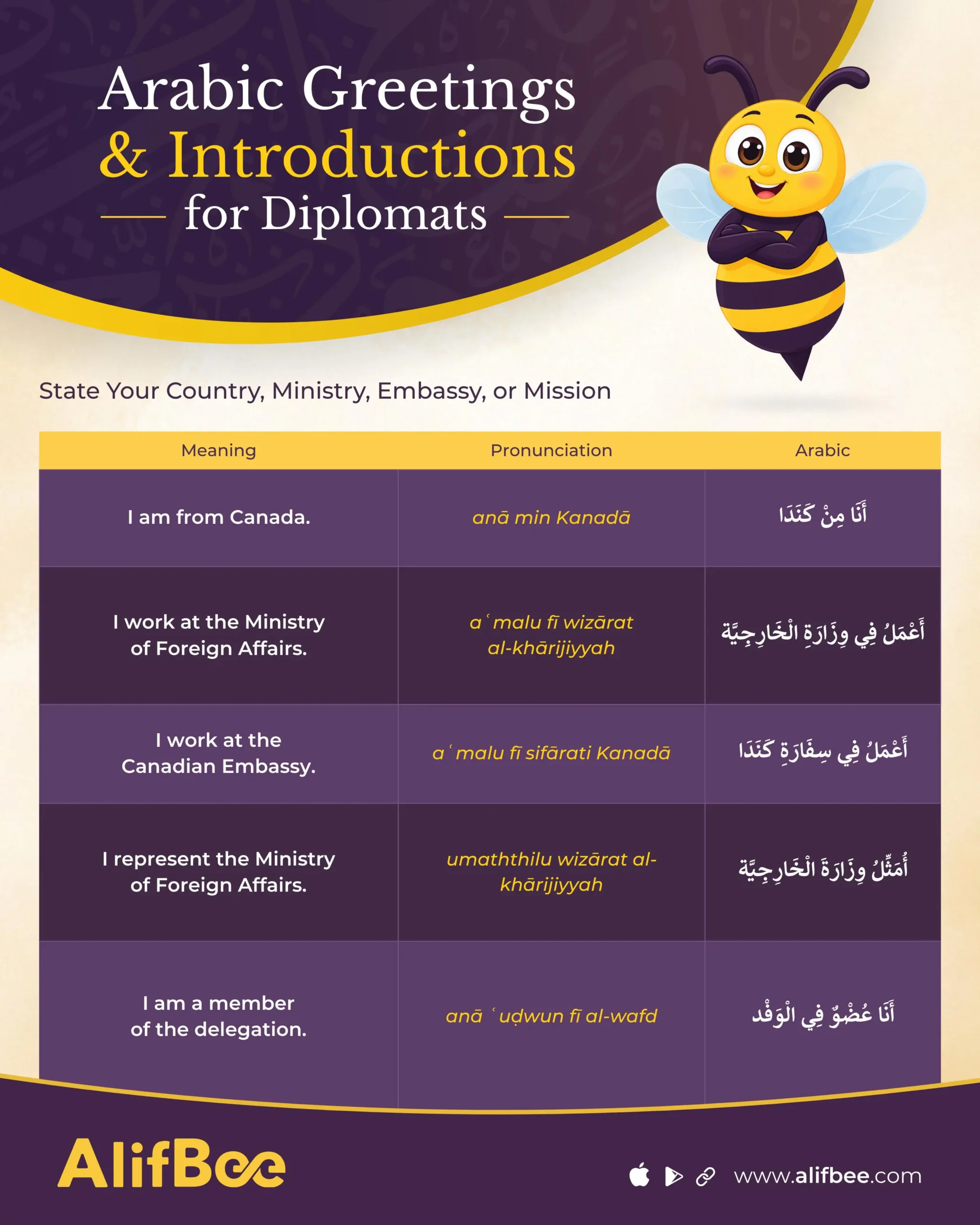
| Meaning | Pronunciation | Arabic | |
|---|---|---|---|
|
I am from Canada.
|
anā min Kanadā
|
أَنَا مِنْ كَنَدَا
|
|
|
I work at the Ministry of Foreign Affairs.
|
aʿmalu fī wizārat al-khārijiyyah
|
أَعْمَلُ فِي وِزَارَةِ الْخَارِجِيَّة
|
|
|
I work at the Canadian Embassy.
|
aʿmalu fī sifārati Kanadā
|
أَعْمَلُ فِي سِفَارَةِ كَنَدَا
|
|
|
I represent the Ministry of Foreign Affairs.
|
umaththilu wizārat al-khārijiyyah
|
أُمَثِّلُ وِزَارَةَ الْخَارِجِيَّة
|
|
|
I am a member of the delegation.
|
anā ʿuḍwun fī al-wafd
|
أَنَا عُضْوٌ فِي الْوَفْد
|
|
Use aʿmalu fī to describe where you work, and use umaththilu when you formally represent an institution or organization. Anā min can identify your country of origin or affiliation, though in a formal introduction, especially an official one, your organization or role is often more relevant.
State Your Diplomatic Role
| Meaning | Pronunciation | Arabic | |
|---|---|---|---|
|
Diplomat, male / female
|
diblūmāsī / diblūmāsiyyah
|
دِبْلُومَاسِيّ / دِبْلُومَاسِيَّة
|
|
|
Ambassador, male / female
|
safīr / safīrah
|
سَفِير / سَفِيرَة
|
|
|
Counsellor or adviser, male / female
|
mustashār / mustashārah
|
مُسْتَشَار / مُسْتَشَارَة
|
|
|
Diplomatic attaché, male / female
|
mulḥaq diblūmāsī / mulḥaqah diblūmāsiyyah
|
مُلْحَق دِبْلُومَاسِيّ / مُلْحَقَة دِبْلُومَاسِيَّة
|
|
|
Protocol officer
|
masʾūl al-marāsim
|
مَسْؤُول الْمَرَاسِم
|
|
|
Representative, male / female
|
mumaththil / mumaththilah
|
مُمَثِّل / مُمَثِّلَة
|
|
Use anā before the role: anā mustashār (“I am a counselor”). Diplomatic titles can have precise institutional meanings, so use the Arabic term that matches the person’s actual rank or position.
Ask for the Other Person’s Name and Role Politely
| Meaning | Pronunciation | Arabic | |
|---|---|---|---|
|
What is your name? (Polite or group form)
|
mā ismukum?
|
مَا اسْمُكُمْ؟
|
|
|
What is your role at the mission?
|
mā dawrukum fī al-baʿthah?
|
مَا دَوْرُكُمْ فِي الْبَعْثَة؟
|
|
|
How are you? (Polite or group form)
|
kayfa ḥālukum?
|
كَيْفَ حَالُكُمْ؟
|
|
These forms use the plural -kum ending. In formal Arabic, this plural form can address a group and may also be used respectfully when addressing one person. Usage varies by country and context, so follow the lead of the host, interpreter, or protocol officer rather than automatically using an unusually formal style.
For wider work and social patterns, use AlifBee’s guide on how to introduce yourself in Arabic.
Diplomatic Titles in Arabic and Formal Forms of Address
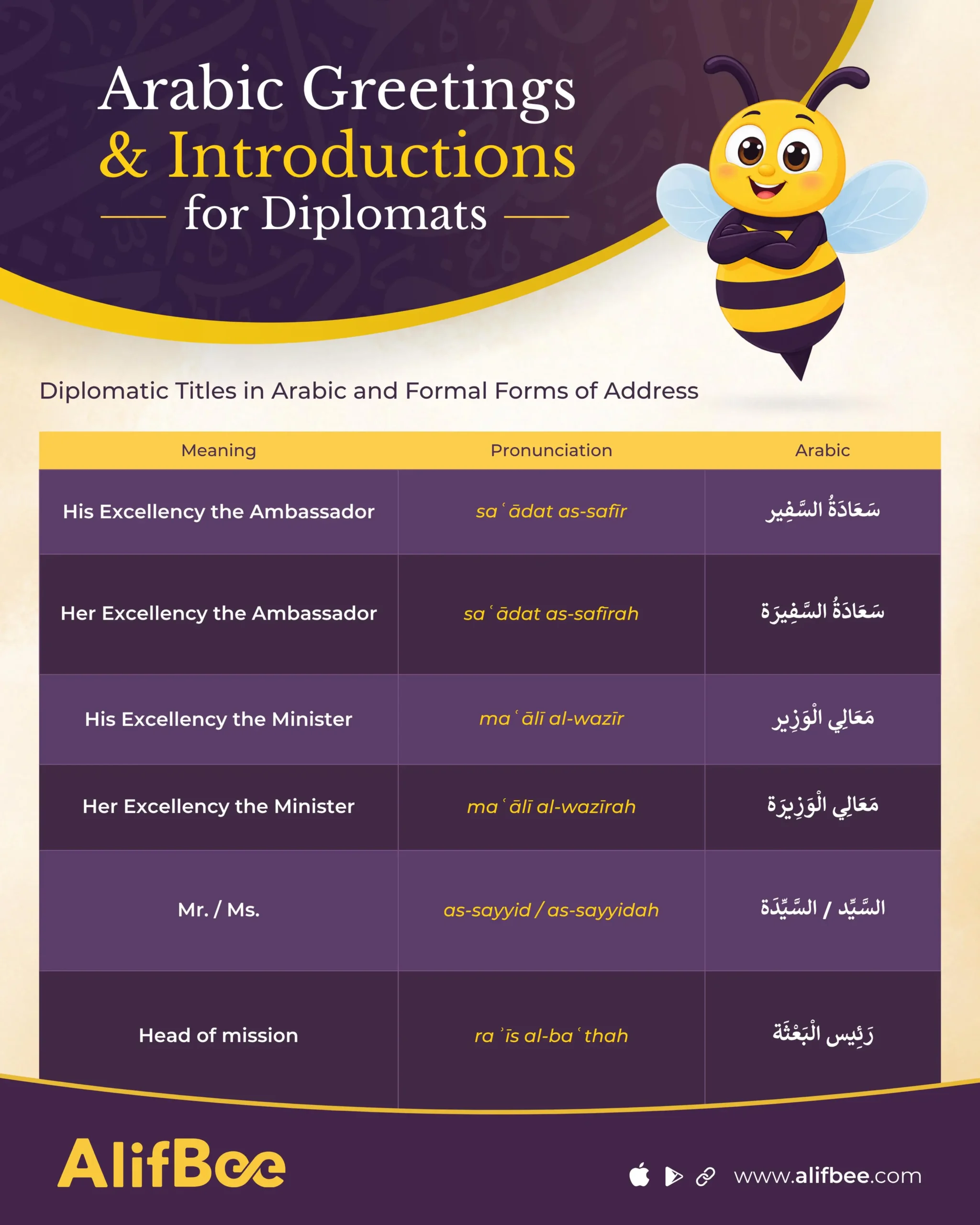
Diplomatic titles in Arabic require careful attention to rank, institution, and local conventions. It is important to verify titles rather than assume them. Check names, spellings, ranks, and honorifics against current official sources.
| Meaning | Pronunciation | Arabic | |
|---|---|---|---|
|
His Excellency the Ambassador
|
saʿādat as-safīr
|
سَعَادَةُ السَّفِير
|
|
|
Her Excellency the Ambassador
|
saʿādat as-safīrah
|
سَعَادَةُ السَّفِيرَة
|
|
|
His Excellency the Minister
|
maʿālī al-wazīr
|
مَعَالِي الْوَزِير
|
|
|
Her Excellency the Minister
|
maʿālī al-wazīrah
|
مَعَالِي الْوَزِيرَة
|
|
|
Mr. / Ms. |
as-sayyid / as-sayyidah
|
السَّيِّد / السَّيِّدَة
|
|
|
Head of mission
|
raʾīs al-baʿthah
|
رَئِيس الْبَعْثَة
|
|
Notes:
- English titles should not always be translated word for word; the appropriate Arabic form depends on the official usage.
- “His Excellency” and “Her Excellency” conventions may vary by country, rank, institution, and occasion.
- The correct title is more important than elaborate wording.
How to Say “Pleased to Meet You” and Welcome a Delegate
| Meaning | Pronunciation | Arabic | |
|---|---|---|---|
|
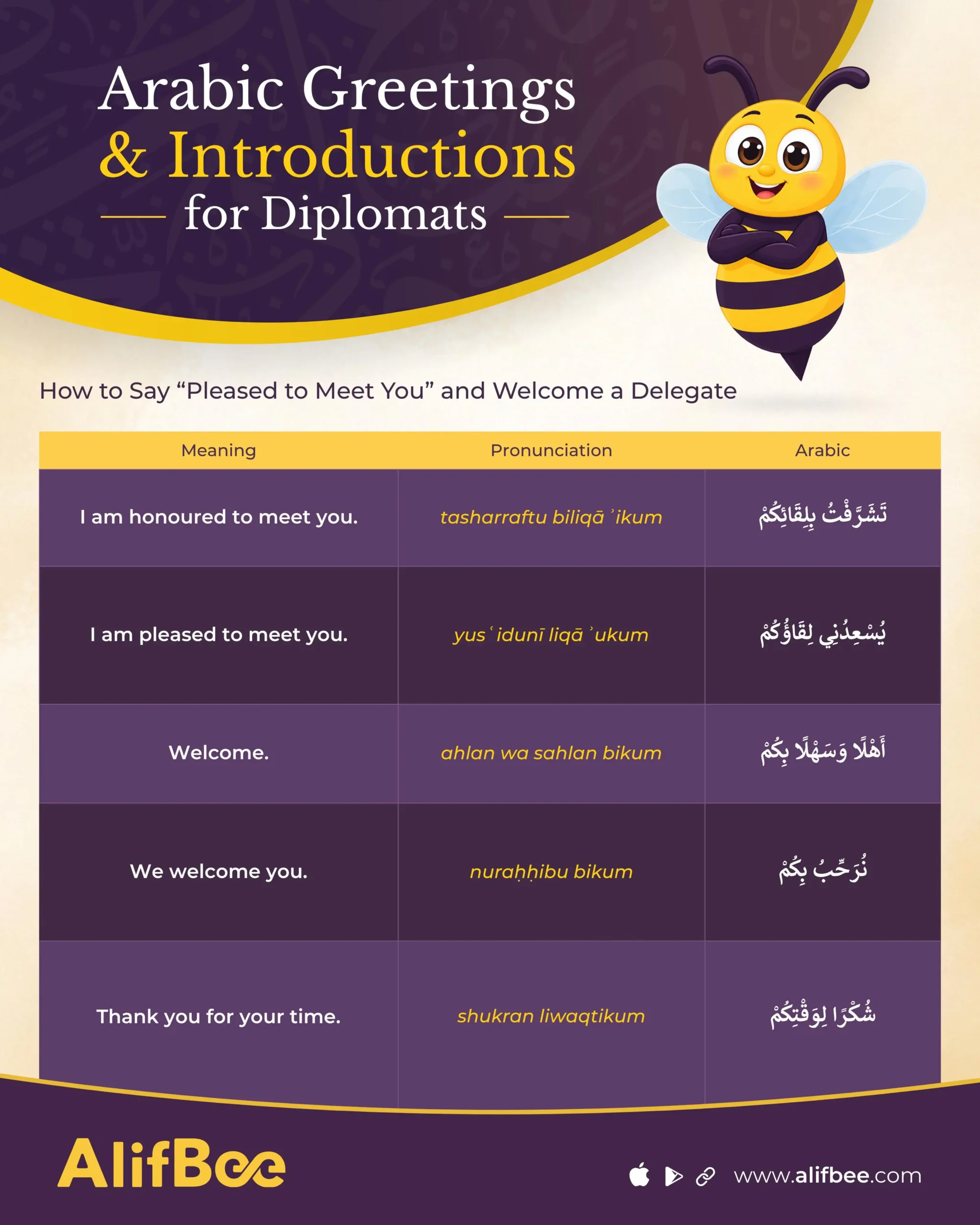
I am honoured to meet you.
|
tasharraftu biliqāʾikum
|
تَشَرَّفْتُ بِلِقَائِكُمْ
|
|
|
I am pleased to meet you.
|
yusʿidunī liqāʾukum
|
يُسْعِدُنِي لِقَاؤُكُمْ
|
|
|
Welcome |
ahlan wa sahlan bikum
|
أَهْلًا وَسَهْلًا بِكُمْ
|
|
|
We welcome you.
|
nuraḥḥibu bikum
|
نُرَحِّبُ بِكُمْ
|
|
|
Thank you for your time.
|
shukran liwaqtikum
|
شُكْرًا لِوَقْتِكُمْ
|
|
Tasharraftu biliqāʾikum is well suited to a formal first meeting. Yusʿidunī liqāʾukum is a more direct expression of pleasure at meeting someone, while nuraḥḥibu bikum welcomes a group. The ending -kum addresses a group and may also be used as a respectful form of address for one person in some settings.
Sample Diplomatic Introductions in Arabic
The dialogues below are rehearsal models for diplomatic introductions in Arabic . Replace the country, institution, department, and title with your own details.
At an Embassy Reception
| English meaning | Pronunciation | Arabic dialogue | |
|---|---|---|---|
|
A: Peace be upon you (hello). Good evening. |
A: As-salāmu ʿalaykum. Masāʾ al-khayr. |
أ: السَّلَامُ عَلَيْكُمْ. مَسَاءُ الْخَيْرِ. |
|
|
B: And peace be upon you. Good evening. |
B: Wa ʿalaykum as-salām. Masāʾ an-nūr. |
ب: وَعَلَيْكُمُ السَّلَامُ. مَسَاءُ النُّورِ. |
|
|
A: My name is Daniel Smith. I work at the Canadian Embassy, and I am a counselor. |
A: Ismī Dānyāl Smīth. Aʿmalu fī sifārat Kanadā, wa-anā mustashār. |
أ: اِسْمِي دَانْيَال سْمِيث. أَعْمَلُ فِي سِفَارَةِ كَنَدَا، وَأَنَا مُسْتَشَارٌ.
|
|
|
B: Pleased to meet you. My name is Maryam Al-Hassan, and I work at the Ministry of Foreign Affairs. |
B: Tasharraftu biliqāʾikum. Ismī Maryam al-Ḥasan, wa-aʿmalu fī Wizārat al-Khārijiyyah. |
ب: تَشَرَّفْتُ بِلِقَائِكُمْ. اِسْمِي مَرْيَم الْحَسَن، وَأَعْمَلُ فِي وِزَارَةِ الْخَارِجِيَّةِ. |
|
|
A: I am pleased to meet you. |
A: yusʿidunī liqāʾukum. |
أ: يُسْعِدُنِي لِقَاؤُكُمْ. |
|
Note: As-salāmu ʿalaykum literally means “Peace be upon you,” but it functions as a general greeting equivalent to “Hello” in many contexts.
To have a complete first exchange, you need only a greeting, your name, your organization or affiliation, your role, and a courteous closing.
Before a Bilateral Meeting
| English meaning | Pronunciation | Arabic dialogue | |
|---|---|---|---|
|
A: Welcome, Your Excellency, the Ambassador. |
A: Ahlan wa-sahlan bikum, Saʿādata al-Safīr. |
أ: أَهْلًا وَسَهْلًا بِكُمْ، سَعَادَةَ السَّفِير.
|
|
|
B: Thank you. |
B: Shukran lakum.
|
ب: شُكْرًا لَكُمْ.
|
|
|
A: I represent the Political Affairs Department at the Ministry of Foreign Affairs.
|
A: Umaththilu Idārata al-Shuʾūn al-Siyāsiyyah fī Wizārat al-Khārijiyyah.
|
أ: أُمَثِّلُ إِدَارَةَ الشُّؤُونِ السِّيَاسِيَّةِ فِي وِزَارَةِ الْخَارِجِيَّةِ.
|
|
|
B: We are pleased to meet you today.
|
B: Naḥnu suʿadāʾu biliqāʾikum al-yawm.
|
ب: نَحْنُ سُعَدَاءُ بِلِقَائِكُمْ الْيَوْمَ.
|
|
|
A: Likewise. We are pleased to begin the meeting.
|
A: Wa-anā kadhālika. Yusʿidunā an nabdaʾa al-ijtimāʿ.
|
أ: وَأَنَا كَذَلِكَ. يُسْعِدُنَا أَنْ نَبْدَأَ الِاجْتِمَاعَ.
|
|
A formal introduction can transition smoothly into the meeting without introducing negotiation topics too early.
Welcoming a Visiting Delegation
| English meaning | Pronunciation | Arabic dialogue | |
|---|---|---|---|
|
A: We welcome you to the ministry. |
A: Nuraḥḥibu bikum fī al-Wizārah.
|
أ: نُرَحِّبُ بِكُمْ فِي الْوِزَارَةِ.
|
|
|
B: Thank you for your kind reception (warm welcome).
|
B: Shukran li-ḥusni istiqbālikum.
|
ب: شُكْرًا لِحُسْنِ اسْتِقْبَالِكُمْ.
|
|
|
A: We wish you a successful visit.
|
A: Natamannā lakum ziyāratan muwaffaqah.
|
أ: نَتَمَنَّى لَكُمْ زِيَارَةً مُوَفَّقَةً.
|
|
|
B: We are pleased to be with you today.
|
B: Yusʿidunā an nakūna maʿakum al-yawm.
|
ب: يُسْعِدُنَا أَنْ نَكُونَ مَعَكُمْ الْيَوْمَ.
|
|
The repeated -kum endings address the delegation as a group. In formal Arabic, the same ending may also be used respectfully when addressing one person in some contexts.
Arabic Greeting Etiquette for Diplomats
There is no single greeting rule that applies identically across all Arabic-speaking countries. Protocol, hierarchy, age, gender, personal preference, and the formality of the occasion may all shape the exchange. Use these principles as a starting point, then follow local guidance.
- Confirm names, titles, pronunciation, and precedence before the event.
- Greet the senior person first when required by the host’s protocol.
- Allow a brief courteous exchange before moving straight to business.
- Follow the other person’s lead on handshakes and other physical greetings.
- Consult an interpreter or protocol colleague when you are uncertain. Asking is better than guessing.
Common Mistakes Professional Learners Should Avoid
- If you are preparing for an official meeting, start with Modern Standard Arabic (MSA) rather than reaching for a dialect you do not know well. Once you are familiar with the country where you will be posted, you can add the local dialect for everyday conversations.
- Learn greetings together with their replies. You may be greeted first, so knowing only how to open the exchange leaves you unprepared for half of it.
- Titles deserve a little preparation too. Check the person’s official rank, honorific, and institutional title before the meeting. Avoid translating titles yourself when an approved Arabic form already exists.
- Pay attention to whether you are addressing one person or a group, especially when using forms that change between singular and plural.
- There is also no advantage in choosing a long ceremonial phrase simply because it sounds impressive. A short sentence you can pronounce clearly is usually more useful.
Finally, do not expect every meeting to move straight to the agenda. A brief exchange of greetings and courtesies often comes first, so leave room for that before shifting to business.
Build Your 30-Second Diplomatic Introduction
Fill-in introduction
| English meaning | Pronunciation | Arabic dialogue | |
|---|---|---|---|
|
Peace be upon you. My name is [name]. I work at [embassy / ministry / mission]. I am [role]. Pleased to meet you. |
As-salāmu ʿalaykum. Ismī [name]. Aʿmalu fī [embassy / ministry / mission]. Anā [role]. Tasharraftu biliqāʾikum. |
السَّلَامُ عَلَيْكُمْ. اِسْمِي [الاسم]. أَعْمَلُ فِي [السفارة / الوزارة / البعثة]. أَنَا [المنصب]. تَشَرَّفْتُ بِلِقَائِكُمْ. |
|
Practice in five passes:
- Listen,
- Repeat slowly,
- Record yourself,
- Compare your pronunciation,
- Rehearse with a colleague or tutor.
Do not wait for perfect pronunciation. Aim for a calm pace and a version you can deliver confidently without reading.
Review Arabic Greetings and Introductions for Diplomats
Final Word
You do not need advanced Arabic to handle a diplomatic introduction well. Learn the greetings and replies you are likely to use, check the correct titles before the meeting, and practice saying them aloud. From there, adjust your Arabic to the person, place, and level of formality.
Learn with AlifBee
The AlifBee Diplomatic Arabic Course develops the Arabic used in official meetings, protocol, formal visits, negotiations, international relations, and cross-cultural exchange.
The program includes four levels and flexible learning paths for individuals and institutions, and uses the AlifBee app to supplement the learning with extra practice and assignments.
You can also explore the four-book Arabic for Diplomatic Purposes Series for structured professional vocabulary, dialogues, and exercises.
FAQs
1. What Is the Most Formal Arabic Greeting for Diplomats?
As-salāmu ʿalaykum (Peace be upon you) is a widely recognized respectful greeting; reply with wa ʿalaykumu as-salām (and peace be upon you). Marḥaban (hello) is a neutral alternative. The setting and local practice still matter.
2. How Do You Introduce Yourself in Arabic Professionally?
Begin with the greeting, ismī and your name, aʿmalu fī (I work in) or umaththilu (I represent) and your organization, then anā plus your role. Example: Ismī Lina. (My name is Lina) Umaththilu wizārat al-khārijiyyah (I represent the Ministry of Foreign Affairs). Anā mustashārah (I am a consultant).
3. Should Diplomats Learn MSA or a Local Arabic Dialect?
Learn MSA first for formal, cross-regional communication. Add the local dialect for country-specific relationships and everyday exchanges. Many professionals eventually need both, but not on their first day.
4. How Do You Address an Ambassador in Arabic?
Use saʿādat as-safīr (His Excellency Ambassador) for a male ambassador and saʿādat as-safīrah (Her Excellency Ambassador) for a female ambassador. Confirm the official title and host-country protocol before a high-level event or formal publication.
5. How Do You Say “Pleased to Meet You” in Formal Arabic?
Use tasharraftu biliqāʾikum (I am honored to meet you) or yusʿidunī liqāʾukum (I am pleased to meet you). Both suit a formal first meeting. The -kum ending addresses a group and may be a respectful plural in some settings.