
Written by Dania Ghraoui, a translator and language teacher with 10 years of experience.
The Arabic root system is a way of building words from a small set of core consonants, usually three. These root letters carry a central meaning, while patterns, vowels, and added letters turn that meaning into specific verbs, nouns, and adjectives. Learning roots helps Arabic learners recognize word families and understand vocabulary more efficiently.
In this article, we will explain Arabic roots, triliteral roots, weak roots, and patterns. We will understand how Arabic words are formed from roots and see how learning them can help you learn Arabic faster. We will also support your journey with examples and learning tips.
Before you go further!
If you want to build a stronger foundation before you go deeper, it helps to connect the Arabic root system to other key parts of the language. You can start with Learn Modern Standard Arabic Basics for a broader overview, then read Master Arabic Vowels: Short & Long Vowels in Arabic to see how sound patterns shape words. To expand the idea further, How to Build a Strong Arabic Vocabulary shows why roots matter for vocabulary growth, while Arabic Past Tense Explained and Present Tense in Arabic Explained help you see how the same root changes across verb forms.
What Is the Arabic Root System?
The Arabic root system is a way of forming many words from a consonantal base. In most cases, that base consists of three consonants, although Arabic also has some roots with two or four consonants. The root itself does not usually tell you everything about grammar. Instead, it gives you a core field of meaning. Patterns then help turn that core into specific words.
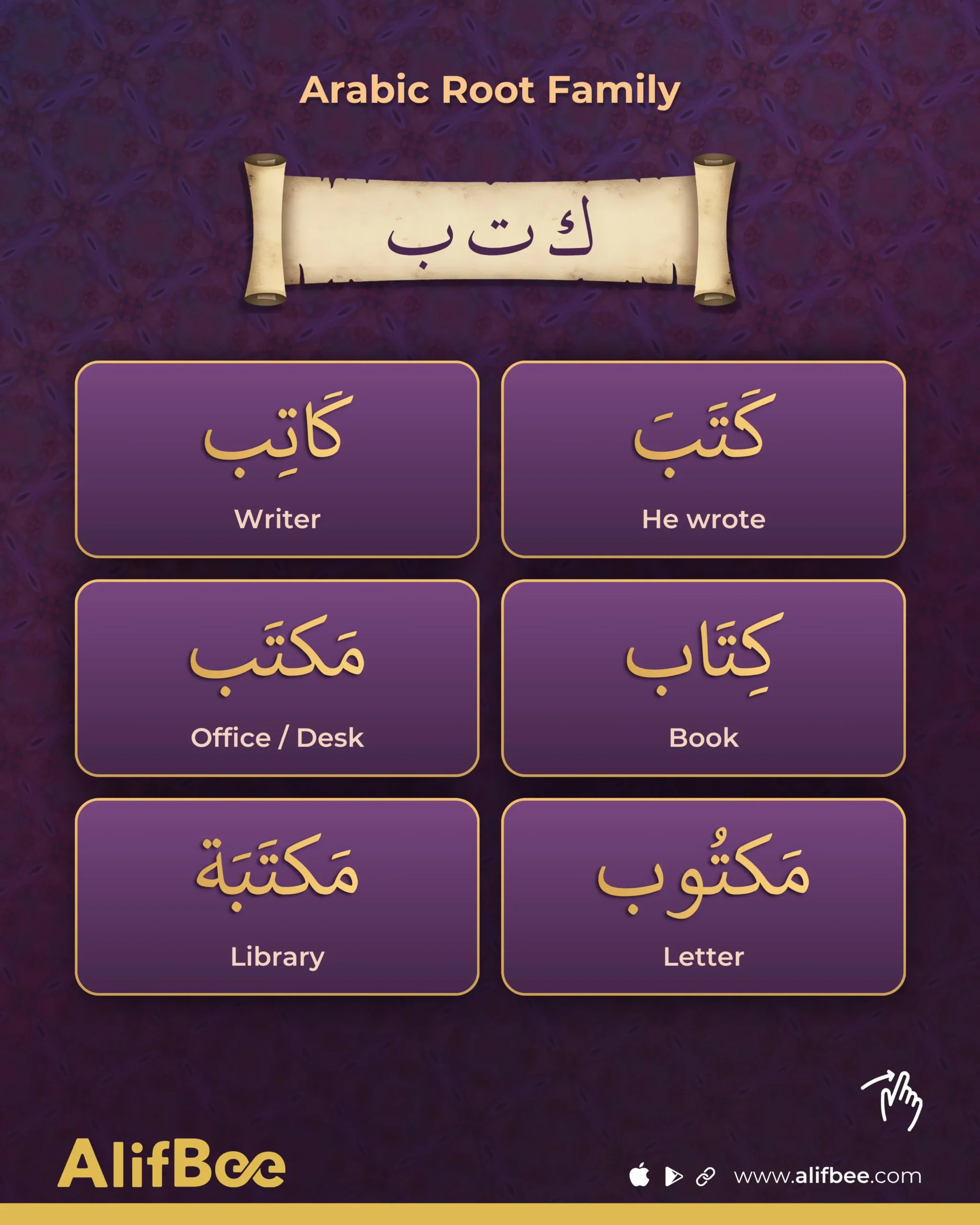
For example, the root ك-ت-ب is associated with writing. From that one root, other related words are formed, like a writer, a book, an office, and more. This is why learning roots can help you grow your vocabulary faster and notice relationships between words more easily.
Key Takeaways
- Arabic words are often built from a shared root that carries a core meaning
- Patterns transform roots into different word types and grammatical forms
- Learning roots helps you recognize related words and learn vocabulary faster
Root vs Pattern: What’s the Difference?
To understand Arabic word formation, you need to distinguish between roots and patterns.
- A root is a set of consonants that carries the core meaning
- A pattern is a template that shapes that meaning into a specific word
| Feature | Root | Pattern |
|---|---|---|
|
Simple meaning |
core word meaning |
word form template |
|
Main role |
carries base meaning |
shapes word form |
|
What it contains |
root consonants only |
vowels and structure |
|
Example |
ك-ت-ب |
فَاعِل |
|
Final result |
meaning source |
form source |
What Is an Arabic Triliteral Root?
A triliteral root is a root made of three consonants. This is the most common type of root in Arabic. If you are new to Arabic grammar, you can think of the triliteral root as the foundation, while the word pattern acts like a mold that shapes the final word.
Are All Arabic Roots Three Letters?
Not all Arabic roots are triliteral. Three-letter roots are the most common and the most important for beginners, but Arabic also has some four-letter roots. For example, ز-ل-ز-ل gives زَلْزال (earthquake), and د-ح-ر-ج gives دَحْرَجَ (to roll).
That said, triliteral roots are still the best place to start. They form a huge part of the Arabic vocabulary and help you understand how Arabic word formation works in a clear and manageable way.
Root Vs Word
It is important to distinguish between the root and a complete word. For example, كَتَبَ (kataba) means “he wrote,” but it is not the root itself. The root is ك-ت-ب. The full word كَتَبَ is a derived verb form built from that root.
Root Vs Stem
You also have to know the difference between a root and a stem. The root is the core, usually a 3-consonant, semantic base (e.g., ك – ت -ب ) relating to writing. The stem is the specific, vowelized, and patterned form created from that root (e.g., kataba – he wrote, or maktab – office).
So, roots represent meaning, but stems enable conjugation and affixing to form words.
How Arabic Word Formation Works
Arabic word formation combines a root with a pattern. The root supplies the central meaning, and the pattern helps express grammatical role or word type. That is why related words often share the same root letters even when their forms look different.
A Simple Root Family Example
Using the root ك-ت-ب, you can build several common words:
| Meaning | Word class | Pronunciation | Arabic | |
|---|---|---|---|---|
|
he wrote |
verb |
kataba |
كَتَبَ |
|
|
writer |
noun |
kātib |
كَاتِب |
|
|
book |
noun |
kitāb |
كِتَاب |
|
|
office / desk |
noun |
maktab |
مَكتَب |
|
|
letter |
noun |
maktoob |
مَكتُوب |
|
|
library |
noun |
maktaba |
مَكتَبَة |
|
These examples show how one root can generate multiple related words. It builds families of meaning from the three root consonants by changing or adding short and long vowels, as well as other Arabic letters.
Why the Root System Makes Vocabulary Easier
When you study Arabic through roots, you stop seeing every word as isolated. Instead, you begin to group related words together. That makes vocabulary easier to remember and easier to guess in context.
For example, if you already know that a root is connected to reading, writing, study, or knowledge, a new related word may feel less intimidating. You may not know the exact dictionary definition yet, but you often understand the general area of meaning. That gives you a strong advantage in reading and listening.
This does not mean you can guess every word perfectly. Some forms are less transparent, some meanings shift over time, and some words need to be learned directly. Still, roots give you a reliable framework that helps you learn more efficiently.
How to Identify a Root Without Guessing Blindly
A common mistake is trying to find the root by simply removing letters. Arabic does not work that way.
Instead, follow this approach:
- Look for familiar patterns (fa’ala – fa’el – maf’al – Istaf’ala etc)
- Identify the main consonants: These usually correspond to the three letters in the pattern (fa’ala )
- Compare with similar words: If you know similar words, it helps to compare them
- Check if the meaning makes sense
- Confirm with a dictionary if needed: We recommend Al-maany, which has strong Arabic dictionaries.
Example of Finding the Root in A Dictionary
Take the word استقبل (istaqbala), for example.
The initial sequence ista- is part of a common derived pattern (Istaf’ala), while the core consonants carry the central meaning.
So, its root is ق-ب-ل, not simply whatever remains after deleting three letters at random.
In context, the word can mean “to receive,” “to welcome,” or “to face,” depending on usage. Check the word in the Al-maany Arabic dictionary.
Even advanced learners sometimes verify roots, so this is completely normal.
Examples of Common Arabic Roots
Here are five roots that beginner learners often meet early on:
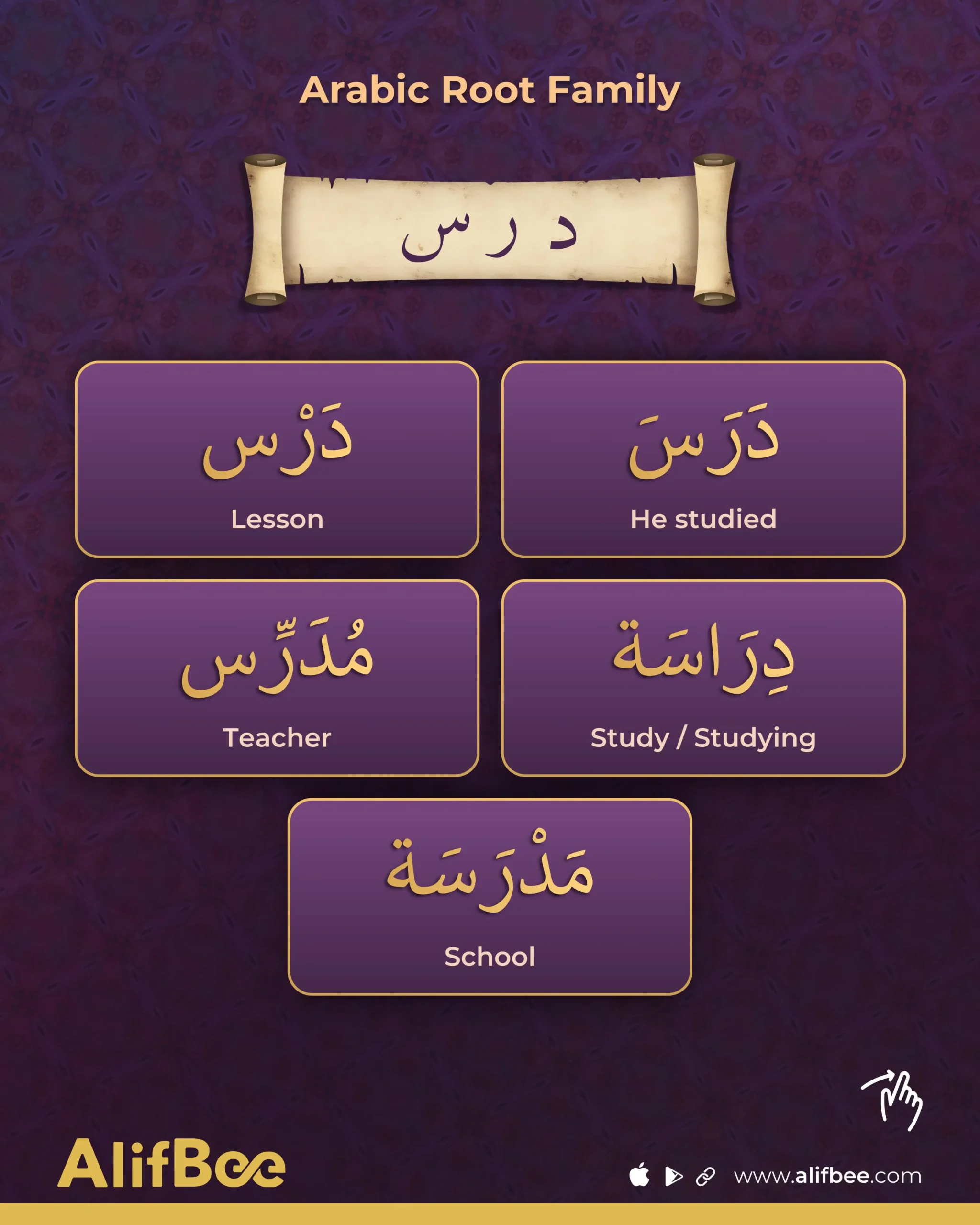
1. Root: د-ر-س
The root د-ر-س creates words around a key action: studying. It’s an important root to learn early since many useful words are formed from it. Here are some examples:
| Meaning | Pronunciation | Arabic | |
|---|---|---|---|
|
he studied |
darasa |
دَرَسَ |
|
|
lesson |
dars |
دَرْس |
|
|
study / studying |
dirāsah |
دِرَاسَة |
|
|
teacher |
mudarris |
مُدَرِّس |
|
|
school |
madrasa |
مَدْرَسَة |
|
Notice how the words are formed by adding short vowels, long vowels, or other Arabic letters to the root.
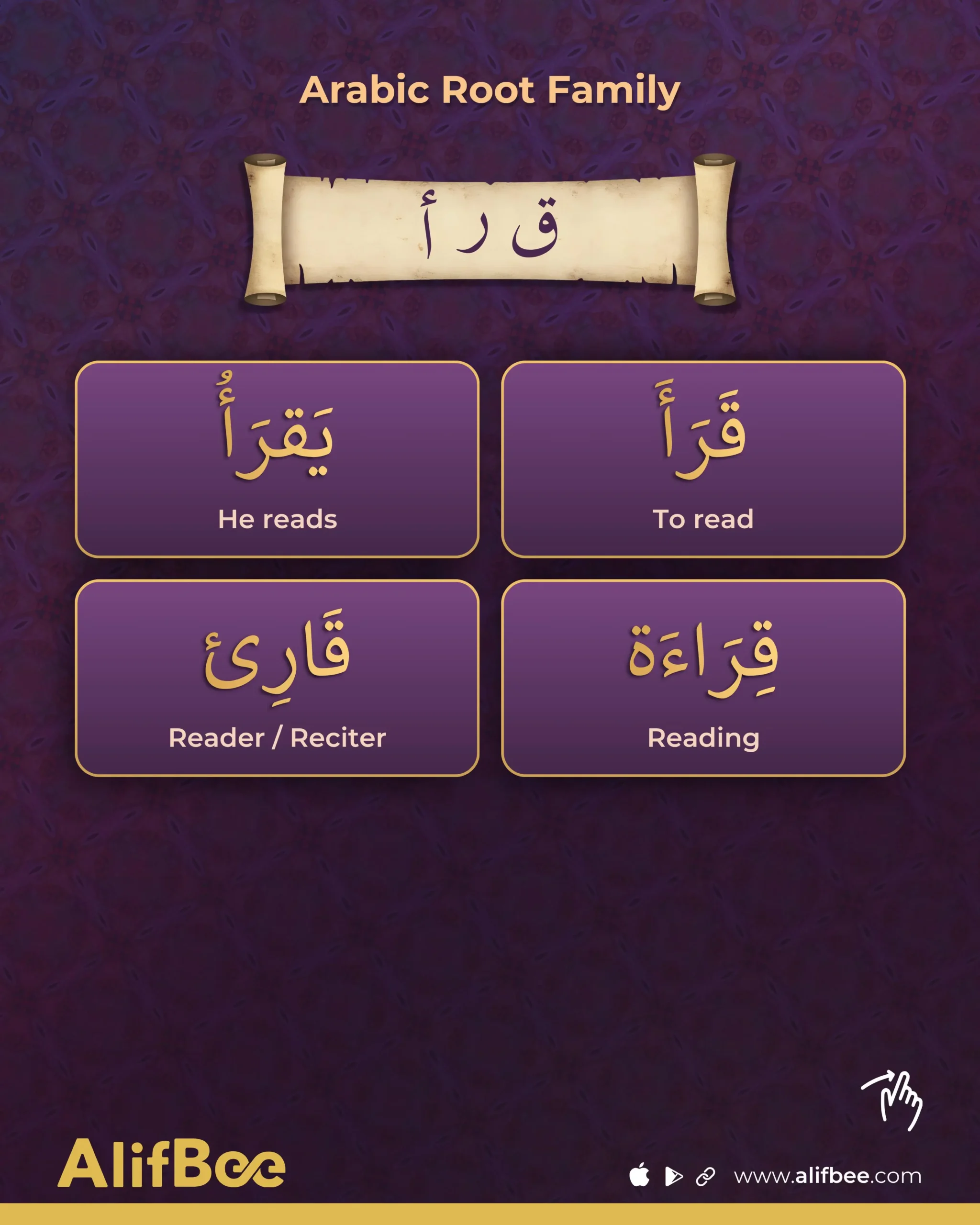
2. Root: ق-ر-أ
This root is for another key action: reading. It forms common and easy verbs and nouns.
| Meaning | Pronunciation | Arabic | |
|---|---|---|---|
|
to read |
qaraʾa |
قَرَأَ |
|
|
he reads |
yaqraʾu |
يَقرَأُ |
|
|
reading |
qirāʾah |
قِرَاءَة |
|
|
reader / reciter |
qāriʾ |
قَارِئ |
|
Learning this root is also helpful, as many related and easy words come from it.
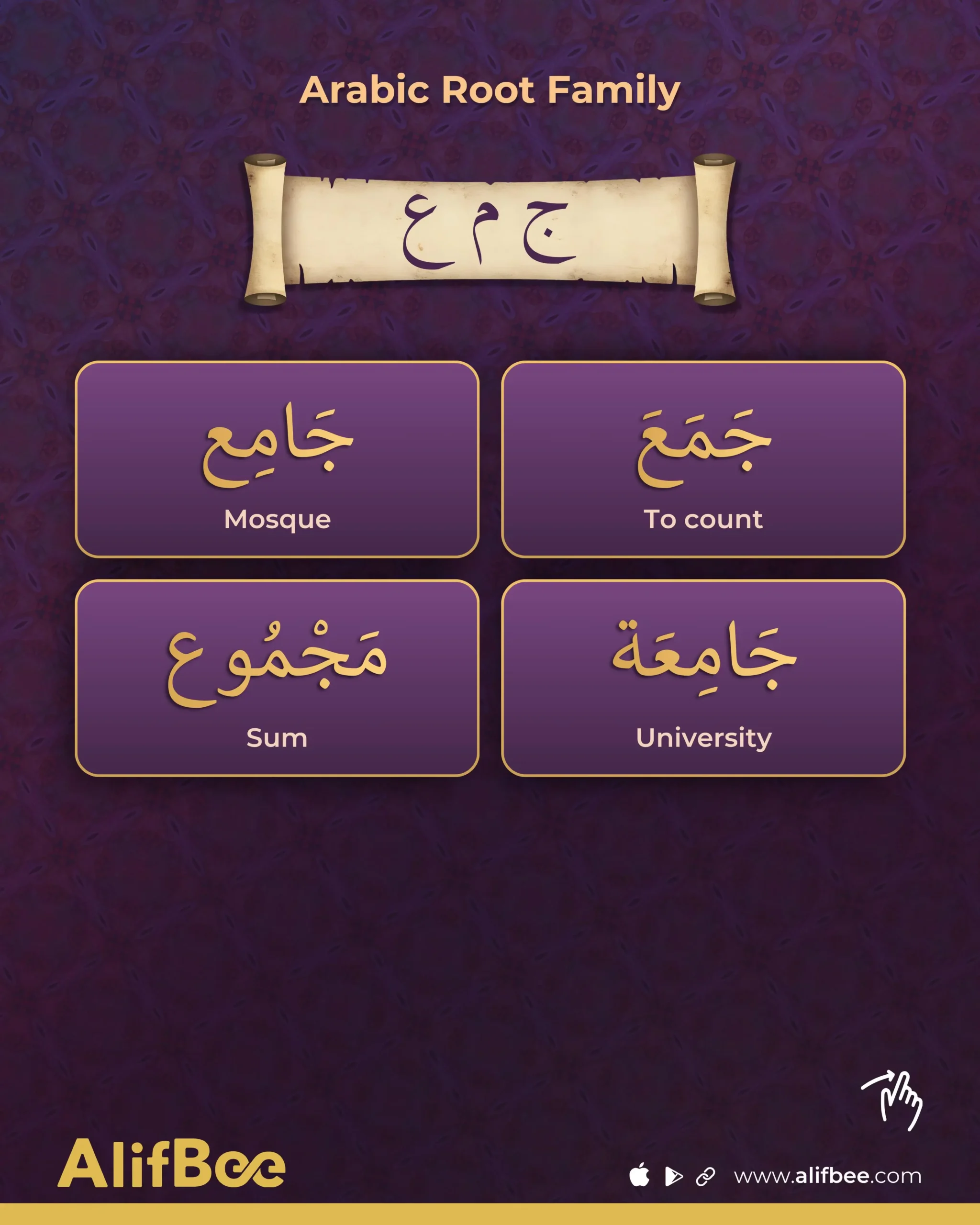
3. Root: ج-م-ع
The root ج-م-ع has the core meaning of “counting” or “bringing together”, but other words, slightly different in meaning, can be formed from the same root.
| Meaning | Pronunciation | Arabic | |
|---|---|---|---|
|
to count |
jamaʿa |
جَمَعَ |
|
|
mosque |
jāmiʿ |
جَامِع |
|
|
university |
jāmiʿah |
جَامِعَة |
|
|
sum |
majmūʿ |
مَجْمُوع |
|
Notice how the meaning stays connected to the idea of gathering: a mosque is where people gather, a university gathers students, and a sum gathers numbers together.
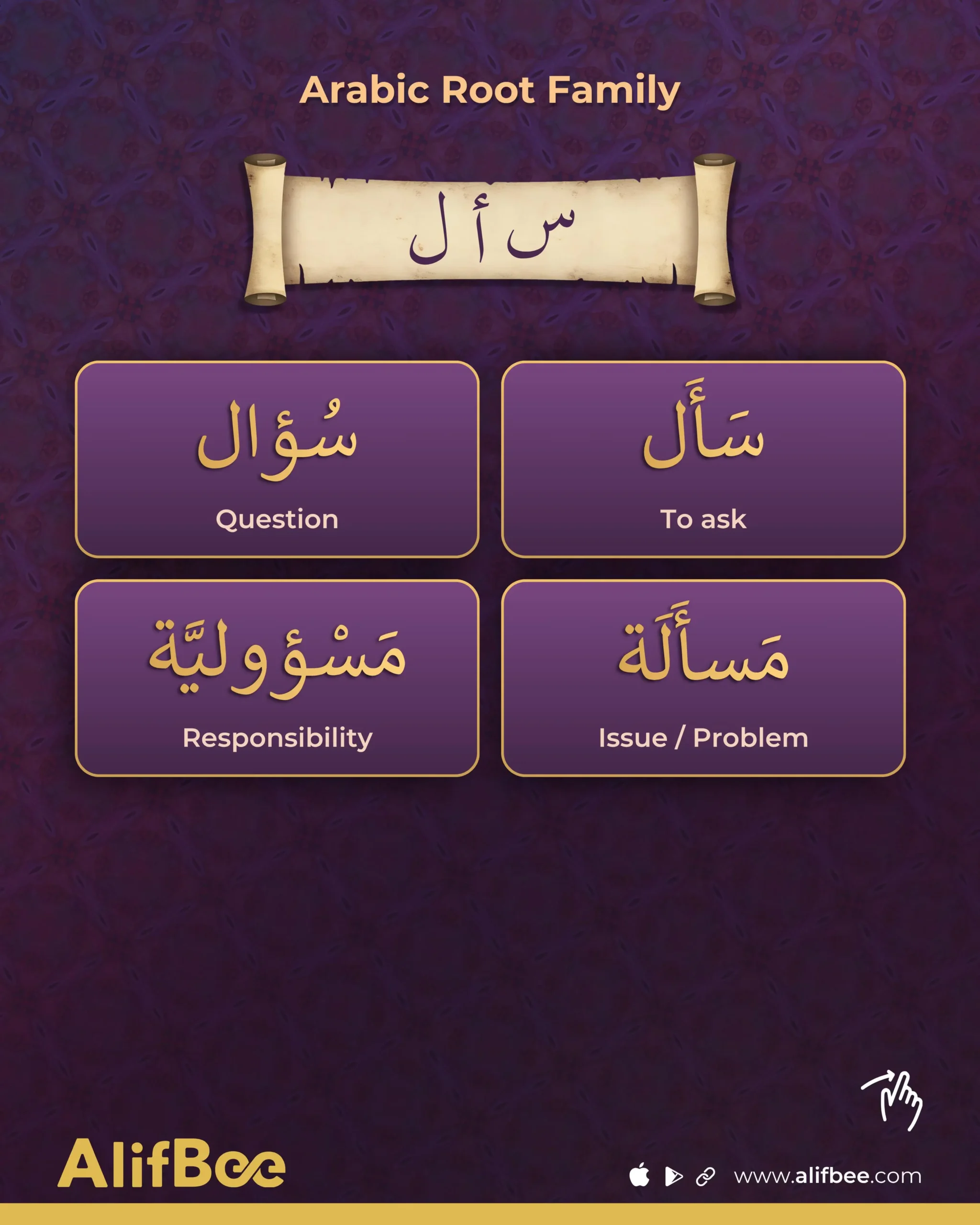
4. Root: س-أ-ل
The root س-أ-ل is connected to asking and seeking information. It appears in many everyday words used when asking questions, discussing problems, or talking about responsibility. Because asking is such a common action, this root shows up frequently in both spoken and written Arabic.
| Meaning | Pronunciation | Arabic | |
|---|---|---|---|
|
to ask |
saʾala |
سَأَل |
|
|
question |
suʾāl |
سُؤال |
|
|
issue/problem |
masʾalah |
مَسأَلَة |
|
|
responsibility |
masʾūliyyah |
مَسْؤوليَّة |
|
Notice how the words are formed by adding vowels, prefixes like مـ, or extra letters to expand the meaning while keeping the same core idea of asking or being accountable.
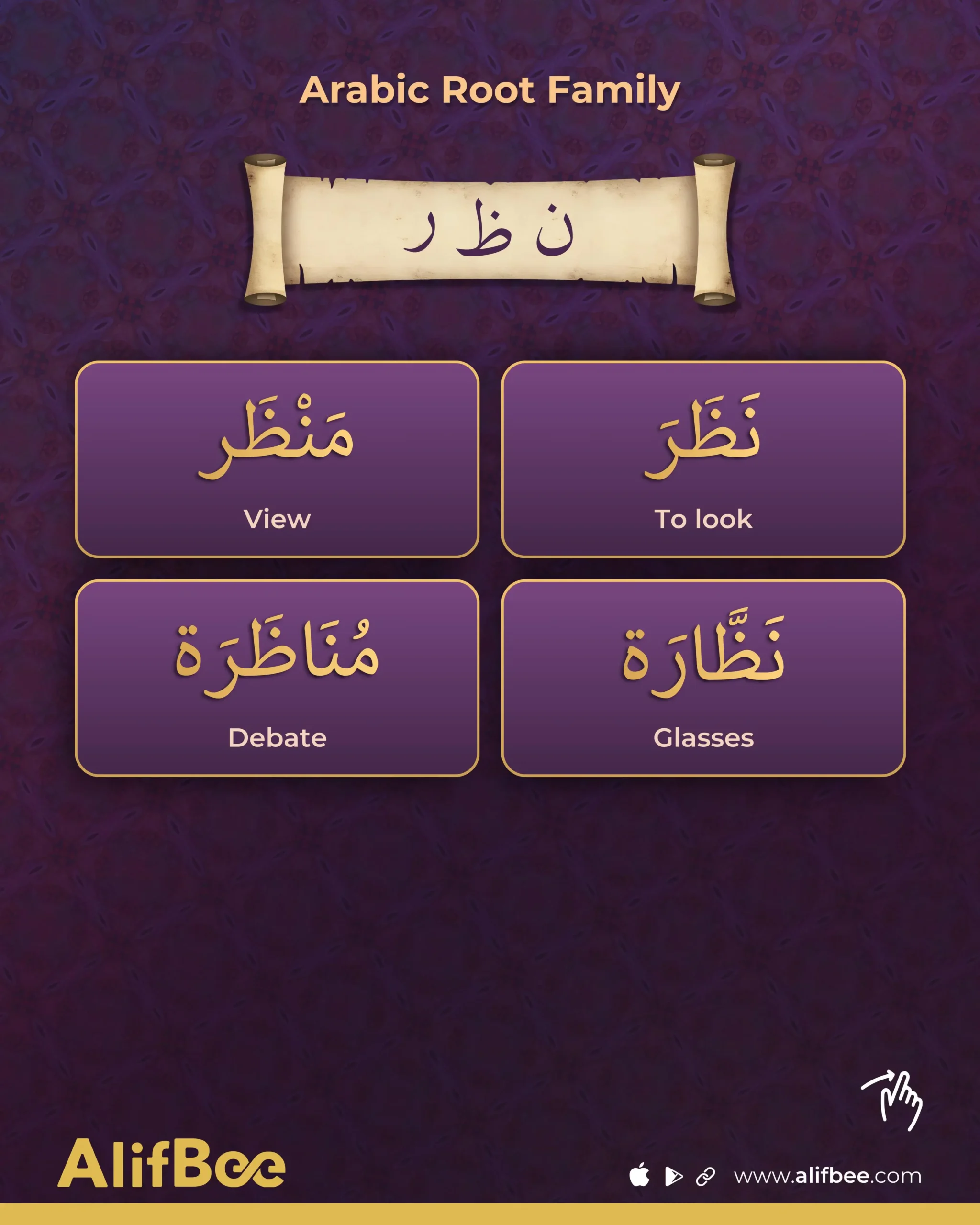
5. Root: ن-ظ-ر
The root ن-ظ-ر is related to looking, seeing, and observing. From this simple idea, Arabic forms words connected to views, vision, and even discussions or debates, where people “look” at ideas from different angles.
| Meaning | Pronunciation | Arabic | |
|---|---|---|---|
|
to look |
naẓara |
نَظَرَ |
|
|
view |
manẓar |
مَنْظَر |
|
|
glasses |
naẓẓārah |
نَظَّارَة |
|
|
debate |
munāẓarah |
مُنَاظَرَة |
|
Again, you can see how different patterns create related meanings while the root letters stay the same, helping you recognize new words more easily.
What Are Weak Roots in Arabic?
A weak root has one weak letter (ا – و – ي ) as one of its main radicals. Because of that, the word often changes more than a regular root during conjugation or derivation.
Common Types of Weak Roots
There are three types of weak roots based on the place of the weak letter in the word:
- first-weak: the weak letter comes first, مثل و-ج-د
- hollow: the weak letter is in the middle, مثل ق-و-ل
- defective: the weak letter comes last, مثل د-ع-و
Example of Weak Root
Here is an example of a hollow root:
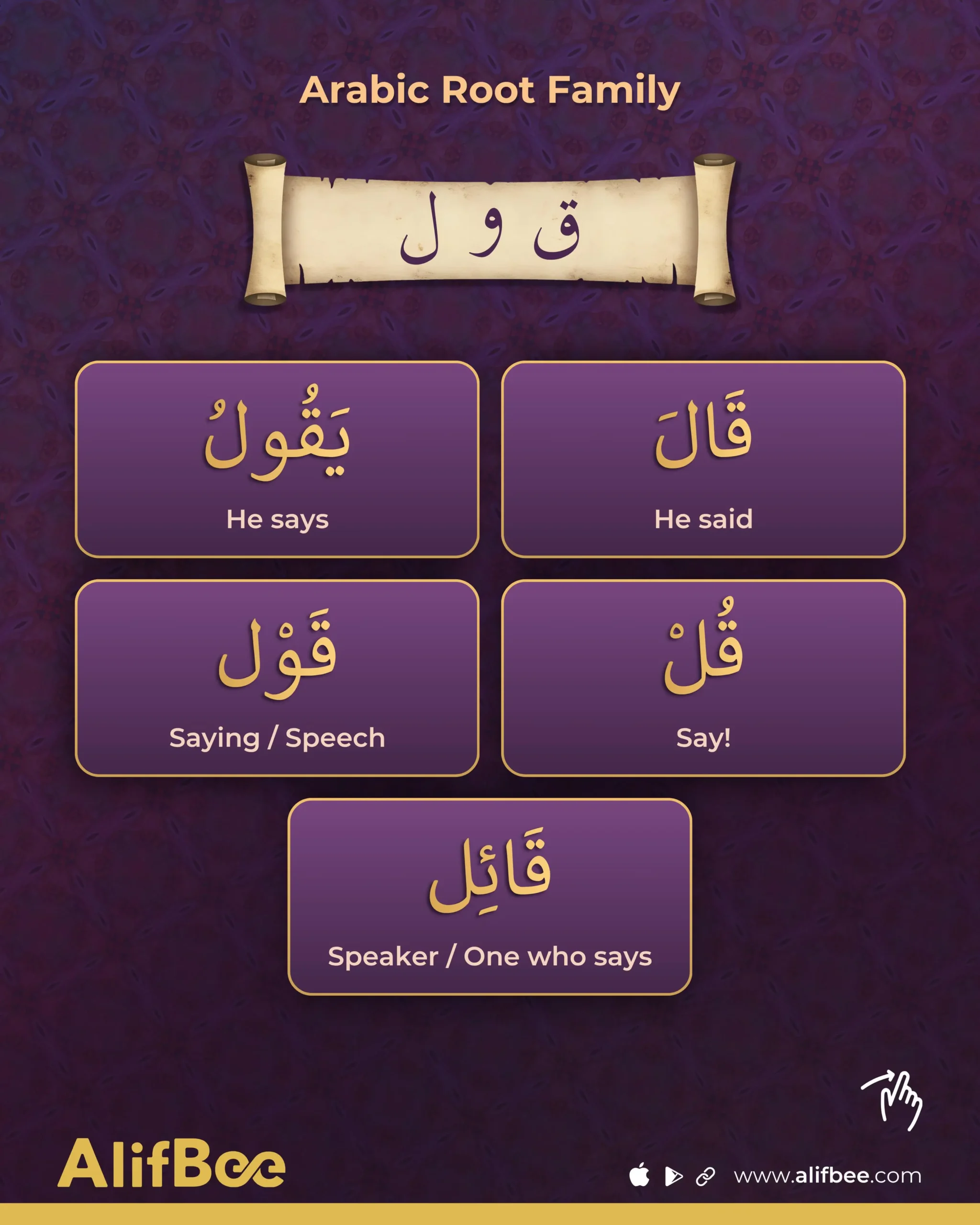
The Root ق-و-ل
It is a weak root because the middle letter is و, so it is a hollow verb root.
| Meaning | Root | Derived from | |
|---|---|---|---|
|
he said |
ق-و-ل |
قَالَ |
|
|
he says |
ق-و-ل |
يَقُولُ |
|
|
say! |
ق-و-ل |
قُلْ |
|
|
saying / speech |
ق-و-ل |
قَوْل |
|
|
speaker / one who says |
ق-و-ل |
قَائِل |
|
Notice how the weak middle و changes shape in different forms, such as قَالَ and قُلْ
Review Arabic Root System
Do All Arabic Words Follow the Root System?
Many Arabic content words do follow the root-and-pattern system, especially verbs and many nouns. However, not every word fits the neat textbook model.
Some forms that can be less transparent:
- Borrowed words
- particles
- some proper names
- some fixed expressions
You should also know that some roots behave less predictably. Weak Roots that contain weak letters such as ا, و, or ي, can show changes in spelling or form that make them harder to recognize at first. That means that Arabic morphology includes both regular patterns and special cases.
How Learning Roots Can Help You Learn Arabic Faster
If you focus on common roots early, you build a stronger foundation in vocabulary, reading, and grammar. A single root can lead you to several related words, and those connections make the review more meaningful.
Download our free compilation of the 20 most common word roots in Arabic with useful derivations. It also contains translations and pronunciation of these words.
Tips to Learn Arabic Roots Easily
Here are useful tips to learn Arabic roots easily:
- Study a few common roots first instead of collecting random vocabulary.
- Learn two to four derived words from each root.
- Make flashcards that show the root and a small word family.
- Look for familiar roots while reading short Arabic texts.
- Use roots as a memory tool, not as a shortcut for guessing every word.
A Practical Way to Study Arabic Roots
To learn roots effectively:
- Start with one common root at a time
Choose a high-frequency root such as ك-ت-ب, د-ر-س, or ق-ر-أ. - Learn a small word family
Study the root with two to four related words, not the root alone. - Notice the pattern of each word
Ask yourself whether the word is a verb, a person, a place, or a verbal noun. - Use the words in short sentences
This helps you connect form, meaning, and usage. - Review roots in groups
Go back to the same root family after a few days instead of studying isolated words once. - Look for roots while reading
When you meet a new word, try to recognize its root and connect it to words you already know.
Common Beginner Mistakes When Learning Arabic Roots
From our contact with learners of Arabic, we noticed common beginner mistakes when learning Arabic roots. Below is a list of these mistakes and why they occur. We also recommend the right approach to avoid these mistakes:
| Mistake | Why it happens | Better approach |
|---|---|---|
|
Treating every word as isolated |
learner misses word families |
group words by root |
|
Confusing root and word |
full word looks basic |
separate root from form |
|
Ignoring patterns |
focus stays on meaning only |
learn root with pattern |
|
Removing letters randomly |
root search becomes mechanical |
identify known patterns first |
|
Guessing every meaning |
related words seem obvious |
confirm with context |
|
Avoiding weak roots |
forms look unusual |
learn common weak roots slowly |
|
Memorizing too many roots |
review becomes shallow |
study fewer roots well |
|
Focusing on theory only |
no real language use |
add examples and sentences |
Keep in mind that it is perfectly normal to make mistakes, not only in Arabic roots, but in language learning in general.
If you find yourself making any of the above mistakes, don’t be discouraged from continuing to practice Arabic roots. Making mistakes is a healthy sign that you are progressing.
Arabic Root System vs Arabic Morphology
Finally, it is important to distinguish between the two concepts: the Arabic root system and Arabic morphology.
The Arabic root system is the idea that many words come from a shared set of root letters that carry a core meaning.
Arabic morphology is broader: it includes:
- the root system
- word patterns
- verb forms
- inflection
- the way words change shape in grammar
Final word
The Arabic root system is one of the clearest keys to understanding how Arabic vocabulary works. When you learn to notice roots and patterns, words stop feeling random. You begin to see how Arabic builds meaning step by step.
That awareness will not replace practice, but it will make your practice smarter. One root can open the door to a whole family of words, and that is one of the reasons Arabic becomes more rewarding the deeper you go.
Start exploring Arabic through roots with the AlifBee app, where structured lessons help you build vocabulary, understand patterns, and improve pronunciation with confidence.
FAQs
What is the Arabic root system?
It is a system in which many Arabic words are built from a consonantal root plus a pattern. The root carries a broad meaning, and the pattern helps create specific word forms.
What is a triliteral root in Arabic?
A triliteral root is a root made of three consonants. This is the most common type of root in Arabic.
Can I always find the root by deleting letters from the beginning of a word?
No. That method is unreliable. It is better to learn common patterns and identify the consonantal core carefully.
Does every Arabic word come from a root?
Many do, especially verbs and many nouns, but not every Arabic word fits the system easily.