
Written by Dania Ghraoui, a translator and language teacher with 10 years of experience.
At a Glance: There is a lot to learn in Arabic grammar, but beginners do not need to tackle everything at once. This article focuses on the main building blocks of MSA: word classes and sentence types, gender and agreement, definiteness, pronouns and verbs, possession, questions, and negation. Along the way, it introduces Naḥw, Ṣarf, and case endings, with examples showing how these points work together in real sentences.
You may know plenty of Arabic words and still struggle to put them into a sentence. Why does an adjective change? Why does a verb take a different form with a female subject? For beginners, Arabic grammar can seem confusing at first, with several rules working together at once.
This guide breaks down the key grammar rules in a clear, practical way, so you can understand how they fit together and start using Arabic with confidence.
What Is Arabic Grammar?
Arabic grammar explains how words are formed and how they work together in a sentence. Two key areas often come up when studying it: naḥw and ṣarf.
Naḥw deals with sentence structure and the grammatical role of each word.
Ṣarf looks at the word itself: how it is formed, how its shape changes, and how roots and patterns create related forms.
Together, they help you understand both how Arabic words are built and how they function in a sentence.
What Are the Three Main Types of Arabic Words?
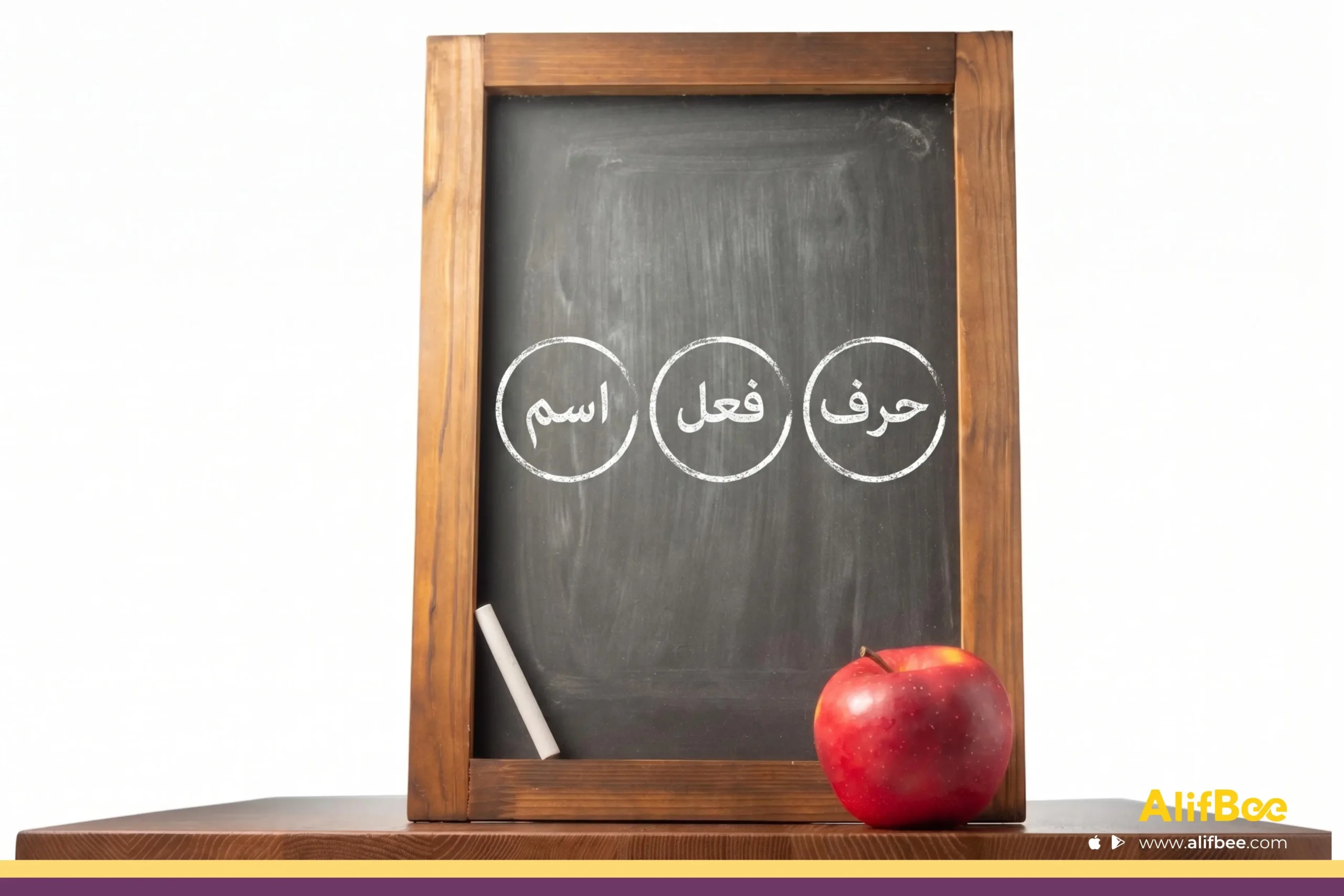
Traditional Arabic grammar divides words into three main categories, which do not correspond exactly to English word classes:
- Ism: covers a broad range of words, including nouns, adjectives, pronouns, and demonstratives
- Fiʿl: refers to verbs, which express an action or event and are associated with a particular time
- Ḥarf: is usually translated as “particle,” and refers to words that often express relationships or grammatical meanings, such as prepositions and conjunctions
Understanding these three categories is a useful starting point because they form the foundation of the traditional Arabic grammatical system.
Look at examples for each one:
| Examples | Pronunciation | Arabic | |
|---|---|---|---|
|
(wardah – rose) – (kitāb – book) – (kabīr – big) – (anā – I) – (hādhā – this) |
ism |
اِسْمٌ |
|
|
(yamshī – walks) – (yaqraʾ – reads) |
fiʿl |
فِعْلٌ |
|
|
(min – from) – (wa – and) |
ḥarf |
حَرْفٌ |
|
12 Essential Arabic Grammar Rules for Beginners
Think of these rules as a learning map. Each one gives you a useful principle, not the whole subject. When a topic starts to feel familiar, follow the linked AlifBee guide for fuller tables and practice.
1. Arabic Uses Nominal and Verbal Sentences
Arabic sentences commonly follow two starting patterns.
- A nominal sentence begins with a noun or pronoun
- A verbal sentence begins with a verb.
| Sentence | Meaning | Pronunciation | Arabic | |
|---|---|---|---|---|
|
Nominal Sentence |
The student is hardworking
|
aṭ-ṭālibu mujtahidun |
الطَّالِبُ مُجْتَهِدٌ |
|
|
Verbal Sentence |
Maryam wrote the lesson |
katabat Maryamu ad-darsa |
كَتَبَتْ مَرْيَمُ الدَّرْسَ |
|
Arabic word order is flexible, but these two patterns give beginners a reliable starting point. Read the full Arabic sentence structure guide for a deeper explanation.
2. Present-Tense Nominal Sentences Usually Omit “To Be”
In a simple present nominal sentence, MSA normally has no separate word for “is,” “am,” or “are.” In الطَّالِبُ مُجْتَهِدٌ, “the student” stands beside “hardworking,” giving the meaning “The student is hardworking.”
Arabic does use forms such as كَانَ, kāna, in the past and other structures. The rule is simply not to insert an English-style “is” into this basic present pattern.
3. Arabic Nouns Have Grammatical Gender
Arabic nouns are masculine or feminine, and gender affects adjectives, pronouns, and some verb forms. The ending ة (tāʾ marbūṭa) often marks a feminine noun, as in سَيَّارَةٌ, “a car,” but this is not an absolute rule. Learn each new noun with its gender rather than guessing from the ending alone.
4. Definite and Indefinite Forms Change Meaning
Arabic uses the prefix الـ (al-) to make a noun definite, and it does not have separate indefinite articles equivalent to the English “a” or “an.” Look at the following example:
| Meaning | Pronunciation | Arabic | |
|---|---|---|---|
|
A book
|
kitābun |
كتابٌ |
|
|
The book
|
al-kitābu
|
الكتابُ |
|
In fully vocalized MSA, tanwīn, the final -un, -an, or -in ending, often marks an indefinite noun.
| Meaning | Pronunciation | Example | Pronunciation | Indefinite Noun | ||
|---|---|---|---|---|---|---|
|
A house – A big house |
Baytun kabīrun. |
بيتٌ كبير. |
|
baytun |
بيتٌ |
|
|
A car – I bought a new car.
|
Ishtaraytu sayyāratan jadīdatan.
|
اشتريت سيارةً جديدة.
|
|
sayyāratan
|
سيارةً |
|
|
A store – I bought the book from a nearby store.
|
Ishtaraytu al-kitāba min matjarin qarībin.
|
اشتريت الكتاب من متجرٍ قريب.
|
|
matjarin |
متجرٍ |
|
This is one of those small changes that affects the rest of the phrase too, especially adjective agreement. The guide to nouns in Arabic explains definiteness, gender, number, and case in more detail.
5. Adjectives Follow Nouns and Agree with Them
An Arabic adjective usually follows the noun and agrees with it in gender, number, definiteness, and case.
The first example below is one phrase, “the big house.” The second is a sentence, “The house is big.” Definiteness, along with the structure of the phrase, helps show the difference.
| Meaning | Pronunciation | Arabic | |
|---|---|---|---|
|
The big house
|
al-baytu al-kabīr
|
البَيْتُ الكَبِيرُ
|
|
|
The house is big.
|
al-baytu kabīrun
|
البَيْتُ كَبِيرٌ
|
|
6. Arabic Has Singular, Dual, and Plural Forms
Arabic distinguishes between singular, dual, and plural forms:
| Meaning | Pronunciation | Arabic | |
|---|---|---|---|
|
a book
|
kitābun |
كِتَابٌ |
|
|
two books
|
kitābāni |
كِتَابَانِ |
|
|
books |
kutubun |
كُتُبٌ |
|
Some plurals are formed with regular endings, while others change the pattern of the word. Learn the plural form with each new noun, and remember that Arabic also has a special form for exactly two: the dual.
7. Pronouns Can Stand Alone or Attach to Words
Arabic has independent pronouns such as أَنَا, anā, “I,” and attached pronoun suffixes such as the -ī in كِتَابِي, kitābī, “my book.” Suffixes can attach to nouns, verbs, and prepositions, so they do a great deal of work.
Arabic verbs also show the subject through their form, as in كَتَبْتُ, katabtu, “I wrote,” which means an independent subject pronoun is often optional. You do not need to memorise every pronoun chart at once; use the complete Arabic pronouns guide when you are ready to practise the full set.
8. Verbs Change for Person, Gender, Number, and Tense
Arabic verbs change according to the person, gender, and number of the subject, and their forms can also indicate tense or time.
Prefixes, suffixes, and vowels carry this information:
| English | Pronunciation | Arabic verb | |
|---|---|---|---|
|
he studied
|
darasa |
دَرَسَ |
|
|
he studies
|
yadrusu |
يَدْرُسُ |
|
|
he will study
|
sayadrusu |
سَيَدْرُسُ |
|
First, learn to match the verb to the subject; fuller conjugation charts can come later. When you are ready, read our guides on the present, the past, and the future tenses.
9. Prepositions Affect the Noun That Follows
In fully inflected MSA, a noun after a preposition is in the genitive case. Compare الْبَيْتُ, al-baytu, “the house,” with فِي الْبَيْتِ, fī al-bayti, “in the house.” You do not need to memorize every case table yet. Start by noticing common prepositions such as فِي, مِنْ, and إِلَى, which trigger the genitive case. Read the full prepositions list and guide.
10. Possession Uses Iḍāfa or Pronoun Suffixes
Arabic commonly expresses possession in two ways:
- Iḍāfa links two nouns, as in كِتَابُ الطَّالِبِ, kitābu aṭ-ṭālibi, “the student’s book.” The first noun takes neither al- nor tanwīn.
- A pronoun suffix can also be attached to a noun: كِتَابُهُ, kitābuhu, means “his book.” Learn to use both patterns in complete phrases.
11. Arabic Questions Usually Keep the Statement Structure
Many Arabic questions keep the same basic word order as statements, with a question particle or question word added when needed. For example, هَلْ تَدْرُسُ العَرَبِيَّةَ؟ means “Do you study Arabic?” and أَيْنَ الكِتَابُ؟ means “Where is the book?”
Unlike English, Arabic does not use an auxiliary such as “do” to form yes/no questions. Instead, Arabic uses particles such as هَلْ or the appropriate question word while keeping the rest of the sentence in its normal grammatical form. Read more about making questions in Arabic.
12. Arabic Uses Different Forms of Negation
Arabic uses different negative forms for different structures.
- لَا (lā) often negates a present action,
- لَمْ (lam) gives a past negative meaning,
- لَنْ (lan) negates future actions,
- لَيْسَ (laysa) negates many nominal sentences.
Look at these examples:
| Meaning | Pronunciation | Arabic | |
|---|---|---|---|
|
I don’t understand what he says.
|
Lā afhamu mā yaqūluhu.
|
لا أفهمُ ما يَقولُهُ.
|
|
|
I did not read the book.
|
Lam aqraʾ al-kitāba.
|
لمْ أَقرأِ الكِتابَ.
|
|
|
I won’t attend the ceremony.
|
Lan aḥḍura al-ḥafla.
|
لنْ أحضرَ الحفلَ.
|
|
|
The weather is not cold.
|
Laysa al-jawwu bāridan.
|
ليسَ الجوُّ بارِداً.
|
|
Learn each form in a complete sentence rather than as a direct translation of English “not.”
Arabic Grammar Examples in Complete Sentences
The examples below show these grammar points in context. They use Modern Standard Arabic with full vowel marks for learning. In ordinary writing, short vowels are usually omitted.
| Meaning | Pronunciation | Arabic | |
|---|---|---|---|
|
The student is hardworking.
|
aṭ-ṭālibu mujtahidun.
|
الطَّالِبُ مُجْتَهِدٌ.
|
|
|
Maryam wrote the lesson.
|
katabat Maryamu ad-darsa.
|
كَتَبَتْ مَرْيَمُ الدَّرْسَ.
|
|
|
This is a new book.
|
hādhā kitābun jadīdun.
|
هَذَا كِتَابٌ جَدِيدٌ.
|
|
|
This is a new car.
|
hādhihi sayyāratun jadīdatun.
|
هَذِهِ سَيَّارَةٌ جَدِيدَةٌ.
|
|
|
I have two books.
|
Ladayya kitābāni.
|
لَدَيَّ كِتَابَانِ.
|
|
|
The student’s book is on the table.
|
kitābu aṭ-ṭālibi ʿalā aṭ-ṭāwilati.
|
كِتَابُ الطَّالِبِ عَلَى الطَّاوِلَةِ.
|
|
|
He studies the Arabic language.
|
huwa yadrusu al-lughata al-ʿarabiyyata.
|
هُوَ يَدْرُسُ اللُّغَةَ العَرَبِيَّةَ.
|
|
|
I do not understand this rule.
|
lā afhamu hādhihi al-qāʿidata.
|
لَا أَفْهَمُ هَذِهِ القَاعِدَةَ.
|
|
Notice how several grammar points can appear in the same sentence. هَذِهِ سَيَّارَةٌ جَدِيدَةٌ contains a feminine demonstrative, a noun, and an adjective. كِتَابُ الطَّالِبِ uses iḍāfa, while عَلَى الطَّاوِلَةِ shows a preposition followed by a genitive noun. Working with complete sentences helps you see how these grammar points are used together.
What Order Should You Learn Arabic Grammar In?
Start with the basic structures you need to form sentences, then add new grammar points as you become more comfortable. The order can change depending on your goals, but the sequence below is a practical starting point for MSA beginners.
| Stage | Focus | What you should be able to do |
|---|---|---|
|
1 |
Script, short vowels, and basic reading
|
Read simple words without relying entirely on transliteration.
|
|
2 |
Ism, fiʿl, ḥarf and sentence types
|
Recognize the main word classes and build a basic nominal or verbal sentence.
|
|
3 |
Gender, definiteness, and adjective agreement
|
Describe people and things using matching forms.
|
|
4 |
Pronouns, verbs, and common tense patterns
|
Say who is doing an action and when it happens.
|
|
5 |
Prepositions, possession, questions, and negation
|
Connect ideas and handle common sentence functions.
|
|
6
|
Useful case endings and more complex structures
|
Read formal MSA more accurately and understand why endings change.
|
Final word
Arabic grammar is easier to approach when you take it one part at a time. Begin with the basics of sentence structure, then work on gender, definiteness, agreement, pronouns, and verbs. After that, add areas such as possession, questions, negation, prepositions, and case endings.
You will not remember everything immediately, and you do not need to. Keep working with short sentences, check your mistakes, and revisit the same patterns regularly. Over time, the rules start to feel less separate because you see them together in actual sentences.
Learn with AlifBee
AlifBee helps you practice Arabic grammar through structured lessons that combine reading, listening, vocabulary, and sentence use. Instead of memorizing a rule and leaving it on the page, you meet the same pattern again in guided activities and review.
Start learning Arabic with AlifBee and build the system step by step.
FAQs
1. Is Arabic Grammar Hard to Learn?
Arabic grammar is different from English, so agreement, verb changes, and case endings can take time to learn. However, many forms follow clear patterns. Roots, word patterns, and common sentence structures give you useful clues as you learn. Start with a few useful patterns and practise them in different sentences before moving on to new ones.
2. What Is the Difference Between Naḥw and Ṣarf?
Naḥw deals with how words work together in a sentence, including subjects, objects, agreement, and case. Ṣarf deals with word forms, including roots, patterns, and conjugation. Beginners usually study both as part of Arabic grammar, since one focuses on sentence structure and the other on how words are formed and changed.
3. Does Arabic Have the Verb “To Be”?
Yes. Arabic has verbs of being, including كَانَ, kāna, which is often used for past states. In simple present nominal sentences, however, Arabic usually leaves out “is,” “am,” and “are.” For example, الطَّالِبُ مُجْتَهِدٌ means “The student is hardworking” without a separate verb.
4. Do Beginners Need to Learn Arabic Case Endings?
Beginners should learn to recognise common case endings and when they are used, especially the genitive after prepositions. You do not need to master full iʿrāb at the beginning. Case endings are especially important in formal MSA, while they are often dropped or simplified in spoken dialects. Learn them gradually through complete sentences.
5. Should I Learn MSA Grammar or Dialect Grammar First?
It depends on what you want to use Arabic for. MSA provides a common foundation for reading, formal writing, news, and academic study. If your main goal is speaking with people from a particular community, starting with their dialect may make more sense. You can also learn both, but keep the differences in mind so that dialect forms do not carry over into formal MSA writing.