
At a Glance: Uhibbuka is the direct translation of “I love you” in Arabic, but it can have other forms depending on the person you are speaking to and the variety of Arabic you use. This guide introduces seven romantic Arabic phrases in Modern Standard Arabic, Levantine Arabic, and Egyptian Arabic, with their meanings and pronunciation.
Some phrases are worth learning because they are useful. Others are worth learning because you cannot wait to say them. “I love you” usually belongs to the second group.
In this guide, you will learn seven natural ways to say “I love you” in Arabic, from direct everyday expressions to warmer and more romantic phrases. We will also explain where each one is commonly used, so you can choose a phrase that suits both the person and the moment.
Before You Go Further!
Love is rarely expressed through one phrase alone. You may also want to learn how to say “I miss you” in Arabic, especially when someone is far away.
For more useful expressions, explore the different ways to say hello in Arabic and thank someone in Arabic. Together, these phrases can help you move beyond memorized vocabulary and start having warmer, more natural conversations.
How to Say “I Love You” in Arabic to a Man or Woman
This quick-reference table summarizes the main Arabic phrases used to express love and affection to a man or a woman. It also includes notes on when to use each phrase and whether it is used in Modern Standard Arabic or a particular dialect. (Read our full guide about Arabic dialects.)
| Use and Dialect | Meaning | To a Man | To a Woman | ||||
|---|---|---|---|---|---|---|---|
|
MSA; correct but more formal than dialect forms. |
I love you |
uḥibbuka |
أُحِبُّكَ |
|
uḥibbuki |
أُحِبُّكِ |
|
|
MSA; stronger and more romantic than “I love you.” |
I adore you |
aʿshaquka |
أَعْشَقُكَ |
|
aʿshaquki |
أَعْشَقُكِ |
|
|
Romantic and literary. A female speaker says مُغْرَمَةٌ. |
I’m infatuated with you |
anā mughramun bika |
أَنَا مُغْرَمَةٌ بِكَ |
|
anā mughramun biki |
أَنَا مُغْرَمٌ بِكِ |
|
|
Poetic and uncommon in daily speech. A female speaker says مَفْتُونَةٌ. |
I’m enchanted by you |
anā maftūnatun bika |
أَنَا مَفْتُونَةٌ بِكَ |
|
anā maftūnun biki |
أَنَا مَفْتُونٌ بِكِ |
|
|
Classical and poetic; common in songs. |
I long for you |
anā ahwāka |
أَنَا أَهْوَاكَ |
|
anā ahwāki |
أَنَا أَهْوَاكِ |
|
|
Very poetic and dramatic. A female speaker says أَسِيرَةُ. |
I’m captivated by your love |
anā asīrtu ḥubbika |
أَنَا أَسِيرةُ حُبِّكَ |
|
anā asīru ḥubbiki |
أَنَا أَسِيرُ حُبِّكِ |
|
|
Formal and literary. A female speaker says مُولَعَةٌ. |
I’m passionately in love with you |
anā mūlaʻatun bika |
أَنَا مُولَعَةٌ بِكَ |
|
anā mūlaʿun biki |
أَنَا مُولَعٌ بِكِ |
|
|
Common in Levantine and Egyptian Arabic. |
I love you |
bḥibbak |
بَحِبَّك |
|
baḥibbik |
بَحِبِّك |
|
|
A strong romantic expression in spoken Arabic. |
I adore you |
bʿashʾak |
بَعْشَقَك |
|
baʿshaʾik |
بَعْشَقِك |
|
|
Poetic dialect expression, often heard in songs. |
I long for you |
bahwāk |
بَهْوَاك |
|
bahwāki |
بَهْوَاكِ |
|
7 MSA Phrases to Say I Love You in Arabic
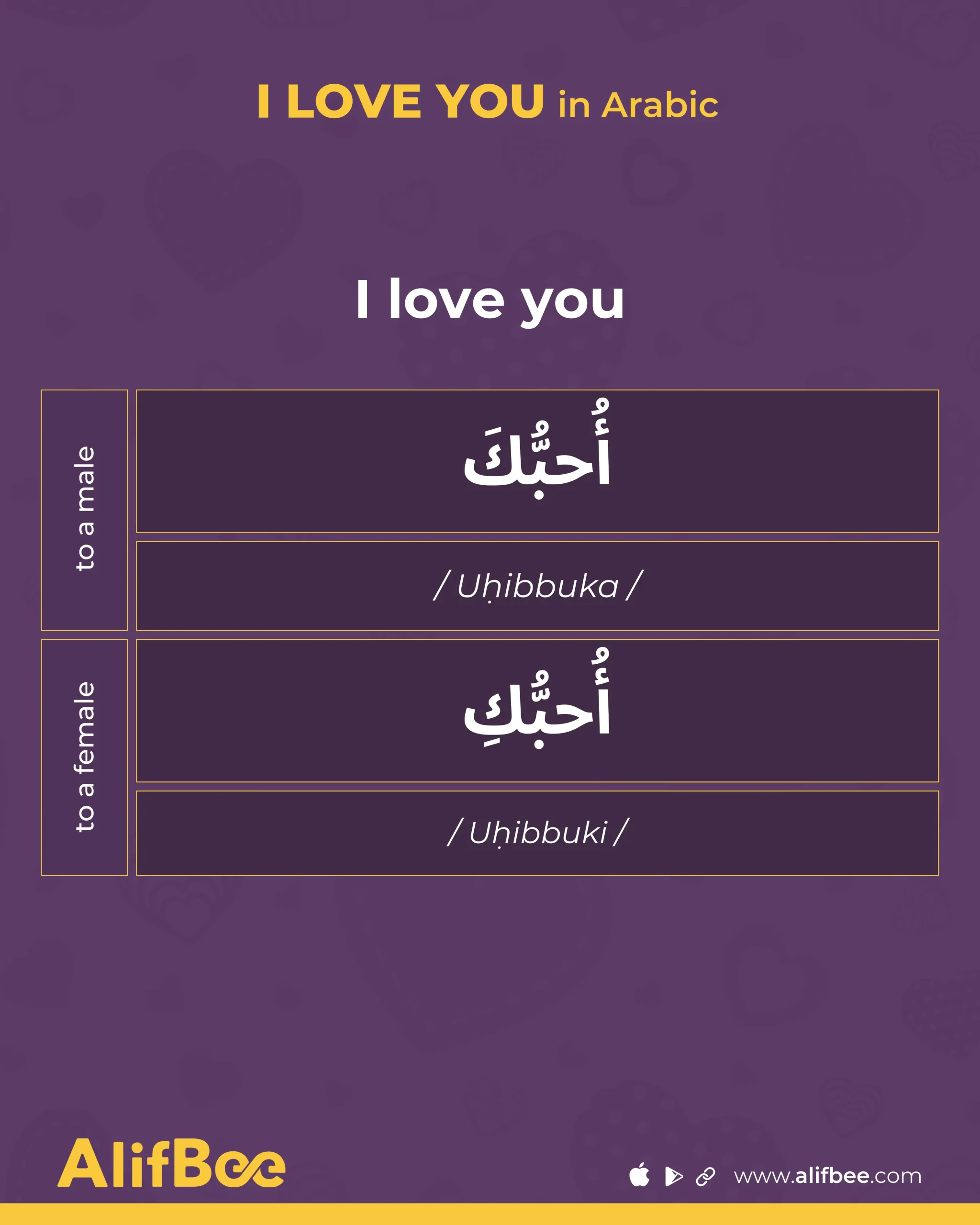
أُحبُّكَ
| Meaning | Pronunciation | Arabic | |
|---|---|---|---|
|
I love you (to a male) |
uḥibbuka |
أُحبُّكَ |
|
|
to a female |
uḥibbuki |
أُحبُّكِ |
|
You must have heard this one before because it is one of the most common phrases used to express love in Arabic.
It can be used in romantic relationships, but also for family, friends, or even things, like saying, Uḥibu alshwkwlā, أُحبُ الشوكولا (I love chocolate)
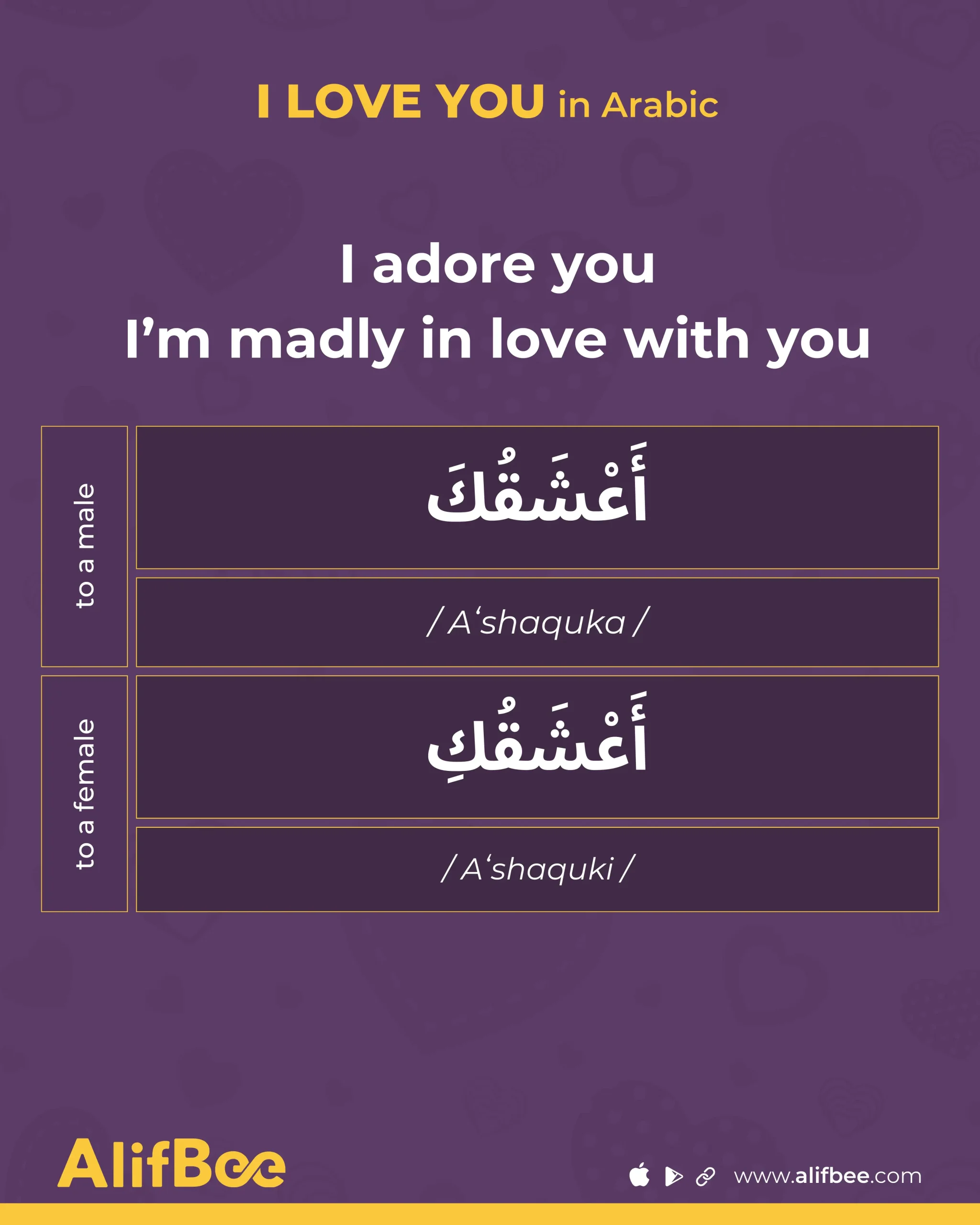
أَعْشَقُكَ
| Meaning | Pronunciation | Arabic | |
|---|---|---|---|
|
I adore you. I’m madly in love with you (to a male) |
aʻshaquka |
أَعْشَقُكَ |
|
|
to a female |
aʻshaquki |
أَعْشَقُكِ |
|
This phrase is stronger and more intense than أحبك. It is usually used in romantic contexts between lovers.
It expresses deep passionate love. However, you can use it to express deep love for things, ideas, concepts and places like saying Aʻshaqu balady أعشقُ بَلَدي (I adore my country).
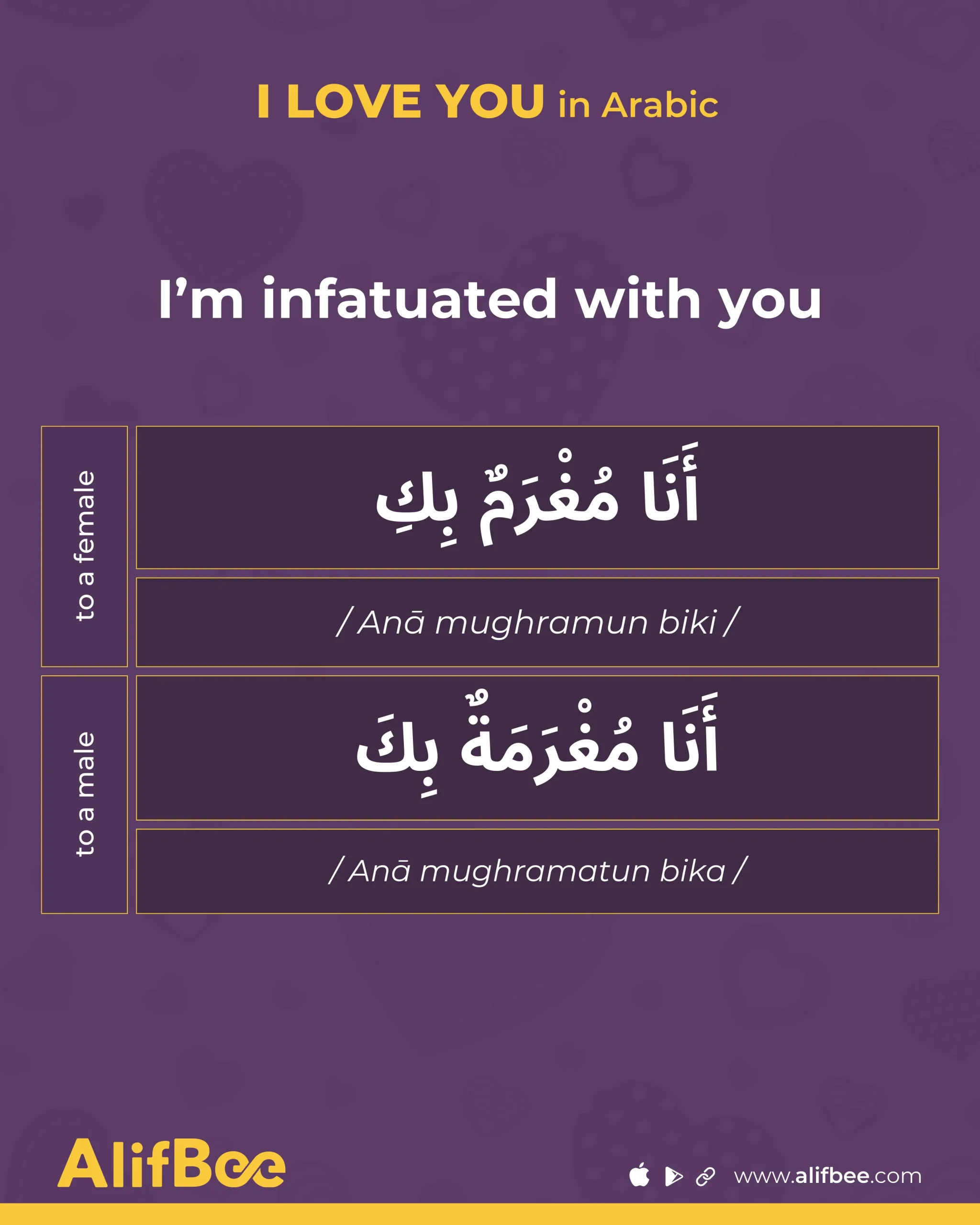
أَنَا مُغْرَمٌ بِكِ
| Meaning | Pronunciation | Arabic | |
|---|---|---|---|
|
I’m infatuated with you (to a male) |
anā mughramatun bika |
أَنَا مُغْرَمَةٌ بِكَ |
|
|
to a female |
anā mughramun biki |
أَنَا مُغْرَمٌ بِكِ |
|
This phrase shows strong attraction, often with passion and obsession. It is mostly found in Arabic poetry, romantic novels, or formal speech. You might also hear this in the Lebanese dialect, but with a slight change in how it’s written and pronounced, for example:
– Anā maghrūmih fīk – أنَا مَغْرُومِة فيك (I’m infatuated with you)
– Anā maghrūmih bhāllwn أَنَا مَغْرُومِة بهاللون – (I’m infatuated with this color)
Speakers of Lebanese Arabic use it to express love for their loved ones, or even things, like a color, dress or a favorite place.
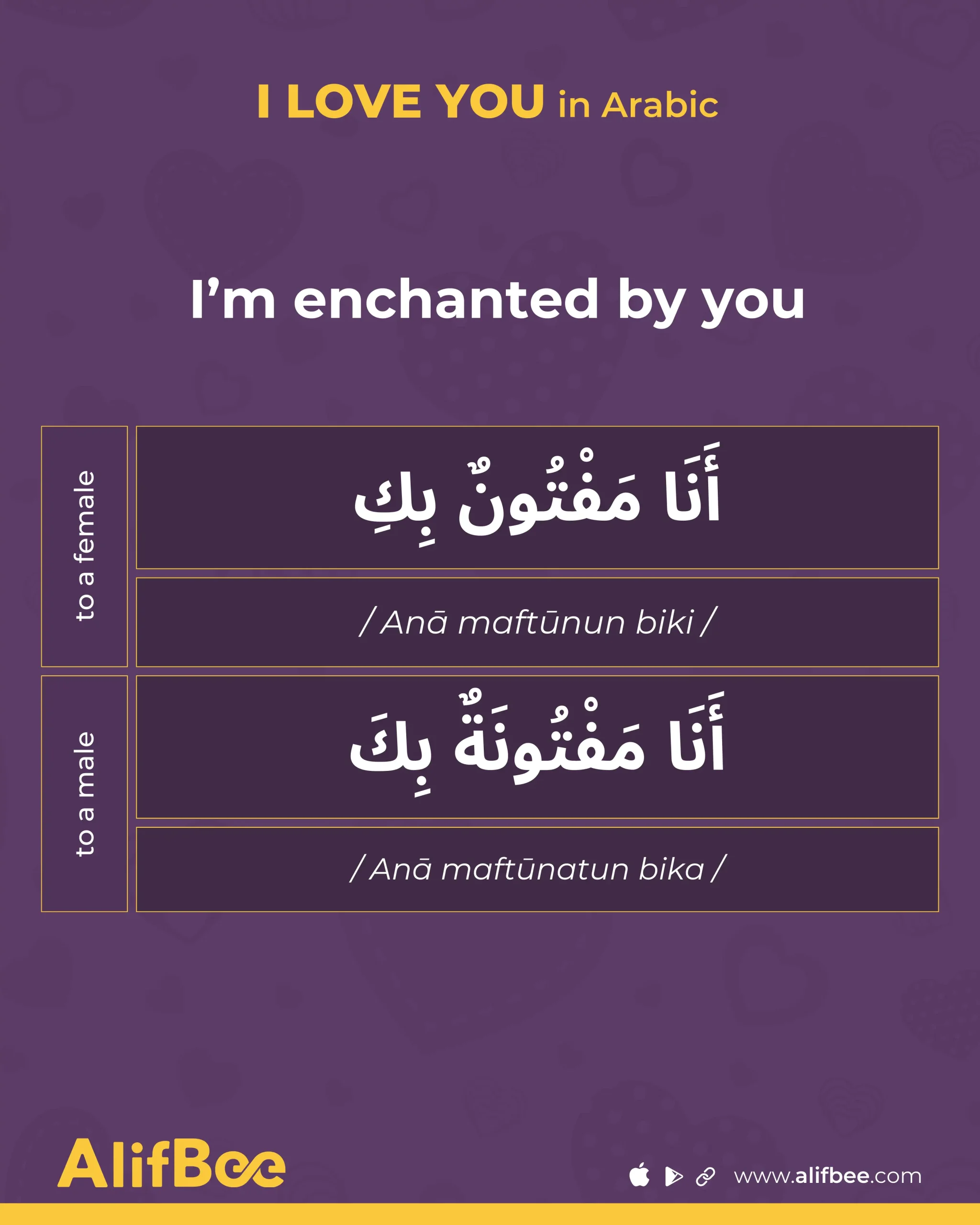
أَنَا مَفْتُونٌ بِكِ
| Meaning | Pronunciation | Arabic | |
|---|---|---|---|
|
I’m enchanted by you (to a male) |
anā maftūnatun bika |
أَنَا مَفْتُونَةٌ بِكَ |
|
|
to a female |
anā maftūnun biki |
أَنَا مَفْتُونٌ بِكِ |
|
This phrase expresses great admiration of someone to the extent of being enchanted by them, as if someone’s charm or beauty has a spell on you. It is used in literature, poetry, or when speaking very romantically.
Read more about Arabic Terms of Endearment .
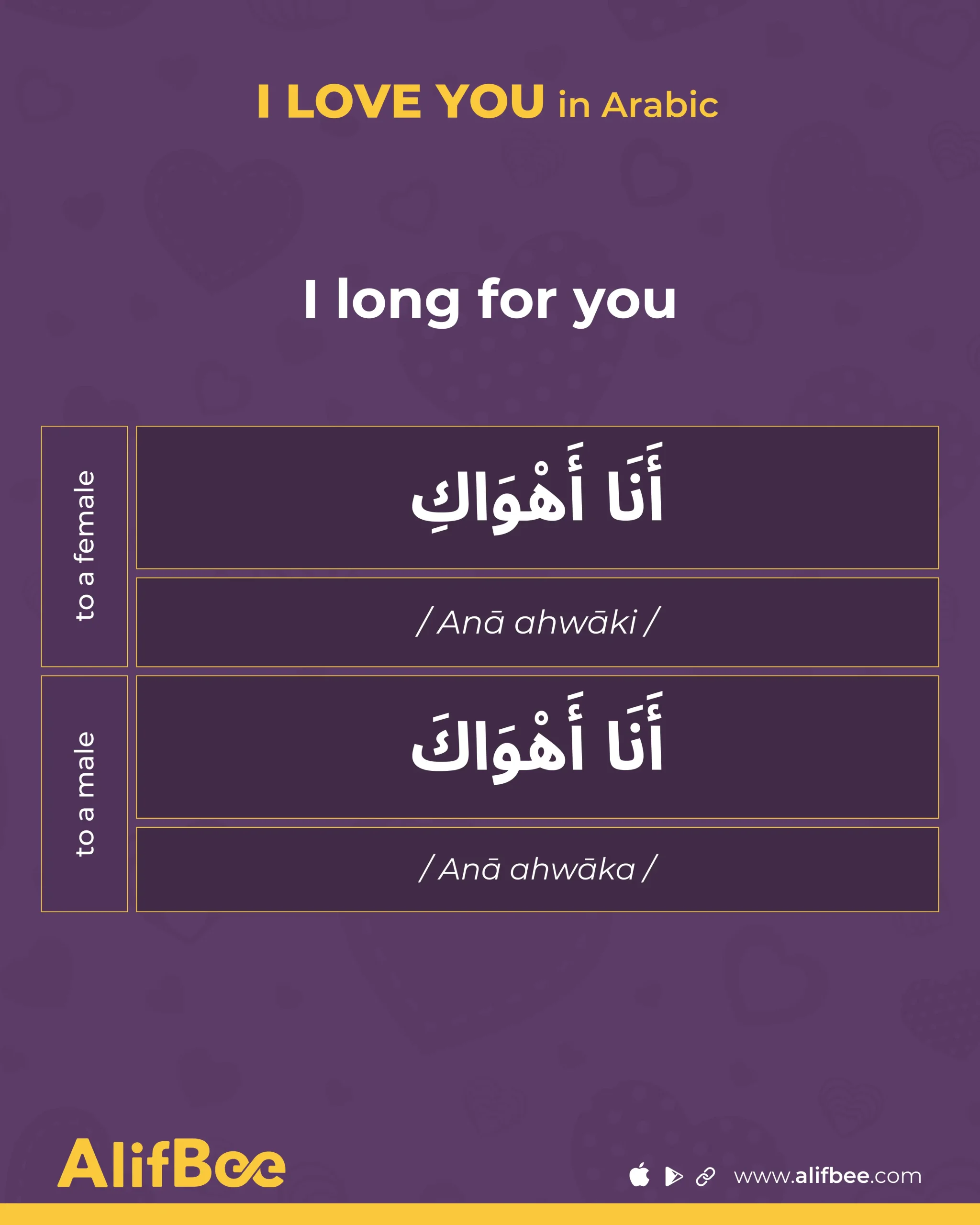
أَنَا أَهْوَاكِ
| Meaning | Pronunciation | Arabic | |
|---|---|---|---|
|
I long for you (to a male) |
anā ahwāka |
أَنَا أَهْوَاكَ |
|
|
to a female |
anā ahwāki |
أَنَا أَهْوَاكِ |
|
This is a classical, poetic way to express love in Arabic. It is very common in Arabic love songs and poetry.
You might hear it, but quite rarely in daily conversation, and people know it because of music.
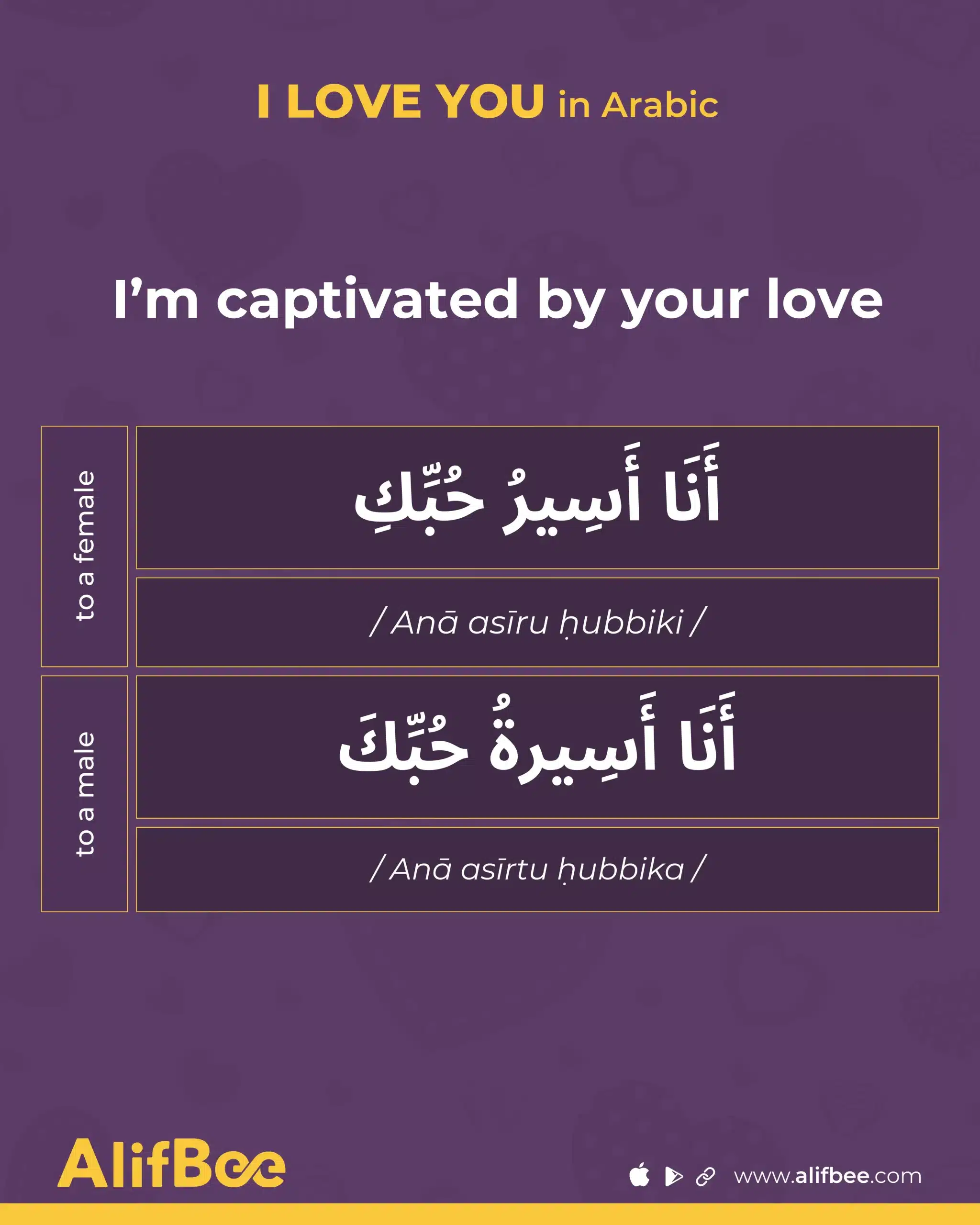
أَنَا أَسِيرُ حُبُّكِ
| Meaning | Pronunciation | Arabic | |
|---|---|---|---|
|
I’m captivated by your love (to a male) |
anā asīrtu ḥubbika |
أَنَا أَسِيرةُ حُبِّكَ |
|
|
to a female |
anā asīru ḥubbiki |
أَنَا أَسِيرُ حُبِّكِ |
|
This phrase means literally, I’m a prisoner of your love, a very poetic, dramatic way of saying you’re completely taken over by someone’s love. Also, you won’t hear it often in daily conversations.
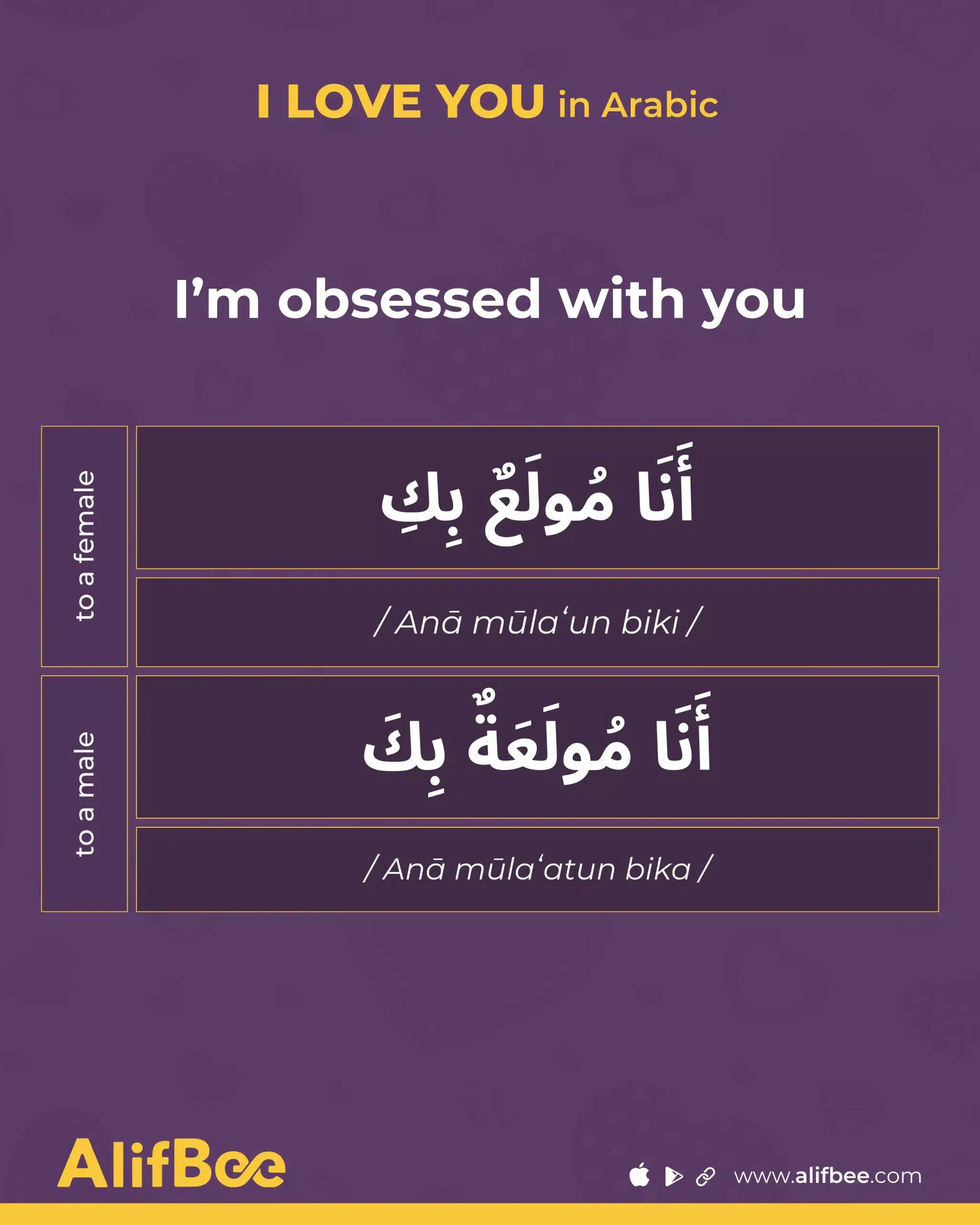
أَنَا مُولَعٌ بِكِ
| Meaning | Pronunciation | Arabic | |
|---|---|---|---|
|
I’m obsessed with you (to a male) |
anā mūlaʻatun bika |
أَنَا مُولَعَةٌ بِكَ |
|
|
to a female |
anā mūlaʻun biki |
أَنَا مُولَعٌ بِكِ |
|
This one shows intense, burning affection. It is rarely used in casual conversation, but strong in poetry.
Review Ways to Say I Love You in Arabic
“I Love You” in Arabic Dialects: Levantine vs Egyptian
Learning how to say I Love You in Arabic dialects will feel more practical since you will be more likely to use it in real life.
I will give you a small tip to make it easy for you to switch from formal to some of the causal phrases we have already covered.
We usually add the letter /Bāʼ/ ب at the beginning of some words to change them from formal standard Arabic to everyday spoken Arabic.
For example, the first word we learned together is Uhibbuk أحبك. Just add /b/ ب instead of /U/ أُ so it becomes Bhibbak بحبك for a male and Bhibbik for a female.
Notice that the pronunciation differs slightly, because we change tashkeel (Short vowels or diacritical marks written as symbols above or below Arabic letters.)
The pronunciation can also differ between dialects. For example, in Levantine Arabic, the B sound added to the start of the verb is silent, but in Egyptian Arabic, it has a short a vowel.
So, بحبك is pronounced Bhibbak in Levantine Arabic and Bahibbak in Egyptian Arabic.
Examples of I Love You in Arabic Dialects
Let’s look at other examples (all in Levantine Arabic):
| Meaning | Pronunciation | Arabic | |
|---|---|---|---|
|
I love you (M) |
Bhibak |
بحبَك |
|
|
I love you (F) |
Bḥbik |
بحبِك |
|
|
I adore you (M) |
Bʻshaʼak |
بعشقَك |
|
|
I adore you (F) |
Bʻshaʼik |
بعشقِك |
|
|
I long for you (M) |
Bahwāk |
بهواك |
|
|
I long for you (F) |
Bahwāki |
بهواكِ |
|
We also have another common Arabic expression in dialectical Arabic that means literally “I die for you”:
| Meaning | Pronunciation | Arabic | |
|---|---|---|---|
|
I’m crazy about you (F) |
bmūt fīki |
بمُوْتْ فِيكِ |
|
|
I’m crazy about you (M) |
bmūt fīk |
بمُوْتْ فِيك |
|
|
I’m crazy about you (F) Egyptian
|
bamūt fīki |
بمُوْتْ فِيكِ |
|
Final word
Some of the expressions you learned today fit in everyday conversations, while others are perfect for poetic and even formal settings.
You can share these Arabic expressions with your loved ones, family, and friends. They can be used everyday or in special occasions, in writing or in everyday conversations.
The more you practice, the more natural they will feel. And who knows? You might just make someone’s day brighter by saying the three precious words I Love You in Arabic.
Learn Arabic with the AlifBee App
If you enjoyed this topic, you will love 25 Arabic Love Words and Expressions For A Special Day, which will give you more words and phrases for special occasions.
You can also download the AlifBee app, which can support your Arabic learning journey with engaging exercises and lessons.