Learn Months in Arabic: Gregorian and Hijri Calendar​s

|
Reading Time: 7 minutes
Home / Arabic Basics / Learn Months in Arabic: Gregorian and Hijri Calendar​s
Listen to: Learn Months in Arabic: Gregorian and Hijri Calendar​s
Listening Bee

Keeping track of time is essential in our everyday lives; it helps us stay organized, plan events, and remember important dates.

But can you imagine having to keep up with two calendars at once?

In Arabic, people use two separate calendars: the Gregorian calendar (used worldwide) and the Hijri calendar (also known as the Islamic Calendar).

Learning the Gregorian and Hijri month names helps Arabic learners understand dates in daily life, official documents, and news. It also builds cultural and religious awareness, especially for important occasions like Ramadan, Hajj, and the two Eids.

In this lesson, you’ll learn the months in both calendars, how to pronounce them, and how to use them in real life. 

Understanding Calendars in Arabic

It’s important to understand that there isn’t just one calendar used in Arabic, and that both calendars are equally important in everyday life, but the key difference is when to use each one.

1. Gregorian Calendar

This is the calendar most of the world uses, and it’s used daily for work, birthdays, events, and schedules.

2. Hijri or Islamic Calendar

This calendar is based on the lunar cycle, and it’s mainly used for religious purposes, such as determining Islamic holidays and events like Ramadan and Eids.

So, by understanding both calendars, you’ll know when and why to use each one, which will help you navigate dates, events, holidays, and daily life in Arabic-speaking cultures.

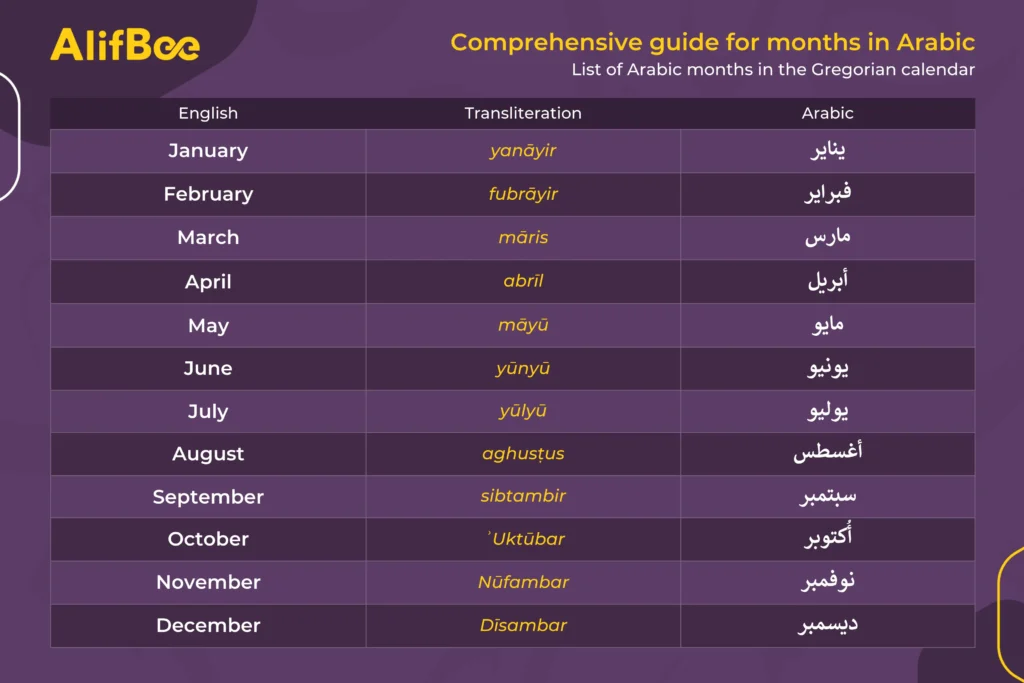
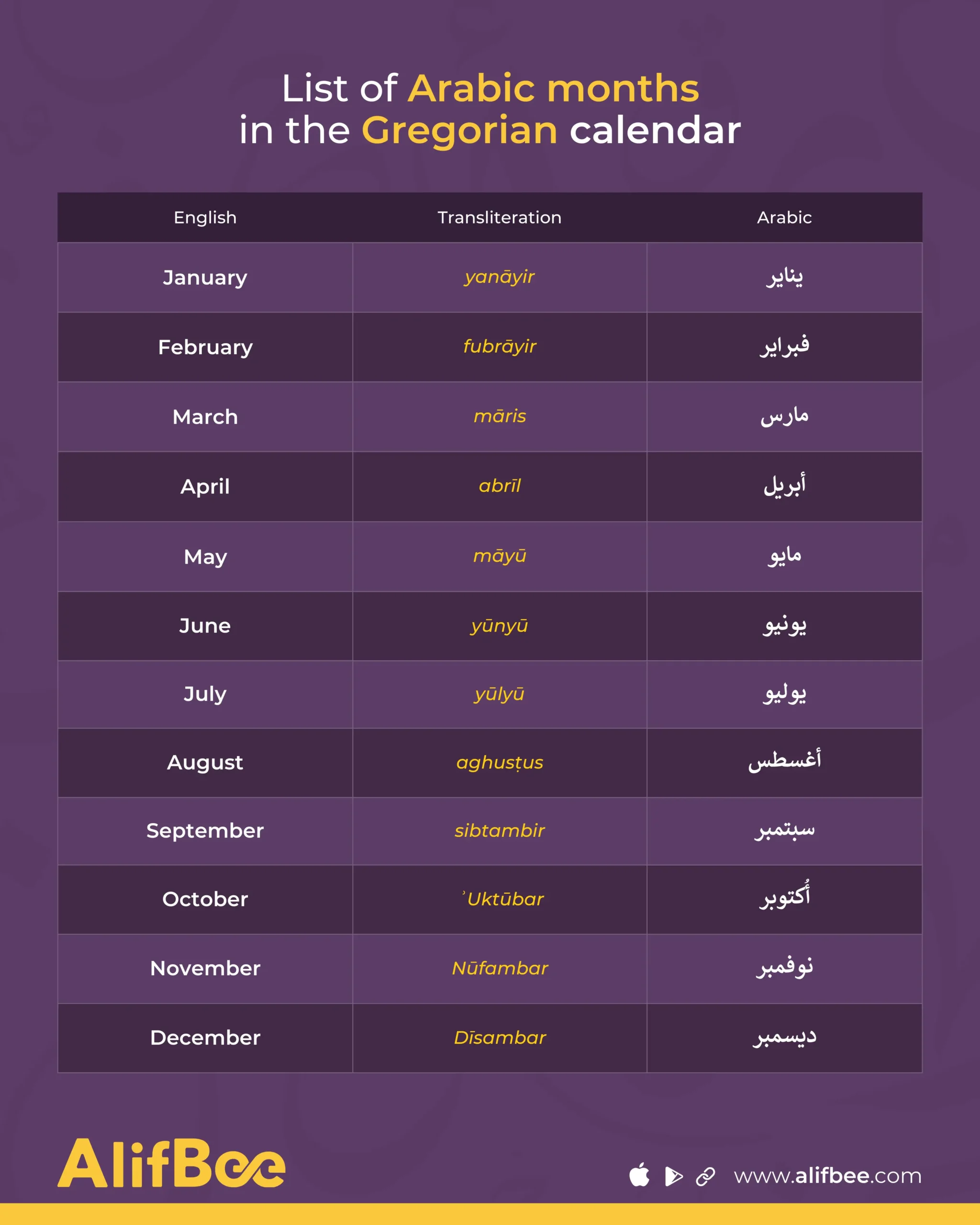
List of Arabic Months in the Gregorian Calendar

Standard Arabic Names of Gregorian months

Comprehensive Guide for Months in Arabic 1

English

Pronunciation

Arabic

January

yanāyir

يناير

February

fubrāyir

فبراير

March

māris

مارس

April

abrīl

أبريل

May

māyū

مايو

June

yūnyū

يونيو

July

yūlyū

يوليو

August

aghusṭus

أغسطس

September

sibtambir

سبتمبر

October

ʾUktūbar

أُكتوبر

November

Nūfambar

نوفمبر

December

Dīsambar

ديسمبر

These Arabic month names are commonly used in newspapers, official documents, and media.

And while the pronunciation might slightly change from one region to another, it’s important to note that these are MSA names.

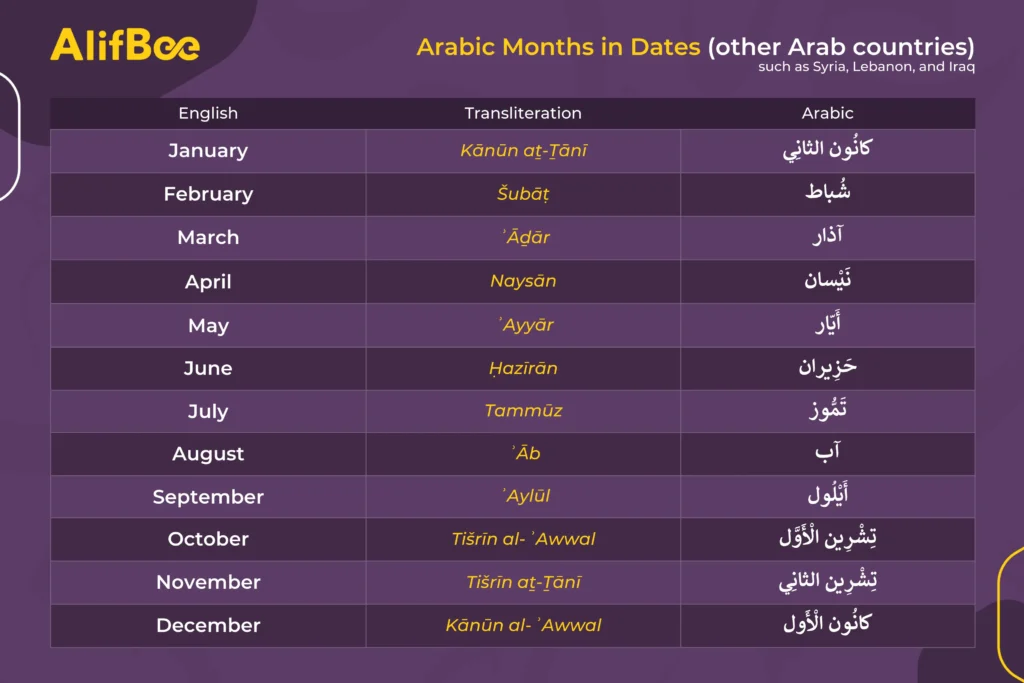
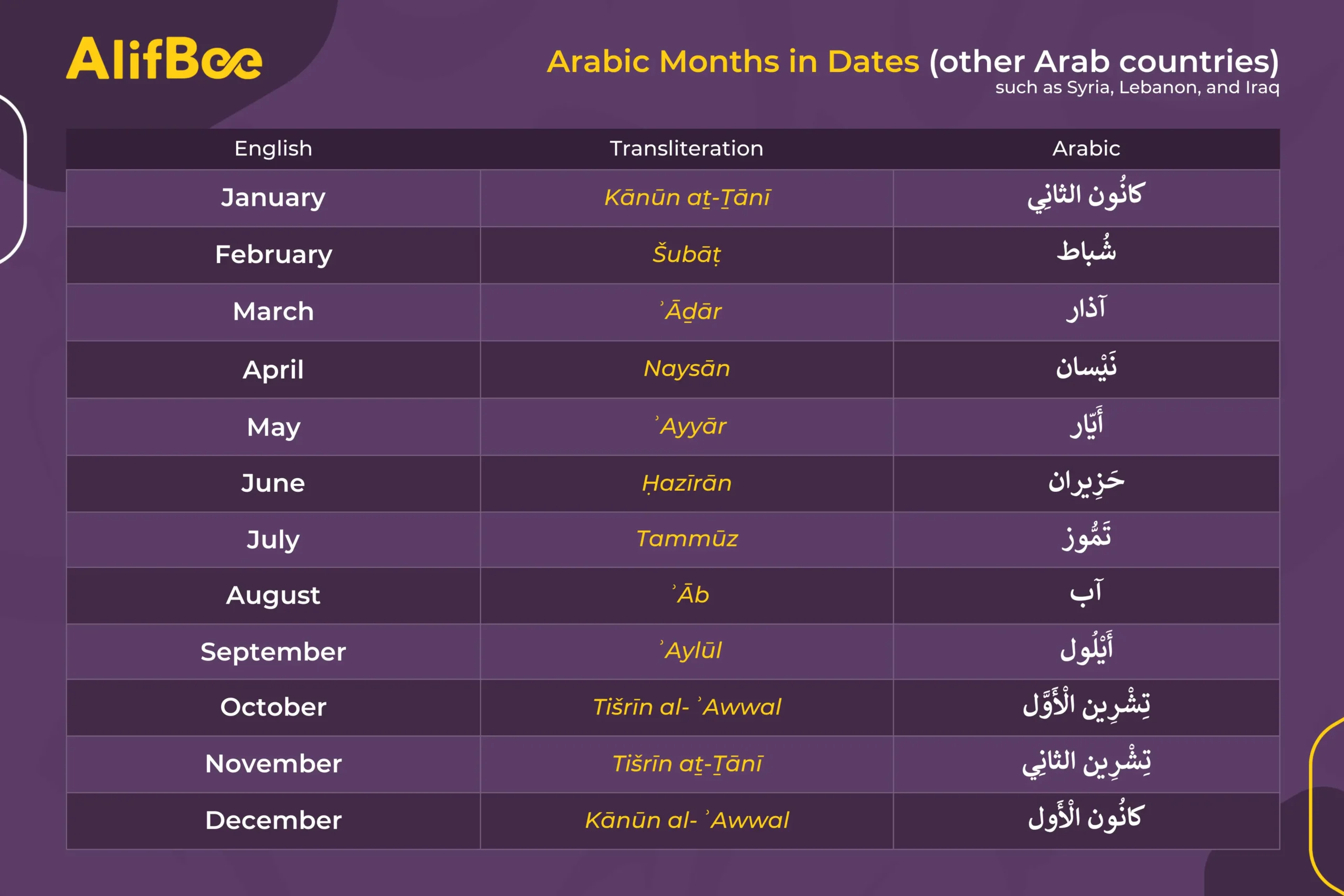
However, in other Arab countries such as Syria, Lebanon, and Iraq, different names are used for the months in Arabic. These Levantine month names are quite distinct from their English translations. (Check our article on Blogs in Arabic for pronunciation audio of these names)

Dates in Arabic 3

Regional Variations in Arabic Month Names

Although these Arabic month names are part of Modern Standard Arabic and are recognized throughout the Arab world, some countries use different names for Arabic months in everyday speech.

In Levantine countries such as Lebanon, Palestine, and Syria, people use Levantine-based month names, while in Gulf countries, people stick to the Modern Standard Arabic names we listed above.

It’s also important to note that these differences are more evident in everyday speech than in formal writing.

However, the goal here for learners isn’t to memorize every regional variant but simply to recognize these different names.

Months in the Hijri or Lunar Calendar

What is the Hijri Calendar?

The Hijri calendar, also known as the Islamic calendar, is lunar, meaning it is based on the moon’s cycle.

Each month begins with the sighting of the Moon, and this is why lunar months are shorter than solar months.

Because the Hijri year is 11 days shorter than a solar year, the Hijri months shift earlier each year in the Gregorian calendar. For example, a Hijri month like Ramadan could fall in summer one year and then gradually move back until it falls in winter.

Why are the Hijri months important? Most learners will encounter these month names in a religious context, especially during important times like Ramadan, Hajj, Eid al-Adha, or Eid al-Fitr. People use the Hijri calendar to know when to fast and when to perform Hajj.

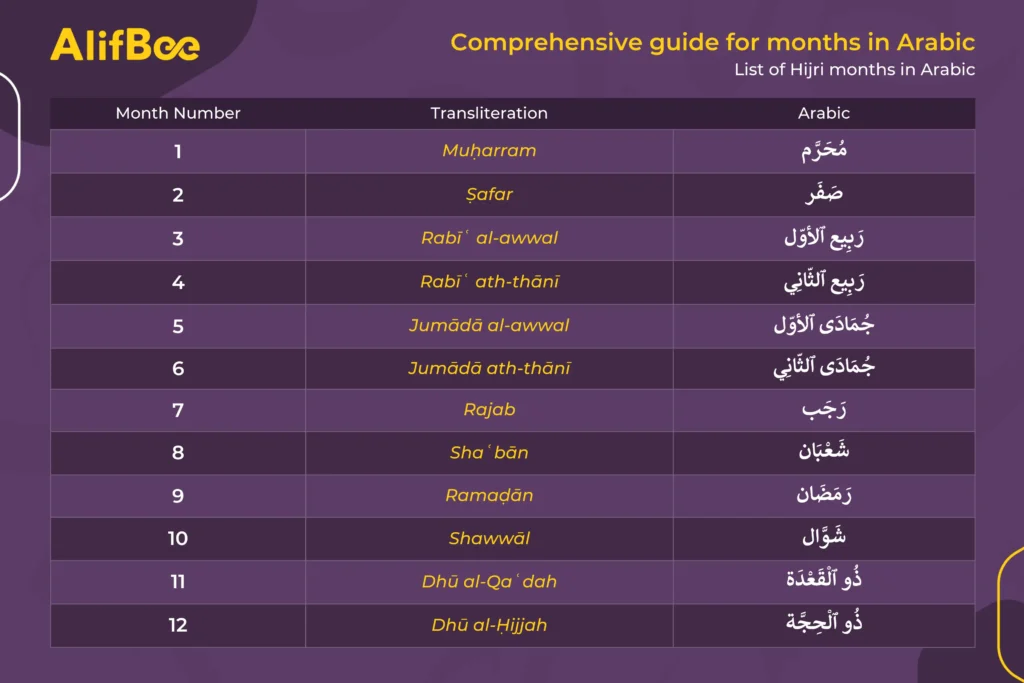
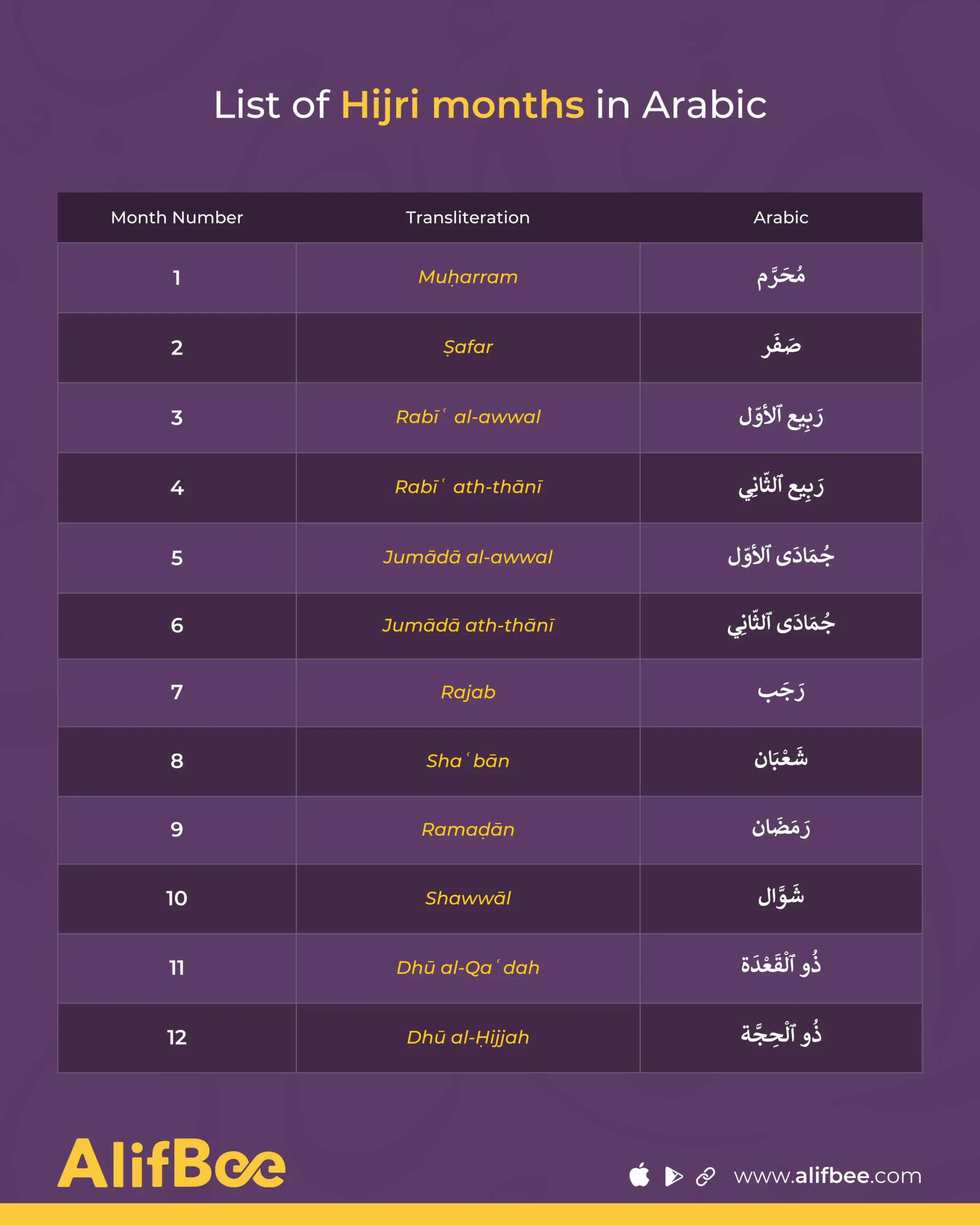
List of Hijri Months in Arabic

Comprehensive Guide for Months in Arabic 2

Month Number

Transliteration

Arabic Name

1

Muḥarram

مُحَرَّم

2

Ṣafar

صَفَر

3

Rabīʿ al-awwal

رَبِيع ٱلأوّل

4

Rabīʿ ath-thānī

رَبِيع ٱلثّانِي

5

Jumādā al-awwal

جُمَادَى ٱلأوّل

6

Jumādā ath-thānī

جُمَادَى ٱلثّانِي

7

Rajab

رَجَب

8

Shaʿbān

شَعْبَان

9

Ramaḍān

رَمَضَان

10

Shawwāl

شَوَّال

11

Dhū al-Qaʿdah

ذُو ٱلْقَعْدَة

12

Dhū al-Ḥijjah

ذُو ٱلْحِجَّة

These Arabic month names are commonly used in newspapers, official documents, and media.

And while the pronunciation might slightly change from one region to another, it’s important to note that these are MSA names.

Key Differences between Gregorian and Hijri months

If you’re still a bit confused between the two calendars, here are the key differences:

Solar vs. Lunar

The Gregorian calendar is a solar calendar based on Earth’s movement around the sun.

The Hijri calendar is lunar, meaning it’s based on the moon’s cycles.

Fixed vs. Shifting Dates

The Gregorian months are fixed, so they stay in the same seasons every year.

Hijri months move about 11 days earlier each year; therefore, they shift. For example, a Hijri month like Ramadan will fall in different seasons over the years.

Usage Context

The Arabic Gregorian calendar is used for daily life and everyday activities, such as schedules, dates, birthdays, and more.

The Hijri calendar is used for religious occasions such as Ramadan, Hajj, and Eids.

Why Arabic Speakers Use Both Calendars

The Arabic Gregorian calendar is used to keep up with the rest of the world, for practical and official matters in everyday life.

The Hijri calendar is used to determine important Islamic occasions.

And because both are part of daily life, people often switch between them .

How to Pronounce Months in Arabic Correctly

Long vowels and stress

Why Long Vowels Matter?

Because in Arabic, the length of vowels can change how words sound, and sometimes it might change the whole meaning of the word.

In this case, many Arabic months include long vowels, and shortening them will make the pronunciation sound a bit off and unnatural. That’s a common mistake new learners make a lot.

Another common mistake English speakers make is shortening vowels, saying them too quickly, or adding English-style stress to one syllable, whereas Arabic sounds smoother.

Simple Pronunciation Notes

  • Whenever you see a long vowel such as ā, ī, or ū, hold the sound a little longer than you do for shorter ones.
  • Try to keep the rhythm balanced by avoiding stress on one syllable.
  • Listen to native speakers and repeat after them; this type of practice will help you sound more natural.

Difficult Arabic Sounds in Month Names

Some Arabic month names include sounds that may sound unfamiliar to new learners. These sounds are usually pronounced with the tongue slightly pulled back, giving them a deeper quality than their English equivalents.

The good news is you don’t need technical phonetics to handle these emphatic sounds. Instead, try to make them sound stronger and fuller rather than sharper and louder.

With regular listening and enough practice, your ear will naturally start to adapt to them. The key is awareness, not perfection.

Common Mistakes Learners Make with Arabic Months

Mixing Calendars

New learners often assume that Arabic month names automatically refer to the Hijri calendar. However, this is not the case, as Arabic speakers use the Gregorian calendar daily, and the Hijri months are used only for Islamic occasions.

Ignoring Long Vowels

Shortening long vowels will make the pronunciation of the month names sound unnatural and unclear.

Over-English Pronunciation

Applying English stress patterns often makes the pronunciation sound off, as Arabic month names have a smoother rhythm.

Trying to Memorize Everything at Once

A common mistake new learners make is trying to memorize everything at once, which can lead to more confusion.

Using months in Arabic in Real Life

Talking about dates and birthdays

Here are some simple examples:

My birthday is in January.

ʿĪd mīlādī fī Yanāyir.

عيد ميلادي في يناير.

My brother was born in August.

Wulida akhī fī Aghusṭus.

ولد أخي في أغسطس.

Talking about religious events

Hajj takes place in Dhū al-Ḥijjah.

Al-Ḥajj yakūn fī Dhū al-Ḥijjah.

الحج يكون في ذي الحجة.

Eid al-Fitr comes after Ramadan.

ʿĪd al-Fiṭr baʿd Ramaḍān.

عيد الفطر بعد رمضان.

Review Months in Arabic

FAQs About Months in Arabic

1. Do all Arabic-speaking countries use the same month names?

No, while modern standard Arabic month names are understood everywhere, some countries use regional variants.

2. What is the difference between Hijri and Gregorian months?

Gregorian months are solar, fixed in the calendar, and used for daily life purposes.

Hijri months are lunar and shift about 11 days earlier each year; they are used for religious purposes.

3. Which calendar should Arabic learners focus on first?

It depends on context:

Start with Gregorian months for everyday life, and gradually learn the Hijri months for religious and cultural understanding.

4. Why do Hijri months change every year?

The Hijri calendar is based on the lunar cycle, which is about 11 days shorter than a solar year, so each Hijri month moves earlier in the Gregorian calendar.

Author

  • Layla AlAhmar

    Layla Alahmar is a writer and proofreader with a master’s degree in Arabic literature and linguistics. At AlifBee, she creates clear and engaging educational content, blending storytelling with practical language insights to make Arabic learning accessible and inspiring.

Picture of Layla AlAhmar
Layla AlAhmar
Layla Alahmar is a writer and proofreader with a master’s degree in Arabic literature and linguistics. At AlifBee, she creates clear and engaging educational content, blending storytelling with practical language insights to make Arabic learning accessible and inspiring.
If you found this article helpful, please share it with your friends to spread the knowledge!
Facebook
LinkedIn
Telegram
X
Start your Arabic Learning Path with AlifBee!
syrian Logo
AlifBee App

Achieve incredible results with our platform Learn Arabic Online with AlifBee

AlifBee-Virtual School
AlifBee Virtual School

Join AlifBee Virtual School and master Arabic at your pace — from guided coaching to interactive self-learning.

AlifBee-Private Arabic Lessons
Private Arabic Lessons

Learn Arabic faster with live, one-on-one sessions tailored to your level and goals.

AlifBee-Books
AlifBee Workbooks Series

Explore AlifBee’s complete range of Arabic learning books for all ages!

Related Posts